Gluttony Kills More Than the Sword, Harderwijk Engraving, c.1625
Description
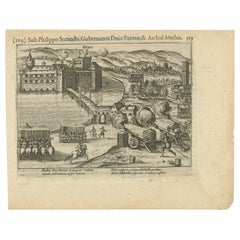
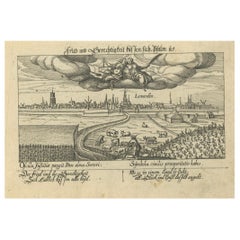
This rare emblematic city view depicts the fortified Dutch city of Harderwijk in Gelderland and originates from Daniel Meisner's celebrated Thesaurus Philopoliticus (Politisches Schatzkästlein), one of the most important emblem books published during the early seventeenth century. Produced by Daniel Meisner and engraved by Eberhard Kieser, the work was published in Frankfurt am Main between approximately 1623 and 1630.
The engraving combines a panoramic view of Harderwijk with a moral allegory, a hallmark of Meisner's influential publication. The city is shown enclosed by its impressive defensive walls, towers, gates, and churches, providing a valuable historical record of Harderwijk during the Dutch Golden Age. The detailed skyline reflects the strategic importance of this Hanseatic city on the Zuiderzee.
In the foreground appears an allegorical scene illustrating the Latin motto:
"Gula plures occidit, quam gladius"
("Gluttony kills more people than the sword.")
While armed soldiers stand to one side, symbolizing the dangers of warfare, two figures indulge excessively in food and drink beside a richly laden table. The accompanying Latin and German verses reinforce the moral lesson that excess and overindulgence are often more destructive than armed conflict. Such emblematic imagery was intended to educate and entertain readers, combining geography, morality, and humanist scholarship in a single composition.
Daniel Meisner's Thesaurus Philopoliticus remains one of the most sought-after emblem books of the seventeenth century. Its engravings are prized for their combination of topographical accuracy, symbolic content, and artistic quality. Individual plates have become increasingly collectible, particularly those depicting Dutch cities.
Today, original Meisner engravings are highly regarded by collectors of Dutch history, city views, emblem literature, early cartography, and seventeenth-century prints. This example offers the rare combination of a historic view of Harderwijk and a powerful moral allegory, making it an attractive acquisition for both collectors and decorators.
Condition report: Good antique condition with age-related toning and minor spotting consistent with a seventeenth-century engraving. Wide margins preserved. Please study the images carefully for exact condition.
Framing tips: Displays beautifully in a dark walnut, ebonized, or museum-black frame with a warm ivory mat. A narrow gilt liner can further enhance the seventeenth-century character of the engraving.
Technique: Copperplate engraving
Maker: Daniel Meisner and Eberhard Kieser, Frankfurt am Main, circa 1623–1630
This is an original 17th-century copperplate engraving, printed at the time. It is not a modern reproduction. Any images showing the print framed are for presentation purposes only. The print is supplied unframed.
Keywords: Harderwijk, Gelderland, Netherlands, Holland, Dutch City View, Daniel Meisner, Eberhard Kieser, Thesaurus Philopoliticus, Politisches Schatzkästlein, Emblem Book, Gluttony, Seven Deadly Sins, Gula Plures Occidit Quam Gladius, Moral Allegory, Dutch Golden Age, Hanseatic City, Zuiderzee, Fortified Town, City Walls, Early Modern Netherlands, Seventeenth Century Print, Frankfurt, Humanism, Symbolic Print, Antique Engraving, Copperplate Engraving.