Video Loading
Want more images or videos?
Request additional images or videos from the seller
1 of 11

Hindu Couple with Ritual Implements – Poutchari of Darma Raja, 1806

$238.27
£174.61
€200VAT Included
CA$328.61
A$332.58
CHF 190.69
MX$4,033.76
NOK 2,217.66
SEK 2,257.37
DKK 1,524.97

About the Item

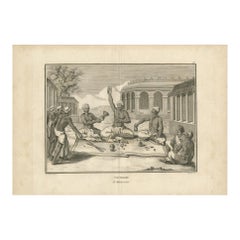
Hindu Couple with Ritual Implements – Poutchari of Darma Raja, 1806 This antique engraving titled Poutchari de Darma-Raja presents an intimate scene of a Hindu couple seated on the ground beneath a palm tree, engaged in what appears to be a moment of religious or ceremonial discussion. The male figure sits cross-legged, adorned with a turban and a pendant around his neck, while the woman beside him gestures expressively as if explaining or reciting something. Both are clothed in regional South Indian garments, the woman notably wearing striped drapery and jewelry. In front of them lies a mat scattered with ritual objects—bells, a cup, and beads or seeds—suggesting their involvement in a devotional or priestly function. The title *Poutchari* again refers to a religious or temple assistant, while *Darma Raja* (or Dharma Raja) likely denotes the deity or ruling authority to whom their service is dedicated. The scene is set against a backdrop of classical temple architecture and a hilly landscape, situating the interaction within a sacred or institutional space. This image is taken from the 1806 edition of Voyage aux Indes Orientales et à la Chine by Pierre Sonnerat (1745–1814), a French explorer and naturalist who documented the cultures, religions, and social customs of India and Southeast Asia. The engraving was created by Jean-Baptiste-Marie Poisson (1747–1820), whose technical finesse captures the calm intimacy of the moment with expressive linework and subtle shading. This piece offers an ethnographic window into temple life and religious dialogue in early 19th-century South India, with a focus on personal interaction rather than grand ceremony. It is a valuable addition for collectors interested in Indian devotional practice, colonial-era observation, or visual anthropology. Condition report: Very good condition. Minor toning and occasional foxing in the margins. Central image clean and sharply printed, with excellent contrast. Framing tips: Ideal for display in a walnut or dark wood frame with a light natural mat to complement the paper tone and highlight the quiet symmetry of the composition. Technique: Engraving Maker: J.-B.-M. Poisson after Pierre Sonnerat, Paris, 1806
  • Dimensions:
    Height: 11.23 in (28.5 cm)Width: 8.27 in (21 cm)Depth: 0.01 in (0.2 mm)
  • Materials and Techniques:
    Paper,Engraved
  • Place of Origin:
  • Period:
  • Date of Manufacture:
    1806
  • Condition:
    Very good condition. Minor toning and occasional foxing in the margins. Central image clean and sharply printed, with excellent contrast.
  • Seller Location:
    Langweer, NL
  • Reference Number:
    Seller: BG-13429-771stDibs: LU3054346092852

More From This Seller

View All
Hindu Sacred Musicians – Satadéven and Vaïche Navin, 1806

Hindu Sacred Musicians – Satadéven and Vaïche Navin, 1806

Located in Langweer, NL

Hindu Sacred Musicians – Satadéven and Vaïche Navin, 1806 This finely executed engraving features two South Indian sacred musicians, titled Satadéven and Vaïche Navin, each holding ...

Category

Antique Early 1800s French Prints

Materials

Paper

Hindu Temple Musicians – Tadin and Chief of the Tadins, 1806

Hindu Temple Musicians – Tadin and Chief of the Tadins, 1806

Located in Langweer, NL

Hindu Temple Musicians – Tadin and Chief of the Tadins, 1806 Description: This paired engraving features two Indian temple musicians, identified as Tadin and Chef des Tadins (Chief ...

Category

Antique Early 1800s French Prints

Materials

Paper

Hindu Priestly Assembly – Poutchari of Maarraami, Engraving, 1806

Hindu Priestly Assembly – Poutchari of Maarraami, Engraving, 1806

Located in Langweer, NL

Hindu Priestly Assembly – Poutchari of Maarraami, Engraving, 1806 This detailed engraving titled Poutchari de Maarraami depicts a group of Hindu priests or temple functionaries sea...

Category

Antique Early 1800s French Prints

Materials

Paper

Indian Penitent with Ritual Implements – Engraving after Sonnerat, 1806

Indian Penitent with Ritual Implements – Engraving after Sonnerat, 1806

Located in Langweer, NL

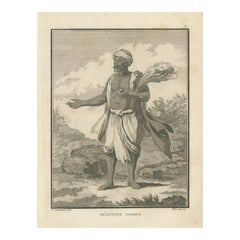
Indian Penitent with Ritual Implements – Engraving after Sonnerat, 1806 This striking antique engraving titled Pénitent Indien (Indian Penitent) portrays a barefoot ascetic figure s...

Category

Antique Early 1800s French Prints

Materials

Paper

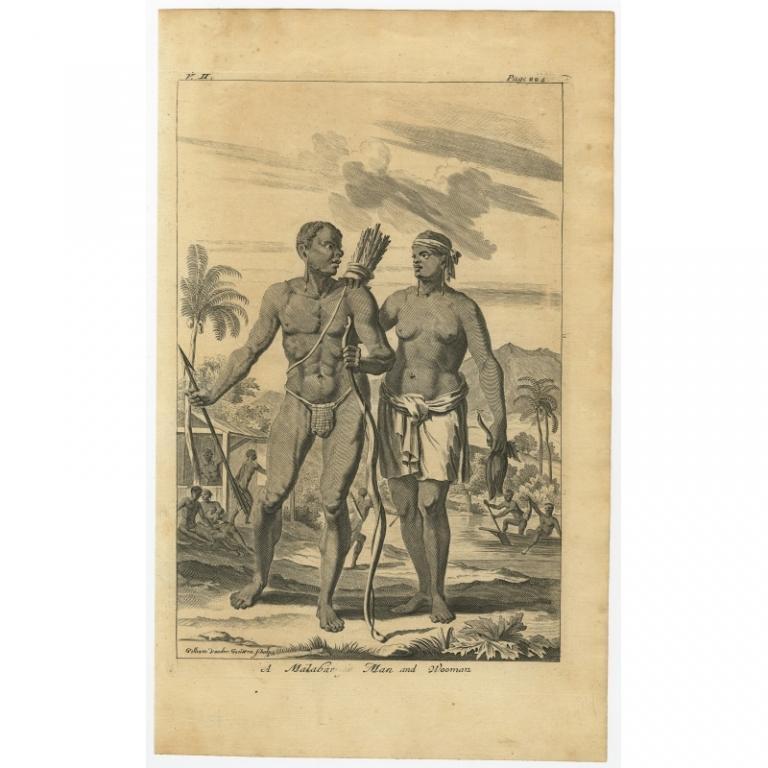
A Malabar Man and Woman, India, Nieuhof, 1744

A Malabar Man and Woman, India, Nieuhof, 1744

Located in Langweer, NL

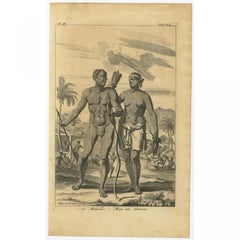
Antique print, titled: 'A Malabar Man and Wooman.' - This plate shows a man and woman from Malabar, India. It originally accompanied J. Nieuhof's account of his 'Voyages and Travels ...

Category

Antique 18th Century Prints

Materials

Paper

IIIter Stamm – Indian Men in Traditional Dress c.1816

IIIter Stamm – Indian Men in Traditional Dress c.1816

Located in Langweer, NL

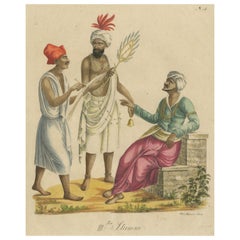
IIIter Stamm – Indian Men in Traditional Dress c.1816 This antique print depicts three men from India, each wearing traditional attire that reflects the regional and occupational di...

Category

Antique Early 19th Century European Prints

Materials

Paper

You May Also Like

Uses and Customs - Indian Rajah - Lithograph - 1862

Uses and Customs - Indian Rajah - Lithograph - 1862

Located in Roma, IT

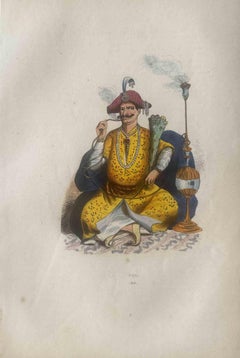
Uses and Customs - Indian Rajah is a lithograph on paper realized in 1862. The artwork belongs to the Suite Uses and customs of all the peoples of the universe: " History of the gov...

Category

1860s Modern Figurative Prints

Materials

Lithograph

Uses and Customs - Indian - Lithograph - 1862

Uses and Customs - Indian - Lithograph - 1862

Located in Roma, IT

Uses and Customs - Indian is a lithograph on paper realized in 1862. The artwork belongs to the Suite Uses and customs of all the peoples of the universe: " History of the governmen...

Category

1860s Modern Figurative Prints

Materials

Lithograph

Uses and Customs - Indian - Lithograph - 1862

Uses and Customs - Indian - Lithograph - 1862

Located in Roma, IT

Uses and Customs - Indian is a lithograph on paper realized in 1862. The artwork belongs to the Suite Uses and customs of all the peoples of the universe: " History of the governmen...

Category

1860s Modern Figurative Prints

Materials

Lithograph

Antique Indian Mughal Painting of a Couple in Erotic Embrace, 19th Century

Antique Indian Mughal Painting of a Couple in Erotic Embrace, 19th Century

Located in San Francisco, CA

Offered here is a gouache and gold miniature painting on paper of an amorous couple on a veranda set against a mountain and lake background. The male dressed in a princely attire is ...

Category

Antique Mid-19th Century Indian Paintings and Screens

Materials

Paper

Original Antique Ethnographical Print, Figures, New South Wales, Australia, 1809

Original Antique Ethnographical Print, Figures, New South Wales, Australia, 1809

Located in St Annes, Lancashire

Wonderful ethnographical print. A copper-plate engraving after Lesieur Published by Sherwood, Neely & Jones. Dated 1809 Unframed.  

Category

Antique Early 1800s English Folk Art Prints

Materials

Paper

Antique 19th Century Indian Kalighat Painting of Krishna Adoring Radha

Antique 19th Century Indian Kalighat Painting of Krishna Adoring Radha

Located in New York, NY

Antique 19th Century Indian Kalighat painting of the God Krishna worshipping his divine consort Radha. Painted in Calcutta, Bengal, India by a Bengali patua, with natural mineral pigment paints on paper. Signed illegibly in pencil, lower right. Origins of Kalighat painting written by the Victoria and Albert Museum in London, England: According to legend, Lord Shiva, the god of dance and destruction, was deep in meditation on Mount Kailash when he received news of the death of his consort, Sati, an avatar (or human manifestation) of the goddess Kali. He wandered for days with her body draped across his shoulders and his inconsolable grief threatened to ruin the earth. Lord Vishnu, the Preserver, was called upon to intervene. To relieve Shiva's burden, he shattered Sati's body into 51 pieces. The little toe of Sati's right foot was said to have fallen at the site of the Hooghly River...

Category

Antique Late 19th Century Indian Folk Art Paintings
Materials

Paper