Want more images or videos?
Request additional images or videos from the seller
1 of 9

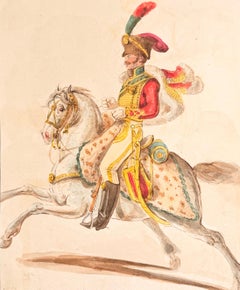
Portuguese Cavalry Officer with Royal Standard — Equestrian Engraving, 1790

$393.13
£288.77
€330VAT Included
CA$542.48
A$552.19
CHF 314.32
MX$6,665.37
NOK 3,665.12
SEK 3,709.32
DKK 2,516.27

About the Item

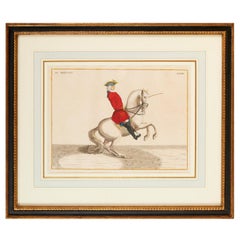
Piaffe Dressage Lesson in the Pillars — Encyclopédie Horse Engraving, 1750 This refined mid-18th century hand-colored copperplate engraving titled Manège, La Capriole. Leçon du Piafer dans les Piliers depicts an elegant equestrian training scene centered on the classical art of dressage. The composition shows a mounted rider guiding a highly trained horse through the piaffe exercise between pillars, a traditional method used in elite riding academies to develop collection, balance, and elevated movement. Several attendants and observers dressed in fashionable period attire stand nearby, reinforcing the formal atmosphere of aristocratic horsemanship during the French Enlightenment. The engraving was drawn by Harguiniez and engraved by Robert Bénard, one of the principal engravers associated with Denis Diderot and Jean le Rond d’Alembert’s monumental Encyclopédie. Published around 1750, the plate belongs to the important series illustrating the sciences, arts, and refined practices of the era. Equestrian subjects such as this reflected both technical instruction and elite culture, documenting the sophisticated riding traditions practiced in the great manèges of France. The horse is shown performing the piaffe, an advanced collected trot executed nearly in place, still regarded today as one of the most demanding movements in classical dressage. The reference to “les piliers” relates to the use of training pillars, a method associated with haute école riding traditions developed in European academies. The composition combines technical precision with elegant draftsmanship, typical of the Encyclopédie engravings, while the delicate original hand-coloring adds warmth and visual appeal. This engraving holds strong appeal for collectors of equestrian art, Enlightenment-era prints, French decorative engravings, and historical sporting subjects. Its combination of technical riding instruction and aristocratic elegance makes it particularly suitable for interiors such as libraries, studies, riding clubs, country houses, or sophisticated equestrian collections. The print remains an authentic 18th-century copper engraving with original period hand-coloring. It is not a modern reproduction. Any framed images shown are for presentation purposes only; the engraving is supplied unframed. Condition: Good overall condition with age-related toning and minor wear to the margins. Pleasing original hand-coloring. Plate mark visible. Displays exceptionally well in dark walnut, black lacquer, or lightly gilt frames paired with a wide ivory or oatmeal mat. Particularly attractive in equestrian interiors, libraries, or classic European-style settings. Technique: Hand-colored copperplate engraving Maker: Robert Bénard after Harguiniez, France, circa 1750 Special note: This is an original engraving not a reproduction. All items we offer are authentic period works of art over 100 years old. The engraving is sold unframed; any framed images are shown for presentation and interior inspiration only and may not always be on scale with the original.
  • Dimensions:
    Height: 12.8 in (32.5 cm)Width: 8.82 in (22.4 cm)Depth: 0.01 in (0.2 mm)
  • Materials and Techniques:
    Paper,Engraved
  • Place of Origin:
  • Period:
  • Date of Manufacture:
    1790
  • Condition:
    Good overall condition with age-related toning and minor wear to the margins. Pleasing original hand-coloring. Plate mark visible.
  • Seller Location:
    Langweer, NL
  • Reference Number:
    Seller: BG-14292-101stDibs: LU3054350242772

More From This Seller

View All
Chevau-Léger Français, Napoleonic Guard Cavalry Officer on Horseback, 1843

Chevau-Léger Français, Napoleonic Guard Cavalry Officer on Horseback, 1843

Located in Langweer, NL

Chevau-Léger Français, Napoleonic Guard Cavalry Officer on Horseback, 1843 This finely executed hand-colored print depicts a Chevau-Léger Français, a light cavalryman of the French ...

Category

Antique 1840s French Prints

Materials

Paper

Antique Andalusian Horse Lithograph by Brodtmann, Equus Hispanicus, 1816

Antique Andalusian Horse Lithograph by Brodtmann, Equus Hispanicus, 1816

Located in Langweer, NL

Antique Andalusian Horse Lithograph by Brodtmann, Equus Hispanicus 1816 This elegant and finely hand-colored antique lithograph depicts a proud rider mounted on a graceful Andalusia...

Category

Antique Early 19th Century Swiss Prints

Materials

Paper

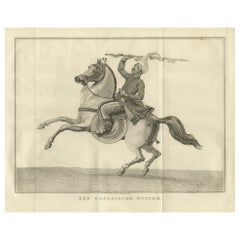
Mounted Warrior of the Kassai Region – Antique Costume Print, circa 1800

Mounted Warrior of the Kassai Region – Antique Costume Print, circa 1800

Located in Langweer, NL

Mounted Warrior of the Kassai Region – Antique Costume Print, circa 1800 This dramatic antique engraving titled “Een Cassaische Ruiter” (“A Kassai Horseman”) presents a dynamic imag...

Category

Antique Early 19th Century Dutch Prints

Materials

Paper

Napoleonic General of Division on Horseback, Bellangé, Military Print, 1843

Napoleonic General of Division on Horseback, Bellangé, Military Print, 1843

Located in Langweer, NL

Napoleonic General of Division on Horseback, Bellangé, French Military Print 1843 This finely hand-coloured military print depicts a General of Division of the Napoleonic army, shown on horseback and accompanied by his aide-de-camp, identified in the caption as “Général de division et son aide-de-camp, 1812.” The scene captures the commanding presence and ceremonial splendour of a senior French officer during the height of Napoleon I’s imperial campaigns, with particular reference to the period of the Russian campaign and the later years of the Empire. The general is portrayed mounted on a white horse, wearing a richly decorated dark blue uniform with gold epaulettes, sash, and orders, emphasizing his high rank within the Grande Armée. The aide-de-camp follows closely behind, reinforcing the hierarchical structure and operational discipline of Napoleonic command. The careful rendering of uniforms, horse trappings, and regalia reflects the period’s obsession with military distinction and visual authority, making this image both a historical document and a work of refined military art. This print originates from the illustrated volume “Histoire de l’Empereur Napoléon” by P.-M. Laurent de l’Ardèche, published in Paris in 1843 and illustrated after designs by Hippolyte (Horace) Bellangé, one of the most important 19th-century French military art...

Category

Antique 1840s French Prints

Materials

Paper

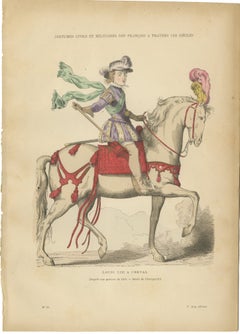
Original Antique Print of Louis XIII on Horseback by F. Roy, circa 1860

Original Antique Print of Louis XIII on Horseback by F. Roy, circa 1860

Located in Langweer, NL

Original Antique Print of Louis XIII on Horseback by F. Roy, circa 1860 Description: A graceful original antique French costume print depicting King Louis XIII of France on horsebac...

Category

Antique 1860s French Prints

Materials

Paper

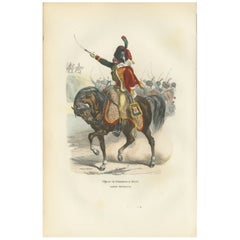
Officier de Chasseurs à Cheval, Garde Impériale – Napoleonic Cavalry Print 1843

Officier de Chasseurs à Cheval, Garde Impériale – Napoleonic Cavalry Print 1843

Located in Langweer, NL

Officier de Chasseurs à Cheval, Garde Impériale – Napoleonic Cavalry Print 1843 This finely executed 19th-century hand-coloured military print depicts an officer of the Chasseurs à Cheval of Napoleon’s Imperial Guard, one of the most elite light cavalry units of the Grande Armée. The scene shows the officer mounted and in full action, raising his sabre while directing his men, a composition that emphasizes speed, command, and martial elegance. The Chasseurs à Cheval were personally favored by Napoleon and frequently served as his escort, reconnaissance force, and shock cavalry during key campaigns. The uniform is rendered with great precision: the richly braided dolman, fur-edged pelisse, tall shako with plume, and ornate horse furniture...

Category

Antique 1840s French Prints

Materials

Paper

You May Also Like

18th Century German Francisco de Moncada Engraved Portrait w/ Full Armor & Horse

18th Century German Francisco de Moncada Engraved Portrait w/ Full Armor & Horse

Located in Marbella, ES

Antique mid 18th century German engraved portrait of Spanish ambassador Francisco de Moncada, with full armor and horse Measures with frame: 71 * 52 * 1.5 cm.  

Category

Antique 18th Century German Decorative Art

Materials

Paper

Royal Gendarmerie on Horseback - Lithograph by Antonio Zezon - 1853

Royal Gendarmerie on Horseback - Lithograph by Antonio Zezon - 1853

By Antonio Zezon

Located in Roma, IT

Royal Gendarmerie on horseback is an original lithograph by Antonio Zezon. Naples 1853. Interesting colored lithograph which describes the Royal Gendarmerie on horseback: An Officer...

Category

1850s Modern Figurative Prints

Materials

Lithograph

Baron Rais d'Eisenberg, Hand-Colored Equestrian Engraving c. 1747, "Le Brillant"

Baron Rais d'Eisenberg, Hand-Colored Equestrian Engraving c. 1747, "Le Brillant"

By Eisenberg

Located in Morristown, NJ

18th century German, a hand-colored engraving of a dressage horse and rider from Description du Manège Moderne by Friedrich Wilhelm, Baron Rais d' Eisenberg (German, ca. 1700-ca. 1770). Engraved by Bernard Picart (French, 1673-1733). Titled "Le Brillant", this dressage engraving is plate XXXIII. There is a gallery label verso. The print is matted and framed under UF-3 plexiglass, which offers the maximum amount of UV protection (approx. 97%). This print was originally part of an illustrated book Baron d'Eisenberg made describing the art of the cavaliers and depicting the different breeds of horses- The full title of the book is L'Art de Monter a Cheval: ou Description du Manége Moderne, Dans sa Perfection, published in Leipzig: Arkstée et Merkus, 1747). A set of 7 framed engravings from the same book sold at Sotheby's for $9,500 (plus tax and buyers premium). Reference: The author, a German horseman and artist, spent some of his youth at the manège of Saxe-Weimar before entering into the service of the Emperor. He then spent six years in Naples as the Master of Horse of the Viceroy before returning to Vienna where he studied under M. de Regenthal, the imperial Master of Horse. He participated in the coronation of the Emperor Charles V at Frankfurt in 1711, then spent some time in England, but was back in Germany before 1753. He probably died in Tuscany where he was Director and Master of the Horse at the Academy in Pisa. Brunet II, 957; Mennessier de la Lance I, p. 438. The Baron wrote several important and lavishly illustrated books on horses: his Description du manège moderne dans sa perfection, London 1727, and Dictionnaire des termes du manège moderne, 1747, being the best well-known. He dedicated Description du Manège Moderne to King George II and to his son, His Royal Highness the Prince of Wales. Subscribers to the book included royalty and nobility from all over Europe. The engraver was Bernard Picart, born in Paris in 1673. He gained honors at the Academy of Paris at the age of sixteen. He was a master designer and engraver and worked in Paris and Amsterdam until his death in 1733. Dimensions: 9"h x 12"w (sight), 16.5"h x 19.25"w (frame) Condition: Good, some rippling to sheet, not examined out of frame. Provenance: Lombard Antiquarian Maps & Prints, Cape Elizabeth...

Category

Antique 1740s German Rococo Drawings

Materials

Plexiglass, Wood, Paint, Paper
Fine English School Ink & Watercolor Mounted Cavalry Officer Equestrian Study

Fine English School Ink & Watercolor Mounted Cavalry Officer Equestrian Study

Located in Cirencester, Gloucestershire

Fine English School Ink & Watercolor Mounted Cavalry Officer Equestrian Study Late 18th / Early 19th Century English School circa 1780–1800 ink and watercolour on artist paper, unfra...

Category

Mid-20th Century English School Figurative Paintings

Materials

Ink, Watercolor