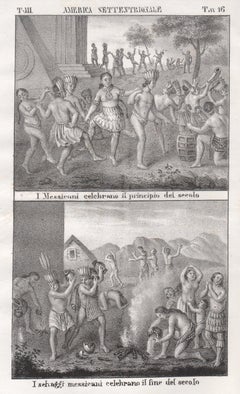
Quetzalcoatl Worship and Hunting Deity – Rare 1734 Engraving of Aztec Rituals
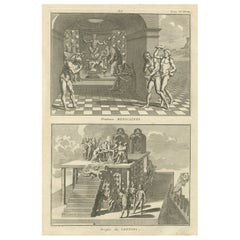
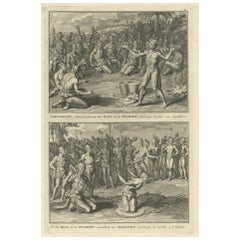
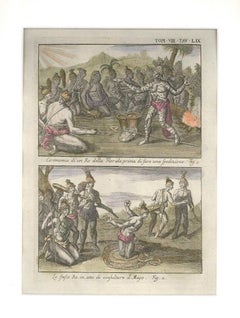
This finely detailed copperplate engraving from 1734 presents two theatrical interpretations of religious rituals in pre-Columbian Mexico, as imagined by European illustrators of the Enlightenment. Published in *Les Cérémonies et Coutumes Religieuses de tous les Peuples du Monde*, the scenes reflect European attempts to depict the spiritual life of Indigenous American civilizations, often with dramatic license and artistic embellishment.
The upper panel is titled *Le Mercure des Mexicains adoré à Cholula sous le nom de Quetzalcoatl*, meaning “The Mercury of the Mexicans worshipped at Cholula under the name of Quetzalcoatl.” Here, the Aztec deity Quetzalcoatl is equated with the Roman god Mercury, a typical Enlightenment-era habit of framing non-European religions in classical terms. Quetzalcoatl, a feathered serpent god associated with wind, knowledge, and priesthood, is shown here as a regal, seated figure surrounded by attendants. Offerings are being made, including incense, food, and possibly ritual bloodletting, while a woman feeds a child in the foreground. The checkerboard floor and columned terrace reflect a European architectural imagination, placing the scene somewhere between fantasy and interpretation.
The lower panel, titled 'Divinité qui préside à la chasse' or “Deity who presides over the hunt,” shows a chaotic and dynamic hunting scene under divine supervision. Dozens of Indigenous hunters, armed with bows and spears, charge across the landscape chasing deer, boars, and wild game. At the center, a hunter strikes a deer with a spear, while in the distance, a deity—possibly Mixcoatl, the god of the hunt—is seated in a forested shrine, overseeing the action. The scene is crowded and theatrical, designed to express vitality, sacred duty, and connection to the natural world through divine favor.
Although not ethnographically precise, the engraving demonstrates how early European artists viewed Indigenous religions with both admiration and exoticism. The association of Quetzalcoatl with Mercury and the depiction of hunting as a divinely governed act reveal a fusion of mythologies and a desire to frame unfamiliar beliefs in familiar terms.
Condition is good. The engraving has strong impressions and crisp detailing throughout. There is some minor toning along the edges, light foxing near the lower margin, and a faint crease in the top right corner. The paper is otherwise stable and clean.
For display, a vertical frame with a double mat to subtly separate the two scenes is ideal. Use archival materials and UV-protective glass to preserve the engraving’s sharp detail. A walnut or black frame will complement the strong contrast of the copperplate lines.