Want more images or videos?
Request additional images or videos from the seller
1 of 6

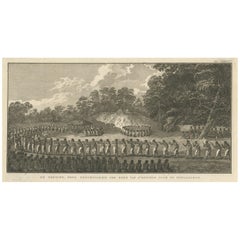
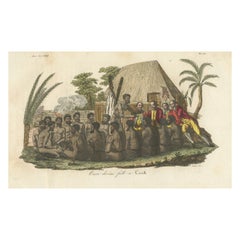
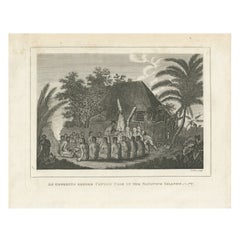
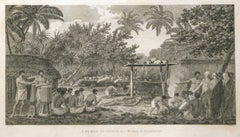
Royal Celebration in Tongatapu: The Natche Ceremony Engraved in circa 1785

$152.24
$190.3020% Off
£111.70
£139.6320% Off
€128VAT Included
€16020% Off
CA$210.91
CA$263.6320% Off
A$212.89
A$266.1120% Off
CHF 122.33
CHF 152.9120% Off
MX$2,580.51
MX$3,225.6320% Off
NOK 1,415.89
NOK 1,769.8620% Off
SEK 1,446.25
SEK 1,807.8120% Off
DKK 975.97
DKK 1,219.9720% Off

About the Item

An authentic antique engraving titled "The NATCHE: a Ceremony in Honour of the KING'S SON, in TONGATABOO." It is likely from a work related to the voyages of Captain James Cook mission to the Pacific Islands in the late 18th century. The engraving portrays a large ceremonial gathering in honor of the son of the king in Tongataboo, which refers to Tongatapu, the main island of the Kingdom of Tonga. The ceremony, labeled as "Natche," seems to involve a significant number of participants, suggesting it is a major event within the society. In the image, there are two prominent groups of figures; one is a circle of individuals, perhaps representing the dignitaries or important people in the society, and the other is a row of men with spears, possibly warriors or guards, in the foreground. Their attire and the way they are positioned suggest a formal and structured event with specific roles and protocol. There are thatched structures in the background, indicative of the traditional architecture of Tonga at the time, and the landscape is lush with palm trees, which aligns with the tropical environment of the island. Given the detail and the cultural significance portrayed in the engraving, it was probably intended to showcase the customs and ceremonies of the Tongan people to a European audience. Such illustrations were an important means of conveying the richness of the cultures encountered during exploratory expeditions. This engraving might be from a larger work that documented the customs and lives of Pacific Islanders, possibly published as part of an official account of a voyage or as a separate ethnographic study. Works that included such images were often intended to educate Europeans about the diverse cultures and societies around the world, and they played a significant role in the dissemination of knowledge during the Age of Discovery and Enlightenment.
  • Dimensions:
    Height: 9.45 in (24 cm)Width: 14.97 in (38 cm)Depth: 0 in (0.02 mm)
  • Materials and Techniques:
    Paper,Engraved
  • Period:
    1780-1789
  • Date of Manufacture:
    circa 1785
  • Condition:
    Good condition, Aged paper with soiling due to handling and age, mainly along the edges. The edges slightly brownish or soiled, with some minor tears and creases. Study the image carefully.
  • Seller Location:
    Langweer, NL
  • Reference Number:
    Seller: BG-13597-881stDibs: LU3054337989902

More From This Seller

View All
De Natsche – Ceremony for the King's Son, Tonga c.1795

De Natsche – Ceremony for the King's Son, Tonga c.1795

Located in Langweer, NL

De Natsche – Ceremony for the King's Son, Tonga c.1795 This antique print depicts a grand ceremony held in honour of the son of the King of Tonga, known as the Natsche, in the villa...

Category

Antique Early 1800s European Prints

Materials

Paper

The Death of Commander Fleuriot de Langle and His Men at Maouna, Samoa, 1797

The Death of Commander Fleuriot de Langle and His Men at Maouna, Samoa, 1797

Located in Langweer, NL

The engraving depicts a harrowing and chaotic scene from an 18th-century exploration, specifically the tragic event involving Commander Fleuriot de Langle and his men. The scene is s...

Category

Antique 1790s Prints

Materials

Paper

Confrontation and Culture: Samoan Warrior Engagement, Published in 1820

Confrontation and Culture: Samoan Warrior Engagement, Published in 1820

Located in Langweer, NL

The engraving is captioned as "Mode of Fighting in the Navigator's Islands" and depicts a scene of conflict among the indigenous people of the Navigator's Islands, now known as the ...

Category

Antique 1820s Prints

Materials

Paper

Divine Honors Bestowed Upon Captain Cook: A Ceremonial Encounter, circa 1820

Divine Honors Bestowed Upon Captain Cook: A Ceremonial Encounter, circa 1820

Located in Langweer, NL

Antique Print “Onori divini fatti a Cook” – Captain James Cook Honored, c.1820 Description Antique hand-colored engraving titled “Onori divini fatti a Cook,” translating as “Divine ...

Category

Antique Early 19th Century Prints

Materials

Paper

The Ceremonial Offering to Captain Cook in Hawaii, Engraved in 1778

The Ceremonial Offering to Captain Cook in Hawaii, Engraved in 1778

Located in Langweer, NL

Title: "The Ceremonial Offering to Captain Cook in Hawaii, 1778" This detailed antique engraving, titled "An Offering Before Captain Cook in the Sandwich Islands," captures a significant historical encounter from Captain James Cook's voyages. The artwork, based on a drawing by John Webber, who accompanied Cook, was skillfully translated into print by the combined talents of Samuel Middiman for the landscape and John Hall for the figures. Created around 1778, this scene illustrates a moment where indigenous Hawaiian men present offerings of suckling pigs to Captain Cook and his European companions. A towering figure wearing an imposing mask stands sentinel behind the Europeans, symbolizing the cultural richness and ceremonial traditions of the Hawaiian people. The scene is framed by native palms and lush tropical vegetation, with a typical steep-roofed thatched building enclosed by a fence in the background, hinting at the architectural styles of the era. This print, marked by 'Walker sculp', offers a poignant visual narrative of cultural exchange in the age of exploration.

Category

Antique Late 18th Century Prints

Materials

Paper

Rhythms of the Pacific: A Communal Dance in Tonga, Engraving Published in 1812

Rhythms of the Pacific: A Communal Dance in Tonga, Engraving Published in 1812

Located in Langweer, NL

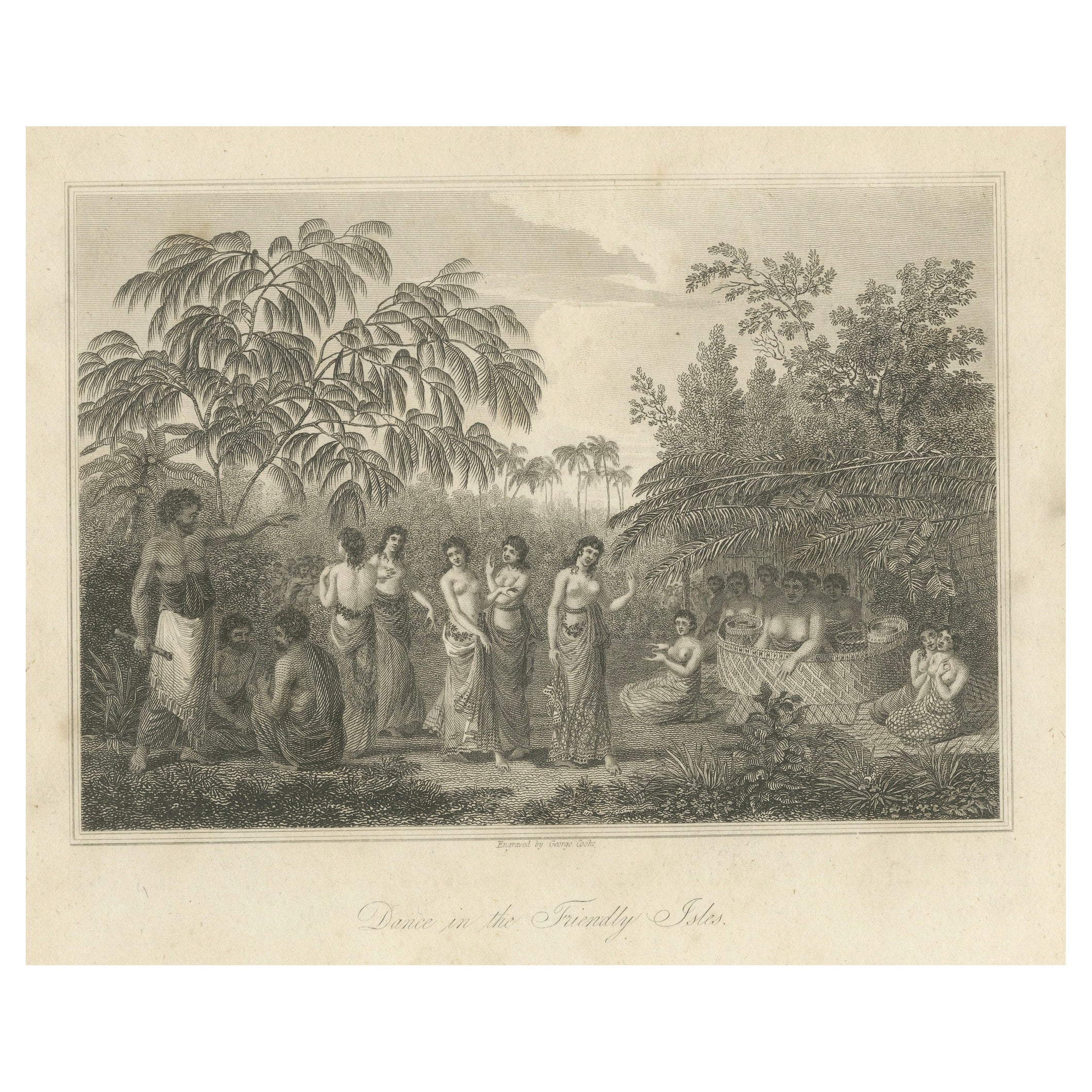
The engraving depicts a serene and communal scene labeled as "Dance in the Friendly Isles." The Friendly Isles is an older name for the Kingdom of Tonga in the South Pacific. This pi...

Category

Antique Early 19th Century Prints

Materials

Paper

You May Also Like

Original Antique Ethnographical Print, Figures, New South Wales, Australia, 1809

Original Antique Ethnographical Print, Figures, New South Wales, Australia, 1809

Located in St Annes, Lancashire

Wonderful ethnographical print. A copper-plate engraving after Lesieur Published by Sherwood, Neely & Jones. Dated 1809 Unframed.  

Category

Antique Early 1800s English Folk Art Prints

Materials

Paper

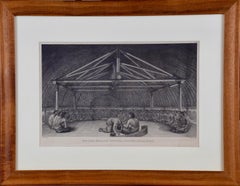
"King of the Friendly Islands" (Tonga); Engraving from Captain Cook's 3rd Voyage

"King of the Friendly Islands" (Tonga); Engraving from Captain Cook's 3rd Voyage

By John Webber

Located in Alamo, CA

"Poulaho, King of the Friendly Islands, Drinking Kava" is an engraving created by William Sharp (1749-1824), from a drawing by John Webber (1752-1793), who was the artist on Captain James Cook's 3rd and final voyage of discovery. It was published in the atlas of "A Voyage to the Pacific Ocean Undertaken by the Command of His Majesty, for Making Discoveries in the Northern Hemisphere", the official British Admirality sanctioned journal published upon completion of the voyage in London in 1784 by Strahan & Cadell. Captain Cook visited Tonga on his 3rd voyage, which he named The Friendly Islands because of the warm welcome he and his crew received, unlike some of the other more hostile Pacific islands. The engraving depicts Cook and his men observed a kava ceremony at the village of Mu’a on Tongatapu. King Paulaho sits in the centre foreground, his back to the spectator with a man kneeling before him. The ceremonial mat depicted behind Paulaho indicates that nobody was allowed to sit behind him. The figure in the centre holds a single cup, referring to the Tongan custom of offering the cup to the king first. Kava is native to the islands of the South Pacific and was first described for English readers in 1768 by Captain James Cook. The kava root has been used for centuries as a central feature of ceremonies and celebrations because it was able to bring about a calming and pleasant social atmosphere. The root was crushed and processed into coconut milk to become the focal ceremonial beverage, simply referred to as kava. This engraving is presented in a Koa wood frame and a white mat. Koa wood is legendary in Hawaii. There are occasional faint spots, but the print is otherwise in very good condition. This amazing Koa wood is native to Hawaii and it is known for the deep rich colors and varied grain pattern. Koa has an honored heritage in Hawaii and is highly revered and sacred. The word “koa” means “warrior” in Hawaiian. The warriors of King Kamehameha the Great, created canoes and weapons from a wood plentiful on the Big Island of Hawaii. This wood became synonymous with the warriors themselves, and it became known as koa. There are three other engravings listed from the official journal of Captain Cook's 3rd voyage available that are presented in identical Koa wood frames and mats (LU117324682422, LU117324684052, LU117324684032). They would make a wonderful grouping for a display of 2, 3 or 4 prints. A discount is available for a grouping depending on the number of items included. Captain Cook is remembered as one of the greatest explorers and navigators in history. His explorations included Australia, New Zealand and islands of the South Pacific and the northwest coast of North America. Hawaii was discovered by Captain Cook during this voyage. Hawaii was originally called The Sandwich Islands in honor of The Earl of Sandwich...

Category

1780s Realist Figurative Prints

Materials

Engraving

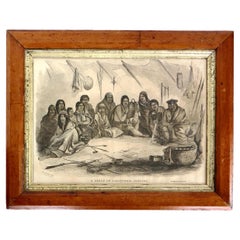
"A Group Of California Indians" Wood Cut Engraving. C 1856. Very Rare. Americana

"A Group Of California Indians" Wood Cut Engraving. C 1856. Very Rare. Americana

Located in Incline Village, NV

This is a very rare and important original image of early Western Americana, or more specifically, "Californiana". Mid 19th century and researched to have been engraved in 1856, it captures, in incredible detail, a group of twelve Native American Indians with a baby in a papoose, gathered together in front of their hanging tools, baskets, implements and weaponry behind them on a "tent like" backdrop. There are men, women, young, and elderly. It is a signed wood cut engraving applied in ink by well known wood cut engraver of the mid 19th century, William J. Peirce (active 1851-1879). It is in excellent all original condition with no additions, no restoration of any kind and it is housed in it's original 1 1/2" double beveled wooden birds eye maple veneered frame with a gilt 1/2" filet interior border. "A Group Of California Indians" is engraved at the base along with a non-descript notation "For description see page 381" which appears in the margin, in addition to an illegible signature. Both these line items are also noted by the New York Public Library, where a digital example exists from the esteemed collection of "The Miriam and Ira D. Wallach Division Picture Collection", which was assembled in 1986 and recently digitalized. The Library of Congress also memorializes this image and theirs is similarly a digital image. My example came out of the Grant Smith Collection of "Californiana", as is noted on the back of the framed engraving. He was located at Main Street in Bolinas, California (see images on the rear for provenance). Research reveals that he was a direct descendant of the coastal Miwok people who built a settlement in the Bolinas lagoon area. The engraving is referenced in both the New York Library and The Library of Congress as "A Group of California Indians". It is one of the earlier images you will find, along with McKenny and Hall lithographed mages of Native American Indians; and because of it's subject matter and extreme rarity, "A Group Of California Indians" commands attention and interest from the Western art collectors' arena. California became a state on September 9, 1850 making this one of the earliest known images (Circa 1856) of "Californiana" and California Native American...

Category

Antique 1850s American Native American Native American Objects
Materials

Paper

Indigenous Costumes  - Original Lithograph - 19th Century

Indigenous Costumes - Original Lithograph - 19th Century

Located in Roma, IT

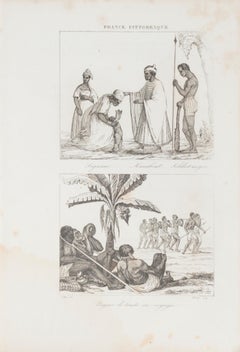
Indigenous Costumes is an original lithograph realized by an anonymous engraver of the 19th Century. Printed as part of the series "France Pittoresque", as indicated at the top cent...

Category

19th Century Figurative Prints

Materials

Lithograph