Video Loading
Want more images or videos?
Request additional images or videos from the seller
1 of 16

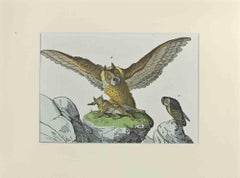
Strix Ulula – Hand-Coloured Engraving of Short-Eared Owl with Eggs, 1770–1829

$1,532.46
$2,240.5331% Off
£1,135.87
£1,660.7631% Off
€1,300VAT Included
€1,90031% Off
CA$2,137.86
CA$3,125.6631% Off
A$2,168.47
A$3,170.8731% Off
CHF 1,238.26
CHF 1,810.4031% Off
MX$26,260.91
MX$38,394.2631% Off
NOK 14,577.32
NOK 21,312.8031% Off
SEK 14,528.94
SEK 21,242.0631% Off
DKK 9,911.94
DKK 14,491.7831% Off

About the Item

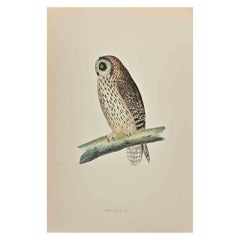
Strix Ulula – Hand-Coloured Engraving of Short-Eared Owl with Eggs, 1770–1829 This fine hand-coloured engraving, titled Strix, Ulula, presents a detailed and lifelike depiction of an owl identified in the 18th-century Dutch text as the Velduil, or short-eared owl (Asio flammeus). The bird is shown standing on the ground among grass and plants, guarding its clutch of five eggs, a naturalistic portrayal characteristic of the celebrated ornithological series Nederlandsche Vogelen; volgens hunne huisdouding, aert, en eigenschappen beschreeven. Published in Amsterdam between 1770 and 1829 by Cornelius Nozeman, Martinus Houttuyn, and Jan Christiaan Sepp, this monumental work was the first comprehensive study of Dutch birdlife. Each plate depicts the species in a setting that reflects its natural environment, often close to life size, and accompanied by scholarly descriptive text. Owls of the genus Strix are medium to large, robustly built birds of prey with a powerful presence and a largely nocturnal lifestyle. They are noted for their lack of ear tufts, rounded heads, and penetrating gaze. The short-eared owl in particular is a ground-nesting species, often found in open fields, grasslands, and marshes, and is a skilled hunter of rodents. The Dutch text included with this plate describes its behaviour, feeding habits, and nesting patterns, noting its preference for hunting at dusk and during the night, and its remarkable efficiency in controlling rodent populations. This engraving displays meticulous detail in the feather patterns, from the mottled browns of the wings to the barred tail feathers and the contrasting pale facial disk. The composition reflects the 18th-century scientific ideal of combining beauty with accuracy, making it both an important zoological record and a work of art. The two original pages of letterpress text in Dutch describing the species in depth — including observations on its physical characteristics, nesting, and seasonal behaviour — are included with this print, adding further historical and scholarly value. Condition: Very good condition. Strong paper with light age toning and occasional minor handling marks in margins, well away from the image, plus some marginal foxing. Plate mark clearly visible. Original hand-colouring fresh; text pages clean and well preserved. Framing tips: A dark wood or walnut frame paired with a warm off-white or light cream archival mat will complement the natural tones of the owl and its surroundings. For a more dramatic presentation, a double mat with a thin dark brown inner mount will help draw the viewer’s focus to the engraving.
  • Creator:
    M. Houttuyn (Author),Cornelius Nozeman (Author),J.C. Sepp (Artist)
  • Dimensions:
    Height: 21.07 in (53.5 cm)Width: 14.57 in (37 cm)Depth: 0.02 in (0.5 mm)
  • Materials and Techniques:
    Paper,Engraved
  • Place of Origin:
  • Period:
  • Date of Manufacture:
    1770
  • Condition:
    Strong paper with light age toning and occasional minor handling marks in margins, well away from the image, plus some marginal foxing. Plate mark clearly visible. Original hand-colouring fresh, text pages clean and well preserved.
  • Seller Location:
    Langweer, NL
  • Reference Number:
    Seller: BG-05991/321stDibs: LU3054310821163

More From This Seller

View All
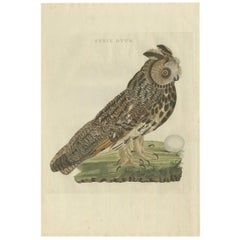
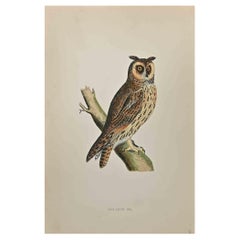
Strix Otus – Antique Long-Eared Owl Print by Nozeman & Sepp, 1809

Strix Otus – Antique Long-Eared Owl Print by Nozeman & Sepp, 1809

By M. Houttuyn, Cornelius Nozeman, J.C. Sepp

Located in Langweer, NL

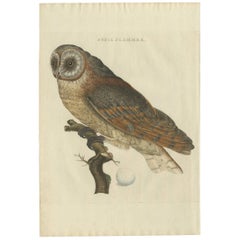
Strix Otus – Antique Long-Eared Owl Print by Nozeman & Sepp, 1809 This finely hand-coloured engraving features the long-eared owl (Asio otus), known in Dutch as the “ransuil.” The a...

Category

Antique Early 19th Century Dutch Prints

Materials

Paper

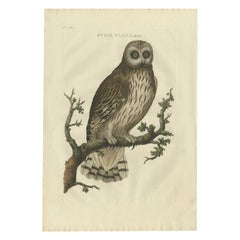
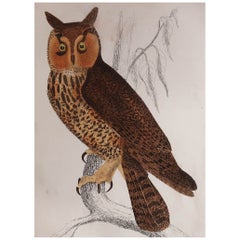
Antique Bird Print of a Male Strix Owl by Sepp & Nozeman, 1770

Antique Bird Print of a Male Strix Owl by Sepp & Nozeman, 1770

Located in Langweer, NL

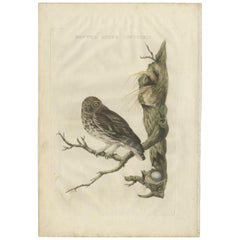
Antique print titled ‘Strix Ulula, mas'. Strix is a genus of owls in the typical owl family (Strigidae), one of the two generally accepted living families of owls, with the other bei...

Category

Antique 18th Century Prints

Materials

Paper

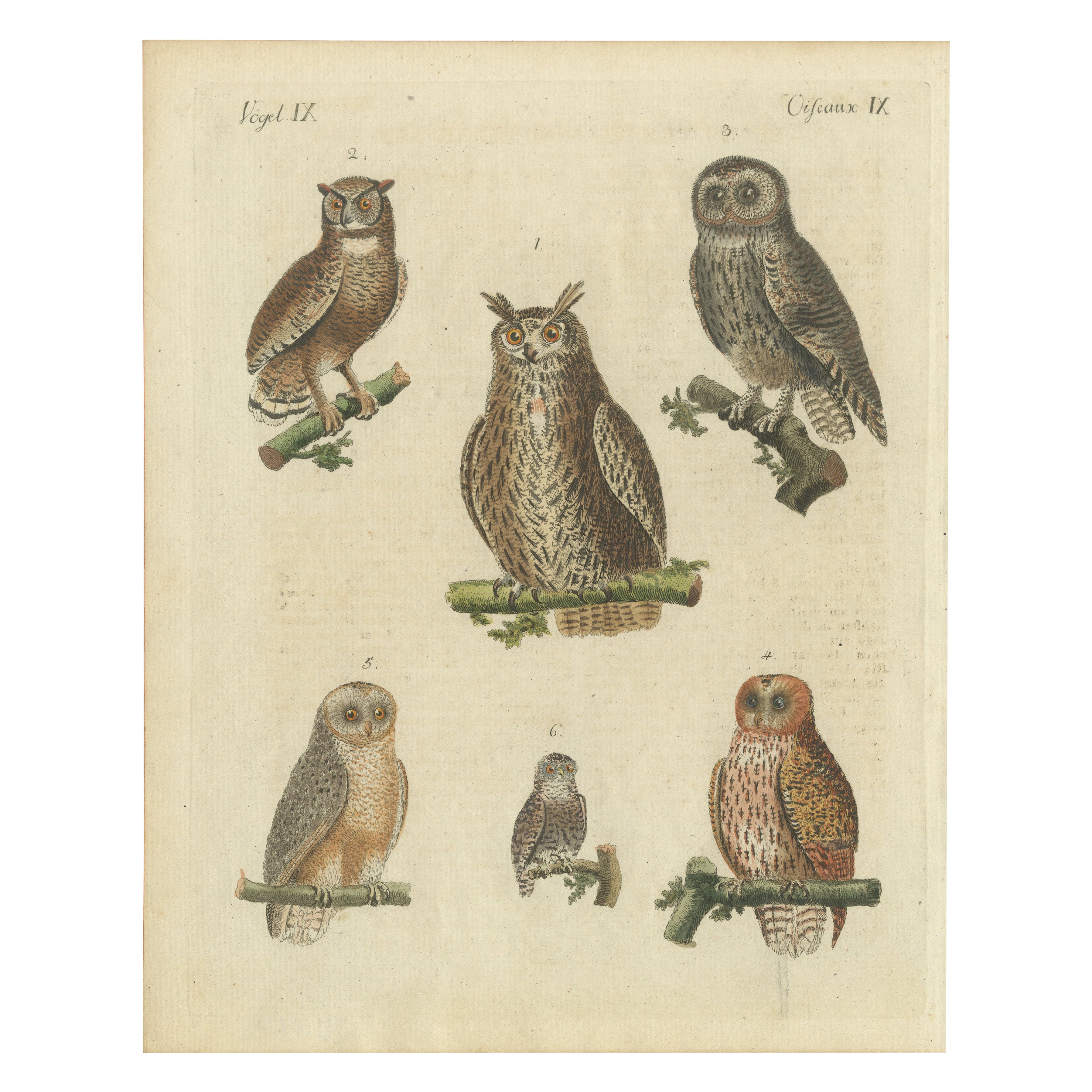
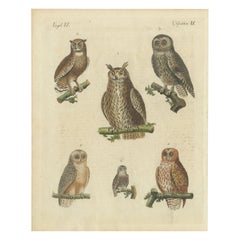
European Owls – Antique Hand-Colored Bird Engraving, Vogel IX, c.1800

European Owls – Antique Hand-Colored Bird Engraving, Vogel IX, c.1800

Located in Langweer, NL

European Owls – Antique Hand-Colored Bird Engraving, Vogel IX, c.1800 This finely executed hand-colored engraving presents six European owl species arranged in comparative study, issued as Plate IX (Vogel IX / Oiseaux IX). The plate belongs to the late 18th–early 19th century tradition of scientific ornithology, in which birds were illustrated side by side to support identification, classification, and study. The owls depicted correspond to species recognized today as the Long-eared Owl (Asio otus), shown prominently with its upright posture and distinct ear tufts; the Tawny Owl (Strix aluco), represented in both its grey-brown form and its warmer rufous color morph; the Short-eared Owl (Asio flammeus), identifiable by its paler facial disc and reduced ear tufts; the small but expressive Little Owl (Athene noctua); and a larger, more powerfully built owl commonly identified as the Eurasian Eagle-Owl (*Bubo bubo*), included to demonstrate contrast in scale and form. Each bird is depicted perched on a branch against a neutral ground, allowing close observation of plumage texture, facial structure, and stance. The hand-applied coloring enhances the naturalistic effect, particularly in the subtle gradations of brown, grey, cream, and rust tones characteristic of owl plumage. The bilingual German and French headings reflect the international scholarly audience for whom such plates were produced during this period of expanding scientific exchange. Plates like this were originally issued in ornithological volumes intended for scholars, collectors, and educated amateurs. Today they are valued both for their scientific relevance and their decorative appeal. The balanced composition of six distinct species on a single sheet makes this print especially attractive to collectors of natural history, bird enthusiasts, and interior designers seeking refined, nature-inspired wall art. Condition report: Good condition. Original hand coloring. Noticeable age toning and patina throughout, with scattered foxing and light surface marks consistent with age. Minor edge wear and small discolorations visible. No modern restoration observed. Framing tips: This print is well suited to a classic museum-style presentation. A soft ivory or light beige mat will complement the aged paper and muted coloration, paired with a medium walnut, light oak, or ebonized frame depending on the desired contrast. UV-protective glazing is recommended to preserve the original hand coloring. Technique: Hand-colored engraving Maker: European school, late 18th–early 19th century Keywords: antique bird print, owl engraving, European owls, ornithology print, hand colored engraving, Vogel IX, Oiseaux IX, natural history print, antique wildlife art, Strix aluco, Asio otus, Asio flammeus, Athene noctua, Bubo bubo, tawny owl, long-eared owl, short-eared owl, little owl, eagle owl, bird illustration, antique zoology, 18th century print, 19th century print, scientific illustration, vintage bird art, collectible print, natural history engraving, European wildlife, decorative wall art, interior design artwork, classic ornithology, antique nature print

Category

Antique Late 19th Century German Prints
Materials

Paper

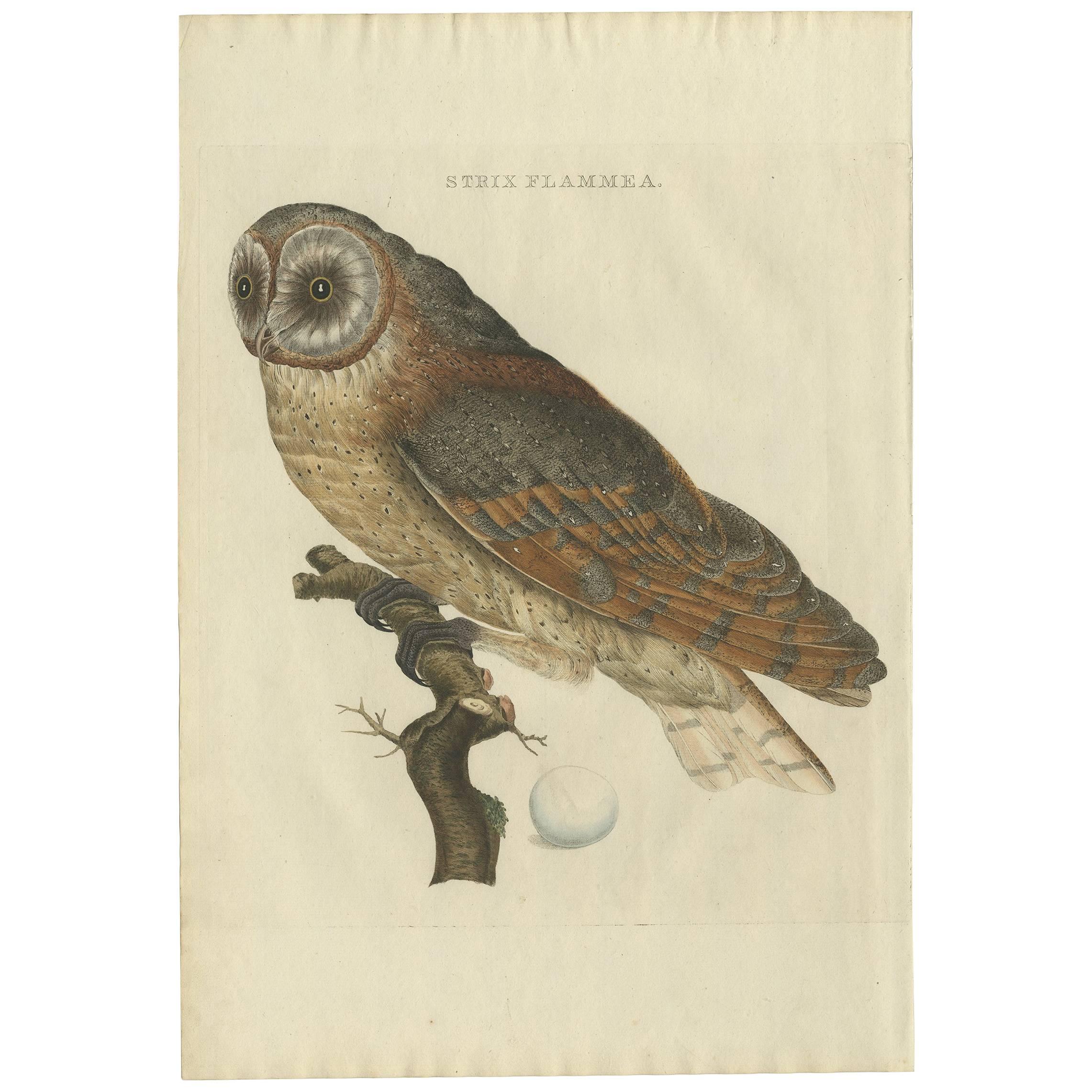
Strix Flammea – Antique Barn Owl Print by Nozeman & Sepp, 1829

Strix Flammea – Antique Barn Owl Print by Nozeman & Sepp, 1829

By J.C. Sepp, M. Houttuyn, Cornelius Nozeman

Located in Langweer, NL

Strix Flammea – Antique Barn Owl Print by Nozeman & Sepp, 1829 This beautifully hand-coloured engraving shows the barn owl (Tyto alba), known in Dutch as...

Category

Antique Early 19th Century Dutch Prints

Materials

Paper

Little Owl – Hand-Colored Dutch Bird Print by Sepp & Nozeman, 1770

Little Owl – Hand-Colored Dutch Bird Print by Sepp & Nozeman, 1770

Located in Langweer, NL

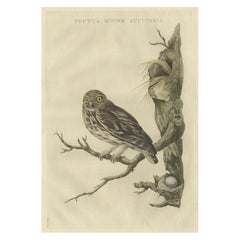
Little Owl Antique Dutch Bird Print by Sepp and Nozeman, circa 1770 This finely hand-coloured copper engraving, titled Noctua Minor Aucuparia, depicts the little owl (Athene noctua)...

Category

Antique Late 18th Century Dutch Prints

Materials

Paper

Antique 18th Century Engraving in Old Handcoloring of a Little Owl, 1770

Antique 18th Century Engraving in Old Handcoloring of a Little Owl, 1770

Located in Langweer, NL

Antique print titled 'Noctua Minor Aucuparia'. This print depicts the little owl (Dutch: steenuil). The little owl (Athene noctua) is a bird that inhabits much of the temperate and...

Category

Antique 1770s Dutch Prints

Materials

Paper

You May Also Like

Original Antique Print of an Owl, 1847 'Unframed'

Original Antique Print of an Owl, 1847 'Unframed'

Located in St Annes, Lancashire

Great image of an owl. Unframed. It gives you the option of perhaps making a set up using your own choice of frames. Lithograph after cpt. brown with original hand color. Publishe...

Category

Antique 1840s English Folk Art Prints

Materials

Paper

Great Owl - Etching by Johann Friedrich Naumann - 1840

Great Owl - Etching by Johann Friedrich Naumann - 1840

By Johann Friedrich Naumann

Located in Roma, IT

Great Owl is an Etching hand colored realized by Gotthilf Heinrich von Schubert - Johann Friedrich Naumann, Illustration from Natural history of birds in pictures, published by Stutt...

Category

1840s Modern Figurative Prints

Materials

Etching

Owls - Etching by Johann Friedrich Naumann - 1840

Owls - Etching by Johann Friedrich Naumann - 1840

By Johann Friedrich Naumann

Located in Roma, IT

Owls is an Etching hand colored realized by Gotthilf Heinrich von Schubert - Johann Friedrich Naumann, Illustration from Natural history of birds in pictures, published by Stuttgart ...

Category

1840s Modern Figurative Prints

Materials

Etching