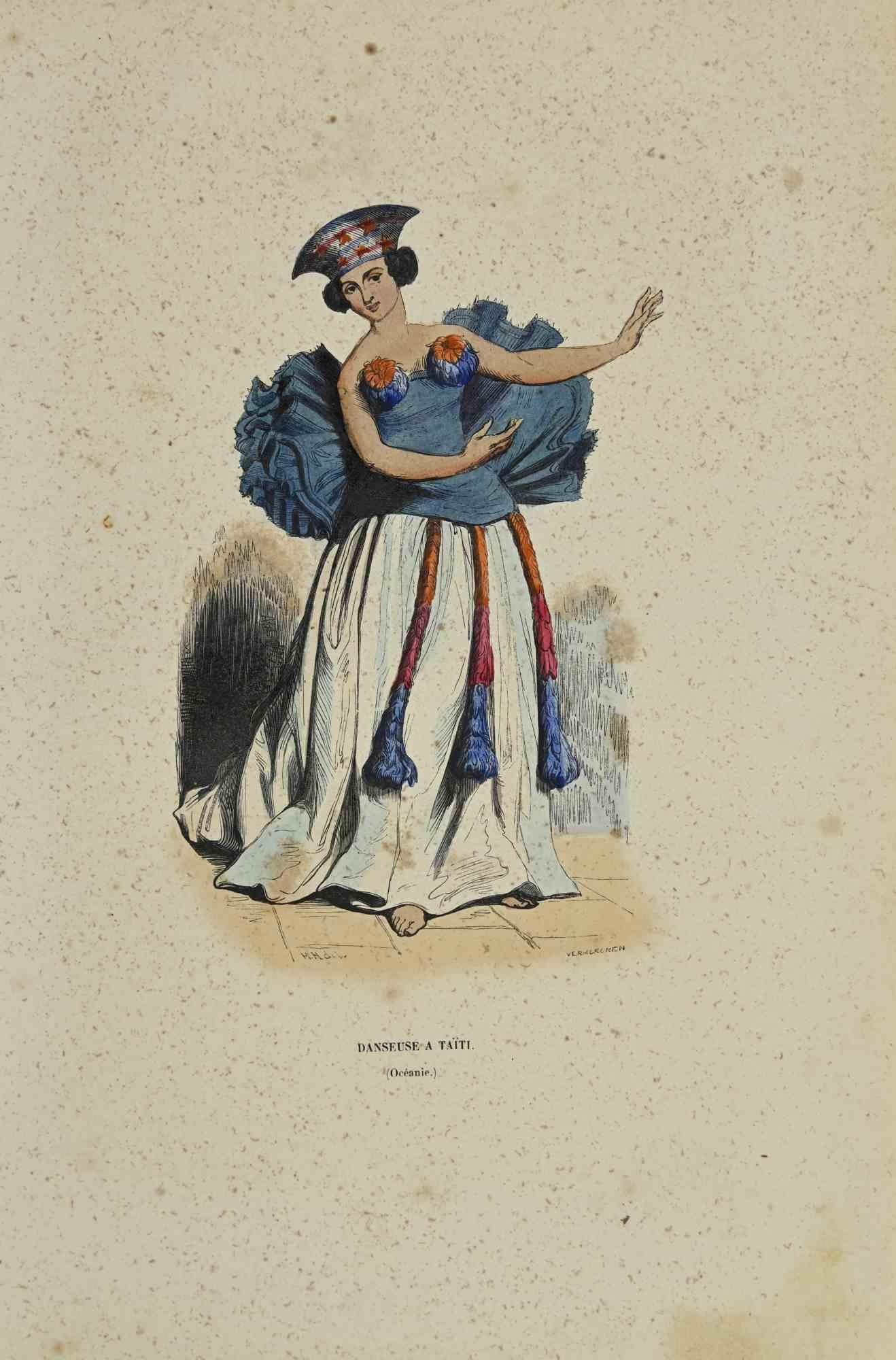
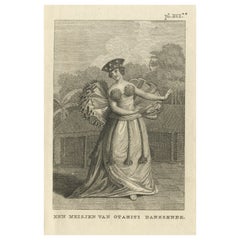
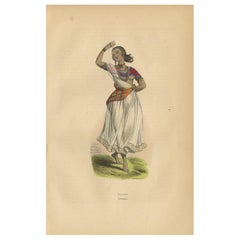
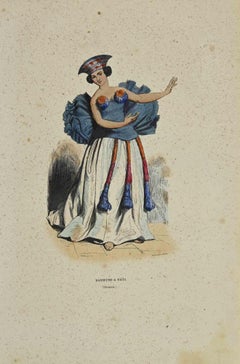
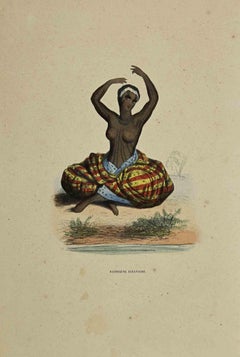
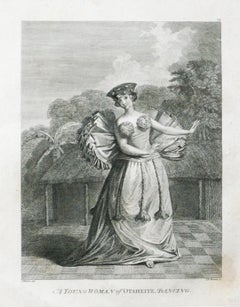
This lithograph by Karl Joseph Brodtmann presents a detailed portrait of a Tahitian dancer. The artwork is part of Brodtmann’s ethnographic series, capturing the attire, posture, and cultural significance of traditional dances in Tahiti, part of French Polynesia. The illustration reflects 19th-century European interest in the "exotic" practices and customs of non-Western cultures.
Description:
The lithograph depicts a Tahitian dancer in full traditional dress, posed gracefully as if in the midst of a dance. The dancer’s expression is serene, and her pose is elegant, with one hand extended outward and the other resting on her hip. Her costume and adornments are richly detailed, reflecting the vibrant cultural traditions of Tahiti.
- Attire: The dancer wears an elaborate skirt made from layers of fabric, possibly resembling the traditional pareu or tapa cloth, draped and flowing down to her feet. Around her waist is a sash, adding a layer of detail to her ensemble. Her upper body is adorned with what appear to be decorative pompons over her chest, and she wears a wide, decorative backpiece, which adds a sense of grandeur to her costume. The backpiece appears to be made from traditional materials like woven fibers or feathers, symbolizing her role as a performer in an important cultural event.
- Headwear: The dancer wears a headdress with intricate patterns and designs, possibly made from woven fabric or adorned with flowers, which was a common practice in Tahitian ceremonial dress. The headdress adds to her regal appearance and highlights the cultural significance of head adornments in Polynesian rituals and performances.
- Pose: Her pose is dynamic yet graceful, capturing the fluidity of movement that is characteristic of Tahitian dance. Tahitian dance, known as ’ōte’a, involves elaborate arm and hand movements, as well as rapid hip movements, and this pose suggests that she is performing one of these traditional dances. Her bare feet are visible, as dancing barefoot is customary in many Polynesian dances.
The lithograph emphasizes both the elegance of the dancer and the cultural importance of dance in Tahitian society, offering European audiences a glimpse into the ceremonial practices of Polynesia.
Maker:
Karl Joseph Brodtmann (1787–1862) was a Swiss lithographer renowned for his detailed illustrations of ethnographic and natural history subjects. His works, widely circulated in Europe during the 19th century, provided visual documentation of various non-Western cultures encountered through exploration and colonialism. Brodtmann’s ethnographic studies, such as this one, were intended to educate European audiences about distant lands and their peoples.
Technique and Style:
The lithograph was created using lithography, a technique that allowed Brodtmann to achieve fine detail and texture in the clothing and adornments of the dancer. His realistic style in this work captures the textures of the flowing fabric, the intricate patterns of the headdress, and the graceful posture of the dancer. Brodtmann’s careful shading emphasizes the three-dimensionality of the figure, giving life to the dancer’s movement and attire.
The overall composition is balanced and harmonious, with the dancer standing on what appears to be a simple wooden platform or stage, further highlighting the figure and her costume without any distractions in the background.
Cultural Context:
Tahitian dance has been a central part of Polynesian culture for centuries, used in religious ceremonies, celebrations, and storytelling. The dancer depicted here likely represents the role of women in these traditional performances, where they would wear elaborate costumes and perform dances that told stories of their gods, ancestors, and nature. Dance in Tahiti was not only a form of entertainment but also a sacred ritual, often performed during important cultural events.
The costume worn by the dancer, with its layered fabrics and intricate headpiece, reflects the artistic craftsmanship of Tahitian society, where costumes were carefully crafted from materials like tapa cloth, feathers, and natural fibers. These elements not only added beauty to the performance but also held symbolic meaning, often associated with fertility, status, or spirituality.
Brodtmann’s depiction of this Tahitian dancer provides European viewers with an image of the elegance and complexity of Polynesian cultural practices, during a time when the West was increasingly fascinated by the "exotic" and distant lands of the Pacific. This portrait contributes to the broader ethnographic documentation of Polynesia, illustrating the importance of dance and ceremony in Tahitian society.