Want more images or videos?
Request additional images or videos from the seller
1 of 10

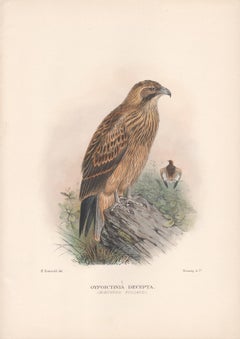
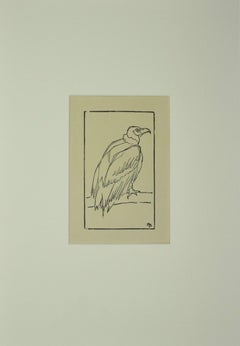
Vulture Etching – Natural History Print of the Andean Condor, ca.1880

$600.47
£444.45
€510VAT Included
CA$836.54
A$850.84
CHF 486.53
MX$10,291.62
NOK 5,700.45
SEK 5,699.08
DKK 3,888.79

About the Item

Vulture Etching – 19th Century Natural History Print of the Andean Condor This striking 19th-century etching features a detailed image of a vulture, most likely the 'Vultur Gryphus', or Andean condor, one of the world’s largest flying birds and an iconic species of South America. The bird is shown perched on a branch, its distinctive hooked beak, fleshy caruncle, and layered feathering rendered with great care. The etching captures the solemn and powerful posture of the bird, making it a compelling study in natural history illustration. The print is executed in fine linework with deep tonal contrasts, emphasizing the textures of the feathers and the anatomical strength of the talons. Below the image, in pencil, is the Latin name Vultur Gryphus, accompanied by a signature and date, which appear to be in a 19th-century hand, though the artist remains unidentified. This anonymity adds a certain historical charm, and the high quality of the execution suggests the work of a skilled illustrator or printmaker familiar with zoological subjects. More research is needed to identify the maker. No second one found. Etchings of birds of prey such as this were highly popular among naturalists and collectors during the 1800s, often created as scientific references or limited edition collector’s prints. The composition’s vertical format and naturalistic detailing make it ideal for framing as a standalone decorative piece or as part of a gallery wall of natural history subjects. The sheet is printed on sturdy cream wove paper with generous margins, allowing for a wide range of framing options. It would appeal to collectors of antique ornithology, zoological art, or 19th-century etchings. Condition Report: Very good condition. Clean impression on cream paper with wide margins. Minor age spots and faint signs of handling. Pencil title and signature below image. Blank verso. No tears or repairs. Framing Tips: Frame with a black, walnut, or antique gold moulding. A warm off-white or ivory mat will complement the tone of the paper and enhance the rich details of the etching. Use UV-protective glass to preserve the print. Based on the style of the etching, paper, and handwriting, this print was most likely produced in the late 19th century, specifically around 1870 to 1890. Here’s why: 1. Etching technique – The fine linework and tonal control reflect the 19th-century revival of etching as an artistic medium, especially popular in Europe from the 1850s to 1890s. 2. Handwriting and terminology – The Latin species name *Vultur Gryphus* and the delicate, slanted pencil script are typical of scientific illustrations or academic prints from this period. 3. Paper and margins – The paper used appears to be quality wove or laid paper with wide margins, common in prints meant for collectors or limited editions in the second half of the 19th century. 4. Stylistic influence – The pose and naturalistic rendering of the bird resemble works in zoological studies and ornithological books produced during the Victorian era. Unless more concrete publication data or artist identity emerges, a safe and accurate listing would state: Date: circa 1870–1890 Period: Late 19th century
  • Dimensions:
    Height: 14.38 in (36.5 cm)Width: 10.04 in (25.5 cm)Depth: 0.01 in (0.2 mm)
  • Materials and Techniques:
  • Period:
  • Date of Manufacture:
    circa 1880
  • Condition:
    Very good condition. Clean impression on cream paper with wide margins. Minor age spots and faint signs of handling. Pencil title and signature below image. Blank verso. No tears or repairs.
  • Seller Location:
    Langweer, NL
  • Reference Number:
    Seller: BG-13750-121stDibs: LU3054345132322

More From This Seller

View All
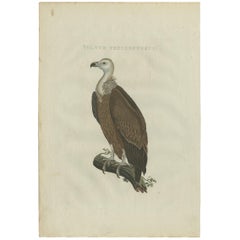
Antique Bird Print of a Vulture by Sepp & Nozeman, 1770

Antique Bird Print of a Vulture by Sepp & Nozeman, 1770

By Cornelius Nozeman, J.C. Sepp

Located in Langweer, NL

Griffon Vulture Antique Dutch Bird Print by Sepp and Nozeman, c.1770 This large-format hand-coloured copper engraving, labeled Vultur Percnopterus, actually depicts the Eurasian Griffon Vulture (Gyps fulvus), rather than the smaller Egyptian Vulture...

Category

Antique Late 18th Century Dutch Prints

Materials

Paper

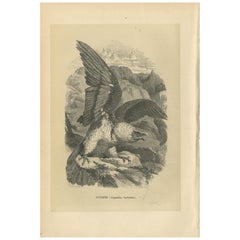
Antique Bird Print of the Bearded Vulture, 1853

Antique Bird Print of the Bearded Vulture, 1853

Located in Langweer, NL

Antique bird print titled 'Gypaete'. Original print of the Bearded Vulture. This print originates from 'Histoire Naturelle des Oiseaux' by M. Emm. le M...

Category

Antique Mid-19th Century Prints

Materials

Paper

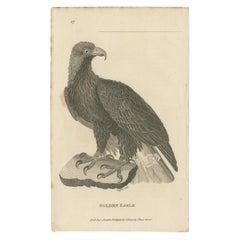
Antique Bird Print of the Golden Eagle by Kearsley, ca.1808

Antique Bird Print of the Golden Eagle by Kearsley, ca.1808

Located in Langweer, NL

Antique print titled 'Golden Eagle'. Original antique print of the golden eagle. Published by G. Kearsley, 1808.

Category

Antique Early 19th Century British Prints

Materials

Paper

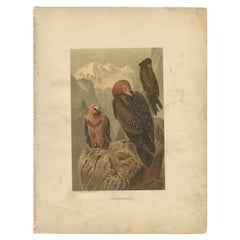
Antique Bird Print of the Bearded Vulture by Prang, 1898

Antique Bird Print of the Bearded Vulture by Prang, 1898

Located in Langweer, NL

Antique bird print titled 'Lammergeyer'. Old bird print depicting the bearded vulture. This chromolithograph originates from the natural history set 'A...

Category

Antique 19th Century Prints

Materials

Paper

You May Also Like

French Large Engraving of an Eagle by Savigny

French Large Engraving of an Eagle by Savigny

Located in Downingtown, PA

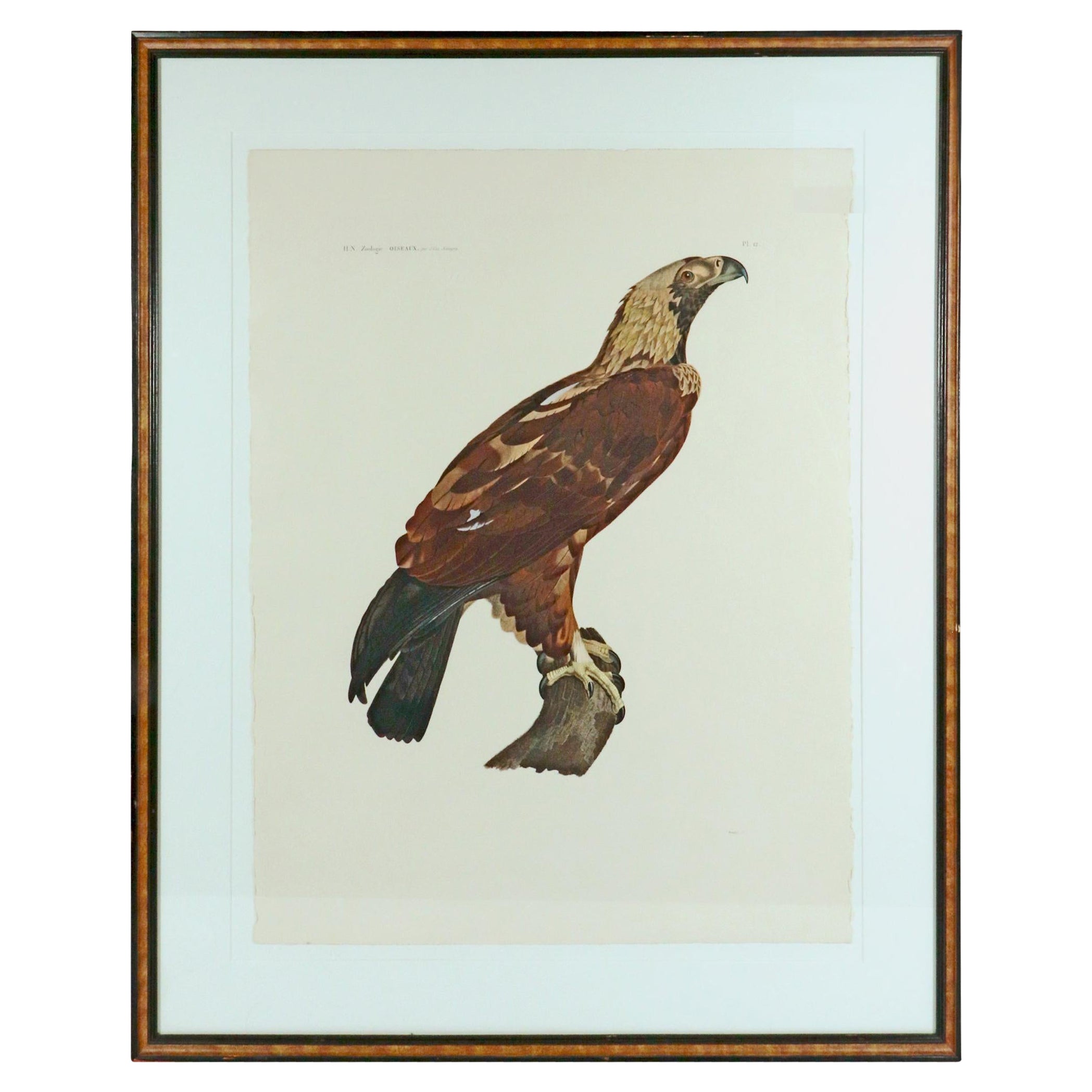
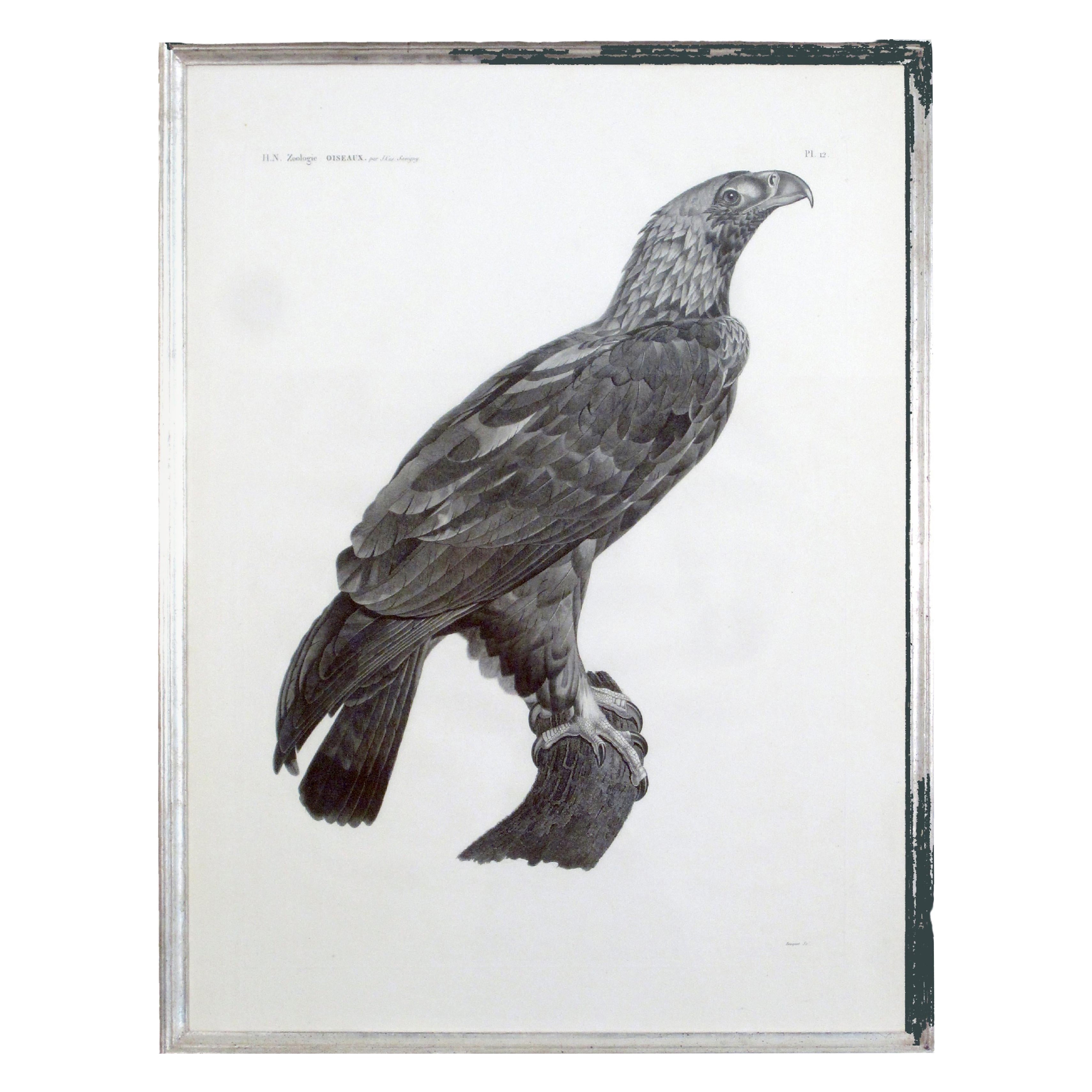
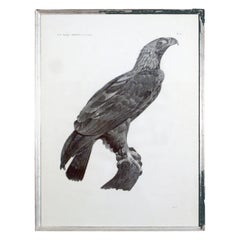
The Eastern Imperial Eagle, from the Description de l'Égypte Jules-César Savigny & Bouquet Snr. (Engraver), Plate 12, Published 1809-1813 This magnificent and historically important stipple engraving is a primary document from one of the most ambitious scholarly projects ever undertaken: the Description de l'Égypte. The print is a superb example of Neoclassical scientific illustration, depicting the majestic Eastern Imperial Eagle (Aquila heliaca...

Category

Antique Early 19th Century French Regency Prints

Materials

Paper

Important 18th Century, American School Bald Eagle Drawing Attr William Bartram

Important 18th Century, American School Bald Eagle Drawing Attr William Bartram

Located in Atlanta, GA

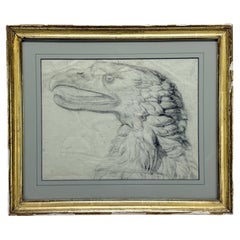
Title: Eagle Head Artist: Attributed to William Bartram (American, 1739–1823) Date: Late 18th century Medium: Pen and ink on laid paper Dimensions: 13.5 × 15.875 in. (framed)...

Category

Antique 18th Century American American Colonial Drawings

Materials

Giltwood, Paper

Golden Eagle: An Original 19th C. Audubon Hand-colored Bird Lithograph

Golden Eagle: An Original 19th C. Audubon Hand-colored Bird Lithograph

By John James Audubon

Located in Alamo, CA

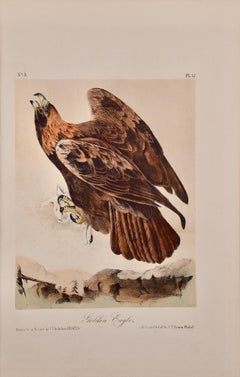
This is an original John James Audubon hand-colored lithograph entitled "Golden Eagle", No. 3, Plate 12 from Audubon's "Birds of America, lithographed, printed and colored by JT Bowe...

Category

Late 19th Century Naturalistic Animal Prints

Materials

Lithograph

The Vulture. 1942 (Histoire Naturelle - Textes de Buffon, B.341)

The Vulture. 1942 (Histoire Naturelle - Textes de Buffon, B.341)

By Pablo Picasso

Located in Greenwich, CT

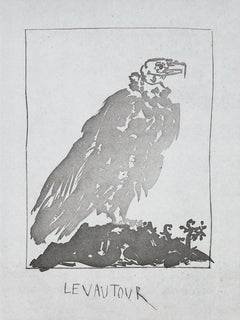
The Vulture is an aquatint and drypoint print on chine from one of the deluxe copies of Picasso's 1942 Histoire Naturelle - Textes de Buffon series. The image size is 10.6 x 8 inches, unsigned as issued, and framed in a contemporary silver and gray moulding. One of about 36 prints that exist with Picasso's remarqued title in French, from the edition of 262 (there were 226 portfolios, some with additional sets on varying papers). Catalogue - Cramer #37 The exceptional etchings from Picasso’s Histoire Naturelle – Textes de Buffon are a masterful combination of sugar-lift aquatint and drypoint, showcasing a full range of gray tonalities. The etchings of animals, birds and insects are considered some of the most beautiful and most unusual examples of Picasso’s graphic work. Roger Lacourière, Picasso’s master printer, pulled the prints for each etching between 1939-1942. It was Lacourière who taught Picasso the sugar-lift aquatint technique which allowed him to mimic the effect of brushstrokes in these etched images. Picasso first explored the technique in his plates for the Vollard Suite, but it was in the creation of the Buffon images that he fully realized its stunning, painterly potential. For the edition, 226 portfolios were produced with the first thirty-six counting as deluxe compilations. These rare deluxe sets were on diverse papers (chine, japon or vergé ancien) and each included a complete additional suite showing Picasso’s title remarques along the bottom. As such, the remarqued versions of the prints are quite rare with just thirty-six of each produced for the edition (with the exception of The Wolf which is never remarqued – the image always fills the entire etching plate). These prints are based on the writings of French naturalist Georges-Louis Leclerc, Comte de Buffon, who extensively documented the natural world in his monumental work Histoire Naturelle. Picasso’s association with the project to illustrate parts of the Buffon came during a tumultuous time in European history – the prelude to, and early years of, World War II. As the continent was ravaged, Picasso lived through the disaster in Paris, which the Germans occupied in 1940. These prints could be seen as a political statement – Picasso channeling his artistic expression into a form of resistance art...

Category

20th Century Modern Prints and Multiples

Materials

Drypoint, Aquatint

Bird - Original Woodcut - Early 20th Century

Bird - Original Woodcut - Early 20th Century

Located in Roma, IT

Bird is an original woodcut realized by an artist of the early 20th Century. The artwork is in very good conditions and mounted on a white cardboard passpartout (49x34). Artist’s i...

Category

Early 20th Century Animal Prints

Materials

Paper, Woodcut