Located in Hamilton, Ontario
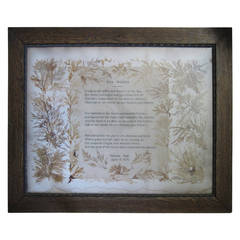
19th century Irish Marine Botany Specimens made for Thomas Barnett of the Niagara Falls Museum. Seaweed samples were collected off the West Coast of Ireland in 1871 by Mrs. Maria J.W. Kirkwood and presented to Thomas Barnett Esquire, proprietor of the Niagara Falls Museum. These come as two separately framed pieces with hand embroidered lettering surrounded by seaweed and a poem written by Victoria Hall.
Free shipping within the United States and Canada.
The Niagara Falls Museum was a museum most notable for being the oldest Canadian museum (1827), as well as for having housed the mummy of Ramesses I for 140 years before its return to Egypt in 2003. It was founded by Thomas Barnett of Birmingham, England and underwent a few vocational changes in its history.
More on Thomas Barnett and the Niagara Falls Museum.
Thomas Barnett was born on December the 4th, 1799 near Birmingham, England. He moved to Canada in the early 1820s and opened the Niagara Falls Museum in 1827 at the base of the Canadian Horseshoe Falls. Barnett had a passion for collecting oddities. He retrofitted a former brewery house to exhibit his private collection. Although Barnett was aware of the collection patterns of his North American contemporaries, his own approach bore an uncanny similarity to the British tradition, such as the Ashmolean Museum in Oxford, the first traditional museum in Britain.
The Niagara Falls Museum had humble beginnings. In 1827, the first museum contained Thomas Barnett's own cabinet of taxidermic curiosities. Although the details were not documented, the collection was likely composed of a number of mounted animals of local origin, combined with a smattering of Native American artifacts. Barnett's collection however rapidly grew. Prior to 1844, an account of the museum's contents stated that there were over 5000 items, including bipeds, quadrupeds, birds, fish, insects, reptiles, shells, minerals, and Native American curiosities. Through the first fifty years of its existence, the Niagara Falls Museum continued to acquire similar artifacts through the diligent efforts of the Barnett family and their associates.
In 1854, Sydney Barnett (son of Thomas Barnett) made the first of his three trips to Egypt (two by himself and one with Dr. J. Douglas of Montreal) and purchased four mummies as well as a host of other Egyptian antiquities. In 1857, mastodon remains were discovered in St. Thomas, Ontario and later placed in the museum. In 1859 an inventory of the museum's contents included, in addition to the previously mentioned artifacts, an egg collection...
Category
Antique 19th Century Decorative Art