Academic Figurative Drawings and Watercolors

ACADEMIC STYLE

During the Renaissance, the first European fine art academies were established in Italy and would guide the style and standards of visual culture in the following centuries. Academic art became dominant across the continent in the 17th century, with artists coming together to offer instruction in this style of painting and sculpture

The academic art period represented a significant change from the previous era when painters, sculptors and other artists were part of guilds and seen more as artisans than purveyors of culture. While patronage from the elite and the church remained pivotal, young artists were able to support themselves for the first time through academic exhibitions and an independent marketplace. The leading academies included the French Académie Royale de Peinture et de Sculpture founded in Paris in 1648 (which became the Académie des Beaux-Arts after the French Revolution) and the London Royal Academy of Arts formed in 1768 under the inaugural leadership of painter Joshua Reynolds

Academy students sketched drawings based on prints, sculptures and, finally, live models. Movements including neoclassicism and romanticism were particularly popular in these art schools and institutions where the influence of Raphael and Nicolas Poussin was prominent. Beaux Arts architecture and furniture design drew on these movements, too, and, as they also originated at the Académie des Beaux-Arts, the disciplines share common ground with academic painting and sculpture.

Although academic art was a major shift for artistic status when it began, by the middle of the 19th century it was viewed as stodgy and resistant to new ideas, with the subject matter of artists such as William-Adolphe Bouguereau and Jean-Léon Gérôme generally limited to allegorical or mythological themes. Impressionism, realism and the other movements that engaged with contemporary issues that followed were direct reactions to the academic tradition, although it continued to inform the avant-garde as artists like Gustav Klimt and Pablo Picasso started their practices as academic realists.  

Find a collection of academic paintings, sculptures, prints and more art on 1stDibs. 

to
34
104
19
16
5
2
Overall Width
to
Overall Height
to
1
49
80
16
5
24
3
6
7
2
1
3
1
1
5,200
3,673
637
400
286
256
233
231
166
159
70
43
30
28
90
51
3
130
63
59
57
52
21
19
18
17
16
8
7
6
5
5
5
3
3
3
2
70
58
58
57
28
15
5
3
3
2
77
10
74
72
Style: Academic
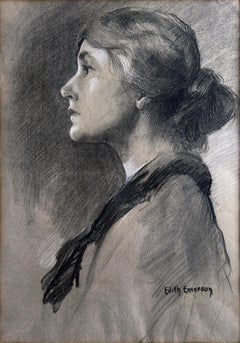
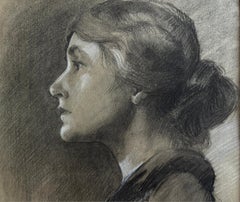
Charcoal Portrait of a Lady Profile  - Partner of Violet Oakley - Gay Interest

Charcoal Portrait of a Lady Profile - Partner of Violet Oakley - Gay Interest

Located in Miami, FL

Academic study in profile of a high bow sitter on gray paper with white highlights. Signed lower right and dated faintly 1916 Edith Emerson (July 27, 1888 – November 21, 1981) was a...

Category

1910s Academic Figurative Drawings and Watercolors

Materials

Paper, Charcoal

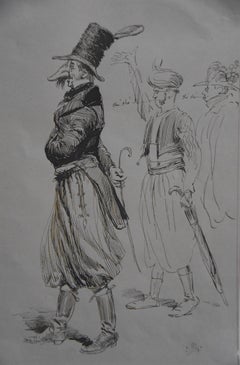
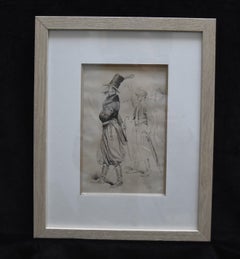
Edouard Detaille (1848 1912), A Carnival character, original signed Drawing

Edouard Detaille (1848 1912), A Carnival character, original signed Drawing

By Jean Baptiste Édouard Detaille

Located in Paris, FR

Edouard Detaille (1848-1912) A Carnival character and a Zouave 19.5 x 12.5 cm Pen and ink on paper Signed lower left with the initials (faded) In a modern framing : 35 x 28 cm T...

Category

1880s Academic Figurative Drawings and Watercolors

Materials

Ink

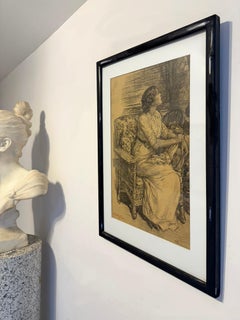
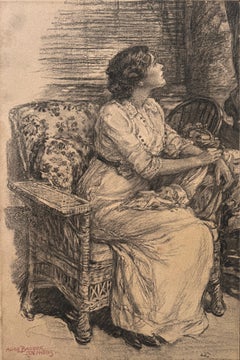
Attractive Young Woman Sitting in Chair and Looking Upwards in Domestic Setting

Attractive Young Woman Sitting in Chair and Looking Upwards in Domestic Setting

By Alice Barber Stephens

Located in Miami, FL

Female Illustrator of the Golden Age Alice Barber Stephens renders in an academic style and women sitting in a chair and responding to something outside of the frame. Signed lower left. Most likely done for a major newsstand magazine like Harper's, Century or Scribner's Monthly. Work is framed under glass in a simple black wood frame. Perhaps period. Matt is new. Frame size: 20.5 x 14.5 From: Wikipedia Alice Barber Stephens (July 1, 1858 – July 13, 1932) was an American painter and engraver, best remembered for her illustrations. Her work regularly appeared in magazines such as Scribner's Monthly, Harper's Weekly, and The Ladies Home Journal. Early life and education Alice Barber was born near Salem, New Jersey. She was the eighth of nine children born to Samuel Clayton Barber and Mary Owen, who were Quakers. She attended local schools until she and her family moved to Philadelphia, Pennsylvania. At age 15 she became a student at the Philadelphia School of Design for Women (now Moore College of Art & Design), where she studied wood engraving. The Women's Life Class (1879), Pennsylvania Academy of the Fine Arts, Philadelphia, Pennsylvania. She was admitted to the Pennsylvania Academy of the Fine Arts in 1876 (the first year women were admitted), studying under Thomas Eakins. Among her fellow students at the Academy were Susan MacDowell, Frank Stephens, David Wilson Jordan, Lavinia Ebbinghausen, Thomas Anshutz, and Charles H. Stephens (whom she would marry). During this time, at the academy, she began to work with a variety of media, including black-and-white oils, ink washes, charcoal, full-color oils, and watercolors. In 1879, Eakins chose Stephens to illustrate an Academy classroom scene for Scribner's Monthly. The resulting work, Women's Life Class, was Stephens' first illustration credit. New Woman As educational opportunities were made more available in the nineteenth century, women artists became part of professional enterprises, including founding their own art associations. Artwork made by women was considered to be inferior by the art world, and to help overcome that stereotype women became "increasingly vocal and confident" in promoting women's work, and thus became part of the emerging image of the educated, modern and freer "New Woman". Artists then, "played crucial roles in representing the New Woman, both by drawing images of the icon and exemplifying this emerging type through their own lives." Alice Barber Stephens, The Women Business, oil, 1897, Brandywine River Museum, Chadds Ford, Pennsylvania One example of overcoming women stereotypes was Stephens' Woman in Business from 1897, which showed how women could focus not only in the home, but also in the economic world.[8] As women began to work, their career choices broadened and illustration became a commendable occupation. People's ideas about education and art started to merge, and the outcome of a certain sensitivity to the arts began to be seen as uplifting and educational. By using illustration as a means to further their practices, women were able to fit the traditional gender role while still being active in their pursuits for the "New Woman". According to Rena Robey of Art Times, "The early feminists began to leave the home to participate in clubs as moral and cultural guardians, focused on cleaning up cities and helping African Americans, impoverished women, working children, immigrants, and other previously ignored groups." Stephens took advantage of the explosion of illustration opportunities, including the opportunity to work from home. Women's education Edwin Forrest House, formerly the home of the Philadelphia School of Design for Women. Throughout the period before the civil war, textile and other decorative work became acceptable occupations for those who aspired to be in the middle class. The Philadelphia School of Design for Women, founded in 1848 by Sarah Worthington Peter was first among a group of women's design schools established in the 1850s and 1860s; others appeared in Boston, New York, Pittsburgh, and Cincinnati. It began as a charitable effort to train needy and deserving young women in textile and wallpaper design, wood engraving, and other salable artistic skills, providing a means for training women who needed wage work. The Pennsylvania Academy of the Fine Arts (PAFA) was established in 1805 by painter and scientist Charles Willson Peale, sculptor William Rush...

Category

Early 1900s Academic Figurative Drawings and Watercolors
Materials

Charcoal, Board

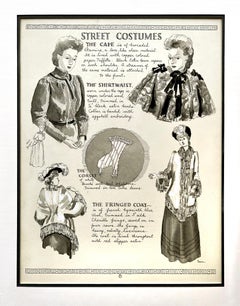
Street Costumes, Gay Nineties Fashion - Female Illustrator

Street Costumes, Gay Nineties Fashion - Female Illustrator

Located in Miami, FL

Street Costumes by Ruth Kreps. Signed lower right. Most likely for a book published in the 1930's about turn of the century women's fashion. "Costume Design of the Gay Nineties" T...

Category

1930s Academic Figurative Drawings and Watercolors
Materials

Ink, Watercolor, Board

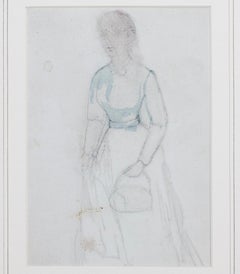
"Woman Carrying Purse, " Watercolor & Graphite on Paper by Hannah de Rothschild

"Woman Carrying Purse, " Watercolor & Graphite on Paper by Hannah de Rothschild

By Hannah de Rothschild

Located in Milwaukee, WI

"Woman Carrying Purse" is an original watercolor and graphite drawing by Hannah de Rothschild. This artwork features a woman with a handbag. She is wearing a blue dress, and her face...

Category

1860s Academic Figurative Drawings and Watercolors
Materials

Watercolor, Graphite

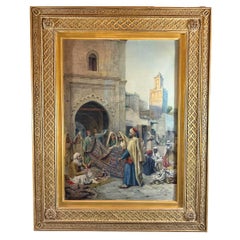
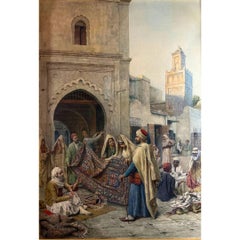
The Carpet Seller 19th Century Orientalist Antique Watercolor Painting on Paper

The Carpet Seller 19th Century Orientalist Antique Watercolor Painting on Paper

By Federico Bartolini

Located in Jacksonville, FL

Provenance John Welles Hollenback, New York The Painting is Signed FBartolini Lower Right Federico Bartolini (Italian, 1861 - 1908) Description: Federico Bartolini was a renowned ...

Category

19th Century Academic Figurative Drawings and Watercolors
Materials

Paper, Watercolor

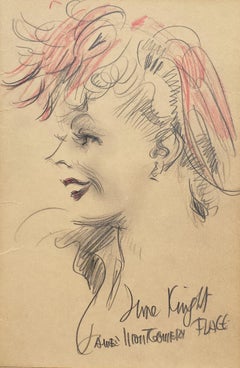
Actress June Knight

Actress June Knight

By James Montgomery Flagg

Located in Miami, FL

Celebrity portrait sketch of actress June Knight but James Montgomery Flagg on card stock in two colors. Signed and inscribed lower right. The work is unframed. There is a slight cr...

Category

1930s Academic Figurative Drawings and Watercolors
Materials

Crayon, Pencil

Academic figurative drawings and watercolors for sale on 1stDibs.

Find a wide variety of authentic Academic figurative drawings and watercolors available for sale on 1stDibs. Works in this style were very popular during the 20th Century, but contemporary artists have continued to produce works inspired by this movement. If you’re looking to add figurative drawings and watercolors created in this style to introduce contrast in an otherwise neutral space in your home, the works available on 1stDibs include elements of blue, purple and other colors. Frequently made by artists working with Archival Paper, and Archival Tape and other materials, all of these pieces for sale are unique and have attracted attention over the years. Not every interior allows for large Academic figurative drawings and watercolors, so small editions measuring 2.56 inches across are also available. Prices for figurative drawings and watercolors made by famous or emerging artists can differ depending on medium, time period and other attributes. On 1stDibs, the price for these items starts at $11 and tops out at $288,500, while the average work sells for $747.