Located in Wilton Manors, FL
Boleslaw Cybis (1895-1957).
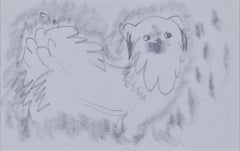
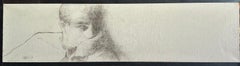
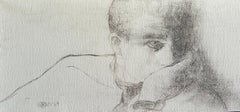
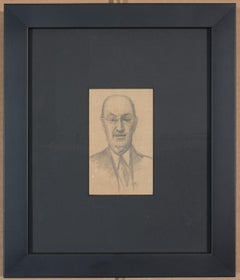
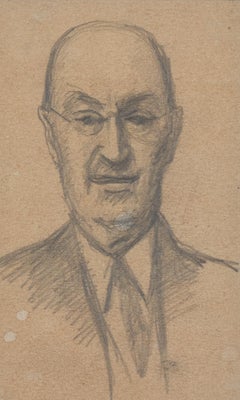
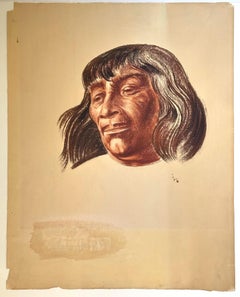
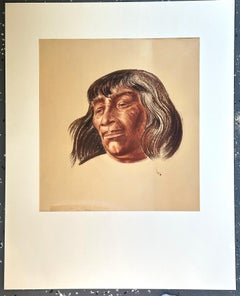
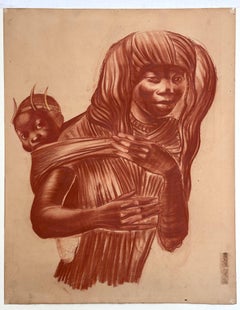
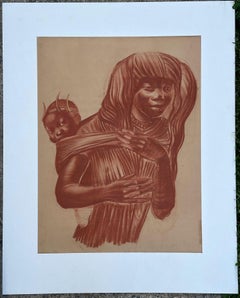
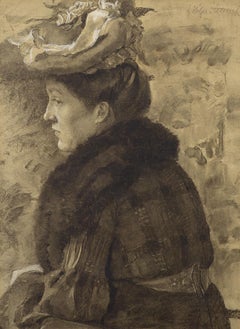
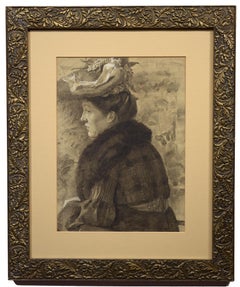
Yuma (Vanished Dreams), Indian Negro Series, image #7 of 18 unique image that comprise the drawing series.
Conte on paper, sheet measures 18 x 23 inches.
Unsigned.
Staining lower left is a consequence of removal of writing prior to lithographic photography process.
Small hole on paper, lower region, patched with white tape.
The sheet is hinged at top margin, not glued down to backing board.
The sheet has an 9 notation on back signifying that it is the 9th and final image selected for the lithographic series.
Provenance: Cybis Archive.
This very unusual portrait is titled Apache ‘Image Makers’ and depicts the ritual Devil Dancer or Spirit Dancer headdress and fully-swathed face. In Apache culture and legend, the Devil Dancer is a somewhat mischievous although benevolent spirit.
This original drawing was created in 1939-40 during an extensive visit to the Southwest US. The artist created 18 portraits and titled the series "Indian Negro Serie".
Of the 18 images, only 9 were selected to be included in a limited edition lithographic series some 30 years after creation. 1000 editions were printed. This is the original drawing upon which one of the images is based, and is thus unique.
Of the 18 original drawings, 2 are owned by the polish government, 5 are in our collection and the other 11 are whereabouts unknown.
The artist and his wife opened a porcelain factory in the 1950's, Cybis Studios.
The only non-porcelain retail offering from the Cybis studio was a 1970s art issue called the Folio One. This was a limited edition reproduction series taken from nine conté drawings of Native Americans made by Boleslaw Cybis in 1939. Conté is the name of a type of crayon made of compressed charcoal or graphite mixed with wax or clay. The artist Georges Seurat was particularly fond of using conté for his drawings.
Boleslaw Cybis was fascinated by the Native American (then typically referred to as American Indian) culture and peoples. This may seem odd when you consider that much of his ceramic-based works were distinctly Rococo and/or Old World European in style….a pretty stark contrast, I’d say! But Cybis was nothing if not eclectic in his tastes.
The originals were reproduced as color lithographs, in an edition of 1000, in 1970. This meant “1000 of each individual print.” At present its original issue pricing is unknown, but a Spring 1972 dealer price list shows the full set of nine at $500. Individual prints could also be purchased at either $50 (for Comanche, Shoshone, or Apache) or $65 (for any of the other six)… representing a $40 savings when buying the entire folio at once versus singly. The Spring 1981 price list is the final one that shows the Folio One set for sale, still at the same price ($500) as it was a decade earlier. Individual prints are not available on that list.
According to the 1979 Cybis catalog text “Each of the 12″ x 20″ prints is hand-numbered on heavy Beckett rag-content paper, with a specially designed validating hallmark in the lower right-hand corner, and carries an accompanying page with a brief tribal history.” The hallmark is blind-embossed, not surface printed.
However, the Spring 1972 dealer price list cited above described the prints as being 17″ x 23″ in size. Checking past auction listings for the set, the actual prints are indeed 17″ x 23″, which means that the 12″ x 20″ size probably refers to the image area. The overall size of the set’s burlap-covered box is 18.5″ x 24.5″.
These nine portraits represent seven different tribes: the Comanche, Shoshone, Taos, Apache, Hopi, Mohave, and Yuma. A bit of trivia is that only two of those tribes (Apache and Shoshone) were featured within the modern studio’s North American Indians porcelain...
Category
1930s Realist Drawings and Watercolor Paintings