Gabriel Argy-Rousseau (1885-1953)
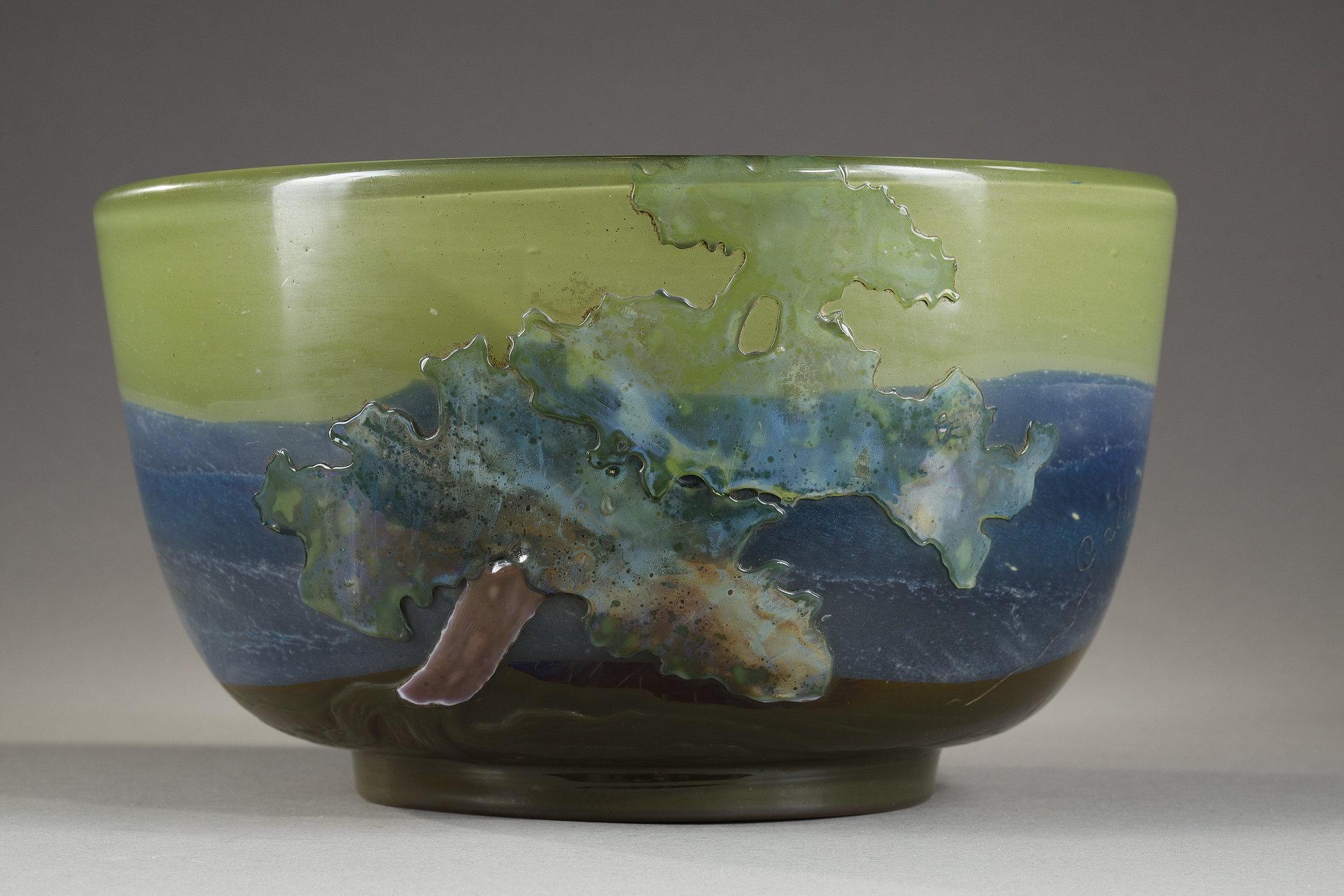
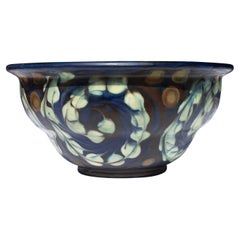
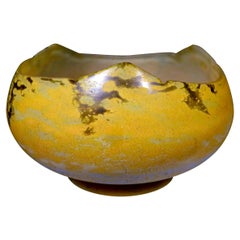
Gourds Bowl c. 1922
Glass
Signed
3.75 x 4.5 inches
This G. Argy-Rousseau bowl has a very distinct arts and crafts feel to it. The level collar of design shows a yellow squash with purple leaves set against a green background. The overall vase color has a hint of purple, which is very typical of many G. Argy-Rousseau pieces. This bowl was first designed and sold in 1922.
"The name Gabriel Argy-Rousseau (1885-1953) appeared for the first time in 1914 at the Exposition des Artistes Française in Paris. Critics and the public alike responded enthusiastically to his debut and recognized the artist’s originality, the idiosyncrasies of his work, and his extraordinary talent at working the little known and little practiced material of pâte de verre (glass paste). Argy-Rousseau himself recognized that "the process of creating ‘pâte de verre’ is certainly the most artistic and the most personal of all the methods of working in glass and crystal because it allows the artist to easily convey all his thoughts.”
But exactly who was this unknown artist who suddenly stepped forward 10 years after the death of Emile Gallé and during a period in which modern art had not yet made its mark on the applied arts, which were still dominated by the Art Nouveau style? Gabriel Argy-Rousseau, whose real name is Joseph Gabriel Rousseau, was born in 1885 under very modest circumstances. He entered the Ecole Nationale de Sèvres in 1902 and it was his training during this formative period that would influence and shape his career as an artist. This included, above all, his introduction to pâte de verre thanks to Jean Cros, his classmate and the son of Henri Cros, the artist who essentially rediscovered pâte de verre at the end of the 19th century.
Argy-Rousseau left the school four years later with a diploma in ceramic engineering. He subsequently set up his own studio and began to show his first works in 1914 under the pseudonym Gabriel Argy-Rousseau, having married the sister of his friend Plato Argyriades. In 1923, he partnered with a major Paris gallery to found the company 'Les Pâte de Verre d’Argy-Rousseau’. Within fifteen years, he created some 300 models that included vases, lamps, lanterns, and bowls, a number of which can be considered masterpieces. The 1929 economic crisis, however, significantly slowed his production and the company was ultimately dissolved in 1931.
Argy-Rousseau derived much of his inspiration from nature’s more humble specimen, especially from flowers and insects, for example for the 'Violette de Parme’ or the 'Fleurs de Chardons’ as well as the 'Roses’, the 'Chrysanthèmes’ and the 'Papyrus’ pieces. The progression of his style presents itself in these designs: while flexible at first and still under the influence of Art Nouveau, his designs quickly became more rigid as flowers or insects are shown pressed against glass or pinned in a box.
Having already studied Greek art at Sèvres, and always having been exposed to it in his family, Argy-Rousseau considered the Greek style his true passion and a permanent influence in his work throughout his career. The well-known vase 'Le Jardin des Hespèrides’ is the best example as it resembles the Attic vases of the VI. century BC with the hieratic pose of the dancing figures. It is as if their movements are suspended in midair with nature itself suggested by branches and the bucolic landscape. In the same spirit, the vases 'La Danse’ and 'Libations', although dated around the same time, offer a different interpretation of the same subject, as does 'Tragi-Comique’ with its grimacing masks of tragedy. One of the most remarkable works of Greek inspiration, however, is the vase 'A la Chevelure’, so moving in the figure’s contemplative attitude and intensity of expression.
Despite the economic crisis of 1929, Argy-Rousseau continued to produce beautiful works including 'Jeunesse’ and 'Farniente’, two works that exemplify the characteristics of the Art Deco style. But how far would Argy-Rousseau’s creative inspiration have gone without the technical resources at his disposal? Argy-Rousseau was not only a designer of models but he was also an inventor of a technique that was personal to him starting from piecework molds, the coloration achieved in the mass and on the surface after firing. In fact, Argy-Rousseau designed everything himself down to the colorful mixtures of oxides. These choices not only reflect his extraordinary sense of color and in their respective harmonies and densities were very personal to him. He had a particular fondness for fiery reds, and yet, depending on his moods, he often incorporated softer pastel shades. His talent as a colorist makes it possible to recognize his work at first glance.
Light is also essential in enhancing Argy-Rousseau’s work and in bringing it to life. Through the subtle play of light, he was able to create a sort of magical and luminescent quality in his work whereby nothing is left to chance. The vase 'Feuillage Moderne’ is a fine examples of this. The collection reflects the ability of an artist to express his emotions and poetical intentions while sharing these sentiments with the viewer. It also allows us to track the progression of the artist’s style, which lies in harmony with his time. But perhaps above all, this collection shows us the sensitivity of a man and his creative inventiveness that spans from naturalism to abstraction, reflecting its modernity.
Argy-Rousseau stands as the great master of pâte de verre who brought together the expertise of the hand and the creative vision of the mind."
Janine Bloch-Dermant Author of Argy-Rousseau: Glassware as Art, London, 1991.
Gabriel Argy-Rousseau is produced wonderful works of pate de verre art glass from about 1914 until 1937. Somewhere between 200 and 300 different designs have been recorded by researchers. Scholars believe that between 15,000 and 20,000 total pieces of art glass were produced by G. Argy-Rousseau. That is a relatively small production and it has made some pieces of his work very rare today. Please do not make the assumption that Argy-Rousseau was just a studio glass maker. He was the main creative force behind the glass, but it was in fact a large production. There were at times as many as 20 employees. G. Argy-Rousseau glass was sold all over Europe, in The United States, Latin America, and even in North Africa. It is partly because of this extensive original sales network that his glass can be found all over the world today.
The importance of Argy-Rousseau was two-fold. First, it was completely unlike anything glass makers were producing at the time. And secondly, while others started trying the same styles, no one else was ever really able to make anything consistently more appealing or better. So not only was Argy-Rousseau the first, he was also the best. That is a feat that is rarely accomplished in the arts.