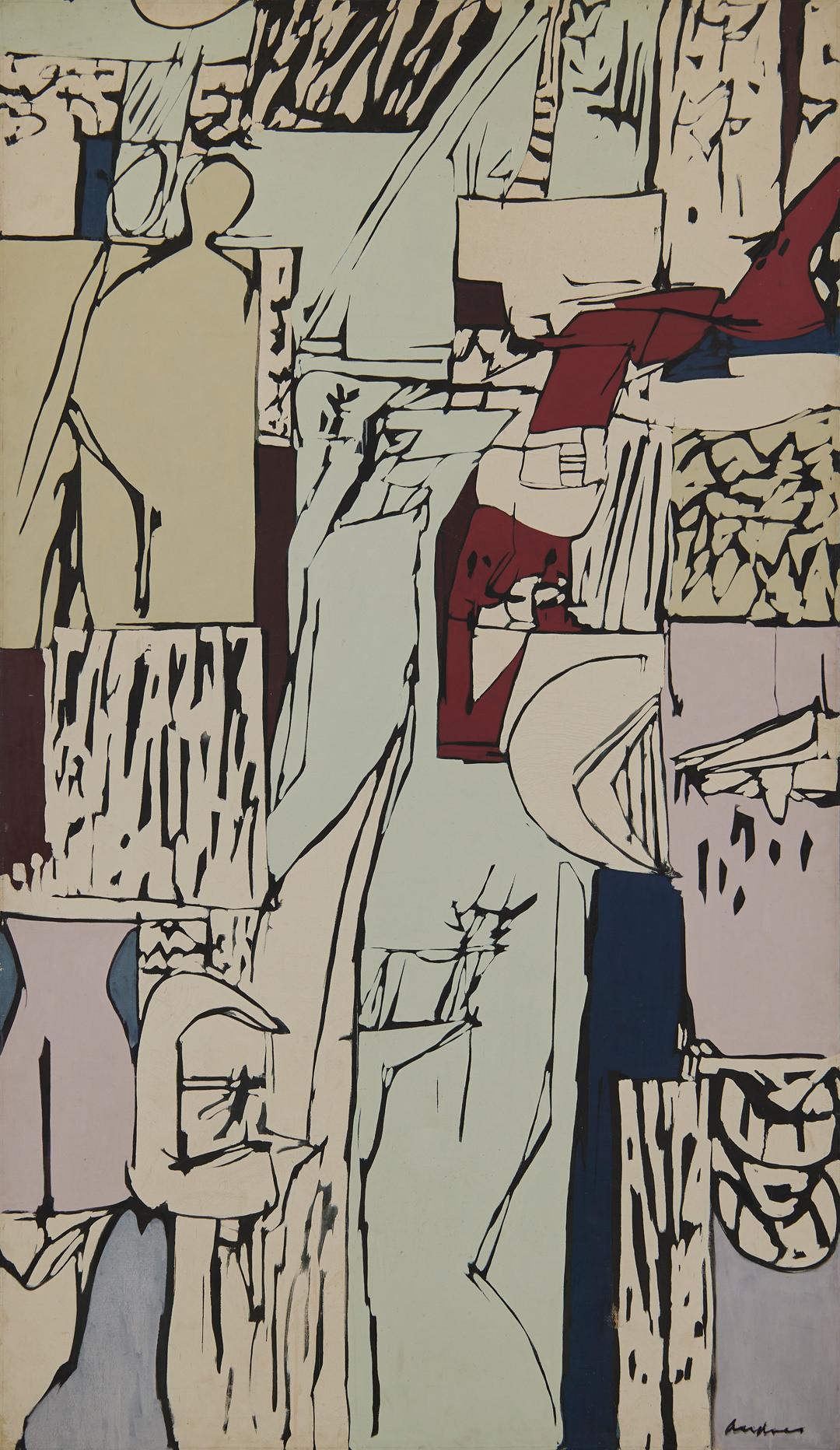
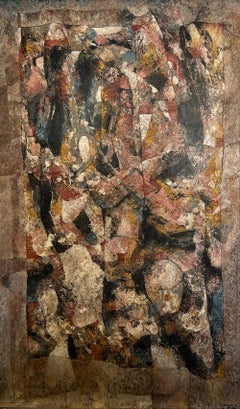
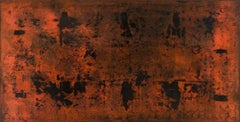
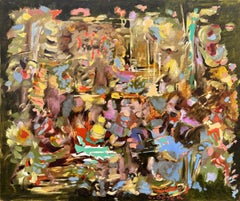
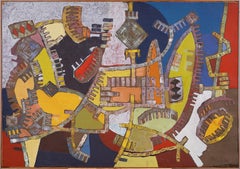
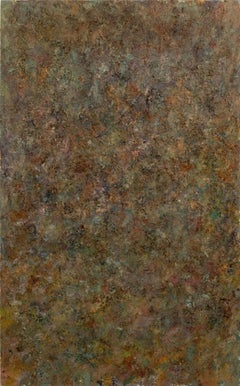
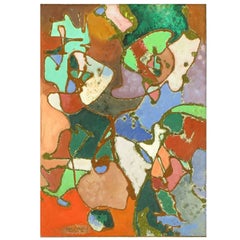
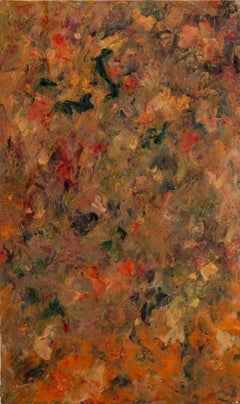
This powerful 1970s painting by William C. Grauer is executed in acrylic on panel at an impressive scale of 48 by 36 inches. The work immediately draws the viewer in with a glowing field of magenta, crimson and rust, punctuated by deep passages of umber, violet and electric blue. Grauer uses acrylic with exceptional physicality, building the paint into a richly encrusted surface that suggests fresco, carved stone and mineral deposits all at once. The panel reads less like a conventional painting and more like a fragment cut from an ancient wall.
At first encounter, the work appears to be a confident abstract composition, a mosaic of fractured color and texture. With longer looking, the painting begins to reveal what gives it such lasting fascination. Within the network of blocks and shards are subtle hints of figuration. Curved, flesh-toned areas in the central zone can be read as intertwined or reclining bodies. Smaller rounded forms in the lower register cluster like a compressed procession or crowd. Along the edges, tall, tapering shapes echo robed or sentinel-like figures that seem to guard a central ritual space. These suggestions never resolve into a single, fixed image. Instead, they hover on the threshold between recognition and ambiguity, inviting the viewer to discover and rediscover new readings over time.
This interplay of abstraction and implied imagery is at the heart of this work. The painting does not depict a specific historical site, yet it unmistakably evokes the feeling of an archaeological wall, where remnants of ancient frescoes and reliefs survive in fragments. Grauer’s layered surface suggests centuries of weathering, excavation and repair. The work feels as if it has been unearthed rather than painted, and this illusion of age and depth lends it a strong sense of narrative and mystery. Viewers often respond to the piece as though they are standing in front of a ruin, piecing together a lost ritual or myth from scattered visual clues.
Created in the 1970s, the painting reflects a key period when many modern artists were exploring hybrid languages that combined abstract painting with references to archaeology, myth and the human figure. Grauer’s approach is entirely in that spirit. He harnesses the speed and versatility of acrylic to achieve a dense, luminous surface associated with fresco and stone, while still maintaining the spontaneity of gestural abstraction. The warm, saturated palette and intricate web of marks create a volcanic energy, yet the vertical format and column-like divisions give the work the presence of a monumental wall or altarpiece.
In a contemporary interior, Untitled (Abstract Archaeological Fresco) functions as a compelling focal point. Against neutral architectural finishes and restrained furnishings, the painting introduces color, texture and a sense of historical depth. It acts almost like a window into another time and place, enriching the space with layered associations of archaeology, ritual, memory and the human figure. For collectors who appreciate both abstract expression and subtle figuration, this work offers a rare combination: a visually dramatic statement piece that continues to yield new discoveries with each viewing and remains a sophisticated conversation starter in any setting.
Signed lower right.
Framed Dimensions: 51 x 39 inches
PROVENANCE: The Artist, Cleveland, Ohio;
Acquired from the above over a 50 year period by a relative of the artist, Rancho Santa Fe, California.