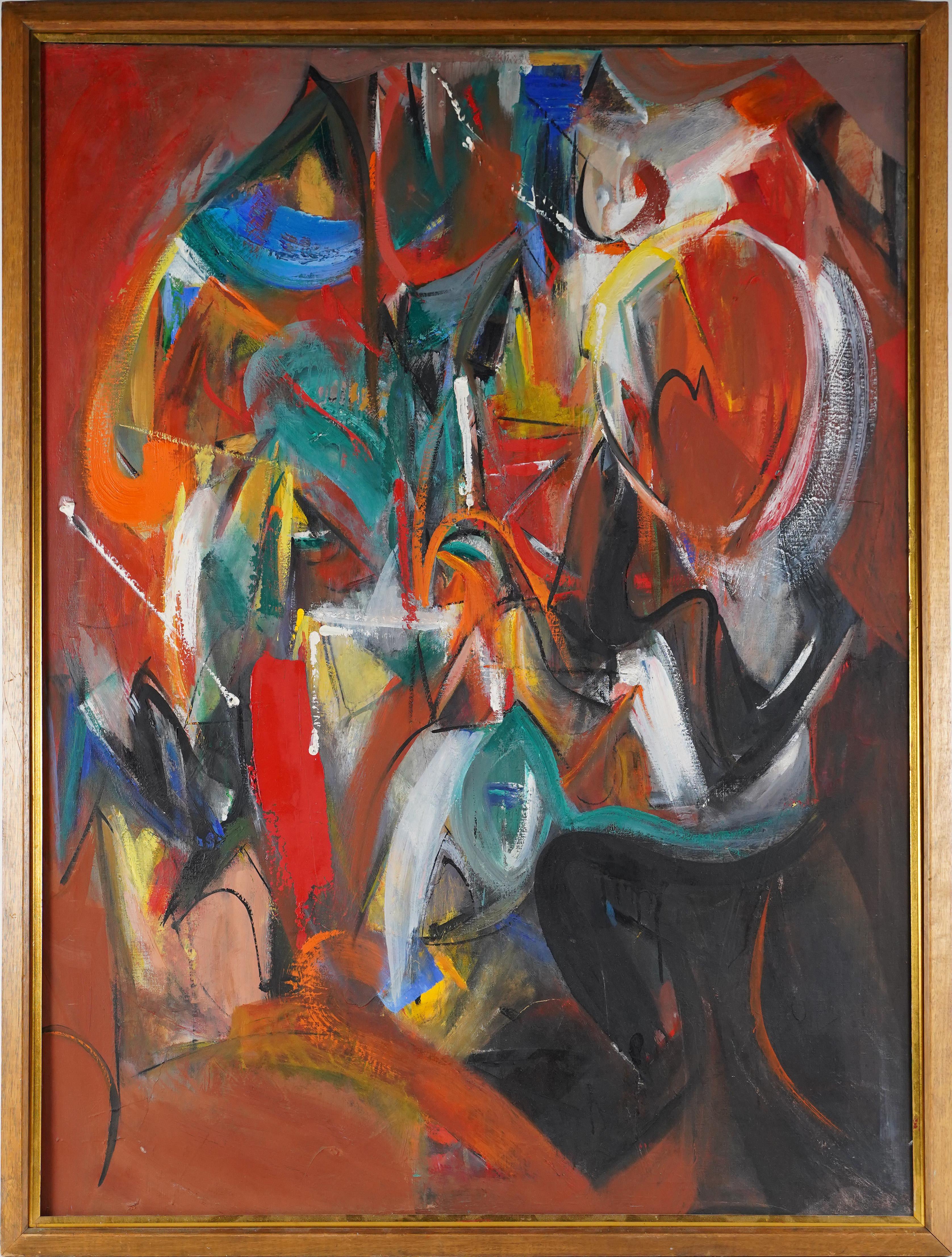
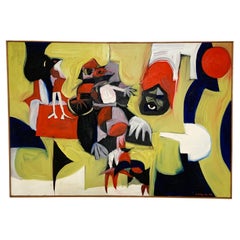
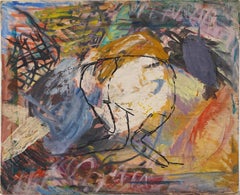
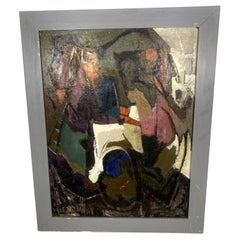
William C. Grauer’s oil painting, Amish Series: Husbandry, is a vivid example of mid century Cleveland School modernism. It merges regional subject matter with a sophisticated, Cubist influenced visual language. Painted in the late 1940s or early 1950s, the work reflects both the broader currents of American modern art and Grauer’s commitment to depicting the life and labor of the Midwest.
At first glance, the composition appears as a whirl of intersecting planes and faceted color. Figures, livestock, and landscape are fractured into overlapping geometric shapes that create a sense of rhythmic movement across the surface. At the center, an Amish farmer cradling a rooster emerges from the angular forms that surround him. Around him, cows, pigs, and other animals are partially abstracted yet still recognizable, their bodies broken into shards of ochre, rust, white, and black. These animals are not treated with sentimental realism; instead, they function as structural elements within a complex design that echoes the arcs and diagonals unifying the composition.
Despite its abstraction, the painting remains grounded in narrative. The title “Husbandry” evokes the traditional Amish relationship to the land, one that is close, cyclical, and labor intensive. Grauer suggests this through his tight clustering of animals and farmer, compressing them into a single, almost circular arena of activity. The densely packed forms convey the interdependence of people, animals, and environment. Architecture and farmland are suggested at the edges through tilted roofs, fence lines, and distant arches. These background elements reinforce the rural setting without drawing attention away from the central focus on agricultural care and responsibility.
Color plays a central role in establishing the painting’s mood. Grauer’s palette is dominated by warm earth tones such as reds, browns, and ochres, interrupted by passages of cool green and muted blue. These colors recall soil, wood, and pasture, but they are also carefully modulated to guide the viewer’s eye. Areas of high contrast, such as the white patches on the cattle or the lighter tones around the farmer’s torso, act as visual anchors within the swirling geometry. The result is a dynamic yet harmonious scene that feels busy and alive while remaining formally controlled.
As a Cleveland School artist, Grauer worked within a community that valued experimentation while staying closely connected to regional life. Amish Series: Husbandry epitomizes that balance. It is not a straightforward genre scene; instead, it offers a modernist reimagining of one. Grauer transforms a familiar rural subject into a sophisticated exploration of form, rhythm, and space. In doing so, he bridges European derived modernism with distinctly American content and preserves the dignity of Amish agricultural life even as he abstracts it into a vibrant, almost musical composition.
Signed lower right.
Framed Dimensions: 32 x 37 inches
PROVENANCE: The Artist, Cleveland, Ohio;
Acquired from the above over a 50 year period by a relative of the artist, Rancho Santa Fe, California.