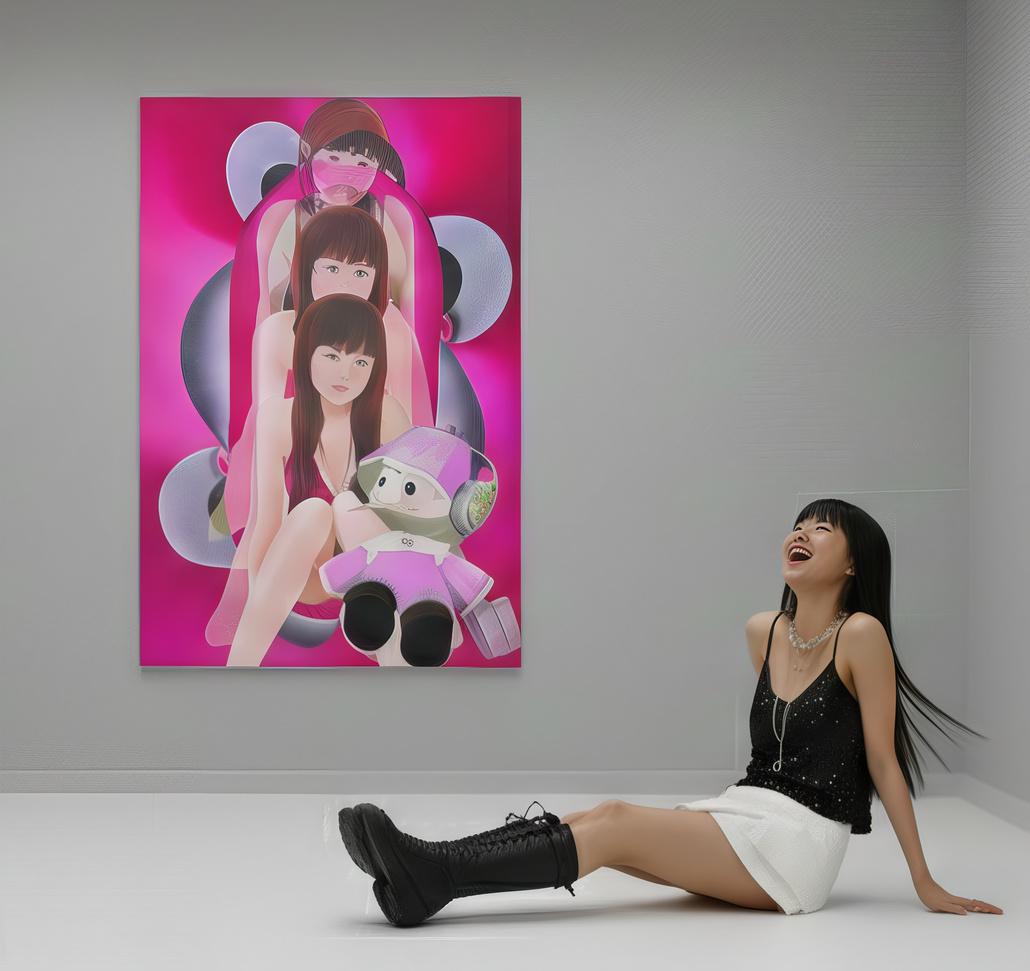
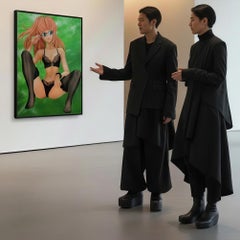
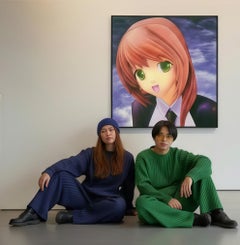
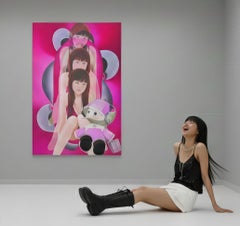
Kanako1: Crimson Temptation in Kawaii Elegance is a work by Japanese Neo-Pop artist Aya Toshikawa, created as part of her signature Sensual Kawaii: Doll Temptation Series.
This painting stands apart within the series through its frontal, almost hieratic treatment of the manga figure, conceived as an icon rather than a narrative moment.
The doll is neither in motion nor engaged in action.
She is presented as a fixed presence, recalling the logic of idealized images, posters, and visual archetypes deeply rooted in Japanese pop culture.
The deep crimson background does not function as a setting but as a symbolic, uniform field.
This monochrome surface isolates the figure, reinforcing clarity, memorability, and a sense of suspended time.
Unlike works driven by movement, playfulness, or emotional fluctuation, Kanako1 relies on stillness and repetition.
Here, sensuality emerges through permanence—through the ability of the image to remain, to imprint itself in the viewer’s memory.
The manga doll becomes a visual sign:
a constructed image designed to be recognized, retained, and desired over time, echoing the aesthetics of idols and pop icons.
Through this work, Toshikawa explores a stabilized form of contemporary femininity—controlled, polished, and almost timeless—shaped by kawaii culture and visual standardization.
The seductive power of Kanako1 lies not in gesture, but in endurance.
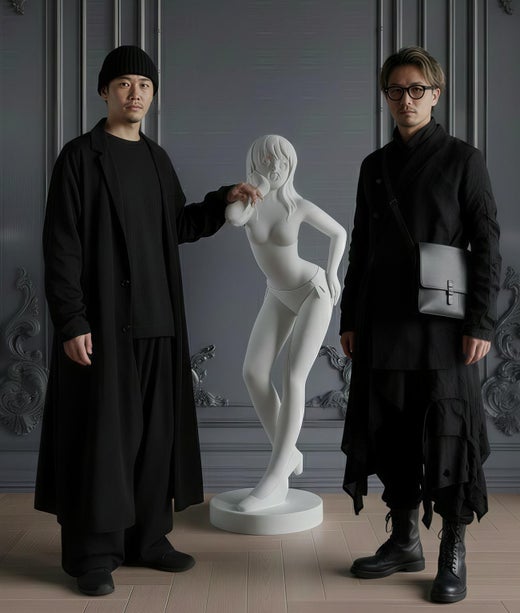
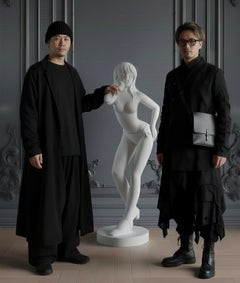
A major member of the Japanese art collective CrazyNoodles, founded by Nippon Neo-Pop icon Hiro Ando, Aya Toshikawa here engages with a more iconographic dimension of Neo-Pop.
With its formal restraint, chromatic intensity, and strong mnemonic presence, Kanako1: Crimson Temptation in Kawaii Elegance occupies a singular position within the series.
A highly collectible work for collectors drawn to contemporary Japanese art, Neo-Pop, and powerful, enduring pop images.
LITERATURE ABOUT THE SERIE “Sensual Kawaii : Doll Temptation Series”
In Sensual Kawaii: Doll Temptation Series, Japanese artist Aya Toshikawa constructs a visually seductive yet conceptually complex universe that reflects the underlying tensions of contemporary Japanese society. Through manga-inspired female dolls set against highly saturated backdrops—floral motifs, kawaii patterns, or vividly colored skies drawn from the realm of virtual fantasy—Toshikawa creates a space where innocence becomes a surface, and desire a carefully coded structure.
The manga doll, central to the series, is neither portrait nor character. It functions instead as a symbolic object, rooted in otaku culture, idol imagery, and Japan’s long tradition of figurines and idealized representations. Devoid of personal narrative, the doll embodies a manufactured femininity—standardized, polished, and designed to be viewed rather than lived. Oversized eyes, flawless skin, and controlled poses transform the figure into an emotional avatar shaped by collective fantasy and social projection.
The backgrounds play an equally crucial role. Toshikawa’s luminous skies, exaggerated floral fields, and hyper-kawaii environments do not depict nature as reality, but as simulation. These spaces resemble digital screens rather than landscapes—flat, immersive, and timeless. They evoke the psychological territories of social media, gaming, and virtual identities, where escape and self-construction merge into a continuous visual flow.
From a sociological perspective, the series can be read as a reflection on the pressures placed upon young Japanese women, whose identities are often negotiated between purity, desirability, and conformity. Toshikawa does not openly condemn these structures; instead, she exposes them through aesthetic allure. Her figures are neither victims nor provocateurs, but inhabitants of an in-between state—simultaneously empowered and constrained by rigid visual codes.
Aya Toshikawa’s artistic psychology reveals itself in this deliberate ambiguity. Rather than seeking shock or overt critique, she employs seduction as a visual language, fully aware of its power and fragility. The works attract before they unsettle, inviting viewers into a gentle discomfort where beauty and control quietly coexist.
As a major member of the Japanese art collective CrazyNoodles, founded by Nippon Neo-Pop icon Hiro Ando, Toshikawa contributes a distinctly introspective and psychological dimension to the movement. While firmly anchored in Neo-Pop aesthetics, her work extends beyond surface pleasure into emotional and cultural reflection.
Sensual Kawaii: Doll Temptation Series ultimately unfolds as a contemporary mythology—a gallery of silent icons whose glossy perfection conceals the emotional complexity beneath. Through these alluring yet unsettling figures, Toshikawa reveals what kawaii culture often masks: the fragile balance between fantasy, identity, and desire in a hyper-visual age.