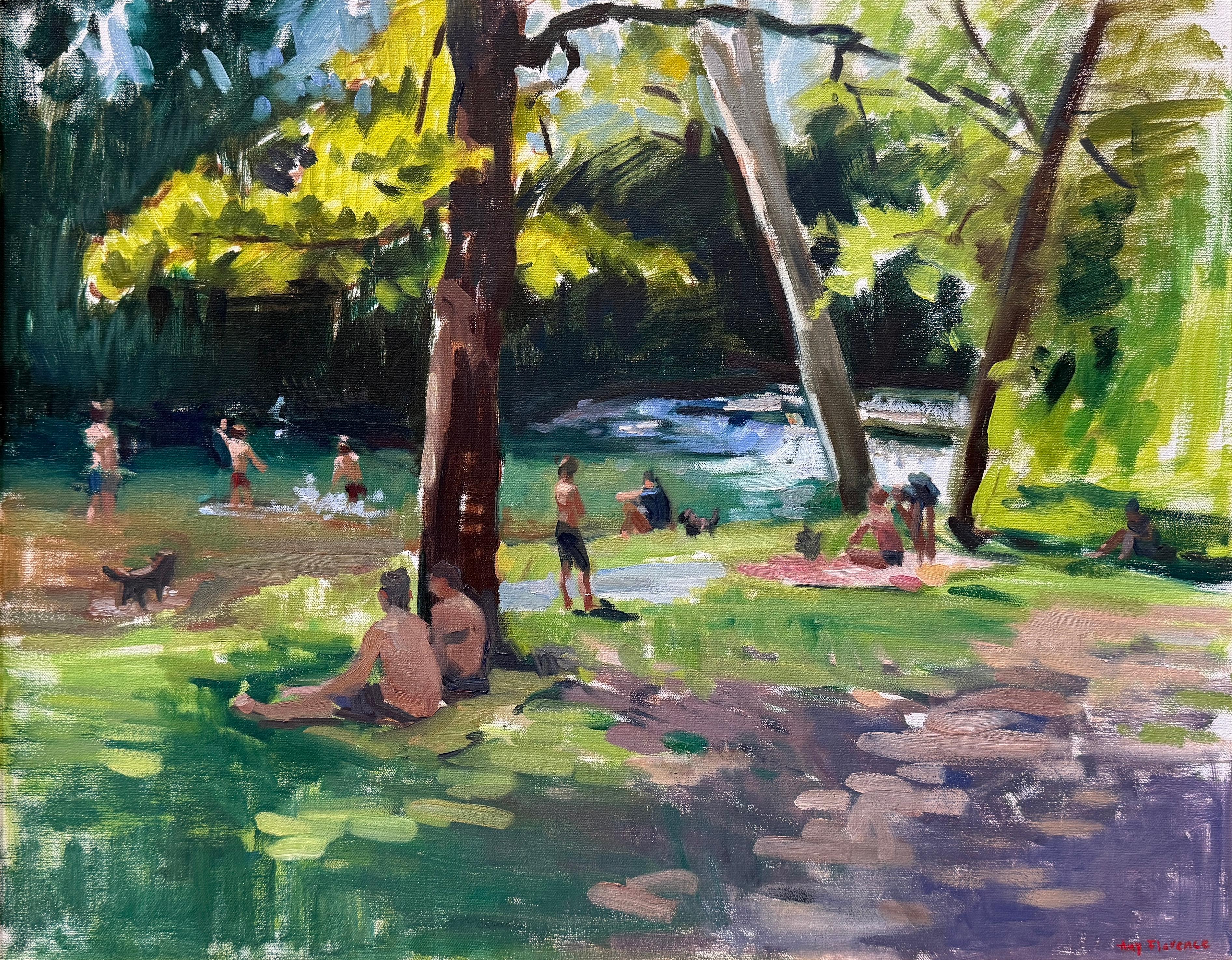
Scandinavian Female Nude Bathers at the Pond, Oil on Canvas, 1965
By Florence Pasternak
Located in Douglas Manor, NY
3804 Fantasy oil painting nude bathers
Category
1950s Nude Paintings
Materials
Oil
Scandinavian Female Nude Bathers at the Pond, Oil on Canvas, 1965
By Florence Pasternak
Located in Douglas Manor, NY
3804 Fantasy oil painting nude bathers
Oil
The Three Graces Farm Girls Painting, Oil Wash on Board, Vintage
By Ricci
Located in Douglas Manor, NY
3895 Three farm girls oil wash on board in a gilt frame
Oil
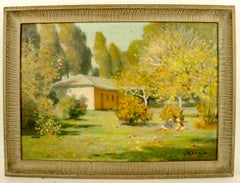
Antique Impressionistic Landscape Oil Painting with Children Circa 1940's
Located in Douglas Manor, NY
#5-3065 Impressionist Landscape, a 1940's Autumnal scene , oil on canvas displayed in a wood frame.Illegible signature lower right.Image size 13.5 H x 19 w
Oil
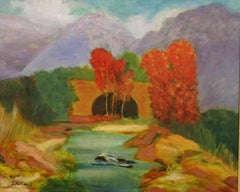
Stream Flowing Under The Bridge Fall Landscape Framed Oil Painting 1950
Located in Douglas Manor, NY
3898 Impressionist oil on canvas set in a hand carved gilt wood frame
Oil
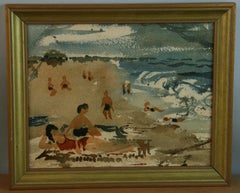
Modern Figural Beach Scene, Gouache on Artist Board, 1980s, Framed
Located in Douglas Manor, NY
4061 Modern beach scene on artist board Image size 7.75x9.5"
Gouache
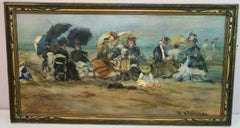
Antique Oil Painting Parisians having a Family Picnic on the Beach
Located in Douglas Manor, NY
6072 Victorian famaily beach outing signed Period frame Image size 13.5x27.5"
Oil
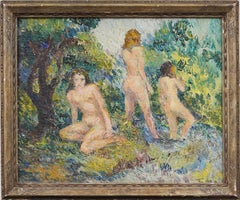
Nicely Framed Antique American Nude Bathers Forest Stream Landscape Oil Painting
Located in Buffalo, NY
Antique American impressionist nude landscape oil painting. Oil on canvas. Framed. Signed. In excellent original condition. Handsomely framed in a silver carved molding. Excelle...
Oil, Board
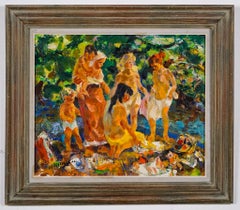
Bathers
By John Edward Costigan
Located in Sheffield, MA
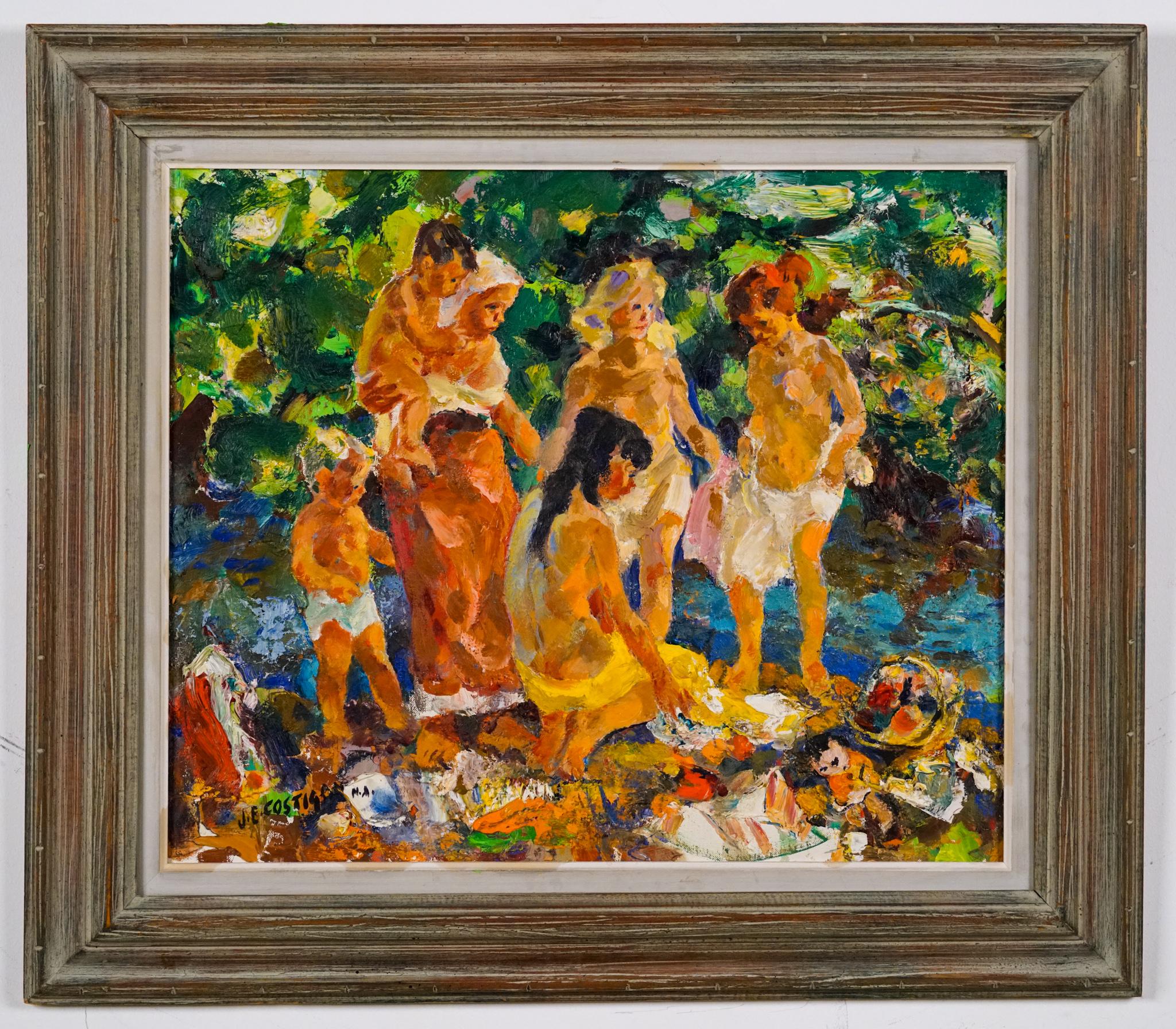
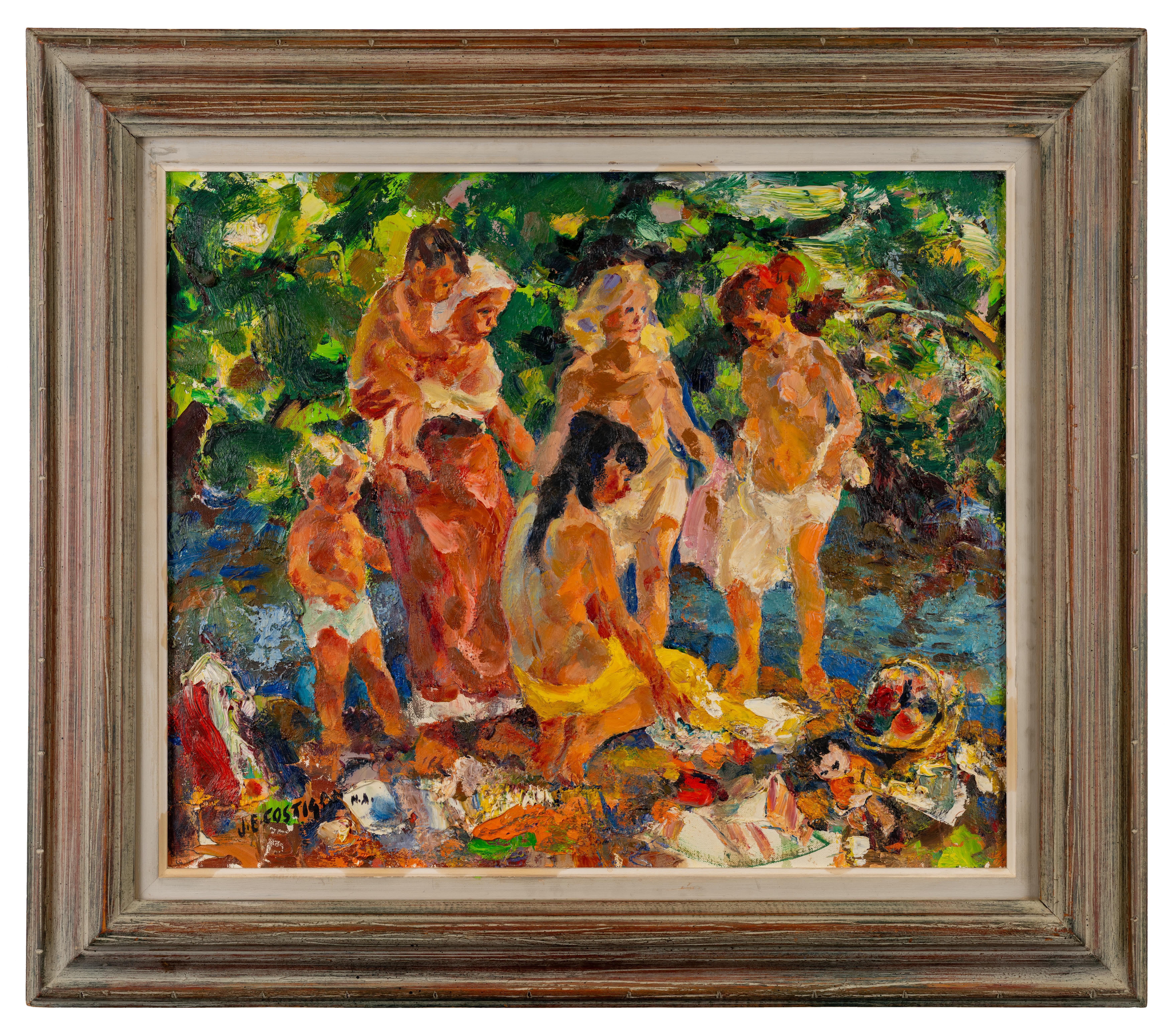
John Edward Costigan, N.A. American, 1888-1972 Bathers Oil on canvas Signed ‘J.E. Costigan N.A.’ lower left 20 by 24 in. W/frame 26 by 30 in. John Costigan was born of Irish-American parents in Providence, Rhode Island, February 29, 1888. He was a cousin of the noted American showman, George M. Cohan, whose parents brought the young Costigan to New York City and was instrumental in starting him on a career in the visual arts. They were less successful in encouraging him to pursue formal studies at the Art Students League (where, however, he later taught) than in exposing him to the commercial art world through the job they had gotten him with the New York lithographing firm that made their theatrical posters. At the H. C. Miner Lithographing Company, Costigan worked his way up from his entry job as a pressroom helper, through various apprenticeships, to the position of sketch artist. In the latter capacity he was an uncredited designer of posters for the Ziegfeld Follies and for numerous silent films. Meanwhile, he had supplemented his very meager formal studies in the fine arts with a self-teaching discipline that led to his first professional recognition in 1920 with the receipt of prizes for an oil painting and watercolor in separate New York exhibitions. A year earlier, Costigan had wed professional model Ida Blessin, with whom he established residence and began raising a family in the sleepy little rural New York hamlet of Orangeburg, the setting for the many idyllic farm landscapes and wood interiors with which he was to become identified in a career that would span half a century. John Costigan’s first national recognition came in 1922 with his winning of the coveted Peterson Purchase prize of the Art Institute of Chicago for an oil on canvas, “Sheep at the Brook.” It marked the start of an unbroken winning streak that would gain him at least one important prize per year for the remainder of the decade. The nation’s art journalists and critics began to take notice, making him the recurring subject of newspaper features and magazine articles. The eminent author and critic Edgar Holger Cahill was just a fledgling reporter when he wrote his first feature, “John Costigan Carries the Flame,” for Shadowland Magazine in 1922. Costigan had his first one-man show of paintings at the Rehn Gallery on New York’s 5th Avenue in November, 1924, to be followed less than three years later by another at the Art Institute of Chicago. In addition, Costigan’s work has been—and continues to be included, side-by-side with that of some of America’s most high-profile artists, in museum and gallery exhibitions throughout the country. His renown had peaked in the early 1930s, by which time his work had been honored with nearly every major award then being bestowed in the fine arts and had been acquired for the permanent collections of several prestigious American museums, including New York’s Metropolitan (which only recently, in 1997, deaccessioned his “Wood Interior,” acquired in 1934). Although Costigan’s celebrity had ebbed by the late 1930s, the Smithsonian Institution saw fit in 1937 to host an exhibition exclusively of his etchings. And, in 1941, the Corcoran Gallery (also Washington, D.C.) similarly honored him for his watercolors. (Another Washington institution, the Library of Congress, today includes 22 Costigan etchings and lithographs in its permanent print collection.) During World War II, Costigan returned briefly to illustrating, mainly for Bluebook, a men’s pulp adventure magazine. A gradual revival of interest in his more serious work began at the end of the war, culminating in 1968 with the mounting of a 50-year Costigan retrospective at the Paine Art Center and Arboretum in Oshkosh, Wisconsin. Oils, watercolors and prints were borrowed from museums and private collections throughout the country, and the exhibition was subsequently toured nationally by the Smithsonian Institution. John Costigan died of pneumonia in Nyack, NY, August 5, 1972, just months after receiving his final prestigious award —the Benjamin West Clinedinst Medal of the Artist’s Fellowship, Inc., presented in general recognition of his “...achievement of exceptional artistic merit...” in the various media he had mastered in the course of his career. This painting depicts one of the artist's favorite themes --the farm family bathing...
Oil
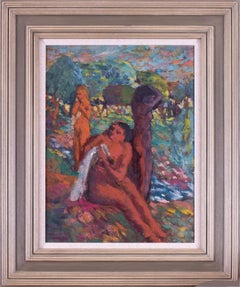
American oil painting 'Bathers II' by Frederick Little Packer
Located in Petworth, West Sussex
Frederick Little Packer (American, 1886–1956) Bathers II Oil on board Signed and inscribed with title (on a label, on the reverse) 19 ¾ x 15 in. (50.2 x 38.3 cm) Radiant and rhythmic...
Oil, Board
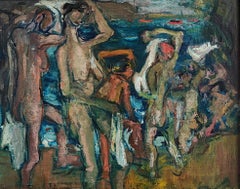
Vibrant Bathers Scene, Expressionist Oil on Canvas, Early 20th Century
Located in Genève, GE
Work on canvas Dimension with frame : 46 x 54.5 x 3.3 cm Vibrant Bathers Scene This expressionist painting captures a lively scene of nude figures gathered near the water, portrayed ...
Oil, Canvas
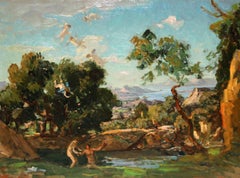
Bathers Oil Painting on Board, Framed, Circa 1940s
Located in Sant Celoni, ES
Firmado en la parte inferior por el autor Estado de conservación aceptable Se presenta enmarcada la obra Medidas de la obra: 50 x 65 cm. Medidas del marco: 59 x 73 cm. :::::::::...
Oil
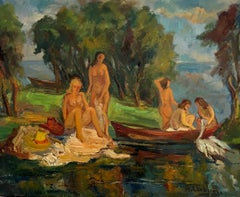
The Bathers and the Swan, Oil on Canvas, Mid-20th Century, Framed
By Harry Urban
Located in Genève, GE
Work on canvas Beige wooden frame 63 x 72.5 x 5.5 cm
Oil