Want more images or videos?
Request additional images or videos from the seller
1 of 14

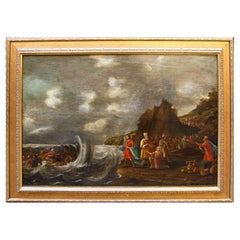
The Crossing of the Red Sea, 17th Century Flemish, Oil on Panel, Frans Francken

$14,785.68
£10,956.76
€12,500VAT Included
CA$20,448.80
A$20,622.77
CHF 12,005.79
MX$250,989.53
NOK 137,593.66
SEK 142,182.47
DKK 95,309.11

About the Item

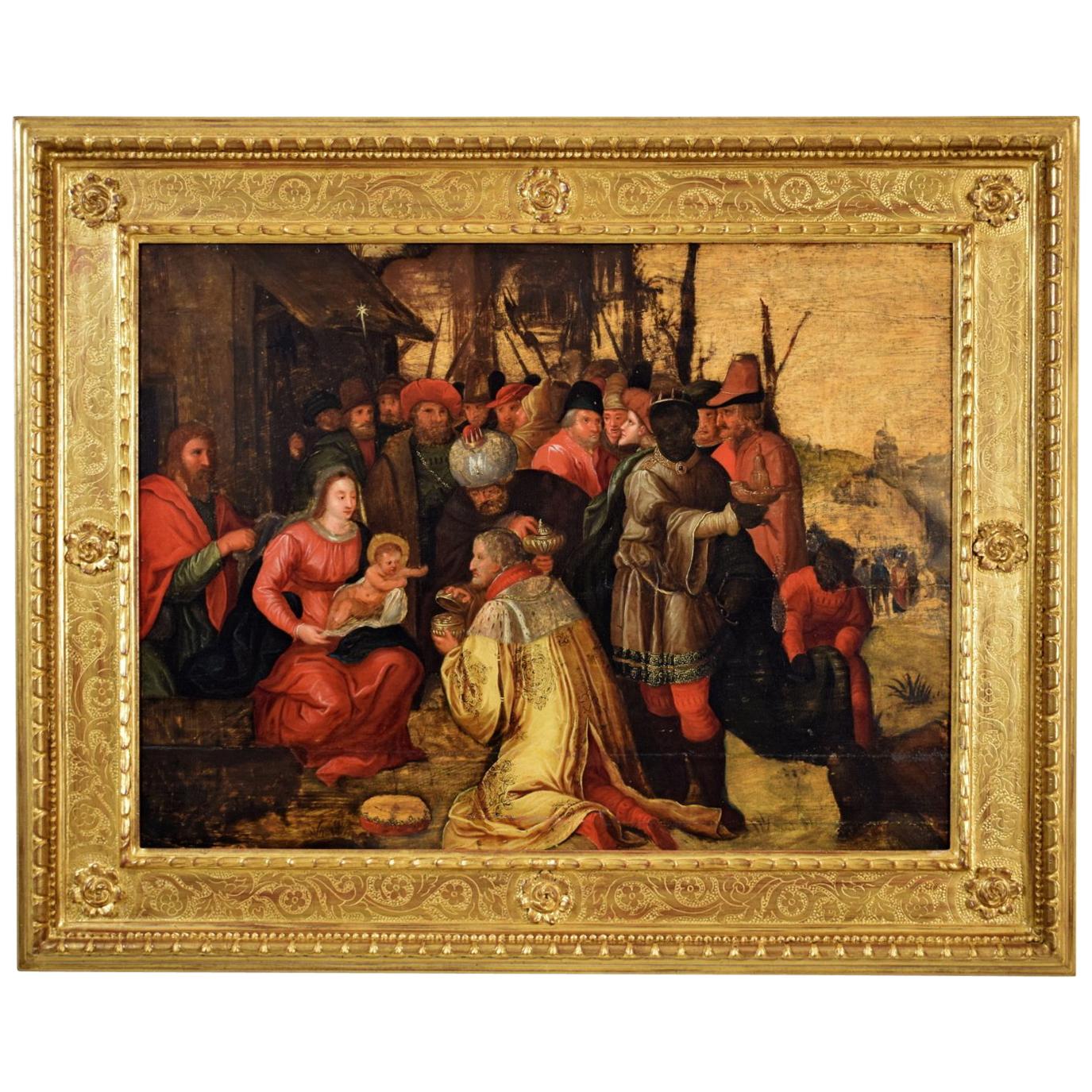
The Crossing of the Red Sea Workshop of Frans Francken II (Antwerp, 1581–1642) Antwerp, first half of the 17th century Oil on oak panel Dimensions: H. 49.5 cm × W. 64.5 cm Moulded and ebonized wood frame with wide mouldings, with reversed profile Framed dimensions: H. 82 cm × W. 97 cm Our panel depicts one of the most celebrated episodes of the Old Testament, recounted in the Book of Exodus: the Crossing of the Red Sea. Having escaped Pharaoh's army through Moses' intervention, the Israelites reach the opposite shore safely, while the waters close over their Egyptian pursuers. The richly conceived composition is structured around a broad and animated foreground populated by a multitude of elegantly dressed figures. At the center, a group gathers around the coffin containing the remains of the patriarch Joseph. Numerous mothers nursing or carrying their children allude to the redemption of the firstborn, while precious goldsmiths' works and vessels taken from Egypt are scattered at their feet. The small monkey seated in the foreground—a recurring motif in Flemish painting—adds a picturesque touch and reflects Frans Francken's fondness for anecdotal detail. In the background, Moses, accompanied by Aaron, raises his staff as the waters engulf the Egyptian army in a dramatic whirlpool. Rendered on a smaller scale, this episode creates a remarkable sense of depth and naturally guides the viewer's eye through the successive moments of the biblical narrative. The composition's richness lies in the profusion of figures, each distinguished by individual poses and costumes. A lively rhythm animates the scene, reinforced by the horse at the center, which serves as a visual pivot. The rolling landscape, with its luminous greens and majestic trees, freely transposes the biblical account into a distinctly Flemish setting, revealing the Antwerp artists' preference for adapting sacred subjects to a contemporary Northern European environment. The warm, refined palette, together with the meticulous rendering of shimmering textiles, expressive faces, and luxurious accessories, attests to the high quality of execution, combining exquisite attention to detail with exceptional narrative clarity. Frans Francken II treated the subject of the Crossing of the Red Sea on several occasions, varying the arrangement of the figures and compositional elements from one version to another. Several examples are recorded in Ursula Härting's monograph (Frans Francken II, 1989, pp. 236–239). Many of these works were executed with the participation of his workshop, particularly his son Hieronymus Francken III, and are now preserved in European museums as well as in important private collections. Beyond its religious significance, this iconography acquired a political dimension during the 17th century. The deliverance of the Hebrew people was frequently interpreted as an allegory of the struggle of the Dutch Republic against Spanish rule, culminating in the formal recognition of its independence in 1648. Related Works - Dorotheum, Vienna, sale of 22 October 2019, The Crossing of the Red Sea, by Hieronymus Francken III, oil on copper, 50.5 × 67.5 cm. - Musée de Tessé, Le Mans, The Crossing of the Red Sea, workshop of Frans Francken II (1581–1642), oil on panel. - Koller, Zurich, sale of 18 September 2009, lot 3052, The Crossing of the Red Sea, by Hieronymus Francken III, oil on panel, 51.2 × 73.5 cm. - Kunsthalle Karlsruhe, c. 1620, attributed to Hieronymus Francken III, oil on panel, 47.5 × 71.8 cm. - Hamburger Kunsthalle, The Israelites Resting by the Red Sea, 1621, by Tobias Verhaecht and Frans Francken II, oil on panel, 60.5 × 105 cm. -Rouillac, Vendôme, sale of 10 June 2018, The Crossing of the Red Sea, oil on panel, 93.5 × 123.5 cm (also featuring the monkey motif). - Herzog Anton Ulrich Museum, Braunschweig, The Crossing of the Red Sea, c. 1625, oil on oak panel, 45 × 47 cm, by Frans Francken II, signed ffranck (the group surrounding Joseph's tomb is particularly comparable).
  • Attributed to:
    Frans Francken II (1581 - 1642, Flemish)
  • Dimensions:
    Height: 32.28 in (82 cm)Width: 38.19 in (97.01 cm)
  • Medium:
  • Movement & Style:
  • Period:
  • Condition:
    Very good original condition, cleaned and revarnished by our professionnal art restorer.
  • Gallery Location:
    PARIS, FR
  • Reference Number:
    1stDibs: LU2433213622312

More From This Seller

View All
The Triumph of the Infant Bacchus, workshop of H. Van Balen, 16th c. Antwerp

The Triumph of the Infant Bacchus, workshop of H. Van Balen, 16th c. Antwerp

By Hendrick van Balen

Located in PARIS, FR

The Triumph of the Infant Bacchus, Workshop of Hendrick Van Balen (1575-1632) Antwerp, c.1630 Oil on copper, h. 28 cm (11.02 in), w. 35 cm (13.78 in) A large Roman 17th century golden painted frame Framed: h. 52 cm (20.47 in.), w. 58 cm (22.83 in) This artwork is sold with a certificate of authenticity guaranteeing its origin, date of execution, and attribution to the artist. Our finely painted work depicts The Triumph of the Bacchus as a young boy and is one of the most popular mythological subjects in Antwerp at the beginning of the 17th century. Feasting, wine and fun are the themes that constantly appeal to the public. Thus unfolds before our eyes on our painting the procession composed of nymphs, baccantes, fauns, satyrs and children, their bodies naked, partially covered with brightly coloured draperies that help to brighten up the parade. Playing various instruments, dancing and drinking, while carrying vases and poles adorned with grapevines, participants to the rhythm of a noisy brass band make their way to an ancient temple standing on the right. The exaggerated gestures convey to us the frenzy of the excited crowd. The Child Bacchus follows the joyous procession, carried by satyrs and nymphs, crowned with ivy and joyfully raising a cup of wine. In the foreground, the drunken participants leave the procession, the children on the left and the group of bacchantes and satyrs on the right are resting among various objects scattered at their feet: cups, vases, ewers bear witness to the festivities in progress. In the background, a hilly landscape stretches out on the horizon, a semblance of calm that contrasts with the bustle of the foreground. The artist strives to multiply the many details, whether it be figures, costumes, flowers or vegetation, in order to demonstrate his know-how and the perfection of his execution. The acidulous palette with fresh and varied colours is characteristic of Hendrick Van Balen's works. There are several versions identical to ours with similar dimensions painted by Hendrick Van Balen and his workshop. Related works: • Koller Auction, Zurich, 21/09/2007, oil on copper, 28,5 x 37,4 cm. • Staatliche Kunsthalle, Karlsruhe, Inv. N° 809 (oil on copper, 40 x 53,5 cm) • Auktionshaus für Altertümer Glückselig, Vienne, 10/05/1932, ( oil on copper, 34 x 42 cm) • Gemäldegalerie of Pommersfelden, Schloss Weissenstein, oil on panel, 47 x 64 cm Hendrick Van Balen, Flemish painter, born and died in Antwerp (1575-1632). A pupil of Adam Van Noort, he entered the Guild of St. Luke in 1593, later trained in Italy and was Van Dyck's first teacher. He often painted small figures taken from scenes from the Bible or classical mythology, on paintings whose backgrounds and landscapes were painted by Josse de Momper...

Category

17th Century Old Masters Figurative Paintings

Materials

Copper

17th c. Flemish - Landscape with Flight to Egypt - Antwerp circa 1630

17th c. Flemish - Landscape with Flight to Egypt - Antwerp circa 1630

Located in PARIS, FR

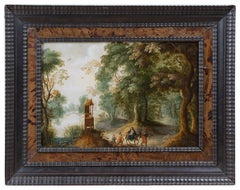
LANDSCAPE WITH FLIGHT TO EGYPT, JASPER VAN DER LANEN (ANTWERP, 1585 - 1634) 17TH CENTURY FLEMISH SCHOOL ANTWERP CIRCA 1630 Oil on copper, dimensions: h. 10.23 in, w. 14.96 in Flemish style frame in ebonized wood adorned with wavy moldings and wood veneer. Framed dimensions: h. 17.32 in, w. 21.65 in This artwork is sold with a certificate of authenticity guaranteeing its origin, date of execution, and attribution to the artist. Provenance: Philips auction...

Category

Early 17th Century Old Masters Figurative Paintings

Materials

Copper

The Rape of Europa, signed Peter Sion (1624-1695), Antwerp, 17th century

The Rape of Europa, signed Peter Sion (1624-1695), Antwerp, 17th century

Located in PARIS, FR

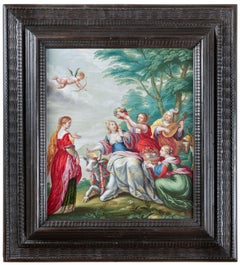
The Rape of Europa By Peter Sion (Antwerp, 1624-1695) Signed in the lower right corner P. Sion 17th century Antwerp School Oil on copper, dim. h. 53 cm, w. 45 cm Moulded and ebonized...

Category

17th Century Old Masters Figurative Paintings

Materials

Oak, Oil, Wood Panel

Attributed à H. Francken II, 17th c. Anwerp - The prodigal son among courtesans

Attributed à H. Francken II, 17th c. Anwerp - The prodigal son among courtesans

Located in PARIS, FR

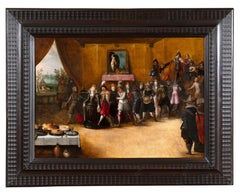
The Prodigal Son Among Courtesans Attributed to Hieronymus Francken II (Antwerp 1578-1623) Early 17th century Antwerp school Oil on oak panel, Dimensions: H. 52.5 cm (20.67 in), W. 74 cm (29.14 in) Flemish-style moulded wood frame Frame: h. 78 cm (h. 30.70 in.), w. 100 cm (39.37 in.) This artwork is sold with a certificate of authenticity guaranteeing its origin, date of execution, and attribution to the artist. At first glance, this festive and joyful painting depicts a group of elegantly dressed people dancing to the sound of an orchestra in a richly decorated interior with a wide opening onto a rural exterior. However, the real theme is cleverly concealed by the painter and is only discernible through the artifice of a small scene in the background where we see a half-naked man, in the company of the pigs next to a makeshift shelter. In fact, beyond the pleasant and apparently superficial character of the painting, it is a subject taken from the parable of the prodigal son in the Gospel. The illustrated episode is the prodigal son among courtesans. Even if the viewer's attention is drawn to the central couple (prodigal son embracing a pretty courtesan) doing the dance steps, the artist takes care in a narrative approach of all the groups and ancillary scenes in order to create a rich and varied composition. Thus the musicians seated on a raised platform are depicted with great skill, their faces animated, their clothes abundantly varied. The theme of music, which has always been associated with that of sensuality and physical love, helps to exacerbate licentious pleasures. The merry company dances "Spanish pavane", a slow court dance from the sixteenth century, danced close to the ground by couples arranged in a procession, which was probably introduced to the south of the Netherlands around 1600 during the governance of Albrecht VII and the daughter of the King of Spain Isabella Clara Eugenia in Brussels. The interior of the house is also carefully elaborated, the embossed leather dyes on the walls, the middle sideboard (typical in Francken interiors), where the rich gold and silver crockery is placed in front of the painting "Andromeda chained to the rock and Perseus arriving to rescue her". The inclusion of a contemporary and probably extant pictorial work is also one of the characteristics of the Francken family, among them Frans Francken the Younger...

Category

Early 17th Century Old Masters Interior Paintings

Materials

Oak, Oil

Madonna and Child with Angels, attributed to Louis de Caullery, Flemish, 17th c.

Madonna and Child with Angels, attributed to Louis de Caullery, Flemish, 17th c.

By Louis de Caullery 1

Located in PARIS, FR

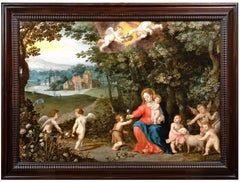
Madonna and Child with Angels Attributed to Louis de Caullery (1565 -1622) for figures & Abraham Govaerts (1589 - 1626) for landscape Not signed 17th century Antwerp school, circa 16...

Category

Early 17th Century Old Masters Figurative Paintings

Materials

Copper

You May Also Like

'The Departure of the Israelites from Egypt' by Frans Francken the Younger

'The Departure of the Israelites from Egypt' by Frans Francken the Younger

Located in Knokke, BE

Frans Francken the Younger 1581 - Antwerp - 1642 Flemish Painter 'The Departure of the Israelites from Egypt – The Exodus', c. 1610 - 1620 Medium: pen in sepia on paper Dimensions: mage size 26 x 34,5 cm, frame size 55 x 65,5 cm Biography: Frans Francken the Younger, born in Antwerp in 1581 and passing away on May 6, 1642, also in Antwerp, was a distinguished Flemish painter. He is recognized as the most prominent and productive member of the renowned Francken family of artists. Francken explored a wide range of subjects, creating large altarpieces for churches and producing smaller works depicting historical, mythological, and allegorical scenes. Notably, his depictions of collectors’ cabinets established a popular new genre of art during his era. He was known for collaborating with other artists, enriching their works with his skilled renderings of figures and narrative elements, complementing specialists in landscape, architectural scenes, and floral still-life painting. Francken was born to Frans Francken the Elder and Elisabeth Mertens. His father was a pupil of Antwerp’s leading history painter, Frans Floris, and a significant creator of altarpieces in Flanders during his time. Francken received his artistic training under the guidance of his father. Additionally, it is possible that Frans and his brother, Hieronymus Francken II, received further instruction in the workshop of their uncle, Hieronymus Francken I, in Paris. A versatile artist, Francken made significant contributions to various genres within Flemish art, introducing new themes and subjects. Many of his works comprised small-scale historical, allegorical, and biblical cabinet paintings, often emphasizing figures. He is credited with either inventing or popularizing several novel themes that gained popularity in Flemish painting, including genre scenes featuring monkeys (also known as singeries) and Kunstkammer or gallery paintings, presenting a plethora of natural and artistic treasures against a neutral wall. Francken introduced various other unconventional themes that later gained traction, such as the ‘Triumphal Procession of Amphitrite’ and ‘Croesus and Solon.’ He also produced a series of paintings depicting witches and witchcraft, including portrayals of witches’ sabbats. His remarkable paintings are held in the collections of numerous major museums throughout Europe. Francken specialized in rendering the human figure, as evidenced by etched and engraved portraits of the artist by Anthony van Dyck (after Peter Paul Rubens), identifying him with the Latin inscription: ‘ANTVERIÆ PICTOR HVMANARVM FIGVRARVM’ (Figure painter of Antwerp). He was frequently invited to contribute figures to compositions by other esteemed artists, including landscape artists such as Tobias Verhaecht, Abraham Govaerts, and Joos de Momper...

Category

Early 17th Century Baroque Interior Paintings

Materials

Paper, Pen

Workshop of Frans Francken the Younger, The Egyptians' Plunge into the Red Sea

Workshop of Frans Francken the Younger, The Egyptians' Plunge into the Red Sea

By Frans Francken II

Located in Milan, IT

Workshop of Frans Francken the Younger (Antwerp, 1581–1642) The Downfall of the Egyptians in the Red Sea Oil on wood, 58 x 83 cm – framed, 74 x 98 cm The work under consideration...

Category

Antique 17th Century Dutch Other Paintings

Materials

Wood

The Adoration of the Magi, an early painting by Frans Francken II (1581 - 1682)

The Adoration of the Magi, an early painting by Frans Francken II (1581 - 1682)

By Frans Francken II

Located in PARIS, FR

We would like to thank Dr. Ursula Härting who, after examining the work, confirmed the autograph nature of this painting by Frans Francken the Younger in a certificate issued on December 9, 2024. In this previously unpublished painting coming from a French private collection, Frans Francken the Younger tackles one of his favorite themes: the adoration of the Magi, the wise men who come from the East to adore the infant Jesus in Bethlehem, Judea. This theme was often taken up by the artist, but this version, which can be dated around 1610, is one of the earliest interpretations. 1. Frans Francken the Younger, "a surprisingly inventive painter". Frans Francken the Younger is the best-known member of an extended artistic family that worked in Antwerp from the late sixteenth to the late seventeenth century. Born in 1581, he almost certainly studied with his father, Frans Francken the Elder (c. 1542-1616), before becoming a master in the Antwerp Saint Luke's Guild in 1605. In 1627 he became a member of the Antwerp archers' guild De Oude Handboog. Francken was an extremely productive and imaginative artist who specialized in expressively rendered small-scale religious and mythological scenes. He also painted larger altarpieces for Catholic churches. His depictions of collectors' cabinets introduced a genre of painting that influenced several artists, including Jan Brueghel the Elder...

Category

1610s Old Masters Figurative Paintings

Materials

Copper

Mocking of Christ, by Frans Francken (II) and possibly Ambrosius Francken (II)

Mocking of Christ, by Frans Francken (II) and possibly Ambrosius Francken (II)

By Frans Francken II

Located in New York, NY

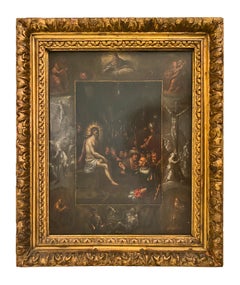
Mocking of Christ, with all around in grisaille: the Crucifixion, the Resurrection, God the Father, Mankind after the Fall,; in the corners the four evangelists. J. Dijkstra ao, cat. The paintings of Museum Catharijneconvent, Utrecht (Museum Catharijneconvent) 2002, p. 196, pict., as Frans Francken...

Category

17th Century Mannerist Figurative Paintings

Materials

Copper

Dutch 17th Century Oil on Wood Painting in the Manner of Frans Francken

Dutch 17th Century Oil on Wood Painting in the Manner of Frans Francken

Located in West Palm Beach, FL

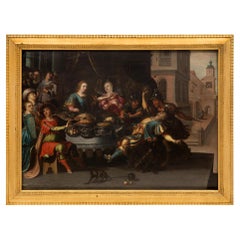
A sensational Dutch 17th century Oil on Wood painting in the manner of Frans Francken. The painting depicts the scene of a feast with a young male and female enjoying a feast while musicians are playing music in the background. To the left of the table that are spectators who are turning their heads away from two guards killing a traitor seated at the table. In the background you have architectural buildings and additional figures. At the bottom center is a pet monkey...

Category

Antique 17th Century Dutch Paintings

Materials

Canvas, Giltwood

The temptation of St Anthony. Oil on canvas. 17th c., after David Teniers II

The temptation of St Anthony. Oil on canvas. 17th c., after David Teniers II

By David Teniers the Younger

Located in Madrid, ES

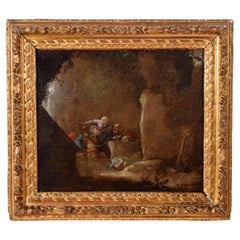
Temptations of San Antonio Abad. Oil on canvas. 17th century, following the model of David Teniers II (Antwerp, 1610-Brussels, 1690). Oil on canvas showing a figurative scene located inside a cave. To the right, you can see a cross standing, supported; to the left, a hut; and in the center of the painting appears an elderly, bearded man, leaning on a table on which there is a ceramic jug and a skull, with an open book at the foot of it. The man looks towards a woman, who points to something outside, and appears accompanied by a large frog and a series of ghostly beings or monsters dressed in brightly colored cloth and clothing. San Antonio Abad or Antonio Magno (251-356) was a Christian monk, considered the founder of the eremitical movement. He was tempted numerous times by the devil while he was in the desert, becoming a subject frequently represented in art (as can be seen in this oil painting). He is represented in a black habit because the Order of the Knights of the Hospital of San Antonio (Hospitals) was placed under his patronage, being the color of the habits of the members of this order (the tau or Egyptian cross was also the symbol chosen by they). David Teniers II or El Joven was a prominent Flemish painter and engraver, son of David Teniers El Viejo or I and father of David Teniers III, much appreciated at the time for his scenes of villagers and common people, his paintings of monkey painters, etc. . He dealt with the theme of the Temptations of Saint Anthony...

Category

Antique 17th Century European Baroque Paintings

Materials

Other