Want more images or videos?
Request additional images or videos from the seller
1 of 3

Master of Montespertoli
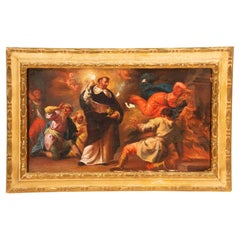
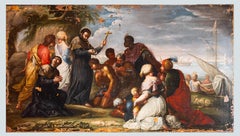
St. Vincent Ferrer Preaching to the People of Salamanca

ca. 1500

$17,500
£13,236.83
€15,455.78
CA$24,922.74
A$25,287.06
CHF 14,445.56
MX$306,163.20
NOK 169,707.82
SEK 169,483.09
DKK 115,538.23

About the Item

Provenance: Private Collection, New Jersey The present painting depicts Saint Vincent Ferrer preaching from a raised pulpit to a group of seven people seated below him. The saint is recognizable as a Dominican friar—tonsured, clean-shaven, wearing a black-and-white habit—and can be further identified as Vincent Ferrer by his gesture pointing to a vision of Christ in a mandorla and by the prominent inscription “TIMETE DEVM.” These are the first two words of a passage from the Book of Revelation (14:7) used by the saint in a celebrated sermon preaching repentance given in Salamanca, and thereafter closely associated with him: “Timete Deum et date illi onorem quia venit,” or “Fear God, and give glory to him.” Vincent Ferrer (1350–1419), the son of an Anglo-Scottish father and a Spanish mother, was born in Valencia, but his career as a preacher took him beyond Spain to France, Flanders, Switzerland, and Italy. He was venerated throughout Europe following his canonization in 1455. The essentials of the saint’s iconography appear in a Milanese print (Fig. 1) in the British Museum roughly contemporary in date to the present painting. In our painting the artist has drawn on imagery of holy figures preaching outdoors—as in, for example, Sano di Pietro’s panel of Saint Bernardino of Siena (Fig. 2)—but he seems equally to refer to secular images of masters and students. In our painting, both secular and religious figures appear (including a monk and a nun), all responding to the saint’s sermon with gestures of astonishment. The style of our panel points to a date about 1500, and its author has recently been identified by Christopher Daly as an anonymous Florentine painter whom he has named the Master of Montespertoli after the town south of Florence where two of his principal works are found (written communication, November 2020). The first is a fresco of the Baptism of Christ at the church of San Andrea, and the second is an altarpiece of the Virgin and Child with Saints Nicholas and Sebastian in the Museo d’Arte Sacra. The Master of Montespertoli appears to have been active in the first two decades of the sixteenth century and was likely a follower of Raffaellino del Garbo. Daly compares our painting with the Master’s Pietà with Saints formerly on the Paris art market (Fig. 3) and the painted frame at the Museo Horne in Florence (Fig. 4). He notes that these works similarly exhibit a varied treatment of scale and a sketchy, translucent handling of the paint. Additionally, the paintings each show smiling figures with ovular heads, large rectangular hands, and rubbery arms bent with a pronounced curve.
  • Creator:
    Master of Montespertoli
  • Creation Year:
    ca. 1500
  • Dimensions:
    Height: 11.75 in (29.85 cm)Width: 8 in (20.32 cm)
  • Medium:
  • Movement & Style:
  • Period:
  • Condition:
  • Gallery Location:
    New York, NY
  • Reference Number:
    1stDibs: LU1027014882

More From This Seller

View All
Study of a Franciscan Saint, probably San Diego de Alcalá

Study of a Franciscan Saint, probably San Diego de Alcalá

Located in New York, NY

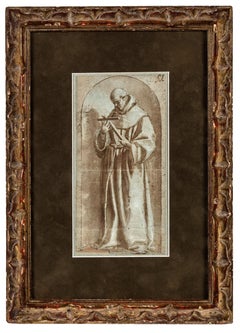
Provenance: Ivan E. Phillips, Montreal and New York, until 2023. The brothers Bartolomé Carducho and Vicente Carducho, both born and trained in Florence, settled in Spain where they made their careers. Vicente worked on numerous commissions for both the church and the Spanish court...

Category

17th Century Old Masters Drawings and Watercolor Paintings

Materials

Paper, Chalk, Ink, Pen

Young Christ Pricked by a Thorn (Niño de la Espina)

Young Christ Pricked by a Thorn (Niño de la Espina)

Located in New York, NY

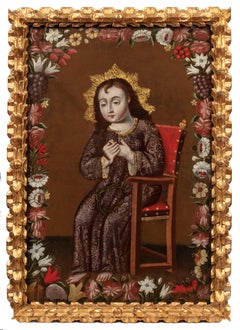
Provenance: Private Collection, Paraguay, for at least the last 80 years Painted in the Viceroyalty of Peru during the 18th century, the present work depicts the young Christ as the Niño de la Espina—a devotional representation of Christ as he looks down at his bleeding finger, which has been pricked by the crown of thorns resting on his lap. The subject of the Young Christ Pricked by a Thorn was especially popular in Cuzco, and the rich details and decorative elements of our work perfectly capture the essence and style of the Cuzco School of painting. In our painting, Christ wears an intricately patterned floor-length robe trimmed with gilded cuffs and a gilded collar. The delicate gilding, including the halo of golden rays emanating from his head, are executed in brocateado, an ornamental over-gilding technique that is characteristic of the Cuzco School. The red chair on which Christ sits also includes brocateado in the decorative gilt elements. The form of the chair takes inspiration from those commonly used by friars both in Spain and the Andes, known as silla frailera or sillon frailero, and was also frequently employed in related depictions of the Virgin Mary Spinning. Here the young Christ is rendered with soft, elongated features that reflect the influence of the Italian Mannerist painters who were pivotal to the formation of the Cuzco School, including the Jesuit friar Bernardo Bitti and Matteo Pérez del Alesio. Additionally, while its origins can be traced to Northern European pictorial traditions, the lush flower garland that frames the work is a signature feature of Cuzqueño painting...

Category

18th Century Old Masters Figurative Paintings

Materials

Canvas, Oil

The Resurrection of Christ

The Resurrection of Christ

Located in New York, NY

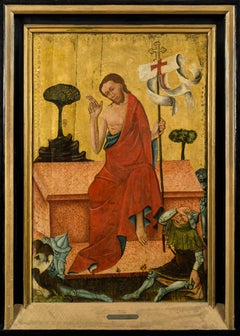
Provenance: with “Mr. Scheer,” Vienna, by July 1918; where acquired by: Jindřich Waldes, Prague, 1918–1941; thence by descent to: Private Collection, New York Literature: Rudolf Kuchynka, “České obrazy tabulové ve Waldesově obrazárně,” Památky archeologické, vol. 31 (1919), pp. 62-64, fig. 5. Jaroslav Pešina, “K datování deskových obrazů ve Waldesově obrazárně,” Ročenka Kruhu pro Pěstování Dějin Umění: za rok (1934), pp. 131-137. Jaroslav Pešina, Pozdně gotické deskové malířství v Čechách, Prague, 1940, pp. 150-151, 220. Patrik Šimon, Jindřich Waldes: sběratel umění, Prague, 2001, pp. 166, 168, footnote 190. Ivo Hlobil, “Tři gotické obrazy ze sbírky Jindřicha Waldese,” Umění, vol. 52, no. 4 (2004), p. 369. Executed sometime in the 1380s or 1390s by a close associate of the Master of the Třeboň Altarpiece, this impressive panel is a rare work created at the royal court in Prague and a significant re-discovery for the corpus of early Bohemian painting. It has emerged from an American collection, descendants of the celebrated Czech industrialist and collector Jindřich Waldes, who died in Havana fleeing Nazi-occupied Europe. The distinctive visual tradition of the Bohemian school first began to take shape in the middle of the fourteenth century after Charles IV—King of Bohemia and later Holy Roman Emperor—established Prague as a major artistic center. The influx of foreign artists and the importation of significant works of art from across Europe had a profound influence on the development of a local pictorial style. Early Italian paintings, especially those by Sienese painters and Tommaso da Modena (who worked at Charles IV’s court), had a considerable impact on the first generation of Bohemian painters. Although this influence is still felt in the brilliant gold ground and the delicate tooling of the present work, the author of this painting appears to be responding more to the paintings of his predecessors in Prague than to foreign influences. This Resurrection of Christ employs a compositional format that was popular throughout the late medieval period but was particularly pervasive in Bohemian painting. Christ is shown sitting atop a pink marble sarcophagus, stepping down onto the ground with one bare foot. He blesses the viewer with his right hand, while in his left he holds a triumphal cross with a fluttering banner, symbolizing his victory over death. Several Roman soldiers doze at the base of the tomb, except for one grotesque figure, who, beginning to wake, shields his eyes from the light and looks on with a face of bewilderment as Christ emerges from his tomb. Christ is wrapped in a striking red robe with a blue interior lining, the colors of which vary subtly in the changing light. He stands out prominently against the gold backdrop, which is interrupted only by the abstractly rendered landscape and trees on either side of him. The soldiers’ armor is rendered in exacting detail, the cool gray of the metal contrasting with the earth tones of the outer garments. The sleeping soldier set within a jumble of armor with neither face nor hands exposed, is covered with what appears to be a shield emblazoned with two flies on a white field, somewhat resembling a cartouche (Fig. 1). This may be a heraldic device of the altarpiece’s patron or it may signify evil, referencing either the Roman soldiers or death, over both of which Christ triumphs. This painting formed part of the collection assembled by the Czech industrialist and founder of the Waldes Koh-i-noor Company, Jindřich Waldes, in the early twentieth century. As a collector he is best remembered for establishing the Waldes Museum in Prague to house his collection of buttons (totaling nearly 70,000 items), as well as for being the primary patron of the modernist painter František Kupka. Waldes was also an avid collector of older art, and he approached his collecting activity with the goal of creating an encyclopedic collection of Czech art from the medieval period through to the then-present day. At the conclusion of two decades of collecting, his inventory counted 2331 paintings and drawings, 4764 prints, and 162 sculptures. This collection, which constituted the Waldesova Obrazárna (Waldes Picture Gallery), was first displayed in Waldes’ home in Prague at 44 Americká Street and later at his newly built Villa Marie at 12 Koperníkova Street. This Resurrection of Christ retains its frame from the Waldes Picture Gallery, including its original plaque “173 / Česky malíř z konce 14 stol.” (“Czech painter from the end of the 14th century”) and Waldes’ collection label on the reverse. The Resurrection of Christ was one of the most significant late medieval panel...

Category

15th Century and Earlier Old Masters Paintings
Materials

Tempera, Panel

A Guardian Angel Leading a Child

A Guardian Angel Leading a Child

Located in New York, NY

Provenance: Private Collection, Argentina; there acquired by Mr. and Mrs. Ernest T. Harper, New York, by 1960; by descent to: Mr. and Mrs. Alan Harper, New York, until 2024. This s...

Category

18th Century Old Masters Figurative Paintings

Materials

Canvas, Oil

You May Also Like

Saint Dominic. Oil on canvas. Spanish school, 18th century.

Saint Dominic. Oil on canvas. Spanish school, 18th century.

Located in Madrid, ES

Saint Dominic. Oil on canvas. Spanish school, 18th century. It has some faults. Oil on canvas with a horizontal layout depicting a Dominican wearing the characteristic habit of the ...

Category

Antique 18th Century Spanish Neoclassical Religious Items

Materials

Other

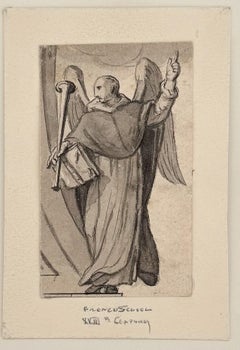
St. Vincent Ferrer with the "Trumpet of Judgment" – French School, 18th Century

St. Vincent Ferrer with the "Trumpet of Judgment" – French School, 18th Century

Located in Middletown, NY

A study of St. Vincent Ferrer, known as the "Angel of the Apocalypse." Ink and wash on laid paper, laid down to a wove paper matrix, 3 1/4 x 2 inches (83 x 50 mm), the full sheet. I...

Category

Mid-17th Century Italian School Figurative Drawings and Watercolors

Materials

Ink, Handmade Paper

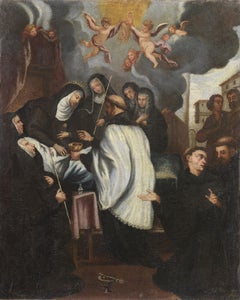
17th Century Martyrium of Saint Juliana Falconieri Italian School Last Communion

17th Century Martyrium of Saint Juliana Falconieri Italian School Last Communion

Located in Sanremo, IT

Painting, oil on canvas, 70 x 45 cm in size, depicting the last Communion and the martyrdom of Saint Giuliana Falconieri by a worthy Lombard school of the mid-17th century. In th...

Category

Mid-17th Century Old Masters Figurative Paintings

Materials

Canvas, Oil

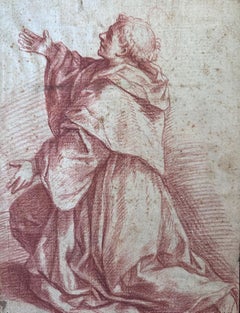
Italian School, 17th century - Study for the Vision of Saint Anthony

Italian School, 17th century - Study for the Vision of Saint Anthony

Located in Paris, Île-de-France

Italian School, 17th century Study for the Vision of Saint Anthony Red chalk on paper 247 x 185 mm Unsigned Provenance Private collection, Paris Collection of Count Alessandro Mag...

Category

17th Century Old Masters Figurative Drawings and Watercolors

Materials

Chalk

Saint Francis Xavier Evangelisation scene. Genovese School 17th century

Saint Francis Xavier Evangelisation scene. Genovese School 17th century

Located in GB

San Francesco Saverio (Saint Francis Xavier), one of the most influential Christian missionaries in history. He was born into a noble Basque family in the Kingdom of Navarre, now par...

Category

17th Century Figurative Paintings

Materials

Canvas, Oil