Adriana Verelst
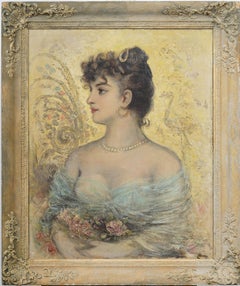
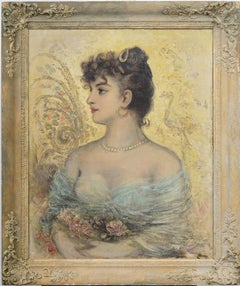
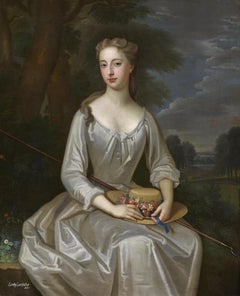
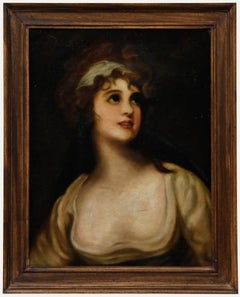
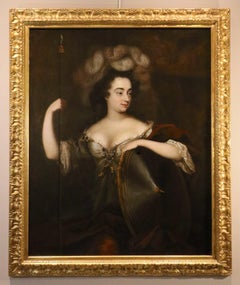
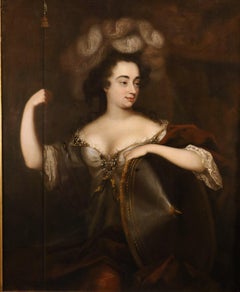
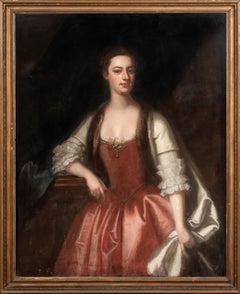
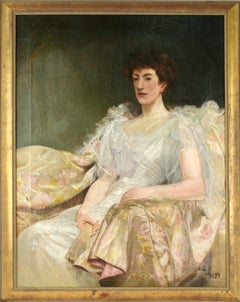
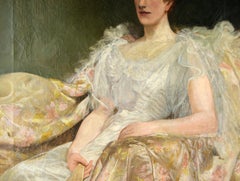
Portrait of Lady Lempster
1683-1769
Oil on canvas, unsigned
Image size: 49 ½ x 40 ⅓ inches
Contemporary-style gilt frame
The sitter is identified as Lady Sophia Osborne, Baroness Lempster (Leominster) (1661 - 1746), the daughter of Thomas Osborne, First Duke of Leeds, and Lady Bridget Bertie. Her first marriage was to Donogh O’Brien, Lord Ibracken in 1679, who passed away in 1682. She then married William Fermor, First Baron Leominster, in 1691, gaining her the title Baroness Leominster. She and William had five children, including Thomas Fermor, First Earl of Pomfret. The portrait is dated 1685, indicating that this identification was added after the creation of the portrait.
During the early 18th century a highly romanticised view of country life reached its peak. Many members of the nobility, particularly women, chose to have their portraits painted in shepherdess costume, a break from the conventional norms of formal portraiture. This style developed from 17th century Roman pastoral landscapes by artists like Claude Lorrain and Dutch three-quarter length portraits of shepherds and shepherdesses. These works aimed to evoke themes of Arcadia, poetic escape and landed virtue, with their subjects depicted wearing fashionable and expensive clothing, inconsistent with actual farm work. A knowledge of Latin and Greek pastoral poetry signified education and refinement, desirable qualities for a woman to possess. Life in the country was perceived as peaceful, contemplative and free of hardships, and to be painted in this pastoral style was to create a tangible expression of power and wealth, creating tension between the aristocratic fantasy and the reality of rural life. Lady Lempster has opted for such a depiction. She is shown seated, wearing a white silk gown, head tilted slightly to one side and with a shepherd’s crook and wicker hat adorned with flowers in her lap. She sits on a bench, in front of a large tree, an expansive view visible on the right behind her. So ingrained was this style that the crook and hat alone would be enough to suggest Arcadia to the viewer.
There is an interesting contrast between the female sitter and the woman artist who painted her. The shepherdess costume was used predominantly in portraits of women sitters, with the aim of expressing virtues such as purity and appropriate education rather than a distinct, individual personality. Portraits of men however, depicted sitters in settings, costume and surrounded by objects that signified their profession and accomplishments. Adriana Verelst was a woman with a career of her own, able to support herself and defying expectations of the time, the conformity of Lady Lempster’s portrait emphasising Verelst’s own unconformity.
Adriana Verelst
Adriana Verelst (c. 1683–1769) was an English portrait artist, and daughter of the portrait painter Herman Verelst. Her exact date and place of birth are unknown, though her parents were from Vienna. Verelst is a prime example of how women artists were often misrepresented or even erased from the cannon of art history. There have been questions surrounding her biography with the view that her sister, Maria Verelst and fellow portrait artist, did not exist and could be Adriana Verelst herself.
Contemporary evidence of Adriana’s birth, marriage, career and death exist, however, she has not been included in later art histories. In contrast, there is no contemporary documentary evidence for the existence of Maria Verelst, though she is named in later publications. The name Maria Verelst first appeared in Matthew Bryan’s Dictionary of 1816 and it has been argued that his use of the name was a misinterpretation of ‘M’ being an abbreviation for Maria rather than ‘Mademoiselle’. The date of birth and location in Antwerp was given by J.B. Descamps in 1753, though there is no archival evidence of a birth or baptism for Maria in Antwerp at this time. In 1762, Horace Walpole made the link between Maria and Herman Verelst, an Anglo-Dutch painter, as the father of the artist. As Herman had fled from the siege of Vienna in 1683, biographers resonated that with a birth date of 1680, Maria must have been born in Vienna. Biographers also stated that Maria was trained by her uncle, Simon Verelst, a renown painter of flowers and still lifes. The first reference to 1744 as the date of Maria’s death was in 1859 in Mrs. Ellet’s Women Artists in all Ages and Countries, though no source is given for this date.
It has been argued that Maria Verelst is in fact Adriana, claiming that earlier biographies used ‘M. Verelst’ as Mademoiselle in reference to Mademoiselle Adriana Verelst. If these were in fact two separate women, they would have been sisters. Maira’s grandfather, Pieter Hermansz Verelst...
Category
Late 17th Century Portrait Paintings