Ignacio Zuloaga was born in Eibar, Spain, in 1870, into an artistic family; his father, Eusebio Zuloaga, was a renowned metalsmith and arms designer, and his grandfather was a decorative artist. From an early age, Zuloaga was immersed in craft and design, which fostered his acute sense of form, line, and material. He received formal artistic training at the Escuela de Bellas Artes in Madrid and studied under notable painters, developing a style deeply rooted in Spanish tradition.
Zuloaga’s work is celebrated for its realist intensity and psychological depth, focusing on Spanish life, culture, and identity. He is particularly renowned for portraits of traditional figures—peasants, bullfighters, and artisans—as well as depictions of Spanish customs and festivals. His style combines robust realism with a dramatic, sometimes dark palette, capturing both the physical presence and inner character of his subjects.
A key aspect of Zuloaga’s approach was his dedication to Spanish national identity, often portraying rural and provincial subjects with dignity and gravitas. His work contrasts sharply with the Impressionist movement of his time, favoring controlled composition, careful chiaroscuro, and an earthy palette reminiscent of Velázquez and El Greco.
Zuloaga exhibited widely in Europe, gaining recognition in Paris, London, and beyond, and he participated in major exhibitions, including the Venice Biennale. His portraits of prominent cultural figures, as well as anonymous sitters, solidified his reputation as one of Spain’s foremost chroniclers of national character.
He continued to paint throughout the interwar years, producing a substantial body of work characterized by intensity, color restraint, and psychological insight. Zuloaga died in Madrid in 1945, leaving behind a legacy as a painter who bridged Spanish tradition with modern portraiture, capturing the soul of his nation in both individual and cultural terms.
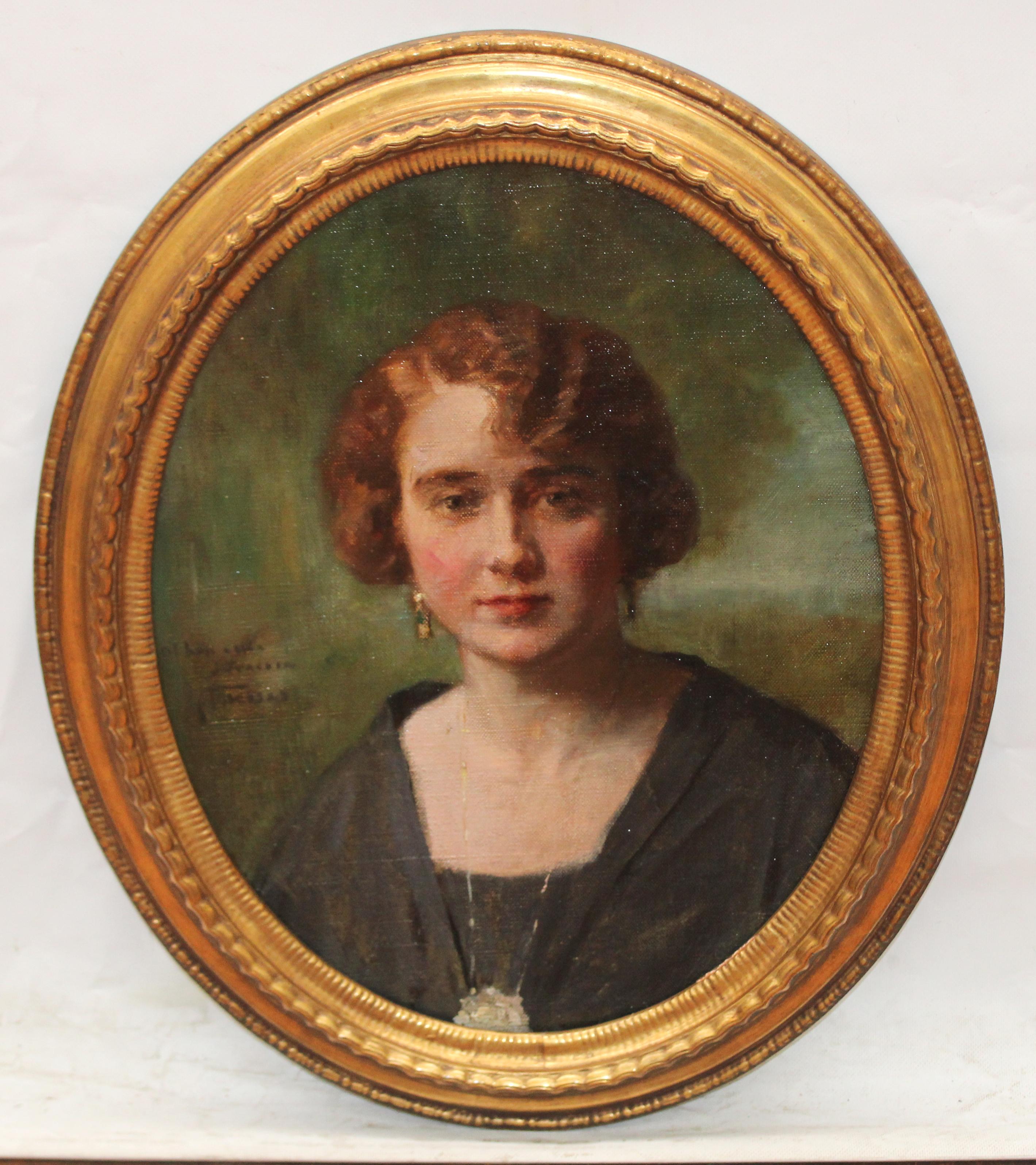
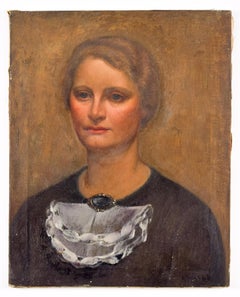
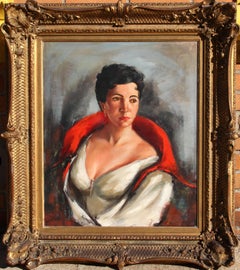
This portrait presents a bust-length depiction of a young woman, rendered with a style reminiscent of Spanish painter Ignacio Zuloaga, whose influence is evident in the strong modeling of form, the earthy realism, and the psychologically attentive gaze. The sitter wears a black blouse, sharply contrasting with her fair skin and the subtle tonalities of the background.
Her short hair, cut in a fashion typical of the 1930s, frames a face of delicate yet defined features. Blue eyes are directed to the left, lending a contemplative or slightly introspective air, while the turn of her head and the positioning of the shoulders convey both dignity and immediacy.
The background is a clouded purple, softly modulated and textured, which situates the sitter without distracting from her presence. The colour choice, along with the loose yet controlled brushwork, evokes the atmospheric depth and dramatic restraint characteristic of Zuloaga’s portraits.
Overall, the painting balances realism with expression, emphasizing the sitter’s individuality while employing muted yet powerful chromatic contrasts. The result is a striking psychological portrait, both intimate and formally composed, recalling the interwar European portrait tradition.
On the back there is an incription I. Hidalgo de Cisneros which can refer to the following. Perhaps the painting is of his wife, Constancia de la Mora, or a member of his family.
Spanish aristocrat, military aviator, and Republican leader. Born in Vitoria, Spain, Hidalgo de Cisneros trained as a pilot and served in Morocco during the Rif War. During the Spanish Civil War (1936–1939), he sided with the Republican government, becoming Commander of the Republican Air Force and joining the Communist Party, despite his aristocratic origins.
After the Republic’s defeat, he went into exile, living in Poland and Romania, where he died in 1966. He is remembered for his leadership of Republican aviation and as a rare example of an aristocrat aligned with leftist Republican ideals.
Size of the painting:
43 x 33.5