Want more images or videos?
Request additional images or videos from the seller
1 of 3

Hans Bellmer
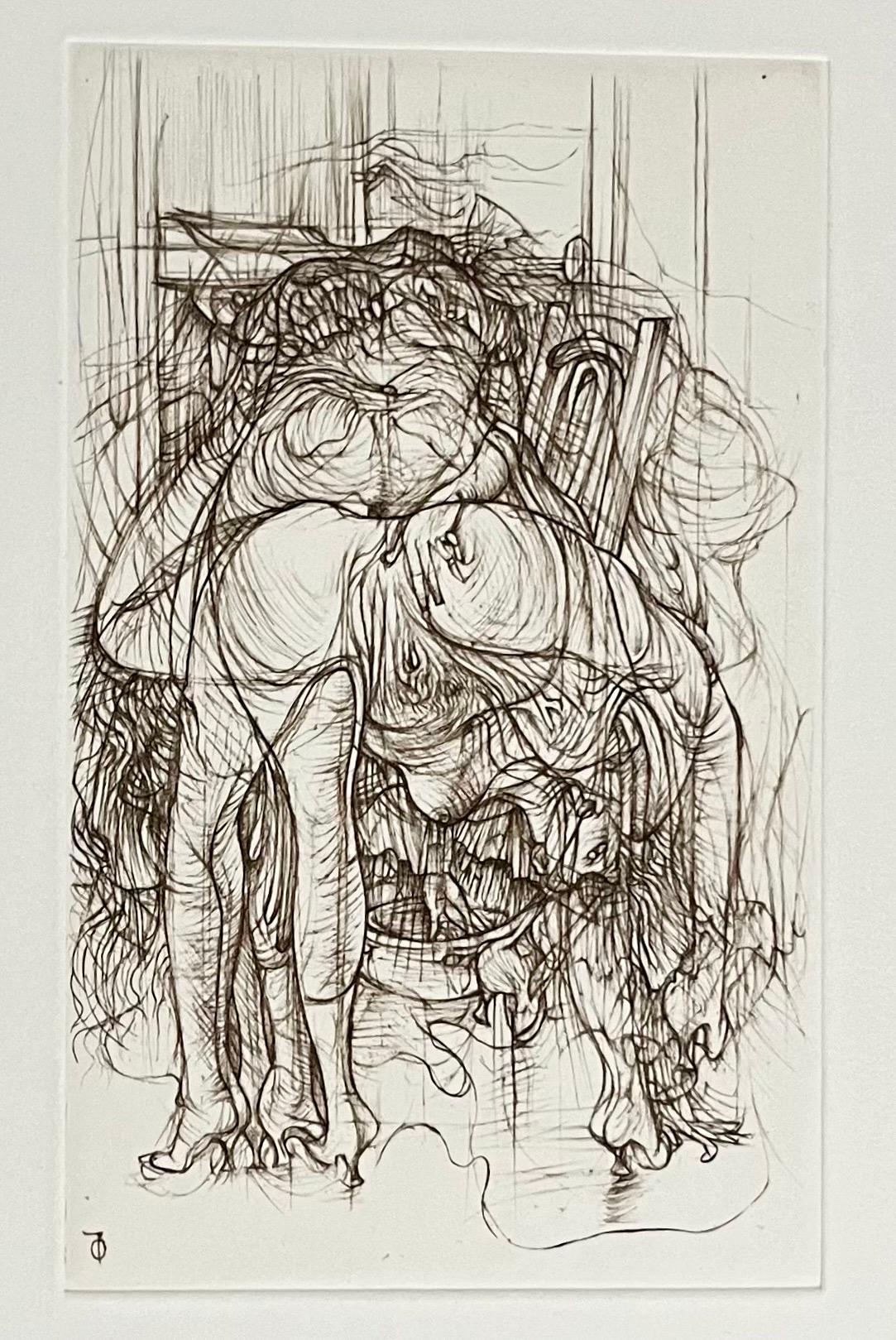
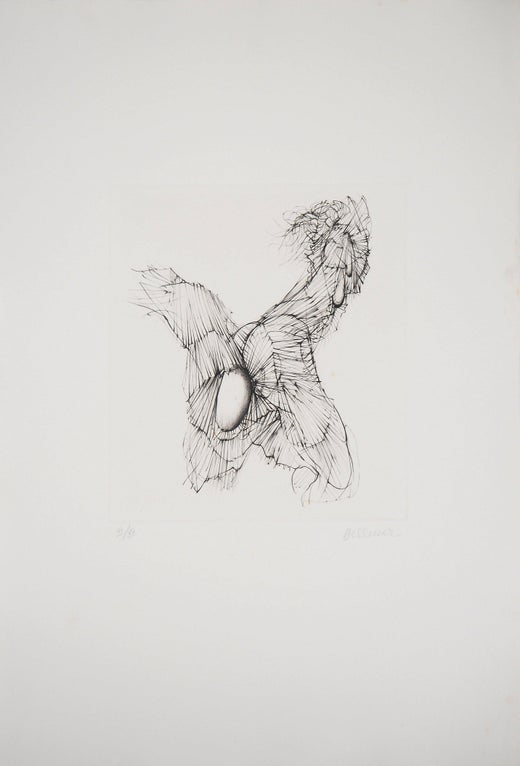
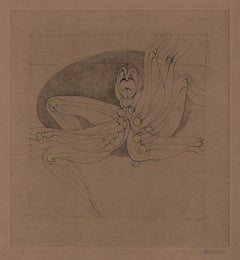
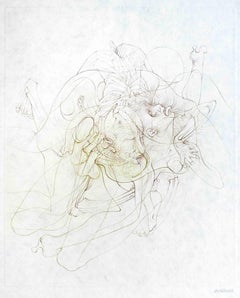
'Child and Seeing Hands' — Surrealist Masterwork, Signed Engraving, 1970

1970

$1,120
£846.82
€991.45
CA$1,593.48
A$1,620.86
CHF 930.21
MX$19,484.67
NOK 10,850.86
SEK 10,953.01
DKK 7,411.98

About the Item

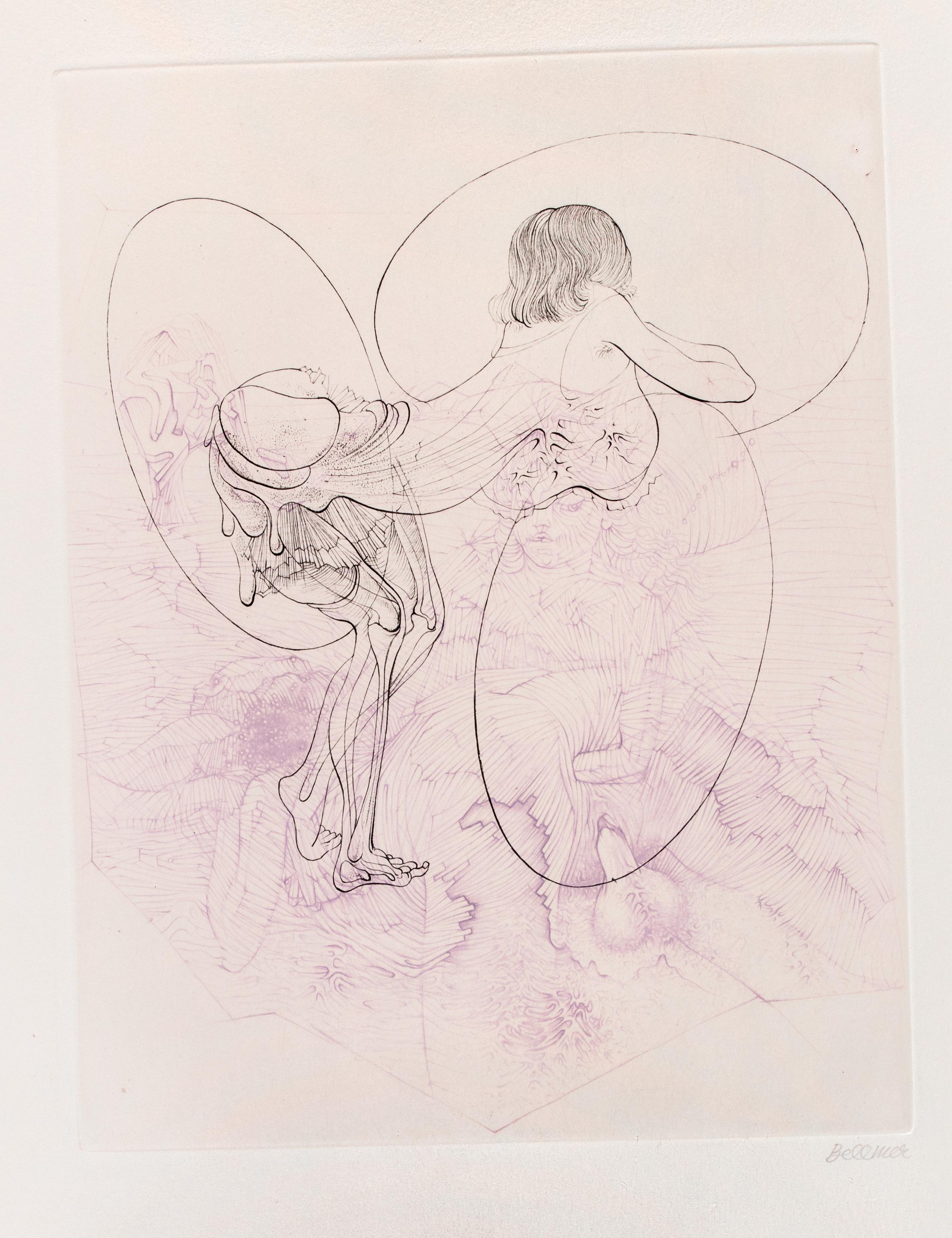
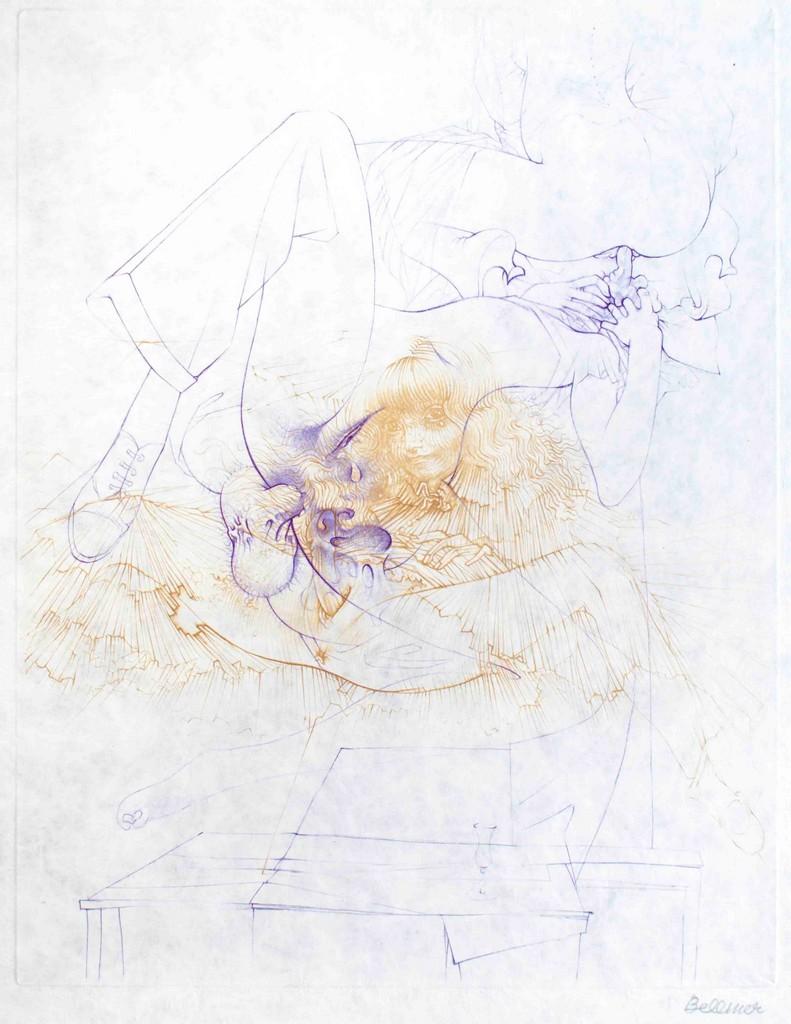
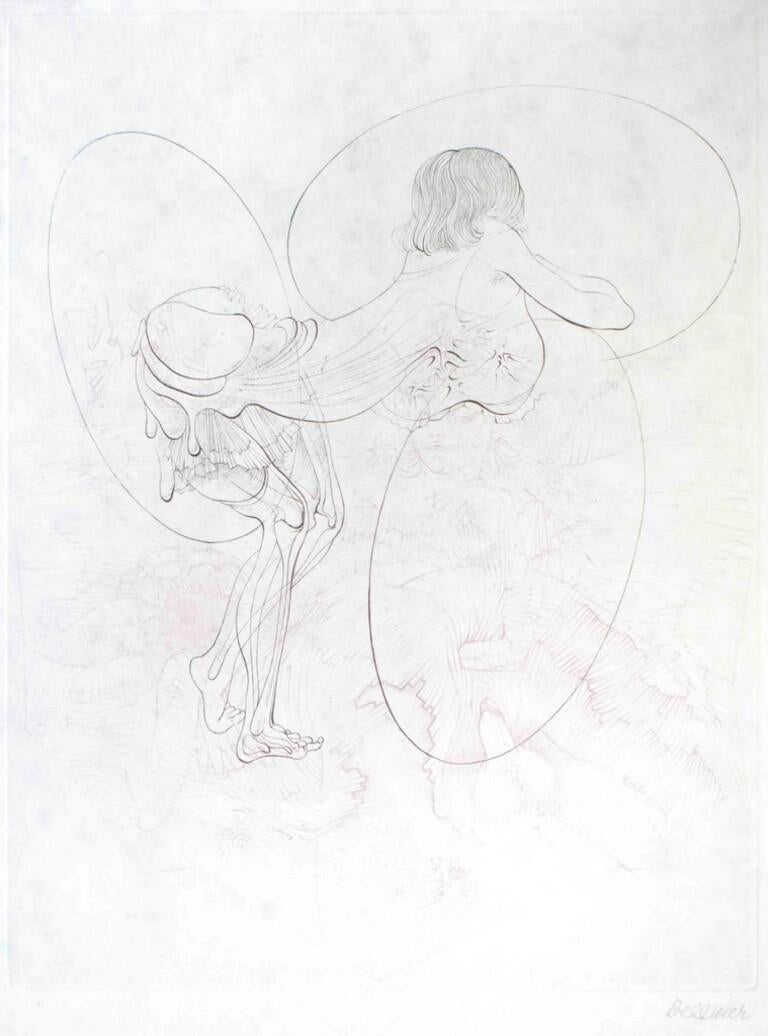
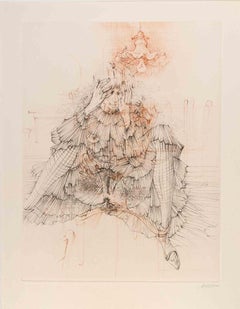
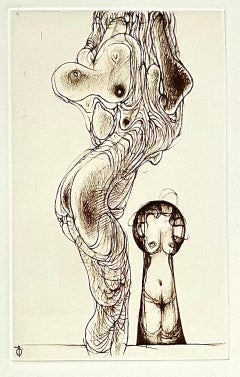
Hans Bellmer, 'Child and Seeing Hands', photogravure and engraving, edition 90, 1970. Flahutez 4-9. Signed by the artist and numbered '41/90' in pencil. A superb, richly-inked impression, on off-white Van Gelder Zonen laid paper; the full sheet with margins (2 5/8 to 3 1/2 inches), in excellent condition. Archivally matted to museum standards, unframed. Image size 6 13/16 x 8 3/4 inches (173 x 222 mm); sheet size 13 x 14 1/16 inches (330 x 357 mm). After a gouache drawing created by the artist in 1948, now in the collection of the Art Institute of Chicago. ABOUT THE ARTIST Hans Bellmer (1902–1975) was a photographer, sculptor, writer, and painter associated with the Surrealist movement. Born in Katowice, Poland, Bellmer was coerced by his overbearing father into working at a steel factory and a coal mine, even after passing university entrance exams. He began studies in engineering at the Technische Hochschule in Berlin but left to pursue his interest in art and politics. Bellmer became close to George Grosz, one of his drawing instructors, whose critical perspective on society strongly influenced Bellmer’s studies and interests. In 1924, Bellmer worked as a book printer and illustrator at Malik Verlag, where he demonstrated his artistic ability, contributing drawings to Dadaist novels. In the late 1920s, Bellmer began traveling, visiting France, Italy, and Tunisia. Bitterly opposed to the rise of Fascism and the Nazi regime in the early 1930s, he stopped working in protest, refusing to support the state. Partly influenced by Jacques Offenbach’s (1819-1880) final opera, The Tales of Hoffmann, where the hero falls in love with a realistic life-size mechanical doll, Bellmer built his first Doll in 1933-4. An articulated construction of wood, plaster, metal rods, nuts, and bolts representing a young girl, it embodied qualities of the archetypal surrealist object: coupled attraction and aversion, subversion and eroticism, sadism and fetishism. Bellmer photographed the doll in a series of erotic postures, publishing a collection of 10 of these images, accompanied by text, as 'Die Puppe' in 1934. He submitted a group of his photographs to the Parisian Surrealist magazine 'Le Minotaure', the publication of which confirmed his place as an innovator within the Surrealist movement. Bellmer’s dolls (one of which he made with a large, bulbous abdomen and two hinged pelvises) often appear fragmented and mangled as though appendages had been detached and rearranged. They are simultaneously naturalistic and surreal, evoking emotional responses from recognition and excitement to anxiety and revulsion. Bellmer moved to Paris in 1938 and continued to create his uniquely sensitive, provocative works featuring the themes of the subconscious, dreams, sexuality, lust, and death. His first solo exhibition was in 1943 at the bookstore Librairie Trentin in Toulouse, France. Bellmer’s work has since been shown in various museums and galleries worldwide, including the Whitechapel Gallery in London, the Neue Nationalgalerie in Berlin, and The Museum of Modern Art in New York City. Bellmer's graphic works are held in numerous museum collections, including the Art Institute of Chicago; The Cleveland Museum of Art; The Israel Museum, Jerusalem; The Metropolitan Museum of Art; Minneapolis Institute of Art; The Museum of Fine Arts, Houston; Museum of Modern Art; Portland Art Museum; Princeton University Art Museum; and the Victoria and Albert Museum, London.
  • Creator:
    Hans Bellmer (1912 - 1975, German)
  • Creation Year:
    1970
  • Dimensions:
    Height: 6.82 in (17.33 cm)Width: 8.75 in (22.23 cm)
  • Medium:
  • Movement & Style:
  • Period:
    1670-1679
  • Condition:
  • Gallery Location:
    Myrtle Beach, SC
  • Reference Number:
    Seller: 1042721stDibs: LU532313474272

More From This Seller

View All
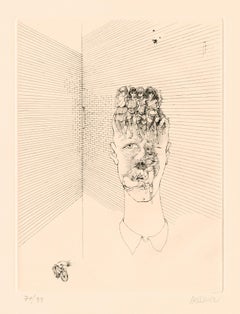
'Blue Eyes' — Erotic Surrealism, Signed Engraving, 1971

'Blue Eyes' — Erotic Surrealism, Signed Engraving, 1971

By Hans Bellmer

Located in Myrtle Beach, SC

Hans Bellmer, 'Blue Eyes', engraving and drypoint, edition 99, 1971. Flahutez 89. Signed and numbered '74/99' in pencil. A fine impression, on Arches cream wove paper; the full sheet...

Category

1970s Surrealist Abstract Prints

Materials

Drypoint, Engraving

Les Marionettes II — Erotic Surrealism, Signed etching, 1969

Les Marionettes II — Erotic Surrealism, Signed etching, 1969

By Hans Bellmer

Located in Myrtle Beach, SC

Hans Bellmer, 'Les Marionettes II', etching with hand coloring, 1969, edition 150, Flahutez 58-8. Signed and annotated 'HC' in pencil. A fine impression on brown Fabriano hand-made laid paper; the full sheet with margins (3/4 to 3 1/4 inches), in excellent condition. Archivally sleeved, unmatted. Image size 13 7/16 x 11 7/8 inches; sheet size 19 1/8 x 13 1/4 inches. A 'Hors Commerce' impression. From a suite of 11 etchings created by Bellmer to illustrate 'On the Marionette Theatre...

Category

1960s Surrealist Abstract Prints

Materials

Etching

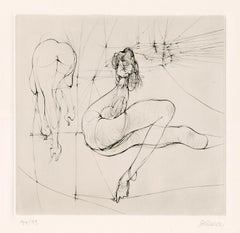
Untitled (Two Nudes) — Erotic Surrealism, Signed etching, 1971

Untitled (Two Nudes) — Erotic Surrealism, Signed etching, 1971

By Hans Bellmer

Located in Myrtle Beach, SC

Hans Bellmer, Untitled (Two Nudes), engraving and drypoint, 1971, edition 99. Signed and numbered '94/99' in pencil. A fine impression, on Arches cream wove paper; the full sheet wit...

Category

1960s Surrealist Abstract Prints

Materials

Engraving, Drypoint

Les Marionettes I — Erotic Surrealism, Signed etching, 1969

Les Marionettes I — Erotic Surrealism, Signed etching, 1969

By Hans Bellmer

Located in Myrtle Beach, SC

Hans Bellmer, Les Marionettes I, etching with hand coloring, 1969, edition 150. Signed and annotated 'HC' in pencil. A fine impression on brown Roma hand-made laid paper; the full sheet with margins (1 to 2 5/8 inches), in excellent condition. Archivally sleeved, unmatted. Image size 11 13/16 x 11 1/8 inches; sheet size 15 5/8 x 13 1/4 inches. A 'Hors Commerce' impression. From a suite of 11 etchings created by Bellmer to illustrate 'On the Marionette Theatre...

Category

1960s Surrealist Abstract Prints

Materials

Etching

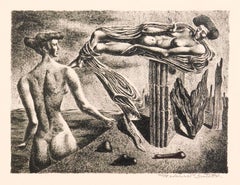
'Body and Soul' — 1930s Rare Signed Surrealist Lithograph

'Body and Soul' — 1930s Rare Signed Surrealist Lithograph

By Federico Castellon

Located in Myrtle Beach, SC

Federico Castellon, 'Body and Soul', 1938, lithograph, edition 30, Freundlich 3. Signed in pencil. Signed in the stone, lower left. A fine, richly-inked, atmospheric impression on cr...

Category

1940s Surrealist Figurative Prints

Materials

Lithograph

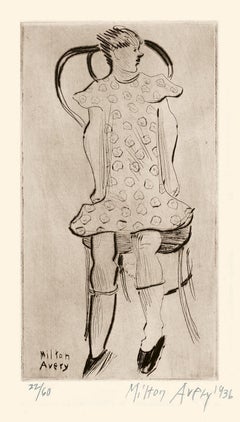
'Little Girl' — American Modernist Signed Drypoint, 1936

'Little Girl' — American Modernist Signed Drypoint, 1936

By Milton Avery

Located in Myrtle Beach, SC

Milton Avery, 'Little Girl', drypoint, 1936, edition 60, Lunn 11. Signed, dated, and numbered '22/60' in pencil. A superb impression, in warm black ink with delicate overall plate tone, on off-white wove paper, with wide margins (2 5/8 to 4 1/8 inches); hinge stains on the top sheet edge, verso, otherwise in excellent condition. Matted to museum standards, unframed. Image size 8 3/4 x 4 3/4 inches (222 x 121 mm); sheet size 14 7/8 x 13 1/8 inches (378 x 333 mm). Collections: Cantor Arts Center, National Gallery of Art. ABOUT THE ARTIST "I never have any rules to follow; I follow myself." "I paint not by sight but by faith. Faith gives you sight." —Milton Avery 'His is the poetry of sheer loveliness.' —Mark Rothko in his 1965 eulogy to Avery. Milton Avery (1885-1965) is recognized as one of America's foremost modernist artists, renowned for his uniquely expressive style, evocative use of color, and captivating compositions. Growing up in a working-class family in Altmar, New York, Avery's early life was marked by the struggles and realities of rural New York. Despite lacking formal artistic training, he displayed an innate talent for drawing from an early age. In 1905, his family relocated to Hartford, Connecticut, where he worked various odd jobs while developing his artistic skills through self-study and experimentation. In 1915, he enrolled at the Connecticut League of Art Students, where he received formal instruction and began to refine his distinctive style. In 1918, Avery transferred to the School of the Art Society of Hartford and worked in the evenings so that he could paint during the day. He became a member of the Connecticut Academy of Fine Arts in 1924. That summer in Gloucester, Massachusetts, he met the artist Sally Michael...

Category

1930s American Modern Figurative Prints

Materials

Drypoint

You May Also Like

Aline et Valcour Etching, Surrealist, Signed, 1968, Japon Nacré

Aline et Valcour Etching, Surrealist, Signed, 1968, Japon Nacré

By Hans Bellmer

Located in Roma, IT

Image dimensions: 38.2 x 28.4 cm. Hand Signed. From the Portfolio "Petit Traité de Morale", Paris, Editions Georges Visat, 1968. Copy on Japon Nacré from the additional suite. Incl...

Category

1960s Surrealist More Prints

Materials

Etching

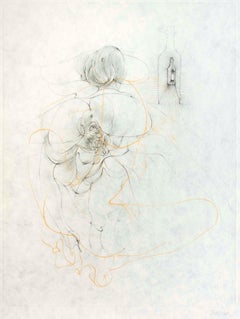
Les Infortunes de la Vertu - Etching by Hans Bellmer - 1968

Les Infortunes de la Vertu - Etching by Hans Bellmer - 1968

By Hans Bellmer

Located in Roma, IT

Les Infortunes de la Vertu is a modern artwork realized by Hans Bellmer. Hand Signed. From the Portfolio "Petit Traité de Morale", Paris, Editions Georges Visat, 1968. Copy on Véli...

Category

1960s Surrealist More Prints

Materials

Paper, Etching

German Surrealist Hans Bellmer Etching Engraving Print Cecile Reims Surrealism

German Surrealist Hans Bellmer Etching Engraving Print Cecile Reims Surrealism

By Hans Bellmer

Located in Surfside, FL

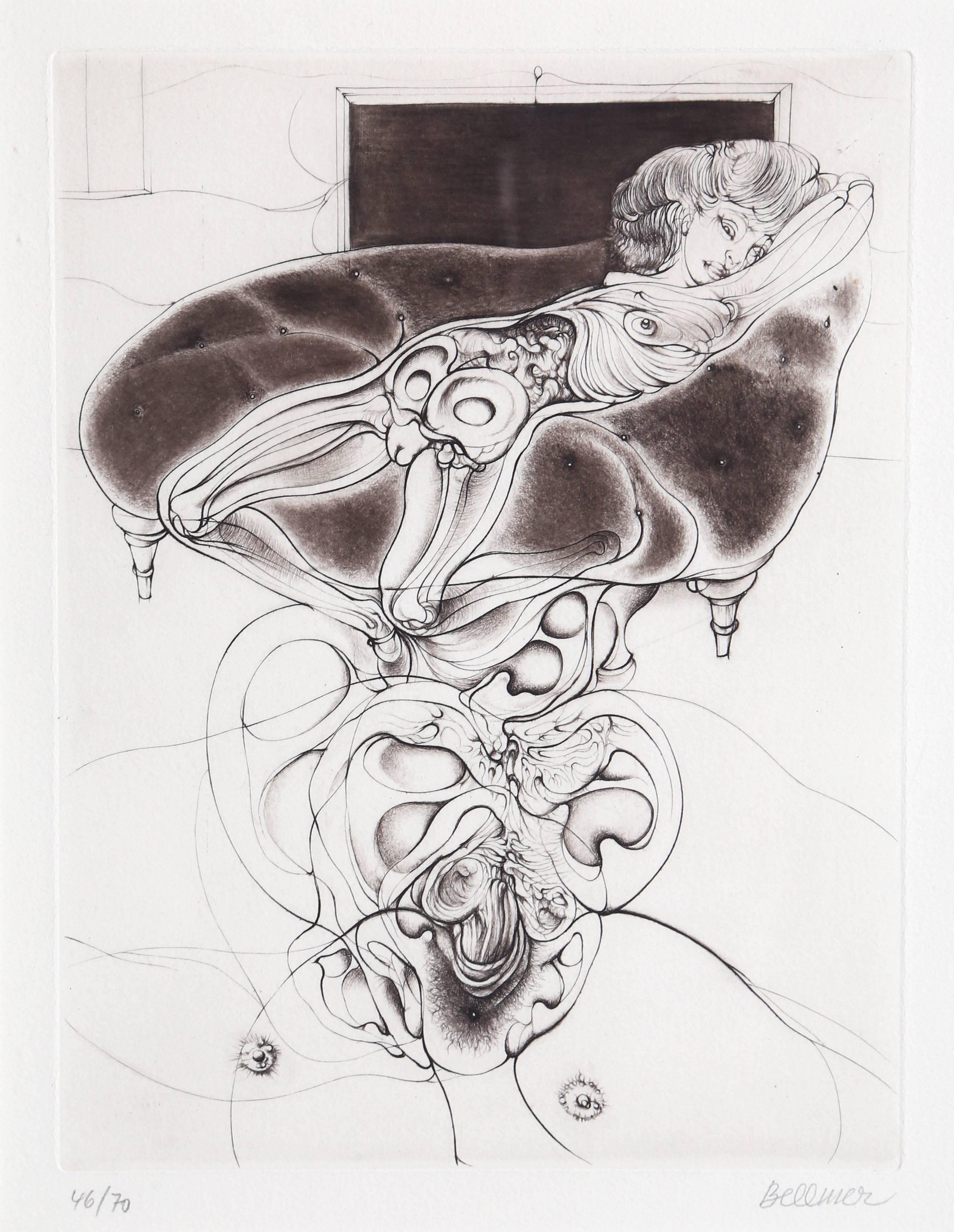
After Hans Bellmer (German, 1902-1975) Surrealist engraving, etching after drawings from a 1942 notebook, engraved in 1974-75 by Cecile Reims Printed by L'Atelier de Chalcographie du Louvre, Paris, Having printed monogram lower left in plate, pencil notations verso Editioned from a very small edition of #7/10 'Musee du Louvre' blindstamp. Dimensions: Sheet 11 X 7.5, Plate size 6.5 X 4 Hans Bellmer ( 1902 – 1975) was a Polish born German artist, best known for his drawings, etchings that illustrates the 1940 edition of Histoire de l’œil, and the life-sized female sculpture mannequin dolls he produced in the mid-1930s. Historians of art and photography also consider him a Surrealist photographer. Bellmer was born in the city of Kattowitz, then part of the German Empire (now Katowice, Poland). Up until 1926, he worked as a draftsman for his own advertising company. Bellmer is most famous for the creation of a series of dolls as well as photographs of them. He was influenced in his choice of art form in part by reading the published letters of Oskar Kokoschka (Der Fetisch, 1925) and Surrealism. Bellmer's puppet doll project is also said to have been catalysed by a series of events in his personal life. Hans Bellmer takes credit for provoking a physical crisis in his father and brings his own artistic creativity into association with childhood insubordination and resentment toward a severe and humorless paternal authority. Perhaps this is one reason for the nearly universal, unquestioning acceptance in the literature of Bellmer's promotion of his art as a struggle against his father, the police, and ultimately, fascism and the state. Events of his personal life also including meeting a beautiful teenage cousin in 1932 (and perhaps other unattainable beauties), attending a performance of Jacques Offenbach's Tales of Hoffmann (in which a man falls tragically in love with an automaton), and receiving a box of his old toys. After these events, he began to actually construct his first dolls. In his works, Bellmer explicitly sexualized the doll as a young girl (his work bears connection to the works of Bathus). Hirschfeld has claimed (without further argumentation) that Bellmer initiated his doll project to oppose the fascism of the Nazi Party by declaring that he would make no work that would support the new German state. Represented by mutated forms and unconventional poses, his dolls (according to this view) were directed specifically at the cult of the perfect body then prominent in Germany. He visited Paris in 1935 and made contacts there, such as Paul Éluard, but returned to Berlin because his wife Margarete was dying of tuberculosis. He was part of the circle of Surrealist luminaries such as Man Ray, Marcel Duchamp, Max Ernst, Joan Miro, André Masson, René Magritte, Alberto Giacometti and Salvador Dali as well as women artists—such as Frida Kahlo, Dorothea Tanning and Leonora Carrington. Bellmer produced the first doll in Berlin in 1933. Long since lost, the assemblage can nevertheless be correctly described thanks to approximately two dozen photographs Bellmer took at the time of its construction. Standing about fifty-six inches tall, the doll consisted of a modeled torso made of flax fiber, glue, and plaster; a mask-like head of the same material with glass eyes and a long, unkempt wig; and a pair of legs made from broomsticks or dowel rods. One of these legs terminated in a wooden, club-like foot; the other was encased in a more naturalistic plaster shell, jointed at the knee and ankle. As the project progressed, Bellmer made a second set of hollow plaster legs, with wooden ball joints for the doll's hips and knees. There were no arms to the first sculpture, but Bellmer did fashion or find a single wooden hand, which appears among the assortment of doll parts the artist documented in an untitled photograph of 1934, as well as in several photographs of later work. Bellmer's 1934 anonymous book, The Doll (Die Puppe), produced and published privately in Germany, contains 10 black-and-white photographs of Bellmer's first doll arranged in a series of "tableaux vivants" (living pictures). The book was not credited to him, as he worked in isolation, and his photographs remained almost unknown in Germany. Yet Bellmer's work was eventually declared "degenerate" (entartete kunst) by the Nazi Party, and he was forced to flee Germany to France in 1938, where Bellmer's work was welcomed by the Surrealists around Andre Breton. He aided the French Resistance during the war by making fake passports. He was imprisoned in the Camp des Milles prison at Aix-en-Provence, a brickworks camp for German nationals, from September 1939 until the end of the Phoney War in May 1940. After the war, Bellmer lived the rest of his life in Paris. Bellmer gave up doll-making and spent the following decades creating erotic drawings, etchings, sexually explicit photographs, paintings, and prints of pubescent girls. In 1954, he met Unica Zürn...

Category

20th Century Abstract Prints
Materials

Etching

German Surrealist Hans Bellmer Etching Engraving Print Cecile Reims Surrealism

German Surrealist Hans Bellmer Etching Engraving Print Cecile Reims Surrealism

By Hans Bellmer

Located in Surfside, FL

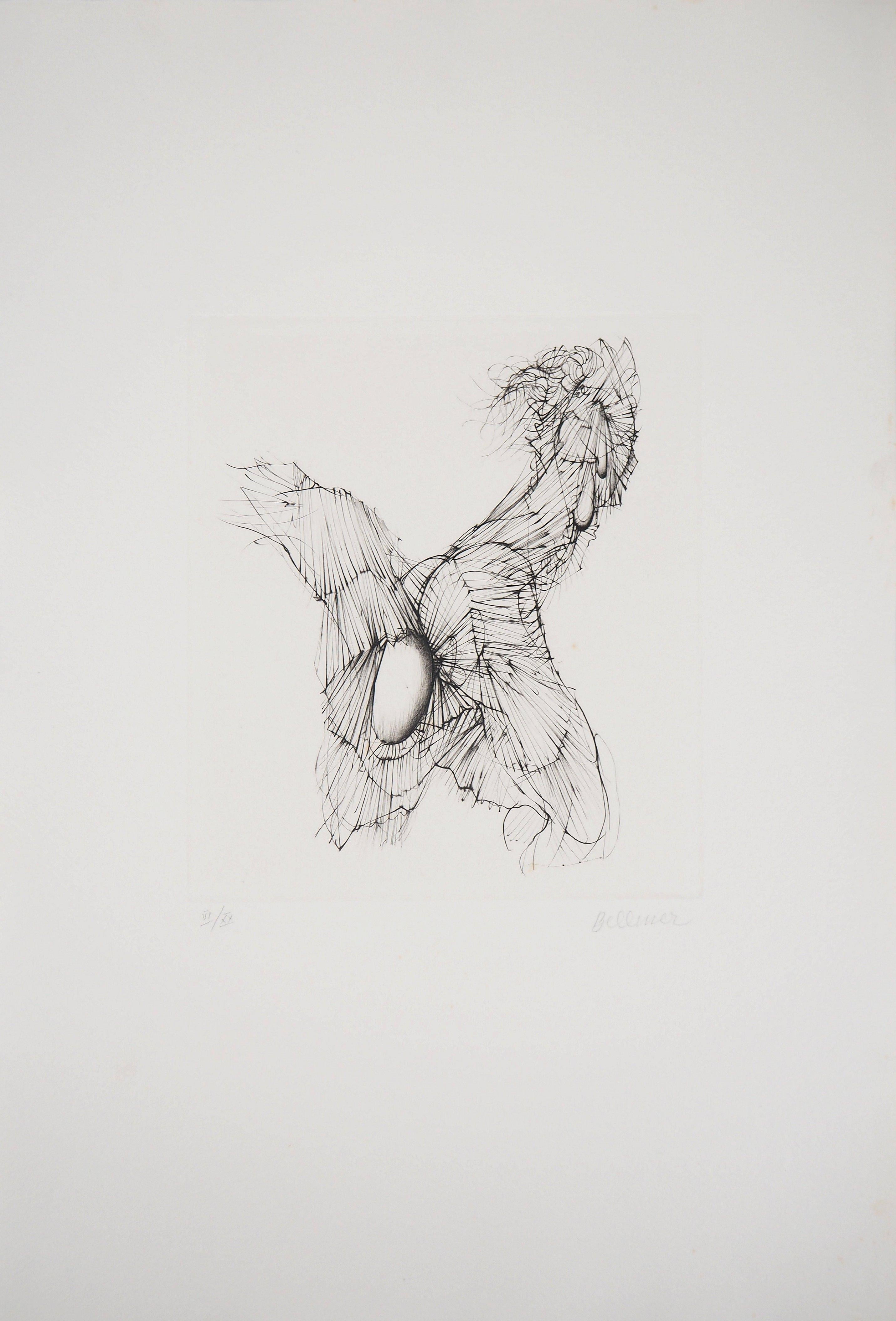
After Hans Bellmer (German, 1902-1975) Surrealist engraving, etching after drawings from a 1942 notebook, engraved in 1974-75 by Cecile Reims Printed by L'Atelier de Chalcographie du Louvre, Paris, Having printed monogram lower left in plate, pencil notations verso Editioned from a very small edition of #7/10 'Musee du Louvre' blindstamp. Dimensions: Sheet 11 X 7.5, Plate size 6.5 X 4 Hans Bellmer ( 1902 – 1975) was a Polish born German artist, best known for his drawings, etchings that illustrates the 1940 edition of Histoire de l’œil, and the life-sized female sculpture mannequin dolls he produced in the mid-1930s. Historians of art and photography also consider him a Surrealist photographer. Bellmer was born in the city of Kattowitz, then part of the German Empire (now Katowice, Poland). Up until 1926, he worked as a draftsman for his own advertising company. Bellmer is most famous for the creation of a series of dolls as well as photographs of them. He was influenced in his choice of art form in part by reading the published letters of Oskar Kokoschka (Der Fetisch, 1925) and Surrealism. Bellmer's puppet doll project is also said to have been catalysed by a series of events in his personal life. Hans Bellmer takes credit for provoking a physical crisis in his father and brings his own artistic creativity into association with childhood insubordination and resentment toward a severe and humorless paternal authority. Perhaps this is one reason for the nearly universal, unquestioning acceptance in the literature of Bellmer's promotion of his art as a struggle against his father, the police, and ultimately, fascism and the state. Events of his personal life also including meeting a beautiful teenage cousin in 1932 (and perhaps other unattainable beauties), attending a performance of Jacques Offenbach's Tales of Hoffmann (in which a man falls tragically in love with an automaton), and receiving a box of his old toys. After these events, he began to actually construct his first dolls. In his works, Bellmer explicitly sexualized the doll as a young girl (his work bears connection to the works of Bathus). Hirschfeld has claimed (without further argumentation) that Bellmer initiated his doll project to oppose the fascism of the Nazi Party by declaring that he would make no work that would support the new German state. Represented by mutated forms and unconventional poses, his dolls (according to this view) were directed specifically at the cult of the perfect body then prominent in Germany. He visited Paris in 1935 and made contacts there, such as Paul Éluard, but returned to Berlin because his wife Margarete was dying of tuberculosis. He was part of the circle of Surrealist luminaries such as Man Ray, Marcel Duchamp, Max Ernst, Joan Miro, André Masson, René Magritte, Alberto Giacometti and Salvador Dali as well as women artists—such as Frida Kahlo, Dorothea Tanning and Leonora Carrington. Bellmer produced the first doll in Berlin in 1933. Long since lost, the assemblage can nevertheless be correctly described thanks to approximately two dozen photographs Bellmer took at the time of its construction. Standing about fifty-six inches tall, the doll consisted of a modeled torso made of flax fiber, glue, and plaster; a mask-like head of the same material with glass eyes and a long, unkempt wig; and a pair of legs made from broomsticks or dowel rods. One of these legs terminated in a wooden, club-like foot; the other was encased in a more naturalistic plaster shell, jointed at the knee and ankle. As the project progressed, Bellmer made a second set of hollow plaster legs, with wooden ball joints for the doll's hips and knees. There were no arms to the first sculpture, but Bellmer did fashion or find a single wooden hand, which appears among the assortment of doll parts the artist documented in an untitled photograph of 1934, as well as in several photographs of later work. Bellmer's 1934 anonymous book, The Doll (Die Puppe), produced and published privately in Germany, contains 10 black-and-white photographs of Bellmer's first doll arranged in a series of "tableaux vivants" (living pictures). The book was not credited to him, as he worked in isolation, and his photographs remained almost unknown in Germany. Yet Bellmer's work was eventually declared "degenerate" (entartete kunst) by the Nazi Party, and he was forced to flee Germany to France in 1938, where Bellmer's work was welcomed by the Surrealists around Andre Breton. He aided the French Resistance during the war by making fake passports. He was imprisoned in the Camp des Milles prison at Aix-en-Provence, a brickworks camp for German nationals, from September 1939 until the end of the Phoney War in May 1940. After the war, Bellmer lived the rest of his life in Paris. Bellmer gave up doll-making and spent the following decades creating erotic drawings, etchings, sexually explicit photographs, paintings, and prints of pubescent girls. In 1954, he met Unica Zürn...

Category

20th Century Abstract Prints
Materials

Etching

Juliette ou les Prospérités du Vice - Etching by Hans Bellmer - 1968

Juliette ou les Prospérités du Vice - Etching by Hans Bellmer - 1968

By Hans Bellmer

Located in Roma, IT

Juliette ou les Prospérités du Vice is a contemporary artwork realized by Hans Bellmer. Hand Signed. From the Portfolio "Petit Traité de Morale", Paris, Editions Georges Visat, 1968...

Category

1960s Surrealist More Prints

Materials

Paper, Etching

Dialogue Entre un Prêtre et un Moribond - Etching by Hans Bellmer - 1968

Dialogue Entre un Prêtre et un Moribond - Etching by Hans Bellmer - 1968

By Hans Bellmer

Located in Roma, IT

Hand Signed. From the Portfolio "Petit Traité de Morale", Paris, Editions Georges Visat, 1968. Copy on Japon Nacré from the additional suite. Includes matting Hans Bellmer was a Ge...

Category

1960s Modern Figurative Prints

Materials

Paper, Etching