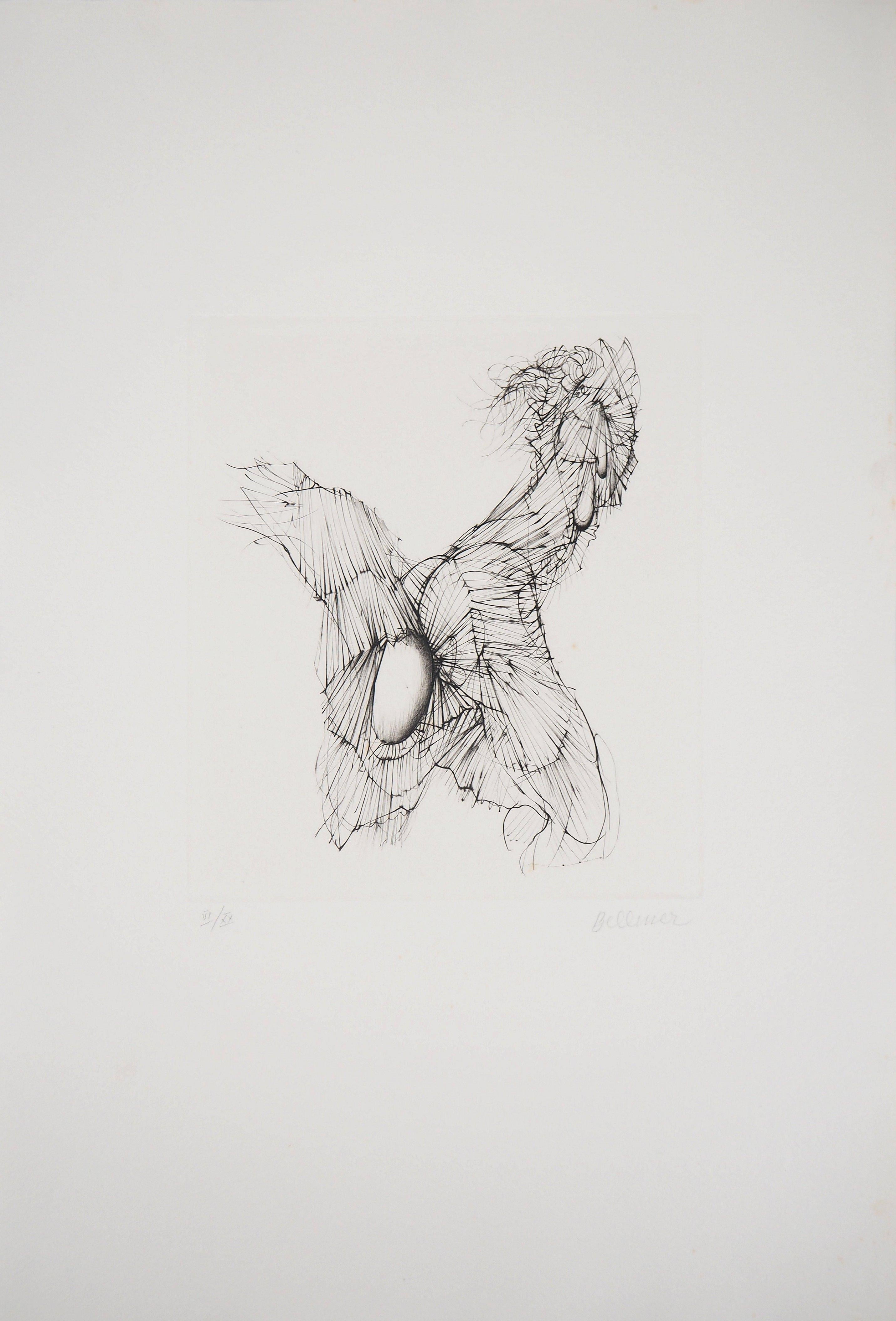
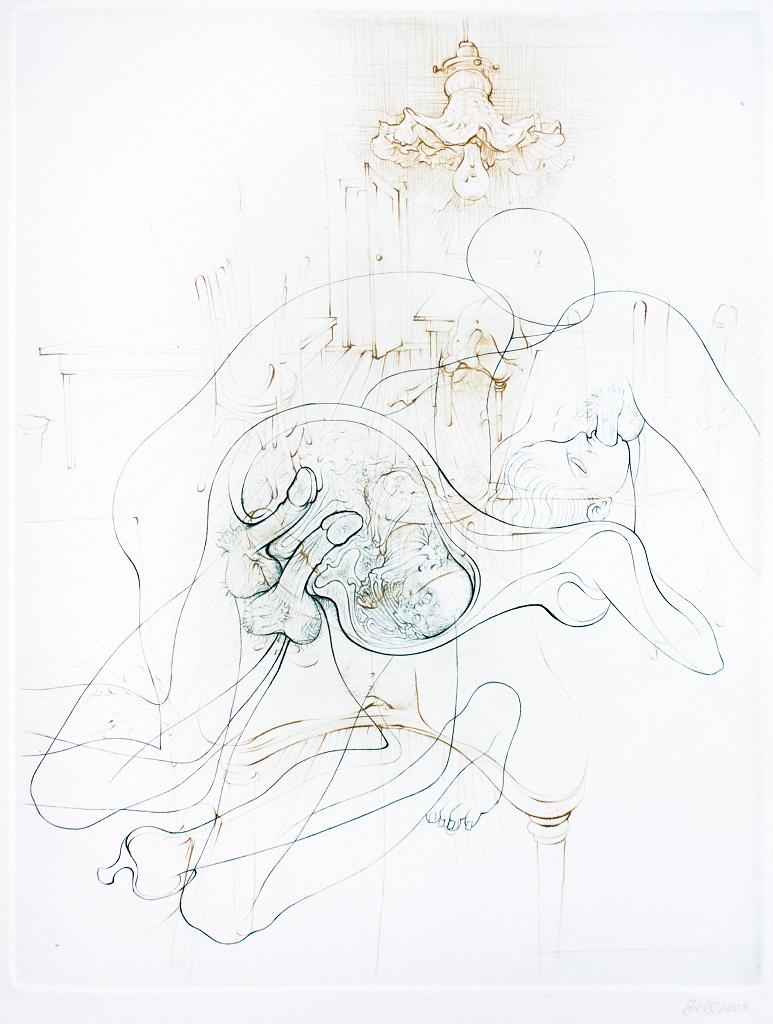
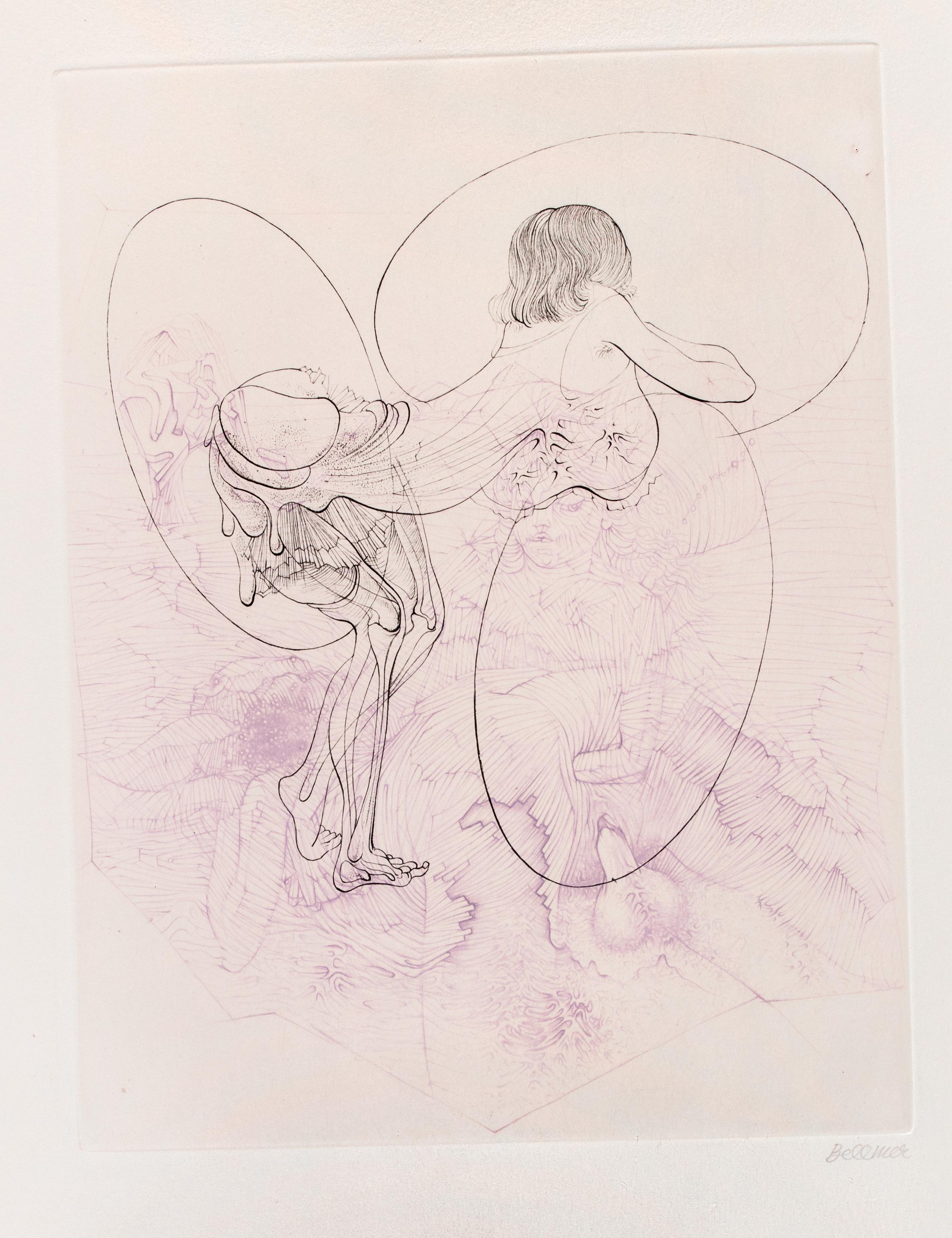
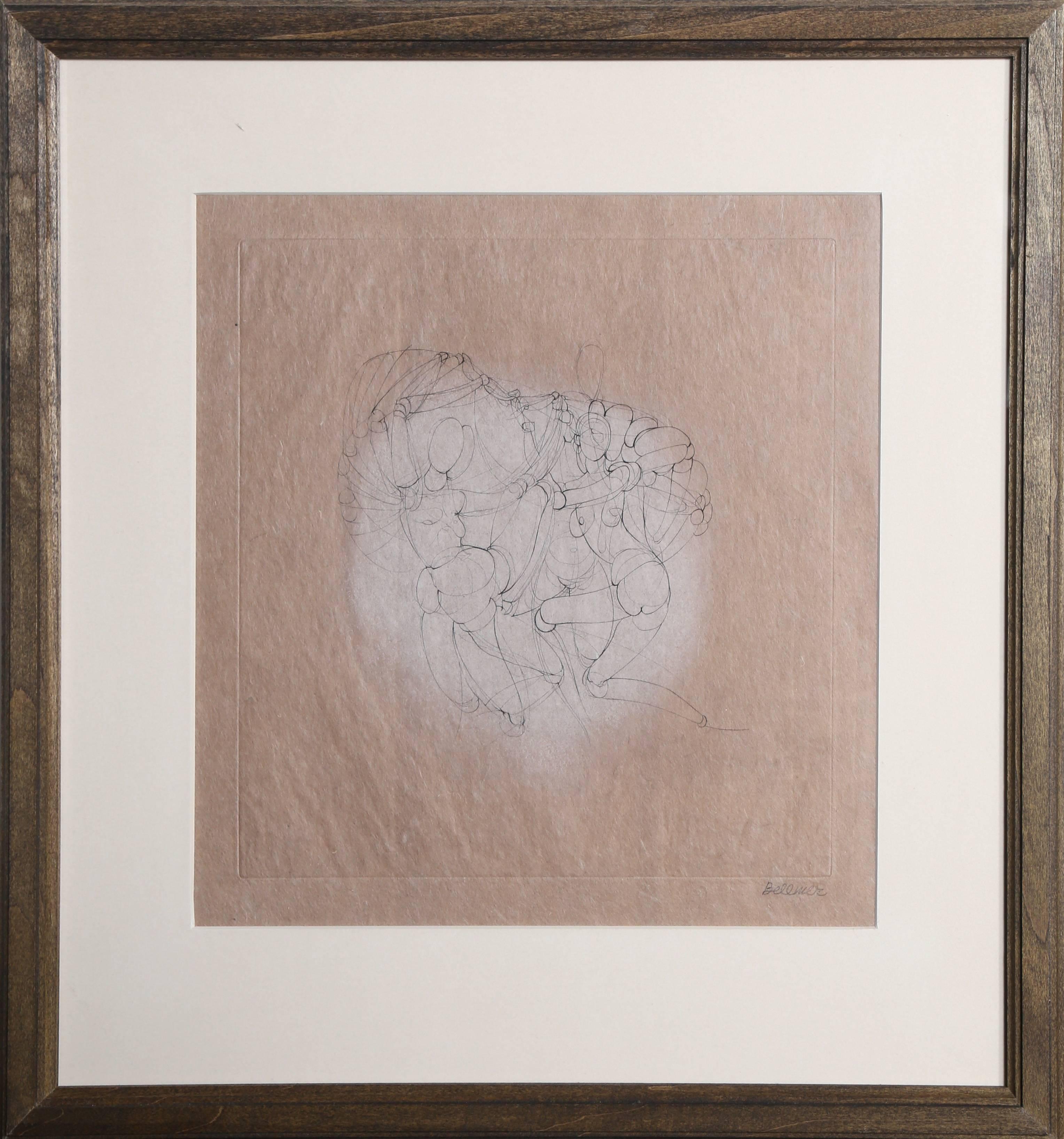
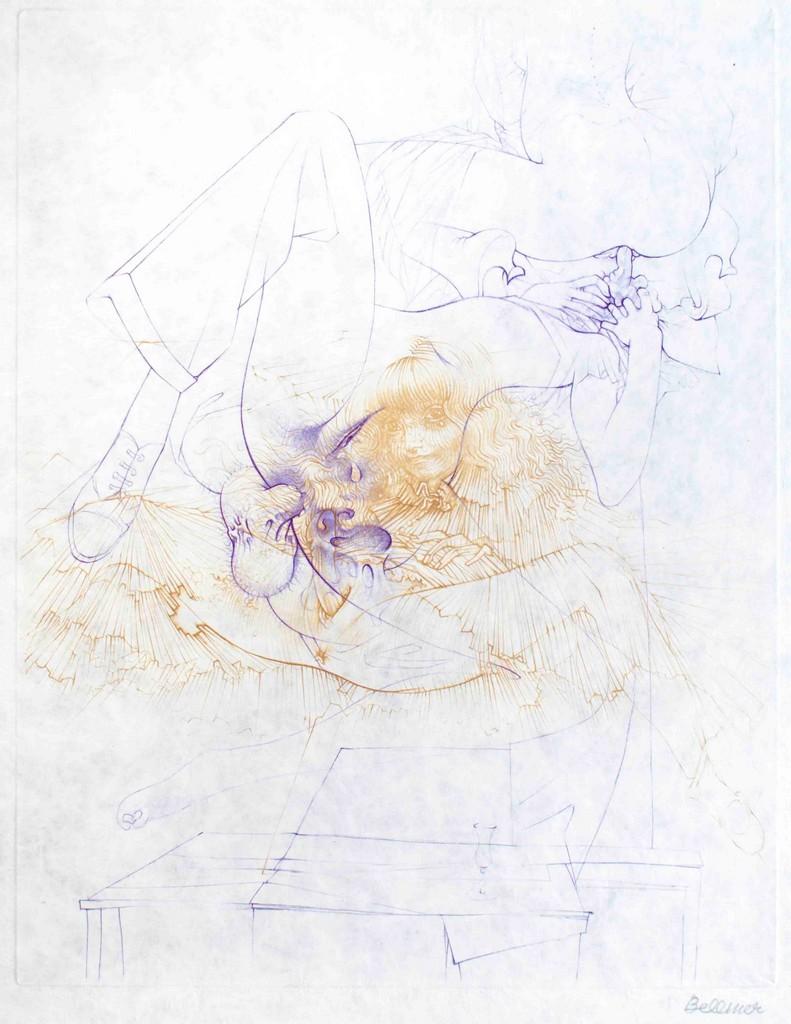
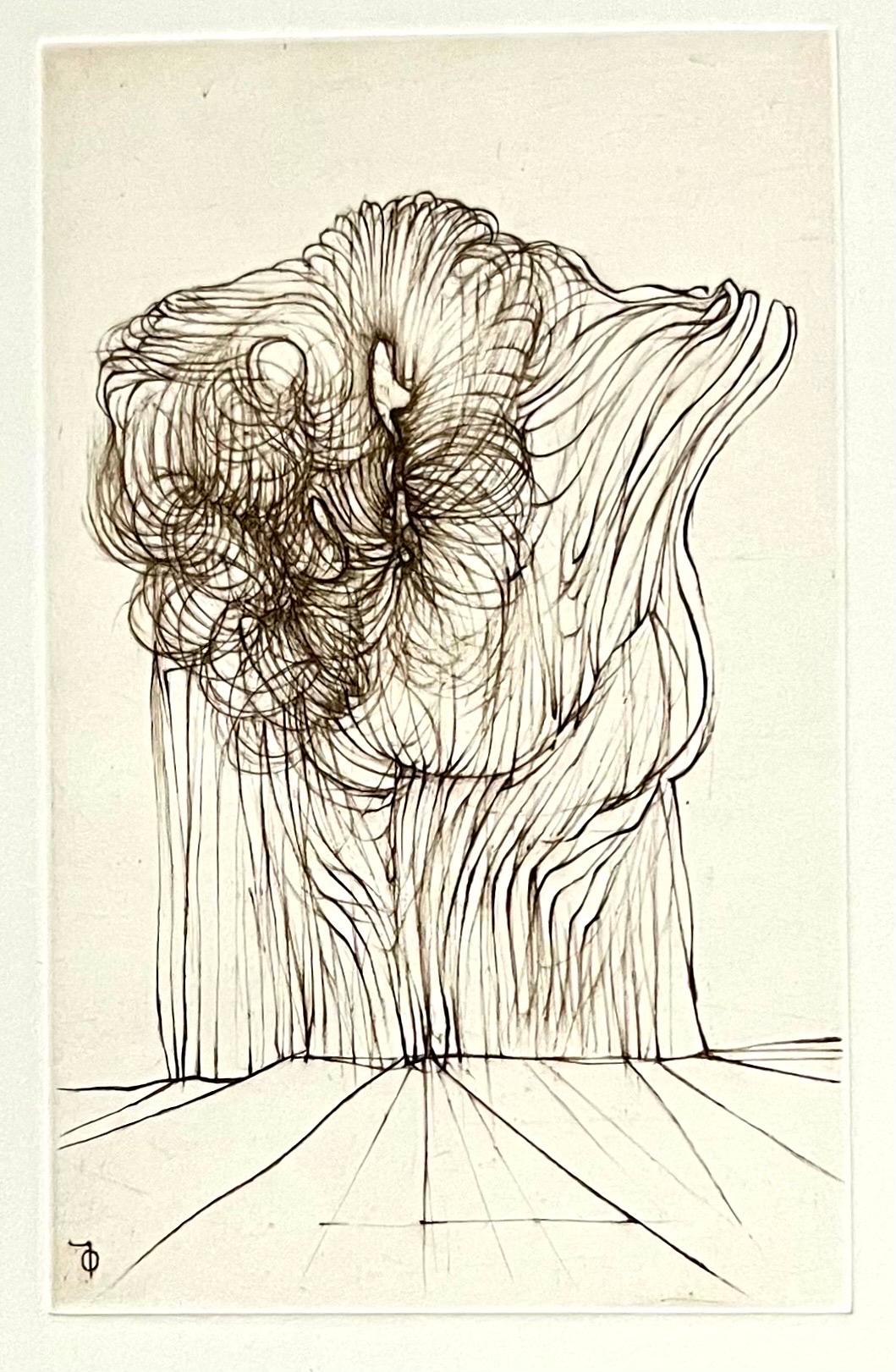
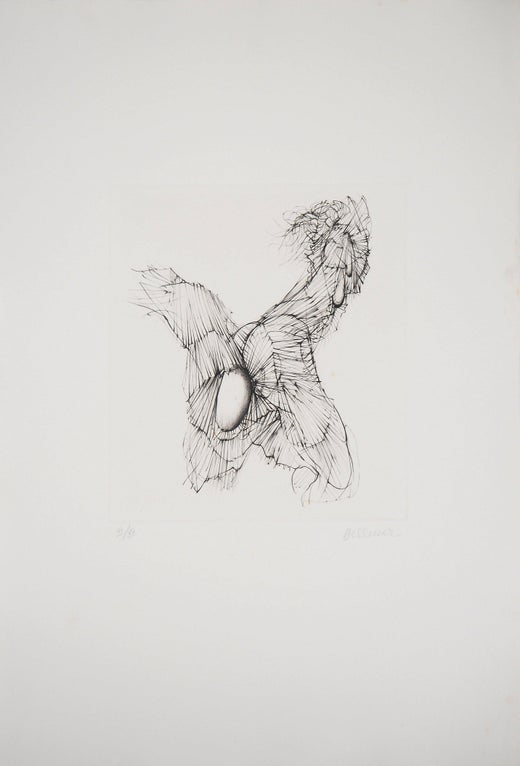
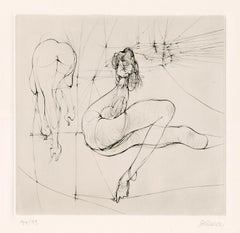
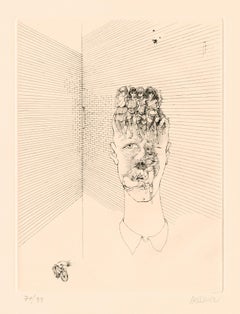
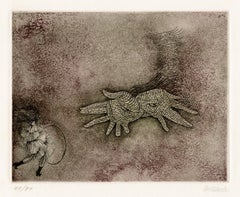
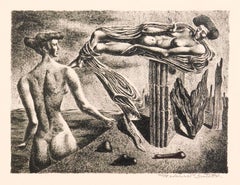
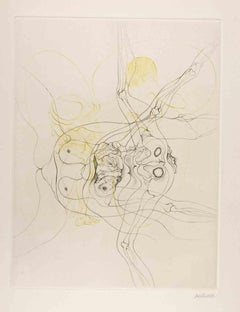
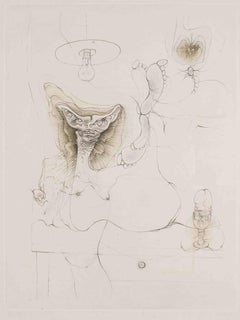
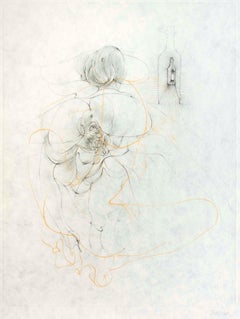
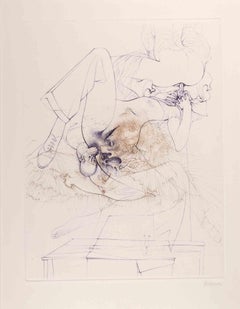
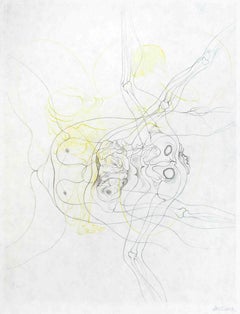
Hans Bellmer, Les Marionettes I, etching with hand coloring, 1969, edition 150. Signed and annotated 'HC' in pencil. A fine impression on brown Roma hand-made laid paper; the full sheet with margins (1 to 2 5/8 inches), in excellent condition. Archivally sleeved, unmatted.
Image size 11 13/16 x 11 1/8 inches; sheet size 15 5/8 x 13 1/4 inches.
A 'Hors Commerce' impression. From a suite of 11 etchings created by Bellmer to illustrate 'On the Marionette Theatre' an essay by renowned German author Heinrich von Kleist (1777-1811). Published by Les Edition Georges Visat, Paris, 1969.
ABOUT THE ARTIST
Hans Bellmer (1902–1975) was a photographer, sculptor, writer, and painter associated with the Surrealist movement. Born in Katowice, Poland, Bellmer was coerced by his overbearing father into working at a steel factory and a coal mine, even after passing university entrance exams. He began studies in engineering at the Technische Hochschule in Berlin but left to pursue his interest in art and politics. Bellmer became close to George Grosz, one of his drawing instructors, whose critical perspective on society strongly influenced Bellmer’s studies and interests.
In 1924, Bellmer worked as a book printer and illustrator at Malik Verlag, where he demonstrated his artistic ability, contributing drawings to Dadaist novels. In the late 1920s, Bellmer began traveling, visiting France, Italy, and Tunisia.
Bitterly opposed to the rise of Fascism and the Nazi regime in the early 1930s, he stopped working in protest, refusing to support the state. Partly influenced by Jacques Offenbach’s (1819-1880) final opera, The Tales of Hoffmann, where the hero falls in love with a realistic life-size mechanical doll, Bellmer built his first Doll in 1933-4. An articulated construction of wood, plaster, metal rods, nuts, and bolts representing a young girl, it embodied qualities of the archetypal surrealist object: coupled attraction and aversion, subversion and eroticism, sadism and fetishism.
Bellmer photographed the doll in a series of erotic postures, publishing a collection of 10 of these images, accompanied by text, as 'Die Puppe' in 1934. He submitted a group of his photographs to the Parisian Surrealist magazine 'Le Minotaure', the publication of which confirmed his place as an innovator within the Surrealist movement. Bellmer’s dolls (one of which he made with a large, bulbous abdomen and two hinged pelvises) often appear fragmented and mangled as though appendages had been detached and rearranged. They are simultaneously naturalistic and surreal, evoking emotional responses from recognition and excitement to anxiety and revulsion.
Bellmer moved to Paris in 1938 and continued to create his uniquely sensitive, provocative works featuring the themes of the subconscious, dreams, sexuality, lust, and death. His first solo exhibition was in 1943 at the bookstore Librairie Trentin in Toulouse, France. Bellmer’s work has since been shown in various museums and galleries worldwide, including the Whitechapel Gallery in London, the Neue Nationalgalerie in Berlin, and The Museum of Modern Art in New York City.
Bellmer's graphic works are held in numerous museum collections, including the Art Institute of Chicago; The Cleveland Museum of Art; The Israel Museum, Jerusalem; The Metropolitan Museum of Art; Minneapolis Institute of Art; The Museum of Fine Arts, Houston; Museum of Modern Art; Portland Art Museum; Princeton University Art Museum; and the Victoria and Albert Museum, London.