Want more images or videos?
Request additional images or videos from the seller
1 of 5

William Hogarth
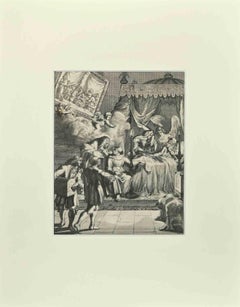
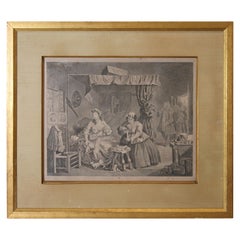
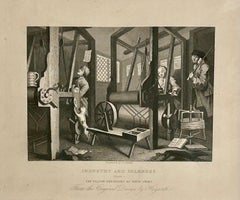
The Industrious Prentice - Etching by William Hogarth - 1747

1747

$646.83
£480.29
€550VAT Included
CA$907.77
A$920.21
CHF 523.39
MX$11,201.54
NOK 6,138.83
SEK 6,153.83
DKK 4,193.48

About the Item

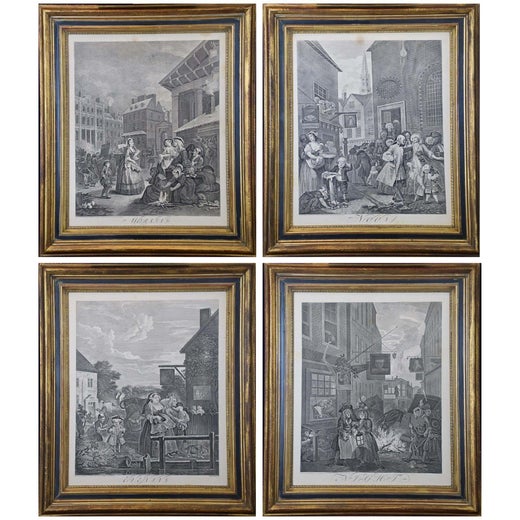
The Industrious Prentice - Lord Mayor of London is an original etching print realized by William Hogarth in 1747 Signature on the plate on the lower right, with the description on the lower. Good conditions, with some foxing. Engraving after William Hogarth's third of the four paintings The Humours of an Election (1754-58), his last painted cycle about contemporary affairs. The paintings are now in Sir John Soane's Museum, London. Hogarth shifted his attention from the squalor of urban life to the corruption of the political world. He drew inspiration from the notorious contest between the liberal Whig party and the conservative Tory party to win Oxfordshire’s parliamentary seats in the General Election of 1754. Hogarth depicts the four 'humours' of an election, and, in this plate, he scrutinizes the electoral process itself. The Polling is the third scene of the series, and depicts the voters at the polling stand with two candidates. Each side tries to extract votes from whomever they can whilst disputing the other side’s right to do the same.
  • Creator:
    William Hogarth (1697 - 1764, British)
  • Creation Year:
    1747
  • Dimensions:
    Height: 15.75 in (40 cm)Width: 21.66 in (55 cm)Depth: 0.08 in (2 mm)
  • Medium:
  • Movement & Style:
  • Period:
    1740-1749
  • Framing:
    Framing Options Available
  • Condition:
    Insurance may be requested by customers as additional service, contact us for more information.
  • Gallery Location:
    Roma, IT
  • Reference Number:
    Seller: T-1252821stDibs: LU65039038382

More From This Seller

View All
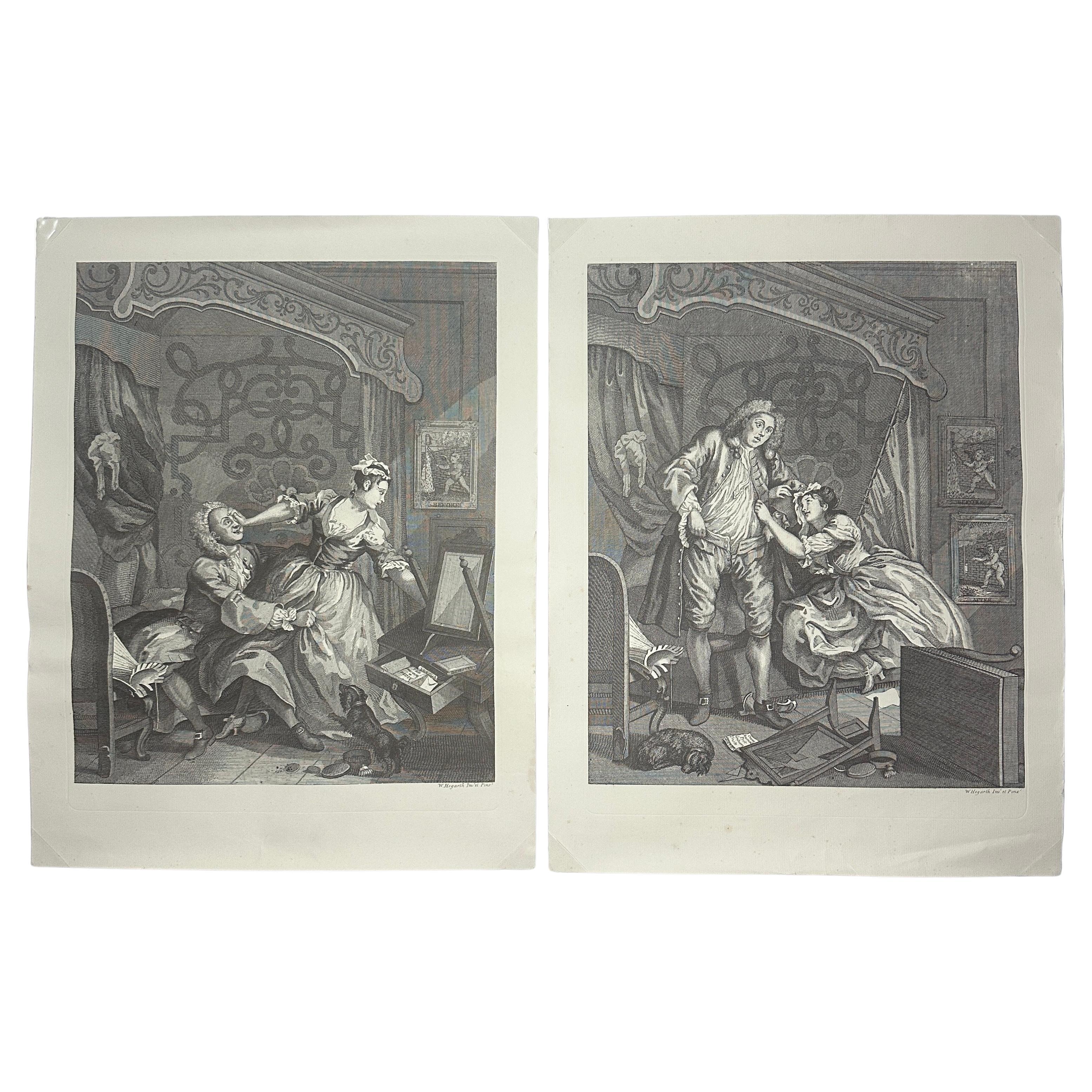
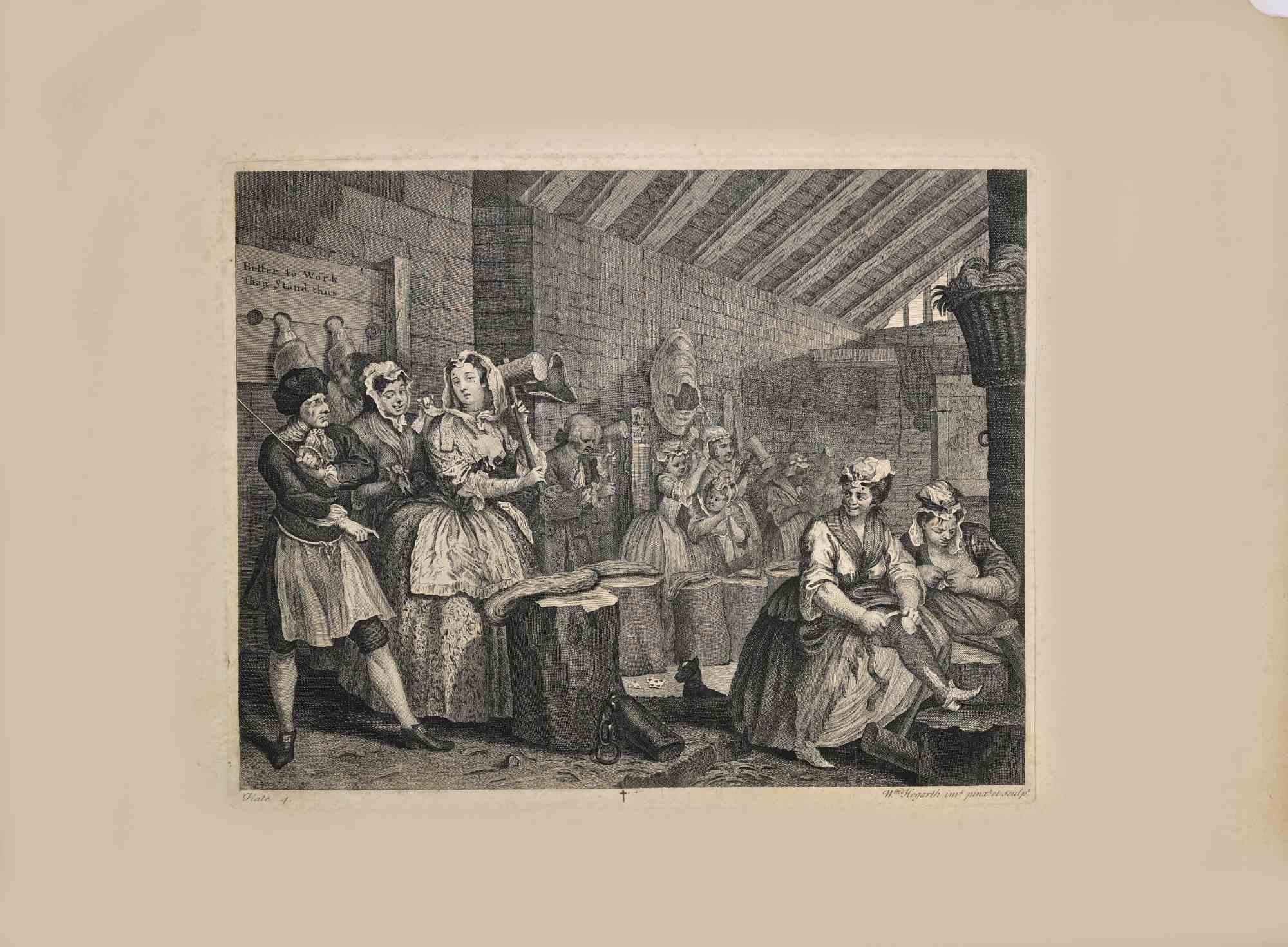
A Harlot's Progress - Etching after William Hogarth - 1732

A Harlot's Progress - Etching after William Hogarth - 1732

By William Hogarth

Located in Roma, IT

A Harlot's Progress is an etching print realized after William Hogarth in 1732 Signature on the plate on the lower right. Good conditions, with some foxing. A Harlot's Progress" i...

Category

1730s Surrealist Figurative Prints

Materials

Etching

By Piety's Due Rites tis Given - Etching by Thomas Rowlandson - 1817

By Piety's Due Rites tis Given - Etching by Thomas Rowlandson - 1817

By Thomas Rowlandson

Located in Roma, IT

Etching and aquatint realized by Thomas Rowlandson in 1817. Plate from "The Dance of Life" by William Combe. Very good condition. Thomas Rowlandson (1757-1827) was an english artis...

Category

Mid-19th Century Modern Figurative Prints

Materials

Etching

The Kermesse - Original Etching by Cornelis Dusart - 1686

The Kermesse - Original Etching by Cornelis Dusart - 1686

By Cornelis Dusart

Located in Roma, IT

Signed and dated on the left lower margin of the plate: “Corn. Dusart fe. 1685”. On Netherlandish watermarked paper. Very good conditions. Bartsch n.16. Beautiful etching describes a scene of ordinary peasant’s life. Passepartout included : 47.5 x 56 cm Cornelis Dusart (Haarlem, 1660 - 1704), Netherlandish painter and engraver, apprentice of Adriaen van Ostade, he was accepted by the Corporation of Saint Luca...

Category

17th Century Old Masters Figurative Prints

Materials

Etching

In His Opprefs'd and Adverse Hour- Etching by Thomas Rowlandson - 1817

In His Opprefs'd and Adverse Hour- Etching by Thomas Rowlandson - 1817

By Thomas Rowlandson

Located in Roma, IT

Etching and aquatint realized by Thomas Rowlandson in 1817. Plate from "The Dance of Life" by William Combe. Very good condition. Thomas Rowlandson (1757-1827) was an english artis...

Category

Mid-19th Century Modern Figurative Prints

Materials

Etching

You May Also Like

An Emblematical Print on the South Sea Bubble, Engraving, Circa 1830

An Emblematical Print on the South Sea Bubble, Engraving, Circa 1830

By William Hogarth

Located in Bournemouth, Dorset

William Hogarth was an English painter and engraver, the outstanding British artist of his period. During his childhood, his father, a schoolteacher, was imprisoned for debt, and th...

Category

1830s Figurative Prints

Materials

Engraving

The Weighing House Engraving, Figurative Print, Circa 1830, Unframed

The Weighing House Engraving, Figurative Print, Circa 1830, Unframed

By William Hogarth

Located in Bournemouth, Dorset

William Hogarth was an English painter and engraver, the outstanding British artist of his period. During his childhood, his father, a schoolteacher, was imprisoned for debt, and th...

Category

1830s Figurative Prints

Materials

Engraving

Industry and Idleness Plate 2: The Industrious 'Prentice Performing: Duty

Industry and Idleness Plate 2: The Industrious 'Prentice Performing: Duty

By William Hogarth

Located in Bournemouth, Dorset

William Hogarth was an English painter and engraver, the outstanding British artist of his period. During his childhood, his father, a schoolteacher, was imprisoned for debt, and this early experience of the seamy side of life left a deep mark on Hogarth (much of his output is concerned with the contrast between success and failure, and he depicted prisons in several works). He trained as an engraver of silver plate and by 1720 had set up his own business in London, doing various kinds of commercial work. In his spare time he studied painting, first at the St Martin's Lane Academy and later under Sir James Thornhill, whose daughter he married in 1729. By the early 1730s he had achieved some success as a painter of conversation pieces and at about the same time he invented the idea of using a sequence of anecdotal pictures ‘similar to representations on the stage’ to point a moral and satirize social abuses. A set of 12 original engravings illustrating Industry and Idleness, after the drawings by William Hogarth, printed in 1833. The engravers are F Jordan, E Smith, C Armstrong, S Davenport, H Adlard, W H Worthington, H Fernell, A Duncan and F F Walker. The engravings, which are in excellent condition, would be mounted (matted) and ready to frame Edward Smith (fl. 1823-49) The landscape, figure, and portrait engraver Edward Smith may have been a native of Edinburgh but appears to have worked mostly in London. His earliest recorded plates...

Category

1830s Figurative Prints
Materials

Engraving

Whoever Makes A Design Without the knowledge of Perspective

Whoever Makes A Design Without the knowledge of Perspective

By William Hogarth

Located in Bournemouth, Dorset

William Hogarth was an English painter and engraver, the outstanding British artist of his period. During his childhood, his father, a schoolteacher, was imprisoned for debt, and th...

Category

1830s Figurative Prints

Materials

Engraving

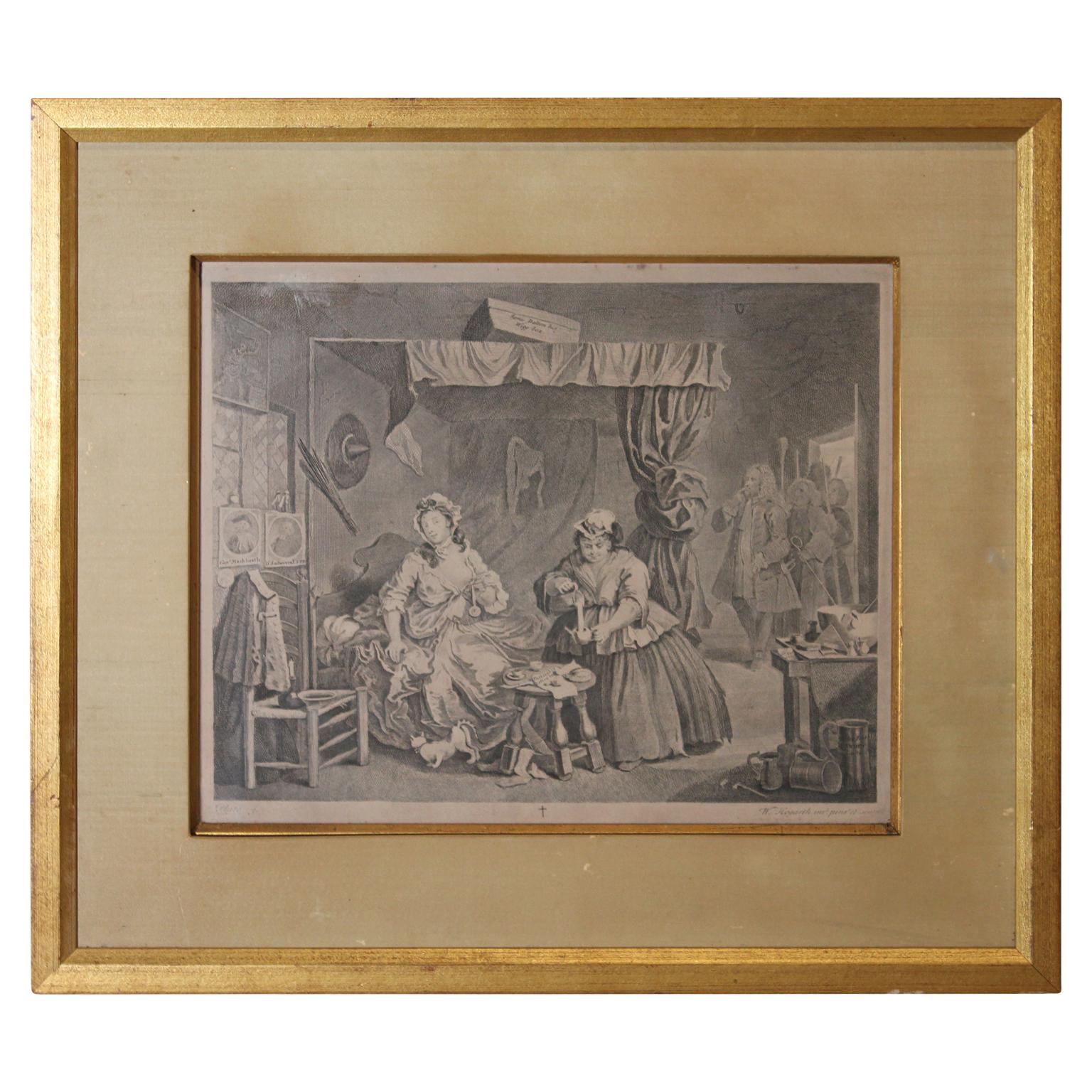
"A Harlot's Progress" Plate 3 Etching

"A Harlot's Progress" Plate 3 Etching

By William Hogarth

Located in Houston, TX

Etching from the series titled "A Harlots Progress" by William Hogarth. The series consists of six paintings and engravings. The story is about a woman named M. Hackabout who arrived in London and started working as a prostitute. The third plate is of her getting arrest for her choice in profession. The series is a satirical story that emphasizes the dangers of being a prostitute and the health risks that come from it. In 18th century engraving, the detail of the black mole on women and men's face is a symbol of the deadly venereal disease, syphilis. In this plate, Hackabout has already contracted the disease and that is why the black dot is visible on her forehead as well as her madam's. In 1828, William Innell Clement published Harlot's Progress in columns on a single page of his newspaper Bell's Life in London #330. The detail with the cross seen in earlier reproductions of the engraving. Dimensions without Frame: H 14.5 in x W 16.5 in. Artist Biography: William Hogarth ( 10 November 1697 – 26 October 1764) was an English painter, printmaker, pictorial satirist, social critic, and editorial cartoonist. His work ranged from realistic portraiture to comic strip-like series of pictures called "modern moral subjects", perhaps best known to be his moral series A Harlot's Progress, A Rake's Progress and Marriage A...

Category

1730s Old Masters Figurative Prints

Materials

Etching

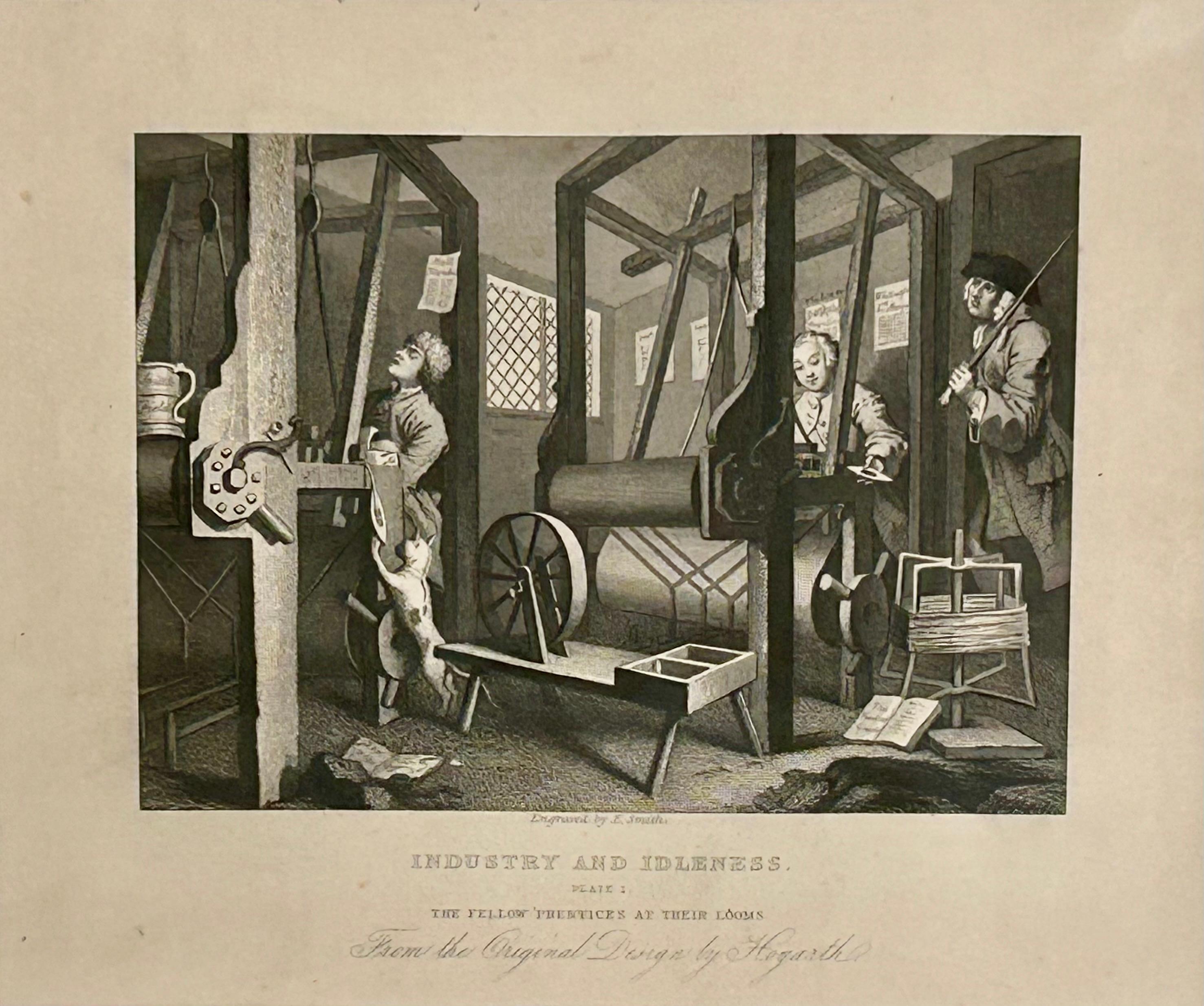
Industry and Idleness Plate 1:  The Fellow 'Prentices at their Looms

Industry and Idleness Plate 1: The Fellow 'Prentices at their Looms

By William Hogarth

Located in Bournemouth, Dorset

William Hogarth was an English painter and engraver, the outstanding British artist of his period. During his childhood, his father, a schoolteacher, was imprisoned for debt, and this early experience of the seamy side of life left a deep mark on Hogarth (much of his output is concerned with the contrast between success and failure, and he depicted prisons in several works). He trained as an engraver of silver plate and by 1720 had set up his own business in London, doing various kinds of commercial work. In his spare time he studied painting, first at the St Martin's Lane Academy and later under Sir James Thornhill, whose daughter he married in 1729. By the early 1730s he had achieved some success as a painter of conversation pieces and at about the same time he invented the idea of using a sequence of anecdotal pictures ‘similar to representations on the stage’ to point a moral and satirize social abuses. A set of 12 original engravings illustrating Industry and Idleness, after the drawings by William Hogarth, printed in 1833. The engravers are F Jordan, E Smith, C Armstrong, S Davenport, H Adlard, W H Worthington, H Fernell, A Duncan and F F Walker. The engravings, which are in excellent condition, would be mounted (matted) and ready to frame Edward Smith (fl. 1823-49) The landscape, figure, and portrait engraver Edward Smith may have been a native of Edinburgh but appears to have worked mostly in London. His earliest recorded plates...

Category

1830s Figurative Prints

Materials

Engraving