Want more images or videos?
Request additional images or videos from the seller
1 of 3

Walter Tittle
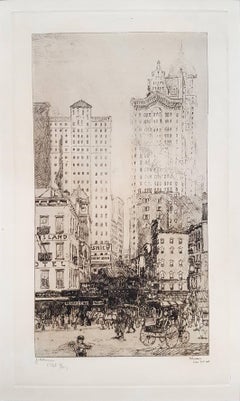
'The Plaza, Sunset Glow' — 1920s Signed Drypoint, Central Park, NYC

c. 1920s

$1,400
£1,046.49
€1,221.10
CA$1,965.88
A$1,999.72
CHF 1,141.87
MX$24,187.71
NOK 13,314.79
SEK 13,518.80
DKK 9,128.64

About the Item

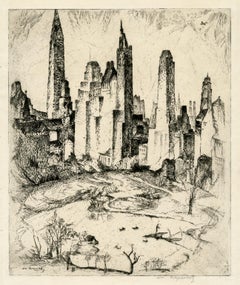
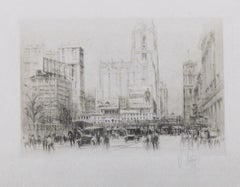
Walter Tittle, 'The Plaza, Sunset Glow', drypoint, c. 1920s, edition not stated. Signed in pencil and initialed in the plate, lower right. Titled 'The Plaza, Sunset' and annotated 'no. 165' in ink, in the bottom left sheet corner. A superb, luminous impression in dark brown ink, with selectively wiped plate tone; on cream wove paper; the full sheet with margins (1 to 2 1/4 inches). Pale tape stains on the top sheet edge, recto, well away from the image, otherwise in excellent condition. Matted to museum standards, unframed. Image size 11 3/4 x 6 15/16 inches (299 x 176 mm); sheet size 15 11/16 x 9 inches (399 x 229 mm). A view across 'The Pond' in New York City's Central Park, toward Grand Army Plaza, with the Plaza Hotel on the right. Impressions of this print are in the permanent collections of the British Museum (London), University of Saint Joseph, Victoria and Albert Museum (London). ABOUT THE ARTIST Walter Tittle (1883–1966) was an American illustrator, painter, and printmaker whose career unfolded during the height of the Golden Age of American illustration. Born in New York City, Tittle studied at the Art Students League, where he absorbed the strong academic draftsmanship and compositional discipline that informed both his painted illustrations and his work in print media. His early professional years coincided with a period when illustrated magazines shaped national taste, and his images quickly found a place within that influential visual culture. By the 1910s and 1920s, Tittle had become a regular contributor to major American periodicals, including The Saturday Evening Post, Collier’s, and other widely circulated magazines. His covers and story illustrations often centered on contemporary urban subjects—fashionable women, spirited social encounters, scenes of modern leisure—rendered with confident brushwork and a keen sense of narrative timing. While he stands in the lineage of society illustrators such as Gibson, Tittle’s figures tend toward a livelier theatricality and a more immediate engagement with gesture and expression. In addition to his painted illustration, Tittle was active in printmaking mediums deeply aligned with early twentieth-century publishing. Like many illustrators of his generation, he translated his compositions into forms suitable for high-quality reproduction—photogravure, halftone, and other mechanical processes—ensuring wide circulation of his imagery. He produced original graphic works that demonstrate a sensitivity to line and tonal contrast consistent with the aesthetics of the American etching revival. His original graphic works, when encountered independently of illustrative work, reveal a disciplined handling of contour and value consistent with the aesthetics of the American etching revival. Images are often articulated through decisive line, and a pronounced sense of design, with nuanced tonal passages reinforcing mood and atmosphere. Tittle’s graphic work also reflects the broader cultural shift of the 1910s–1930s, when American artists increasingly sought to elevate printmaking within institutional and collector circles. Original prints circulated through exhibitions and print societies, opening the boundaries between fine art and commercial art. Today, Walter Tittle’s paintings and prints are collected by enthusiasts of Golden Age illustration and early twentieth-century American graphic art. His career illustrates the fluid relationship between painting, printmaking, and mass reproduction in shaping the visual identity of American modernity during the first half of the twentieth century. Institutions that hold examples of his work include the Amon Carter Museum of American Art, the Brooklyn Museum, the Fine Arts Museums of San Francisco, the Metropolitan Museum of Art (New York), the National Museum of American Art/Smithsonian American Art Museum, the New York Public Library Print Collection, the Philadelphia Museum of Art, and the Smithsonian Institution.
  • Creator:
    Walter Tittle (1883 - 1966, American)
  • Creation Year:
    c. 1920s
  • Dimensions:
    Height: 11.75 in (29.85 cm)Width: 6.94 in (17.63 cm)Depth: 0.01 in (0.26 mm)
  • Medium:
  • Movement & Style:
  • Period:
  • Condition:
  • Gallery Location:
    Myrtle Beach, SC
  • Reference Number:
    Seller: 1032551stDibs: LU53232636213

More From This Seller

View All
'New York, Central Park' — 1930s American Modernism

'New York, Central Park' — 1930s American Modernism

By William Meyerowitz

Located in Myrtle Beach, SC

'New York, Central Park', etching, edition 40, c. 1930. Signed in pencil. Titled and numbered '14/40' on the bottom sheet edge, in pencil. Signed in the plate, lower left. A superb, ...

Category

1930s American Modern Landscape Prints

Materials

Etching

'Grand Central Station' — New York City Landmark, Signed Etching, 1927

'Grand Central Station' — New York City Landmark, Signed Etching, 1927

By Otto Kuhler

Located in Myrtle Beach, SC

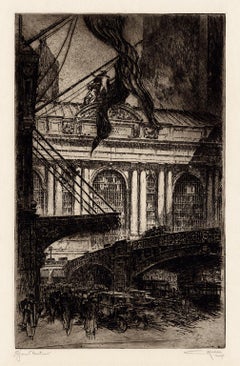
Otto Kuhler, 'Grand Central Station', etching and drypoint, 1927, edition c. 50, Kennedy 27. Signed and titled in pencil. A superb, richly-inked impression, in brown/black ink, with ...

Category

1920s American Impressionist Figurative Prints

Materials

Etching, Drypoint

'Downtown, New York' — 1920s Modernism, Signed Aquatint

'Downtown, New York' — 1920s Modernism, Signed Aquatint

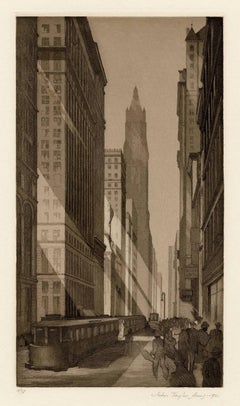
By John Taylor Arms

Located in Myrtle Beach, SC

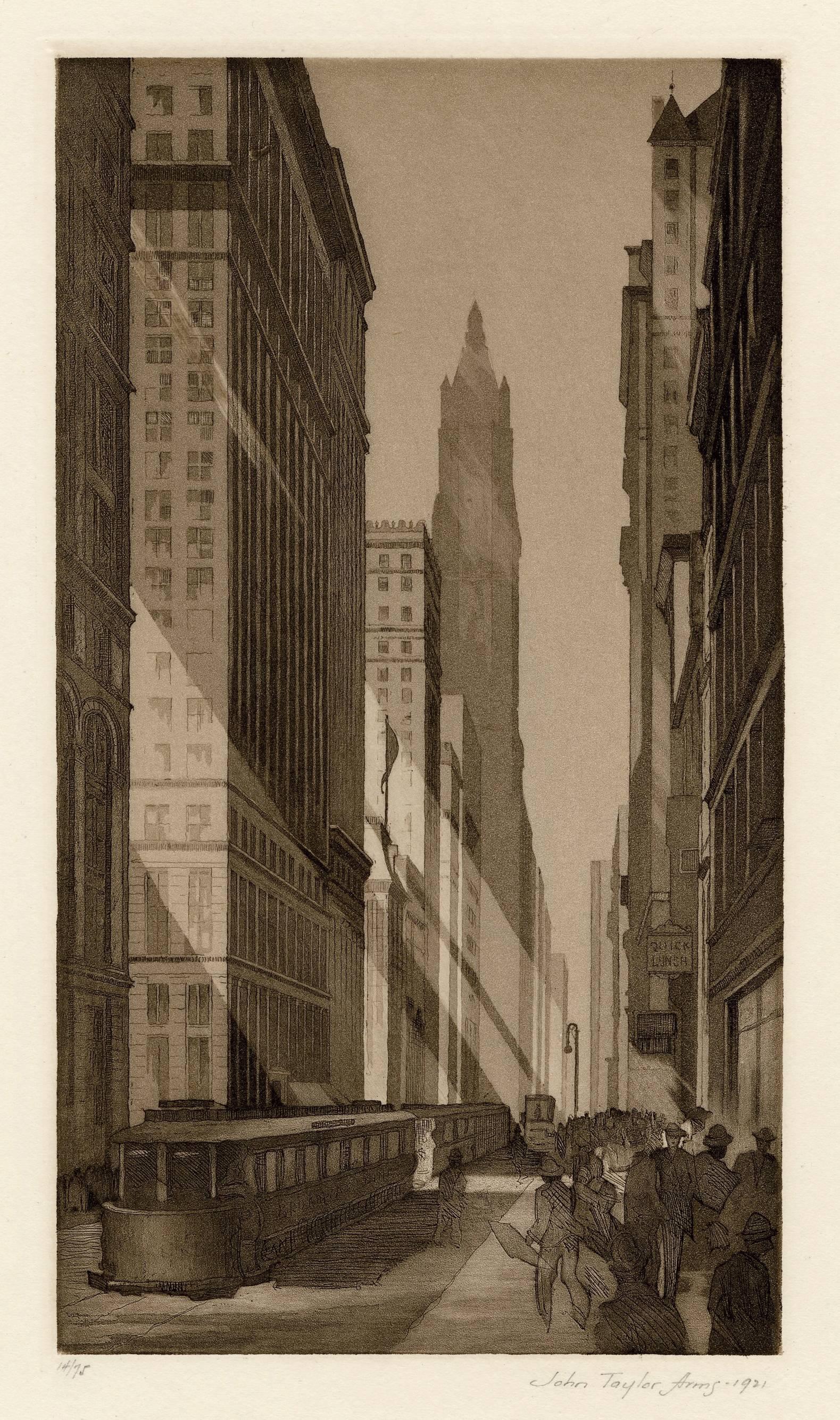
John Taylor Arms, 'Downtown, New York', etching with aquatint, 1921, edition 75, Fletcher 108. Signed, dated, and numbered 14/75 in pencil. A superb, finely nuanced impression, in da...

Category

Early 20th Century American Modern Landscape Prints

Materials

Etching

'St. Marks on the Bowery' — New York City Landmark, Signed Etching, 1932

'St. Marks on the Bowery' — New York City Landmark, Signed Etching, 1932

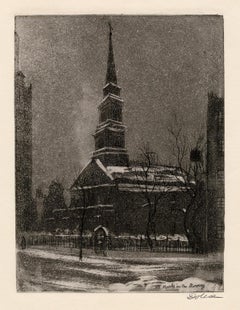
By Leon Dolice

Located in Myrtle Beach, SC

'St. Mark's Church on the Bowery', aquatint with etching, edition not stated but small, 1932. Signed in pencil. Signed in the plate lower left and titled in the plate lower right. A superb, atmospheric impression, on cream wove paper, with full margins (1 1/8 to 2 inches), in excellent condition. Matted to museum standards, unframed. Image size 9 3/4 x 7 3/8 inches (248 x 187 mm); sheet size 13 1/8 x 10 inches (333 x 254 mm). Impressions of this work are held in the collections of the Princeton University Art Museum and the Five College Museums. ABOUT THE ARTIST Born in Vienna, Leon Dolice left a secure position in the family business to pursue his artistic interests. He began his art education in his teens and early twenties when he traveled through Europe to study the works of the Old Masters. He immigrated to America in 1920 and made his home in Manhattan. As a printmaker, he chose as his subjects the architecture, back streets, dock scenes, and other aspects of New York City life that were being overtaken by the modern world. In 1950, learning of the coming demolition of the Third Avenue El, Dolice created a series of Third Avenue and other New York City landmarks that were threatened with extinction. His images from that period provide a record of a New York that has passed into history. During his lifetime, Dolice exhibited throughout Europe and the United States. Retrospectives of his work include a one-man show of his graphic work at Tribeca Gallery, New York; the traveling exhibition ‘Vintage New York’ with the New Rochelle Council on the Arts; and the Hofstra Museum, Hempstead. Dolice's works are in the permanent collections of the Museum of the City of New York, the National Gallery of Art, the New York Historical Society, Georgetown University, the Philadelphia Print Club, and the New York Public Library, as well as private and corporate collections. ABOUT ST. MARKS CHURCH St. Mark's Church in-the-Bowery is a parish of the Episcopal Church located at 131 East 10th Street, at the intersection of Stuyvesant Street and Second Avenue in the East Village neighborhood of Manhattan in New York City. The property has been the site of continuous Christian worship since the mid-17th century, making it New York City's oldest site of continuous religious practice. The structure is the second-oldest church building in Manhattan. In 1651, Petrus Stuyvesant, Director General of New Netherland, purchased land for a bowery or farm from the Dutch West India Company and, by 1660, built a family chapel at the present-day site of St. Mark's Church. Stuyvesant died in 1672 and was interred in a vault under the chapel. Stuyvesant's great-grandson, Petrus "Peter" Stuyvesant, sold the chapel property to the Episcopal Church for $1 in 1793, stipulating that a new chapel be erected to serve Bowery Village, the community which had coalesced around the Stuyvesant family chapel. In 1795, the cornerstone of the present-day St. Mark's Church was laid, and the fieldstone Georgian-style church, built by the architect and mason John McComb Jr., was completed and consecrated on May 9, 1799.[4] Alexander Hamilton provided legal aid in incorporating St. Mark's Church as the first Episcopal parish independent of Trinity Church in New York City. By 1807, the church had as many as two hundred worshipers at its summer services, with 70 during the winter. While the 19th century saw St. Mark's Church grow through its many construction projects, the 20th century was marked by community service and cultural expansion. Today, the rectory houses the Neighborhood Preservation Center, the Greenwich Village Society for Historic Preservation, and the Historic Districts Council, as well as other preservation and community organizations such as the Poetry Project, the Millennium Film Workshop, and the Danspace Project. St Mark's has supported an active artistic community since the 19th century. In 1919, poet Kahlil Gibran was appointed a member of the St. Mark's Arts Committee, and the next year, the two prominent Indian statues, "Aspiration" and "Inspiration" by sculptor Solon Borglum...

Category

1930s American Modern Landscape Prints

Materials

Etching, Aquatint

'Heart of San Francisco' — Vintage 1920s Realism, Signed Etching

'Heart of San Francisco' — Vintage 1920s Realism, Signed Etching

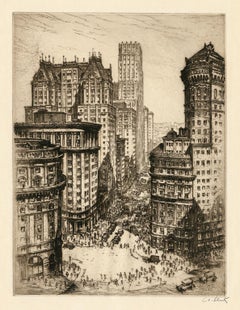
By Anton Schutz

Located in Myrtle Beach, SC

Anton Schutz, 'Heart of San Francisco', etching, c. 1927, edition not stated. Signed in pencil. A superb, richly-inked impression, on cream wove paper; the full sheet with margins (2...

Category

1920s American Realist Landscape Prints

Materials

Etching

'Soaring New York' — 1930s American Modernism, Signed Aquatint

'Soaring New York' — 1930s American Modernism, Signed Aquatint

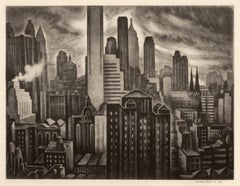
By Howard Norton Cook

Located in Myrtle Beach, SC

Howard Cook, 'Soaring New York', aquatint, soft-ground etching, roulette, 1931-32, edition 25, Duffy 165. Signed, dated, and annotated 'imp' in pencil. A superb, richly-inked, atmosp...

Category

1930s American Modern Figurative Prints

Materials

Etching, Aquatint

You May Also Like

New York, Courtland Street Etching, Realist Style, Signed, 1908

New York, Courtland Street Etching, Realist Style, Signed, 1908

By Jean-Emile Laboureur

Located in Roma, IT

Etching, 1908. Image Dimensions: 30 x 17 cm Hand signed and signed on plate. Provenance: Galleria Prandi 26/10/1976. Jean-Émile Laboureur was a French painter, illustrator and engra...

Category

Early 1900s Realist Landscape Prints

Materials

Etching

1927 Etching of Bowling Green Park New York by Anton Schutz

1927 Etching of Bowling Green Park New York by Anton Schutz

By Anton Schutz

Located in Chicago, IL

This signed etching of Bowling Green Park was done by Anton Schutz. It is dated 1927. It depicts a bustling scene in the Financial District of Lower Manh...

Category

Early 20th Century American Art Deco Prints

Materials

Glass, Wood, Paper

Henry Ives Cobb Jr. (1883-1974) Charcoal Drawing of Central Park, 1930

Henry Ives Cobb Jr. (1883-1974) Charcoal Drawing of Central Park, 1930

Located in New Windsor, NY

A wonderfully playful charcoal sketch on paper rendering of Central Park, New York City. Circa 1930. Signed with initials, HIC, lower left corner. Possibly a drawing for a later pain...

Category

Vintage 1930s American Art Deco Drawings

Materials

Paper

William Walcott Original Drypoint Etching Mint Condition- New York 42nd Street

William Walcott Original Drypoint Etching Mint Condition- New York 42nd Street

By William Walcot R. E. Hon. R. I. B. A.

Located in Phoenix, AZ

Historic Drypoint Etching by Russian/Scottish/British artist William Walcott (1874-1943). This beautiful image of New York City created 1923 is in mint condition with large margins. ...

Category

1920s Realist More Prints

Materials

Paper, Drypoint