18th Century Still-life Prints

to
3
92
64
14
2
Overall Width
to
Overall Height
to
66
5
33
21
9
9
7
200
239
2,351
1,680
10
17
34
32
127
186
301
499
574
220
139
32
1
85
63
53
34
27
21
15
13
12
11
10
10
10
9
9
7
6
6
6
6
93
83
35
26
26
25
99
103
66
Period: 18th Century
4 plates from The Wondrous Transformation of Caterpillars & their Strange Diet..

4 plates from The Wondrous Transformation of Caterpillars & their Strange Diet..

By Maria Sibylla Merian

Located in Middletown, NY

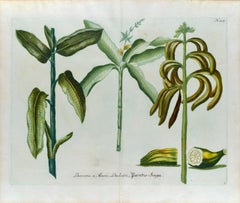
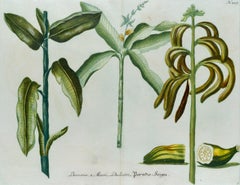
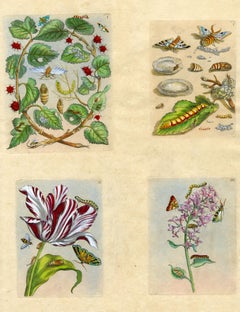
Four plates from The Wondrous Transformation of Caterpillars and their Strange Diet of Flowers. “Wolfsmelk Rupsen;" “Wolfsmilch, Raupe und Schmetterling" Amsterdam: J F Bernard, 1730. Each an engraving with hand coloring in watercolor and gouache printed on one sheet of watermarked Honig cream laid paper, each measures 6 1/4 x 5 inches (157 x 121 mm), sheet measures 20 5/8 x 14 inches (522 x 355 mm), full margins. With handling creases in the lower right sheet quadrant, as well as minor, loose cockling, otherwise in very good condition. The colors are superb with exceptionally fresh and bright saturation. Engraved between 1679 and 1683, printed 1730. Plates included: No.1:I; No. 2:1; II & III. MARIA SIBYLLA MERIAN was one of the most highly respected entomologists of the 17th century, and remains today one of the field's most significant figures. A German-born naturalist and scientific illustrator, she reared herself on the study of caterpillars, and made tremendous contributions to the knowledge of the life cycles of numerous species. Until her detailed and careful study of the process of metamorphosis it was thought that insects were "born of mud," through spontaneous generation. Trained as a miniature painter by her stepfather, she published her first book of illustrations in 1675, at the age of 28. In 1679, Merian published the first volume of the two-volume series on caterpillars, The Wondrous Transformation of Caterpillars and their Strange Diet of Flowers; the second volume followed in 1683. Each volume contained 50 plates that she engraved and etched. In 1699, Merian traveled to Dutch Guiana...

Category

Naturalistic 18th Century Still-life Prints

Materials

Watercolor, Engraving
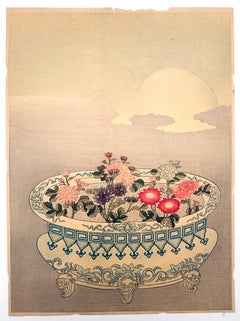
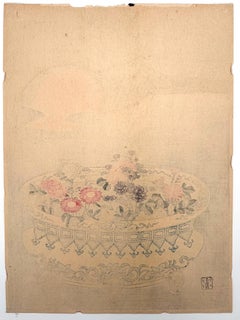
Chrysanthemums and the Rising Moon

Chrysanthemums and the Rising Moon

By Suzuki (Hozumi) Harunobu

Located in Middletown, NY

An image that originally appeared in an astrological calendar for the year 1766. Tokyo: Shuei-Sha, 1766. Woodblock print in colors printed on laid mulberry paper, 10 3/4 x 7 7/8 in...

Category

Edo 18th Century Still-life Prints

Materials

Watercolor, Handmade Paper, Woodcut

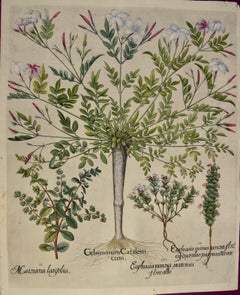
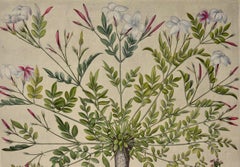
Flowering Jasmine and Laurel Plants: A Besler Hand-colored Botanical Engraving

Flowering Jasmine and Laurel Plants: A Besler Hand-colored Botanical Engraving

By Basilius Besler 1

Located in Alamo, CA

This is a hand-colored copper-plate engraving entitled "Gelsiminum Catalonicum, Mairana Latifollia, Euphasiaramosa Pratensis Flore Albo, Euphasia Minus Ramosa Flore Excereruleo Purpurascente", depicting flowering Jasmine, Mountain Laurel...

Category

Academic 18th Century Still-life Prints

Materials

Engraving

Flowering Medlar Tree: An 18th C. Hand-colored Botanical Engraving by Weinmann

Flowering Medlar Tree: An 18th C. Hand-colored Botanical Engraving by Weinmann

By Johann Wilhelm Weinmann

Located in Alamo, CA

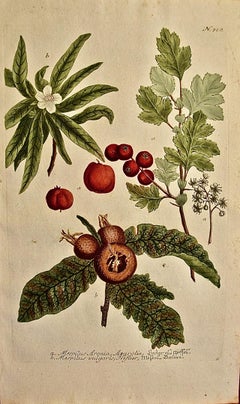
This hand-colored botanical mezzotint and line engraving by Johann Wilhelm Weinmann (1683-1741) is entitled "A. Mespilus Aronia Azarolie B. Mespilus Vulgaris Neflier". It is plate 7...

Category

Naturalistic 18th Century Still-life Prints

Materials

Engraving, Mezzotint

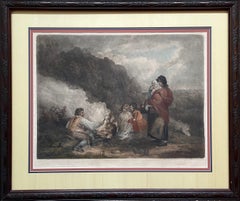
A Hebrew nomadic camp – English School, 18th century

A Hebrew nomadic camp – English School, 18th century

Located in Middletown, NY

Engraving on light weight laid paper with an small indiscernible, alphabetic watermark, 9 x 7 1/2 (230 x 188 mm); sheet 11 1/4 x 8 1/2 inches (284 x 215 mm), wide margins. In very go...

Category

Old Masters 18th Century Still-life Prints

Materials

Ink, Handmade Paper, Laid Paper, Woodcut

Eight 18th century-era fashion plates from the portfolio Modes, by M. Connat

Eight 18th century-era fashion plates from the portfolio Modes, by M. Connat

Located in Middletown, NY

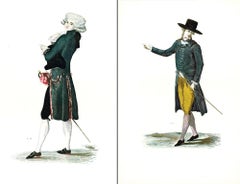
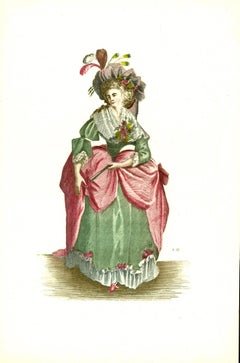
Eight 18th century-era fashion plates from the portfolio Modes, by Madeleine Connat. Paris: Paris Etching Society, 1951. Each an engraving with hand coloring in watercolor on cream ...

Category

French School 18th Century Still-life Prints

Materials

Watercolor, Engraving
4 plates from The Wondrous Transformation of Caterpillars & their Strange Diet..

4 plates from The Wondrous Transformation of Caterpillars & their Strange Diet..

By Maria Sibylla Merian

Located in Middletown, NY

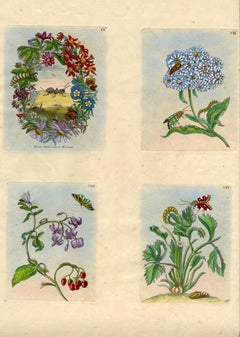
Four plates from The Wondrous Transformation of Caterpillars and their Strange Diet of Flowers. “Wolfsmelk Rupsen;" “Wolfsmilch, Raupe und Schmetterling" Amsterdam: J F Bernard, 1730. Each an engraving with hand coloring in watercolor and gouache printed on one sheet of watermarked Honig cream laid paper, each measures 6 1/4 x 5 inches (157 x 121 mm), sheet measures 20 5/8 x 14 inches (522 x 355 mm), full margins. With handling creases in the lower right sheet quadrant, as well as minor, loose cockling, otherwise in very good condition. The colors are superb with exceptionally fresh and bright saturation. Engraved between 1679 and 1683, printed 1730. Plates included: CI; CII; CIII & CIV. MARIA SIBYLLA MERIAN was one of the most highly respected entomologists of the 17th century, and remains today one of the field's most significant figures. A German-born naturalist and scientific illustrator, she reared herself on the study of caterpillars, and made tremendous contributions to the knowledge of the life cycles of numerous species. Until her detailed and careful study of the process of metamorphosis it was thought that insects were "born of mud," through spontaneous generation. Trained as a miniature painter by her stepfather, she published her first book of illustrations in 1675, at the age of 28. In 1679, Merian published the first volume of the two-volume series on caterpillars, The Wondrous Transformation of Caterpillars and their Strange Diet of Flowers; the second volume followed in 1683. Each volume contained 50 plates that she engraved and etched. In 1699, Merian traveled to Dutch Guiana...

Category

Naturalistic 18th Century Still-life Prints

Materials

Watercolor, Engraving
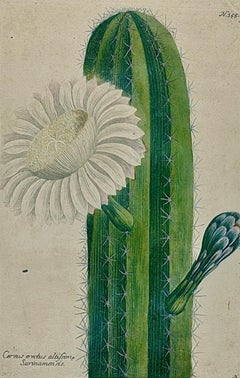
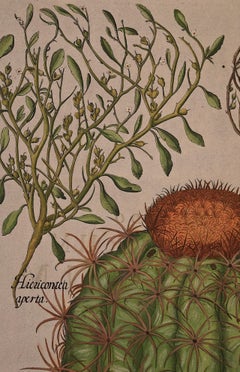
A Flowering Cactus Plant: 18th C. Hand-colored Botanical Engraving by Weinmann

A Flowering Cactus Plant: 18th C. Hand-colored Botanical Engraving by Weinmann

By Johann Wilhelm Weinmann

Located in Alamo, CA

This hand-colored botanical mezzotint and line engraving by Johann Wilhelm Weinmann (1683-1741) is entitled "Cereus Erectus Altissimo Surinamensis (Cereus Cactus Plant)". It is plate...

Category

Naturalistic 18th Century Still-life Prints

Materials

Engraving, Mezzotint

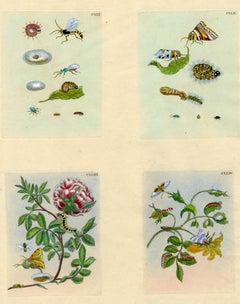
4 plates from The Wondrous Transformation of Caterpillars & their Strange Diet..

4 plates from The Wondrous Transformation of Caterpillars & their Strange Diet..

By Maria Sibylla Merian

Located in Middletown, NY

Four plates from The Wondrous Transformation of Caterpillars and their Strange Diet of Flowers. “Wolfsmelk Rupsen;" “Wolfsmilch, Raupe und Schmetterling" Amsterdam: JF Bernard, 1730. Each an engraving with hand coloring in watercolor and gouache printed on one sheet of watermarked Honig cream laid paper, each measures 6 1/4 x 5 inches (157 x 121 mm), sheet measures 20 5/8 x 14 inches (522 x 355 mm), full margins. With handling creases in the lower right sheet quadrant, as well as minor, loose cockling, otherwise in very good condition. The colors are superb with exceptionally fresh and bright saturation. Engraved between 1679 and 1683, printed 1730. Plates included: CXLI, CXLII, CXIII & CXLIV. MARIA SIBYLLA MERIAN was one of the most highly respected entomologists of the 17th century, and remains today one of the field's most significant figures. A German-born naturalist and scientific illustrator, she reared herself on the study of caterpillars, and made tremendous contributions to the knowledge of the life cycles of numerous species. Until her detailed and careful study of the process of metamorphosis it was thought that insects were "born of mud," through spontaneous generation. Trained as a miniature painter by her stepfather, she published her first book of illustrations in 1675, at the age of 28. In 1679, Merian published the first volume of the two-volume series on caterpillars, The Wondrous Transformation of Caterpillars and their Strange Diet of Flowers; the second volume followed in 1683. Each volume contained 50 plates that she engraved and etched. In 1699, Merian traveled to Dutch Guiana...

Category

Naturalistic 18th Century Still-life Prints

Materials

Watercolor, Engraving
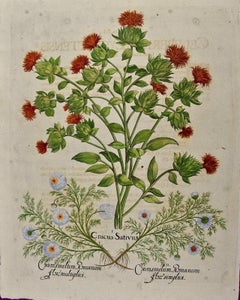
Chamomile & Safflower: A 17th-18th C. Besler Hand-colored Botanical Engraving

Chamomile & Safflower: A 17th-18th C. Besler Hand-colored Botanical Engraving

By Basilius Besler 1

Located in Alamo, CA

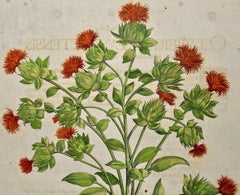
This is a hand-colored copper plate engraving entitled "Chamemelum Romanum flore simplici (Chamomile), Cincus Sativus (False saffron, Safflower), Chamaemelum Romanum Flore (Roman Chamomile)", depicting flowering Chamomile, Safflower and Roman Chamomile plants respectively from Basilius Besler's landmark work, Hortus Eystettensis (Garden at Eichstatt), first published in 1613 in Eichstatt, Germany near Nuremberg and later in 1640 and 1713. This beautiful colorful engraving is printed on thin laid chain-linked paper with wide margins. There are a few small spots and some irregularity of the lower edge. There is some bleed-through of text from the verso. The print is otherwise in excellent condition with striking hand-coloring. The sheet measures 22.25" high and 17.38" wide. Basilius Besler (1561–1629) was an apothecary and botanist. He was curator of the Willibaldsburg Castle garden of Johann Konrad von Gemmingen, prince bishop...

Category

Academic 18th Century Still-life Prints

Materials

Engraving

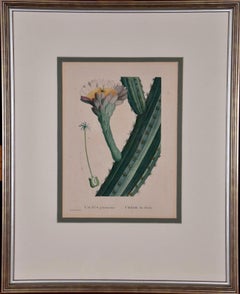
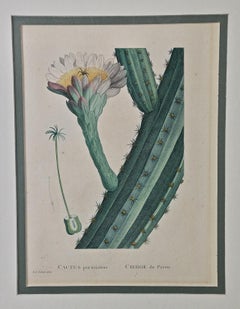
Flowering Cactus: A Framed 18th C. Hand-colored Engraving by Redoute

Flowering Cactus: A Framed 18th C. Hand-colored Engraving by Redoute

By Pierre-Joseph Redouté

Located in Alamo, CA

This framed hand-colored stipple engraving entitled "Cactus Peruvianus Cierge du Pérou" by Pierre-Joseph Redouté, Plate 58 from his illustrated publication 'Plantarum Historia Succulentarum ou Histoire des Plantes Grasses', published in Paris in 1799. It depicts a branching limb of a cactus with a beautiful flower. There is a separate detail of the anatomy of a seed with early growth. Redoute was a pioneer of the stipple engraving technique, which he used to create this image. It involves utilizing a series of small dots worked into a copper plate rather than the more common lines. These dots can be made smaller or thicker depending on the degree of opacity the artist intends for various areas of the print. When inked and applied to paper, this allows for a greater portion of the paper to be seen, which accentuates the appearance of luminosity of the subject the artist is creating. Different color inks are used in the printing process, a time consuming technique known as "a la poupee". The engraving is then finished with watercolor to further enhance the beauty and realism of the print subject. This engraving of a flowering cactus is presented in silver-colored ribbed wood frame and a double mat; cream-colored outer mat and heather green inner mat. The frame measures 21.25" high by 17.25" wide by 1.13" deep. The sheet measures 19.88" high by 14" wide. There are wide margins with a few short tears and chips along the the left, right and upper edges, which are all covered by the mat. There are small spots predominantly in the margins, with a few present in the image area. The print is otherwise in very good condition. There is another Redoute flowering cactus listed on 1stdibs, LU117326853392, which is framed and matted identically to this one. The pair would make an attractive display grouping. Pierre-Joseph Redouté (1759-1840), was a painter and botanist originally from Belgium, who pursued his extremely successful artistic career in France. He is well known for his watercolor paintings of roses, lilies and other flowers and their subsequent folio-sized, color stipple engravings. Some believe him to be the greatest botanical illustrator of all time. Redouté was a favorite of the French royal court at the time and of the post French...

Category

Naturalistic 18th Century Still-life Prints

Materials

Engraving

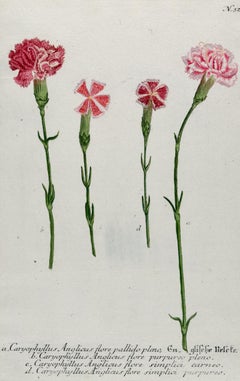
Flowering Carnation Plant: 18th C. Hand-colored Botanical Engraving by Weinmann

Flowering Carnation Plant: 18th C. Hand-colored Botanical Engraving by Weinmann

By Johann Wilhelm Weinmann

Located in Alamo, CA

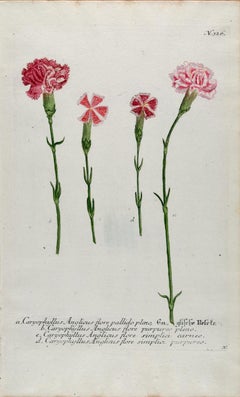
This hand-colored botanical mezzotint and line engraving by Johann Wilhelm Weinmann (1683-1741) is entitled "Caryophyllus Anglicus flore". It is plate 326 in Weinmann's monumental pu...

Category

Naturalistic 18th Century Still-life Prints

Materials

Engraving, Mezzotint

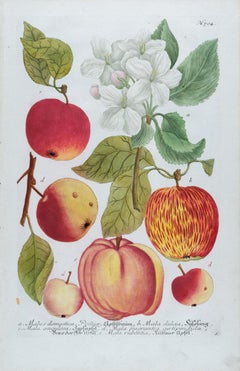
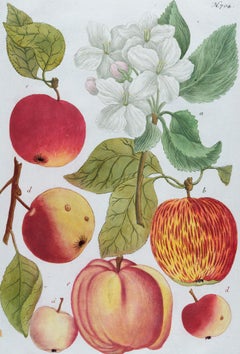
Flowering Apple Plant: 18th Century Hand-colored Botanical Engraving by Weinmann

Flowering Apple Plant: 18th Century Hand-colored Botanical Engraving by Weinmann

By Johann Wilhelm Weinmann

Located in Alamo, CA

This striking hand-colored botanical mezzotint and line engraving is entitled Malus domestica, Pomier, Apfelbaunt (Apple)". It is plate 704 in Johann Weinmann's monumental publicatio...

Category

Naturalistic 18th Century Still-life Prints

Materials

Engraving, Mezzotint

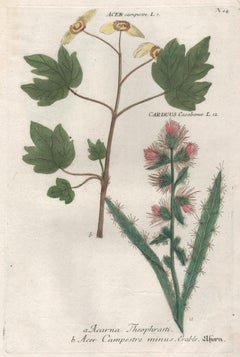
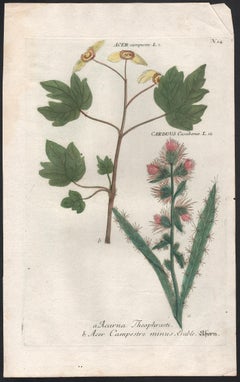
Acer & Carduus - 18th century Weinmann botanical plant flower engraving

Acer & Carduus - 18th century Weinmann botanical plant flower engraving

By Johann Wilhelm Weinmann

Located in Melbourne, Victoria

'Acarna Theophrasti' and 'Acer Campestre minus' Mezzotint printed in colours. Circa 1740. From Johann W Weinmann's Phytanthoza Iconographia, published in Regensburg 1737-45. The fi...

Category

Naturalistic 18th Century Still-life Prints

Materials

Engraving

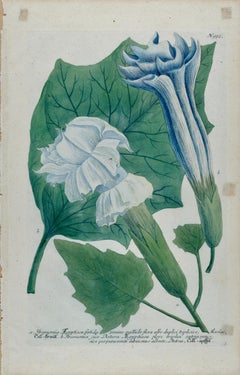
Flowering Trumpet Plant: 18th C. Hand-colored Botanical Engraving by Weinmann

Flowering Trumpet Plant: 18th C. Hand-colored Botanical Engraving by Weinmann

By Johann Wilhelm Weinmann

Located in Alamo, CA

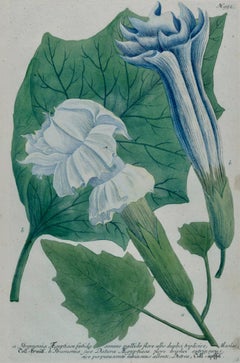
This hand-colored botanical mezzotint and line engraving by Johann Wilhelm Weinmann (1683-1741) is entitled "Stramonia Aegyptiaca foetida semine pallido flore albo duplici triplicive...

Category

Naturalistic 18th Century Still-life Prints

Materials

Engraving, Mezzotint

Flowering Spurge: 18th Century Hand-colored Botanical Engraving by J. Weinmann

Flowering Spurge: 18th Century Hand-colored Botanical Engraving by J. Weinmann

By Johann Wilhelm Weinmann

Located in Alamo, CA

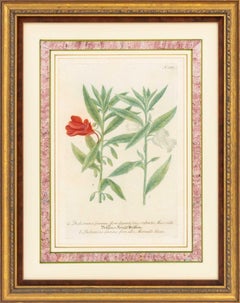
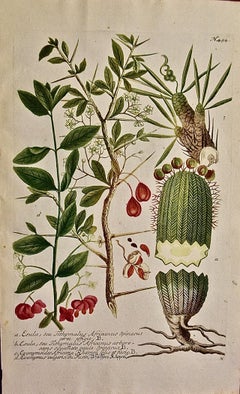
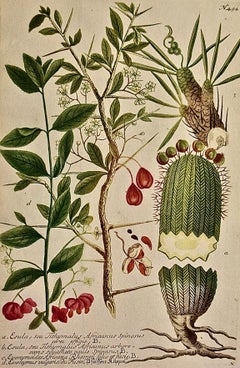
This hand-colored botanical mezzotint and line engraving by Johann Wilhelm Weinmann (1683-1741) is entitled "A. Esula seu Tithyinalus Africanus SpinosusCera Effigie, B. Esula seu Ti...

Category

Naturalistic 18th Century Still-life Prints

Materials

Engraving, Mezzotint

Flowering Prickly Pear Cactus: Framed 18th C. Hand-colored Engraving by Redoute

Flowering Prickly Pear Cactus: Framed 18th C. Hand-colored Engraving by Redoute

By Pierre-Joseph Redouté

Located in Alamo, CA

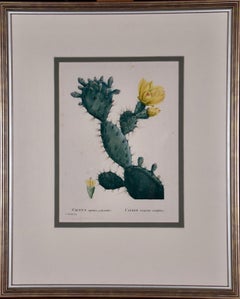
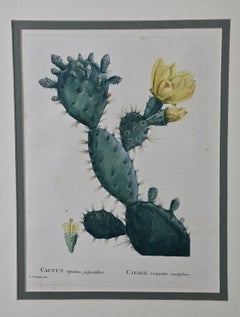
This is a hand-colored stipple engraving entitled "Cactus Opuntia Polyanthos, Cierge Raquette Multiflore" (Prickly Pear Cactus) by Pierre-Joseph Redouté, Plate 59 from his illustrated publication 'Plantarum Historia Succulentarum ou Histoire des Plantes Grasses', published in Paris in 1799. Redoute was a pioneer of the stipple engraving technique, which he used to create this image. It involves utilizing a series of small dots worked into a copper plate rather than the more common lines. These dots can be made smaller or thicker depending on the degree of opacity the artist intends for various areas of the print. When inked and applied to paper, this allows for a greater portion of the paper to be seen, which accentuates the appearance of luminosity of the subject the artist is creating. Different color inks are used in the printing process, a time consuming technique known as "a la poupee". The engraving is then finished with watercolor to further enhance the beauty and realism of the print subject. This engraving of a flowering cactus is presented in a double mat; white outer mat and heather green inner mat.The mat measures 20" x 16" and the sheet measures 19.5" x 13.38". There are wide margins with a few short tears and chips along the the right and upper edges, which are all covered by the mat. There are small spots predominantly in the margins, but a few are present in the image area, but the print is otherwise in very good condition. There is another Redoute flowering cactus listed on 1stdibs, LU117326854582. The pair would make an attractive display grouping. Pierre-Joseph Redouté (1759-1840), was a painter and botanist originally from Belgium, who pursued his extremely successful artistic career in France. He is well known for his watercolor paintings of roses, lilies and other flowers and their subsequent folio-sized, color stipple engravings. Some believe him to be the greatest botanical illustrator of all time. Redouté was a favorite of the French royal court at the time and of the post French...

Category

Naturalistic 18th Century Still-life Prints

Materials

Engraving

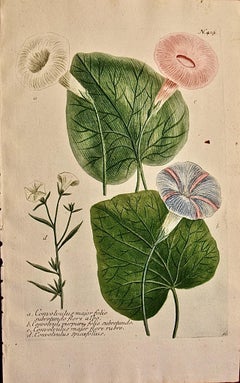
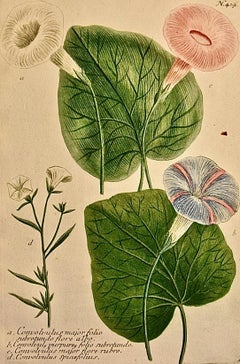
Flowering Morning Glory: 18th Century Hand-colored Weinmann Botanical Engraving

Flowering Morning Glory: 18th Century Hand-colored Weinmann Botanical Engraving

By Johann Wilhelm Weinmann

Located in Alamo, CA

This hand-colored botanical mezzotint and line engraving by Johann Wilhelm Weinmann (1683-1741) is entitled "A. Convolvulus Major Folio Subrotundo Purpureg Albo, B. Convolvulus Major...

Category

Naturalistic 18th Century Still-life Prints

Materials

Engraving, Mezzotint

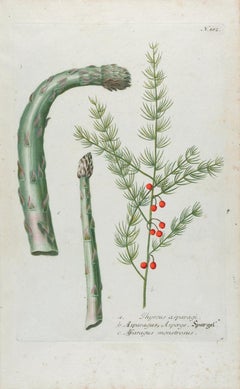
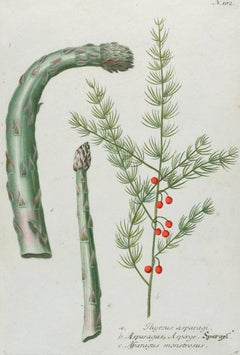
Asparagus Plant: An 18th Century Hand-colored Botanical Engraving by J. Weinmann

Asparagus Plant: An 18th Century Hand-colored Botanical Engraving by J. Weinmann

By Johann Wilhelm Weinmann

Located in Alamo, CA

This colored botanical mezzotint and line engraving finished with hand coloring by Johann Wilhelm Weinmann (1683-1741) is entitled a. Thyrsus asparagi. b. Asparagus, Asperge. c. Aspa...

Category

Naturalistic 18th Century Still-life Prints

Materials

Engraving, Mezzotint

Cultivated Pea Plants: An 18th C. Hand-colored Botanical Engraving by Weinmann

Cultivated Pea Plants: An 18th C. Hand-colored Botanical Engraving by Weinmann

By Johann Wilhelm Weinmann

Located in Alamo, CA

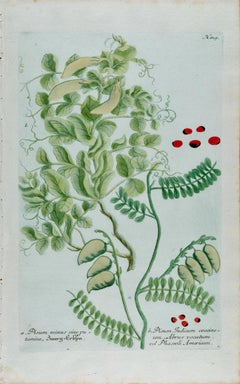
This hand-colored botanical mezzotint and line engraving by Johann Wilhelm Weinmann (1683-1741) is entitled "a. Pisum Minus sine Putamine, b. Pisa Indicum". It is plate 819 in Weinma...

Category

Naturalistic 18th Century Still-life Prints

Materials

Engraving, Mezzotint

Banana Plants: An 18th Century Hand-colored Botanical Engraving by J. Weinmann

Banana Plants: An 18th Century Hand-colored Botanical Engraving by J. Weinmann

By Johann Wilhelm Weinmann

Located in Alamo, CA

This is a striking original antique colored botanical mezzotint and line double page engraving of banana plants, which is finished with hand-coloring. It is entitled "Banana 1. Musa,...

Category

Naturalistic 18th Century Still-life Prints

Materials

Engraving, Mezzotint

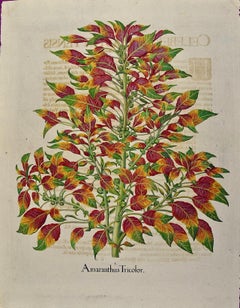
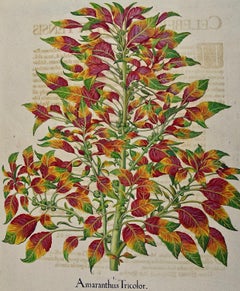
Amaranthus tricolor: A 17th-18th C. Besler Hand-colored Botanical Engraving

Amaranthus tricolor: A 17th-18th C. Besler Hand-colored Botanical Engraving

By Basilius Besler 1

Located in Alamo, CA

This is a hand-colored copper plate engraving entitled "Amaranthus Tricolor", depicting a flowering Amaranthus Tricolor plant from Basilius Besler's landmark work, Hortus Eystettensis (Garden at Eichstatt), first published in 1613 in Eichstatt, Germany near Nuremberg and later in 1640 and 1713. Amaranthus tricolor, known as edible amaranth, is a species of flowering plant in the genus Amaranthus. The plant is often cultivated for ornamental and culinary purposes. Cultivars have a striking yellow, red, and green foliage. It is known as Joseph's coat in some areas, after the biblical figure Joseph, who is said to have worn a coat of many colors. Amaranthus tricolor is one of several species of amaranth cultivated in warm regions across the world. This beautiful colorful engraving is printed on thin laid chain-linked paper with very wide margins. There is a short crease in the upper right corner, mild irregularity of the left, right and lower edges and some bleed-through of text from the verso. The print is otherwise in excellent condition with striking hand-coloring. The sheet measures 22.13" high and 17.13" wide. Basilius Besler (1561–1629) was an apothecary and botanist. He was curator of the Willibaldsburg Castle garden of Johann Konrad von Gemmingen, prince bishop...

Category

Academic 18th Century Still-life Prints

Materials

Engraving

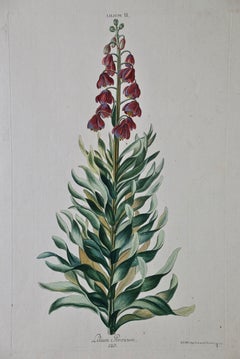
"Lilium Persicum" Ehret 18th Century Hand Colored Botanical Engraving

"Lilium Persicum" Ehret 18th Century Hand Colored Botanical Engraving

By Georg Dionysius Ehret

Located in Alamo, CA

A beautiful and important 18th century hand colored copperplate engraving of lillies which was most likely designed by Georg Dionysius Ehret (1708-1770) and engraved by Johann Michae...

Category

Naturalistic 18th Century Still-life Prints

Materials

Engraving

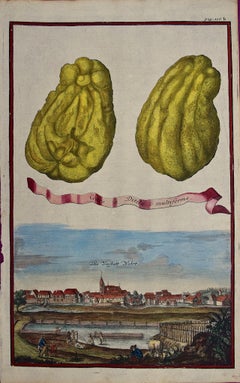
Lemons "Cedro Ditela Multiforme": An 18th C. Volckamer Hand-colored Engraving

Lemons "Cedro Ditela Multiforme": An 18th C. Volckamer Hand-colored Engraving

By Johann Christoph Volkhamer

Located in Alamo, CA

This is an early 18th century hand-colored copperplate engraving of lemons by Johann Christoph Volkhamer entitled "Cedro a Ditela o Multiforme" from his publication "Nurmbergische He...

Category

Naturalistic 18th Century Still-life Prints

Materials

Engraving

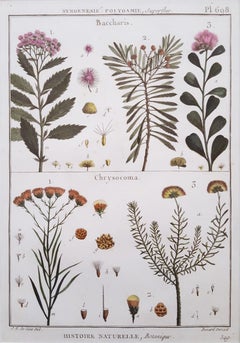
Baccharis (Baccharises); Chrysocoma (Golden Bitter Bush) /// Botanical Botany

Baccharis (Baccharises); Chrysocoma (Golden Bitter Bush) /// Botanical Botany

By Georges-Louis Leclerc, Comte de Buffon

Located in Saint Augustine, FL

Artist: Georges-Louis Leclerc, Comte de Buffon (French, 1707-1788) Title: "Baccharis (Baccharises); Chrysocoma (Golden Bitter Bush)" (Syngenesie; Polygamie, Plate 698) Portfolio: His...

Category

Old Masters 18th Century Still-life Prints

Materials

Watercolor, Laid Paper, Engraving, Intaglio

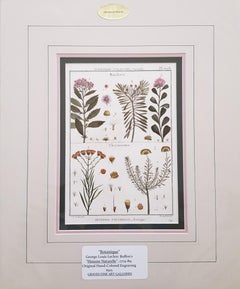
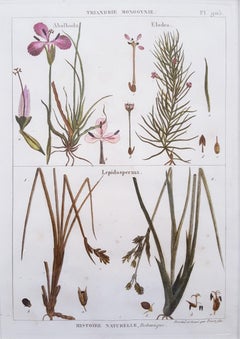
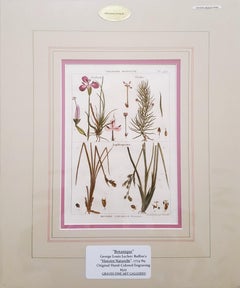
Abolboda; Elodea (Waterweeds); Lepidosperma (Hoary Rapier-Sedge) /// Botanical

Abolboda; Elodea (Waterweeds); Lepidosperma (Hoary Rapier-Sedge) /// Botanical

By Georges-Louis Leclerc, Comte de Buffon

Located in Saint Augustine, FL

Artist: Georges-Louis Leclerc, Comte de Buffon (French, 1707-1788) Title: "Abolboda; Elodea (Waterweeds); Lepidosperma (Hoary Rapier-Sedge)" (Triandrie Monogynie, Plate 905) Portfoli...

Category

Old Masters 18th Century Still-life Prints

Materials

Watercolor, Laid Paper, Engraving, Intaglio

[ Bird of Paradise] La Pie de paradise, vue par derriere, No.21

[ Bird of Paradise] La Pie de paradise, vue par derriere, No.21

By Jacques Barraband

Located in Paonia, CO

[ Bird of Paradise] La Pie de paradise, vue par derriere , No.21, Paris 1801-1806 [Astrapia nigra]. Color-printed engraving with hand-coloring. French botanical and zoological illustrator Jacques Barraband (1767-1809) was known as one of the finest ornithological artists of his time .He is best known for his watercolors and engravings that were commissioned by François LeVaillant, French explorer, naturalist, zoological collector , noted ornithologist and author. Levaillant’s Histoire naturelle des perroquets (1801-05) and his Histoire naturelle des oiseaux de paradis (Birds of Paradise, 1801-06), both of which Barraband contributed to, are still considered some of the most beautiful bird books of all times because of their exceptional scientific accuracy, rich color and detail. The Astrapia nigra is a Bird of Paradise that inhabits the Vogelkop Peninsula of West Papua...

Category

Other Art Style 18th Century Still-life Prints

Materials

Engraving

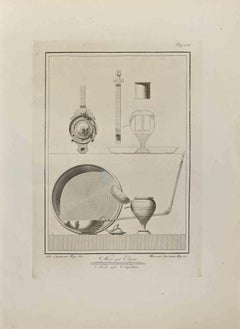
Antiche Urne Cinerarie e Lampade Etching, Old Masters, 18th Century

Antiche Urne Cinerarie e Lampade Etching, Old Masters, 18th Century

By Giovanni Battista Piranesi

Located in Roma, IT

From the Piranesi's series “Vasi, candelabri, cippi, sarcofagi, tripodi, lucerne, ed ornamenti antichi disegnati ed incisi dal cav. Gio. Batt. Piranesi pubblicati l’anno MDCCLXXIIX” (1778). Antiche urne cinerarie e lampade" is an artist proof, printed on contemporary laid paper, large margins, representing antique marble cinerary urns - “found into antique graves...

Category

Old Masters 18th Century Still-life Prints

Materials

Etching

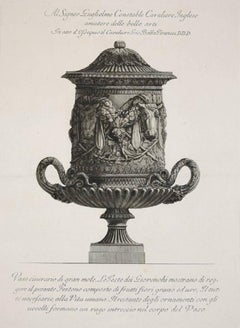
Vaso Cinerario di Gran Mole, etching from "Vases, Candelabras, Grave, Stones..."

Vaso Cinerario di Gran Mole, etching from "Vases, Candelabras, Grave, Stones..."

By Giovanni Battista Piranesi

Located in Roma, IT

Well-knowned as an architect and an archaeologist, undoubtedly Giovanni Battista Piranesi, is the most important engraver of the 18th century: the leading artist in this field in the...

Category

18th Century Still-life Prints

Materials

Engraving, Etching

3 plates from The Wondrous Transformation of Caterpillars & their Strange Diet..

3 plates from The Wondrous Transformation of Caterpillars & their Strange Diet..

By Maria Sibylla Merian

Located in Middletown, NY

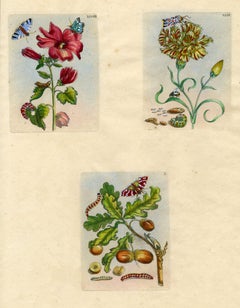
Three plates from The Wondrous Transformation of Caterpillars and their Strange Diet of Flowers. “Wolfsmelk Rupsen;" “Wolfsmilch, Raupe und Schmetterling" Amsterdam: J F Bernard, 1730. Each an engraving with hand coloring in watercolor and gouache printed on one sheet of watermarked Honig cream laid paper, each measures 6 1/4 x 5 inches (157 x 121 mm), sheet measures 20 5/8 x 14 inches (522 x 355 mm), full margins. With handling creases in the lower right sheet quadrant, as well as minor, loose cockling, otherwise in very good condition. The colors are superb with exceptionally fresh and bright saturation. Engraved between 1679 and 1683, printed 1730. Plates included: XLVIII; XLIX & L. MARIA SIBYLLA MERIAN was one of the most highly respected entomologists of the 17th century, and remains today one of the field's most significant figures. A German-born naturalist and scientific illustrator, she reared herself on the study of caterpillars, and made tremendous contributions to the knowledge of the life cycles of numerous species. Until her detailed and careful study of the process of metamorphosis it was thought that insects were "born of mud," through spontaneous generation. Trained as a miniature painter by her stepfather, she published her first book of illustrations in 1675, at the age of 28. In 1679, Merian published the first volume of the two-volume series on caterpillars, The Wondrous Transformation of Caterpillars and their Strange Diet of Flowers; the second volume followed in 1683. Each volume contained 50 plates that she engraved and etched. In 1699, Merian traveled to Dutch Guiana...

Category

Naturalistic 18th Century Still-life Prints

Materials

Watercolor, Engraving
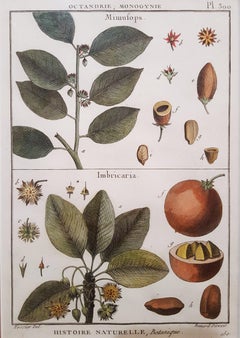
Mimufops (Mimusops); Ibricaria (Shingle Oak) /// Botanical Botany Plants Buffon

Mimufops (Mimusops); Ibricaria (Shingle Oak) /// Botanical Botany Plants Buffon

By Georges-Louis Leclerc, Comte de Buffon

Located in Saint Augustine, FL

Artist: Georges-Louis Leclerc, Comte de Buffon (French, 1707-1788) Title: "Mimufops (Mimusops); Ibricaria (Shingle Oak)" (Octandreie, Monogynie, Plate 300) Portfolio: Histoire Nature...

Category

Old Masters 18th Century Still-life Prints

Materials

Watercolor, Laid Paper, Engraving, Intaglio

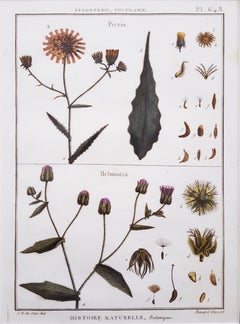
Picris (Sunflower); Helmintia (Bristly Oxtongue) /// Botanical Botany Plants Art

Picris (Sunflower); Helmintia (Bristly Oxtongue) /// Botanical Botany Plants Art

By Georges-Louis Leclerc, Comte de Buffon

Located in Saint Augustine, FL

Artist: Georges-Louis Leclerc, Comte de Buffon (French, 1707-1788) Title: "Picris (Sunflower); Helmintia (Bristly Oxtongue)" (Syngenesie; Polygamie, Plate 648) Portfolio: Histoire Na...

Category

Old Masters 18th Century Still-life Prints

Materials

Watercolor, Laid Paper, Engraving, Intaglio

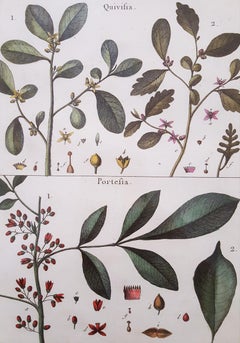
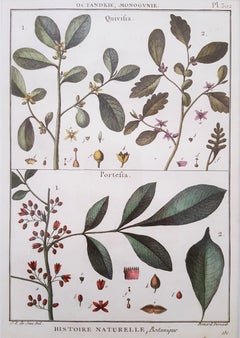
Quivisia; Portesia /// Antique Botanical Botany Plants Science Engraving Buffon
Quivisia; Portesia /// Antique Botanical Botany Plants Science Engraving Buffon
By Georges-Louis Leclerc, Comte de Buffon

Located in Saint Augustine, FL

Artist: Georges-Louis Leclerc, Comte de Buffon (French, 1707-1788) Title: "Quivisia; Portesia" (Octandreie, Monogynie, Plate 302) Portfolio: Histoire Naturelle Year: 1749-1789 Medium...

Category

Old Masters 18th Century Still-life Prints

Materials

Watercolor, Laid Paper, Engraving, Intaglio

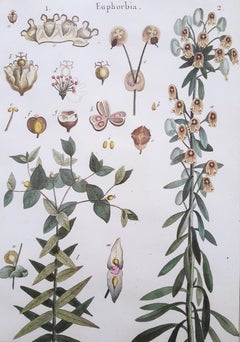
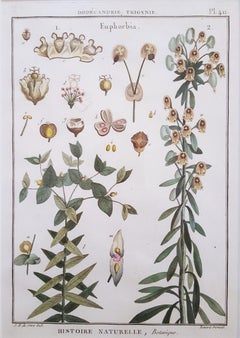
Euphorbia (Spurge) /// Antique Botanical Botany Plants Engraving Buffon Science
Euphorbia (Spurge) /// Antique Botanical Botany Plants Engraving Buffon Science
By Georges-Louis Leclerc, Comte de Buffon

Located in Saint Augustine, FL

Artist: Georges-Louis Leclerc, Comte de Buffon (French, 1707-1788) Title: "Euphorbia (Spurge)" (Dodecandrie, Trigynie, Plate 411) Portfolio: Histoire Naturelle Year: 1749-1789 Medium...

Category

Old Masters 18th Century Still-life Prints

Materials

Watercolor, Laid Paper, Engraving, Intaglio