Want more images or videos?
Request additional images or videos from the seller
1 of 14

Pierre Jules Mêne
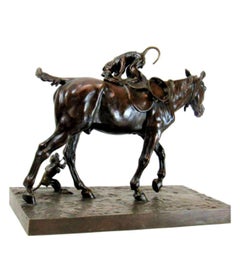
Horse Playing with a Dog (The Good Companions) Pierre-Jules Mene (1810-1879)

$10,500
$14,00025% Off
£7,882
£10,509.3425% Off
€9,188.79
€12,251.7325% Off
CA$14,870.14
CA$19,826.8525% Off
A$14,911.24
A$19,881.6625% Off
CHF 8,626.96
CHF 11,502.6125% Off
MX$181,568.71
MX$242,091.6125% Off
NOK 100,113.30
NOK 133,484.4025% Off
SEK 102,038.61
SEK 136,051.4925% Off
DKK 68,698.31
DKK 91,597.7525% Off

About the Item

Antique Horse Bronze  "Horse  in the Stable Playing with a Dog (The Good Companions)" Jument à l'écurie jouant avec un chien Pierre-Jules Mene (French, 1810-1879) Bronze 19 x 10 inches One of Mene's most beloved bronze, well-loved early example with beautiful rich patina. A sensitive portrait of a horse nuzzling his companion while the terrier is giving kisses to the horse’s nose. Cast by Mene’s own foundry and is very well detailed with a medium brown patina. Pierre-Jules Mêne (1810-1879) was one of the most successful and prolific animalier sculptors of the 19th century, known for his naturalistic representation of animals. Mêne received no formal education in sculpture but was taught to draw and model by his father and later began casting his own sculptures. He was largely self-taught, possessing a keen observation of nature that enabled him to capture the essence of his animal subjects with remarkable accuracy and vivacity. His work debuted at the Paris Salon in 1838, and from that point onwards, he exhibited his sculptures regularly. Mêne specialized in small-scale domestic animals, his subjects often including horses, dogs, bulls, and sheep. Interestingly, almost no big game are found in Mêne's ouevre. Beginning in 1837 as orders started coming in, Mêne worked as Antoine-Louis Barye before him, opening his own foundry where he personally oversaw the manufacture and production of his art. The work produced there bears the hallmark of extraordinary attention to detail and thoughtfulness shown in every element of presentation and assembly. His mastery in the technical aspects of casting bronze without relying on professional founders for the completion of his models gave him a significant advantage in producing his pieces with fine detail and at a lower cost. This operation was expanded in 1852 to handle the casting of models for his new son-in-law, Auguste Cain. Mêne’s sculptures are characterized by their naturalistic detail and the sense of immediate and candid snapshots of the animals in their daily lives. The essence of these qualities is captured in the sculpture “The Good Companions” which would become one of his best-known sculpture and clearly was a cherished favorite demanded by his clients. In the 1850s, Mêne's work gained international fame, and he started receiving commissions from patrons across Europe. His success was such that his sculptures were reproduced widely, in different sizes, and his foundry became one of the most prominent in Paris for animal bronzes. To this end, as an avenue into the profitable English market, he made arrangements with the Coalbrookdale foundry and the Falkirk foundry to cast some of his models. Mêne’s artistic contributions were recognized with several awards during his lifetime. He was awarded first-class medals at the Expositions Universelles in Paris in 1855, 1861, and 1867, and he was made a Chevalier of the Legion of Honor in 1861. Mêne's commitment to realism, at a time when the academic tradition still dominated art, was innovative and influential. He is often mentioned alongside artists like Antoine-Louis Barye and Auguste Caïn, who also contributed to the popularity of the animalier school in France. After a prosperous career, Pierre-Jules Mêne died in Paris on May 20, 1879. Today, the works of Mêne are held in numerous private collections and museums worldwide, including the Louvre and the Musée d'Orsay in Paris. In terms of reputation, he was second only to the great father of the Animaliers, Antoine-Louis Barye. Mêne remains celebrated for his contributions to French art and the animalier genre, and his sculptures are highly sought after by collectors for their beauty and lifelike quality.
  • Creator:
    Pierre Jules Mêne (1810 - 1879, French)
  • Dimensions:
    Height: 10 in (25.4 cm)Width: 19 in (48.26 cm)
  • Medium:
  • Movement & Style:
  • Period:
  • Condition:
    The bronze is in very good condition with a rich and lustrous patina.
  • Gallery Location:
    SANTA FE, NM
  • Reference Number:
    1stDibs: LU1408215223032

More From This Seller

View All
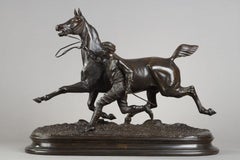
Antique Horse Bronze Trotting Stallion Isidore Jules Bonheur (France, 1827-1901)

Antique Horse Bronze Trotting Stallion Isidore Jules Bonheur (France, 1827-1901)

By Isidore Jules Bonheur

Located in SANTA FE, NM

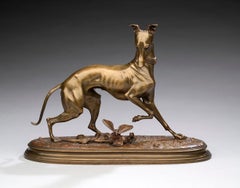
Antique Horse Bronze Portrait of a Trotting Stallion Isidore Jules Bonheur (France, 1827-1901) Cast bronze mounted on a rectangular plinth with dark brown patina, Signed: I. BONHEUR 17 x 11 3/4 A brilliant exploration of a stallion in full trot. The patina is a deep, warm walnut brown with honey-colored tones. Isidore Bonheur was best known and the most distinguished of the 19th century French animalier sculptors. Isidore, the younger brother of Rosa Bonheur and older brother of Auguste, began his studies of painting initially with his father, who was friends with Francisco Goya. By 1848 he debuted at the Paris Salon having discontinued animal and landscape painting to concentrate on creating sculptures and in 1849, Bonheur enrolled at the Ecole des Beaux Arts. He won medals at the Paris Salon in 1859 and did so again in 1865 and in 1869. After entering the Exposition Universelle 1855, he won the Gold Medal in 1889. In the 1870s exhibited in the London at the Royal Academy of Arts where he earned great prestige and won the coveted Medaille d’Or. After winning numerous other medals and prizes, Bonheur was awarded the Legion d' Honneur in 1895 and he was Knighted in Portugal, Spain and France. Bonheur continued exhibiting at the Paris Salon until 1899. Many of his bronzes were fabricated at the foundry owned by Hippolyte Peyrol, Bonheur's brother-in-law by marriage to Isidore’s youngest sister Juliette Bonheur. The Peyrol casts for both Rosa and Isidore are exceptionally well executed which suggests a strong working relationship between the founder and sculptor. There is little doubt that Isidore Bonheur was an acute observer of nature; his animals were not anthropomorphized but modelled to catch movement or posture characteristics of the particular species he was sculpting. He achieved this most successfully with his sculptures of horses which are usually depicted as relaxed rather than spirited. These figures are among his most renowned works and his equestrian models became very popular, particularly among the British aristocracy. An acute observer of nature, his sculptures reflect his commitment to the Realist school - with precise detailing of the movements of animals in their natural habitats. Ultimately, His naturalistic studies of animals are now some of the most highly sought after works by any of the animalier. He was possibly inspired by his many visits to the Buffalo Bill Wild West Show...

Category

1870s Realist Figurative Sculptures
Materials

Bronze

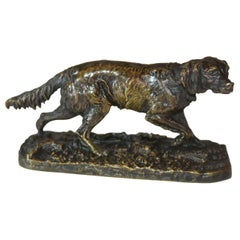
Antique Bronze Dog Portrait of a Cavalier King Charles "Thigley" circa 1905

Antique Bronze Dog Portrait of a Cavalier King Charles "Thigley" circa 1905

Located in SANTA FE, NM

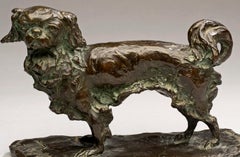
Antique Bronze Dog Portrait of a Cavalier King Charles "Thigley" French School (possibly Franck Burty Haviland) Lost wax bronze casting Circa 1910 5 7/8 x 9 x 3 1/4 A sophisticated bronze casting of a Cavalier King Charles spaniel made in lost wax casting (cire perdue) from the beginning of the 20th century by Valsuani Foundry. This an unusual bronze approached in its aesthetic that’s reminiscent of the work of great animal sculptors of the second half of the 19th century except in this presentation which is more avant-garde for the time with a much looser, more impressionistic execution. The patina is a superb bronze color, brown and slightly greenish, going in places towards a more antique green. The attitude of the dog is extremely well and sensitively rendered with the placement of material unlike the renderings of a bronze by Barye...

Category

Early 1900s French School Figurative Sculptures
Materials

Bronze

You May Also Like

P.J. Mene The Hunt Scene Large Bronze Sculpture Pierre Jules Statue Horse Dogs

P.J. Mene The Hunt Scene Large Bronze Sculpture Pierre Jules Statue Horse Dogs

By Pierre Jules Mêne

Located in Philadelphia, PA

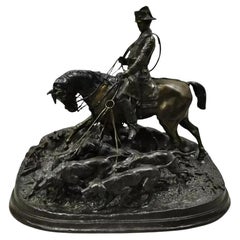
P.J. Mene The Hunt Scene Large Bronze Sculpture Pierre Jules Statue Horse Dogs. Item featured is signed in cast to base, "P.J. Mene 1869", artist Pierre Jules Mene, large impressive ...

Category

Antique Late 19th Century Unknown Other Figurative Sculptures

Materials

Bronze

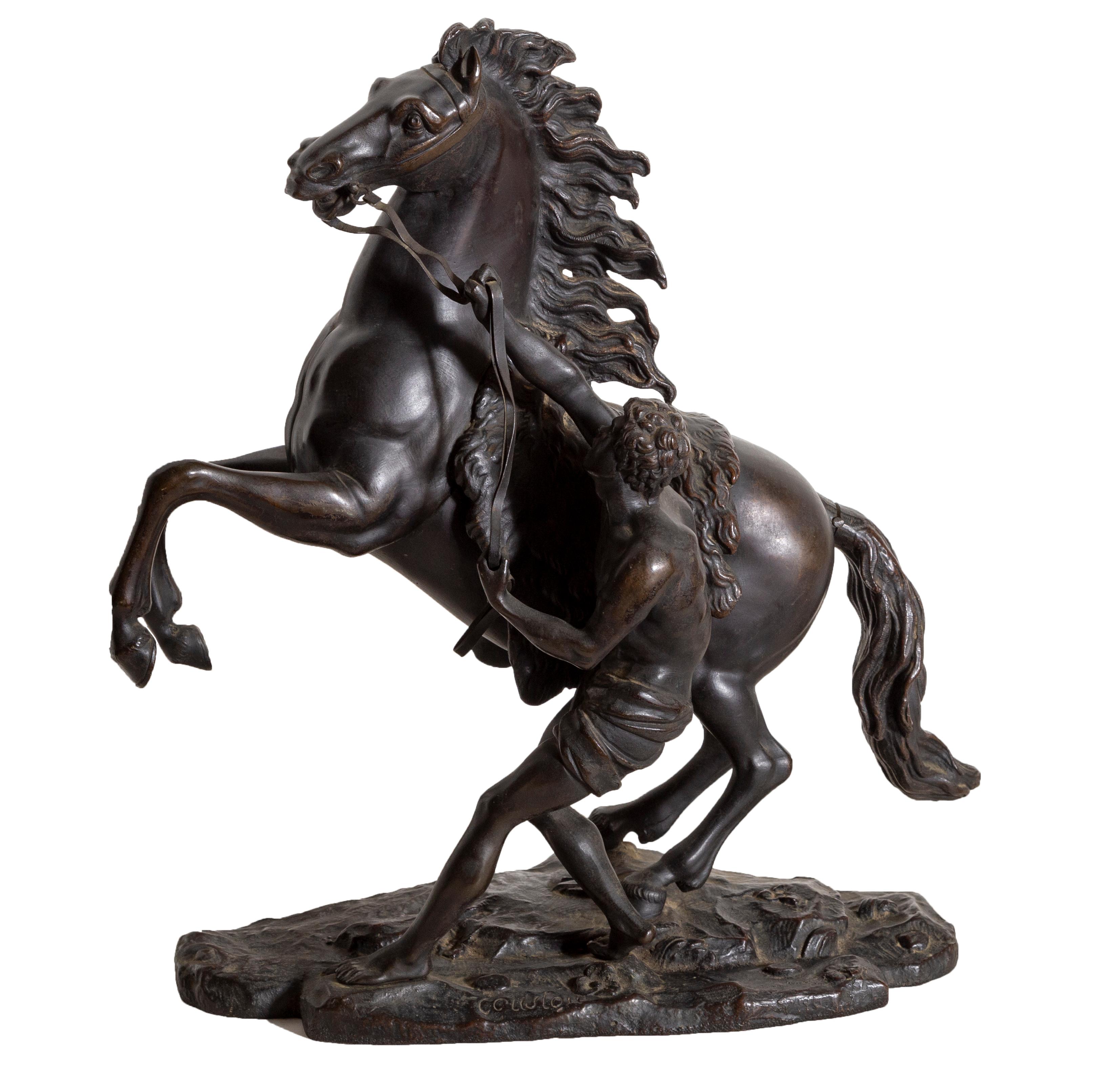
Horse training with its stable lad

Horse training with its stable lad

Located in PARIS, FR

Horse training with its stable lad by Arthur Marie Gabriel comte du Passage (1838-1909) A bronze group with nuanced dark brown patina Signed on the base " Cte du Passage " Period ca...

Category

Late 19th Century French School Figurative Sculptures

Materials

Bronze

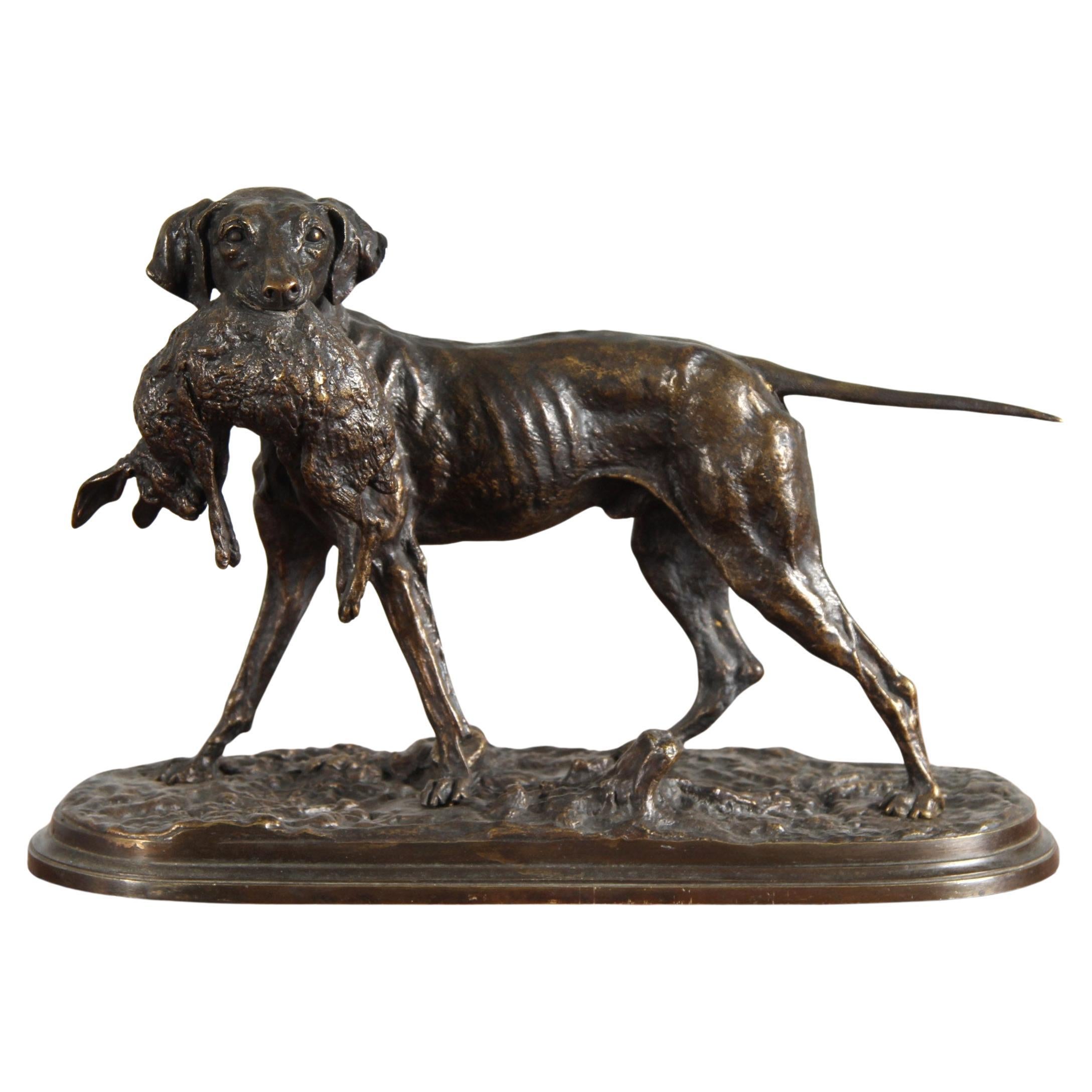
Pierre-Jules Mène - Bronze Hunting Dog, France, circa 1870

Pierre-Jules Mène - Bronze Hunting Dog, France, circa 1870

By P.J. Mêne

Located in Greven, DE

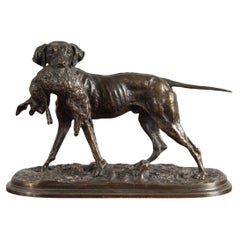
Pierre-Jules Mène - Bronze hunting dog France Bronze around 1870 Dimensions: H × W × D: 21 × 30 × 13 cm Description: Antique bronze sculpture of a short-haired hunting dog carryin...

Category

Antique 1870s French Animal Sculptures

Materials

Bronze