Video Loading
Want more images or videos?
Request additional images or videos from the seller
1 of 22

René Rozet
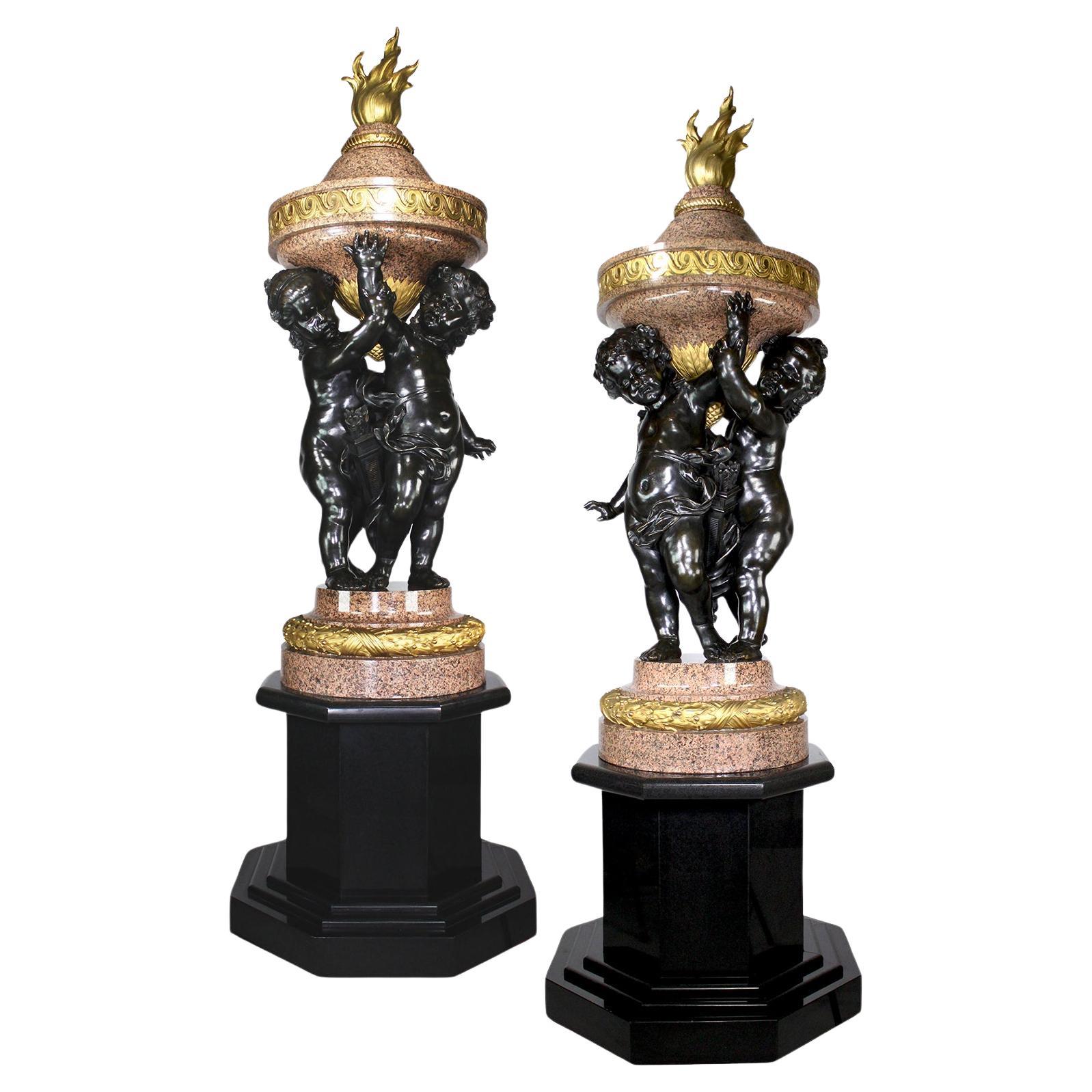
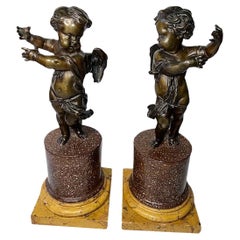
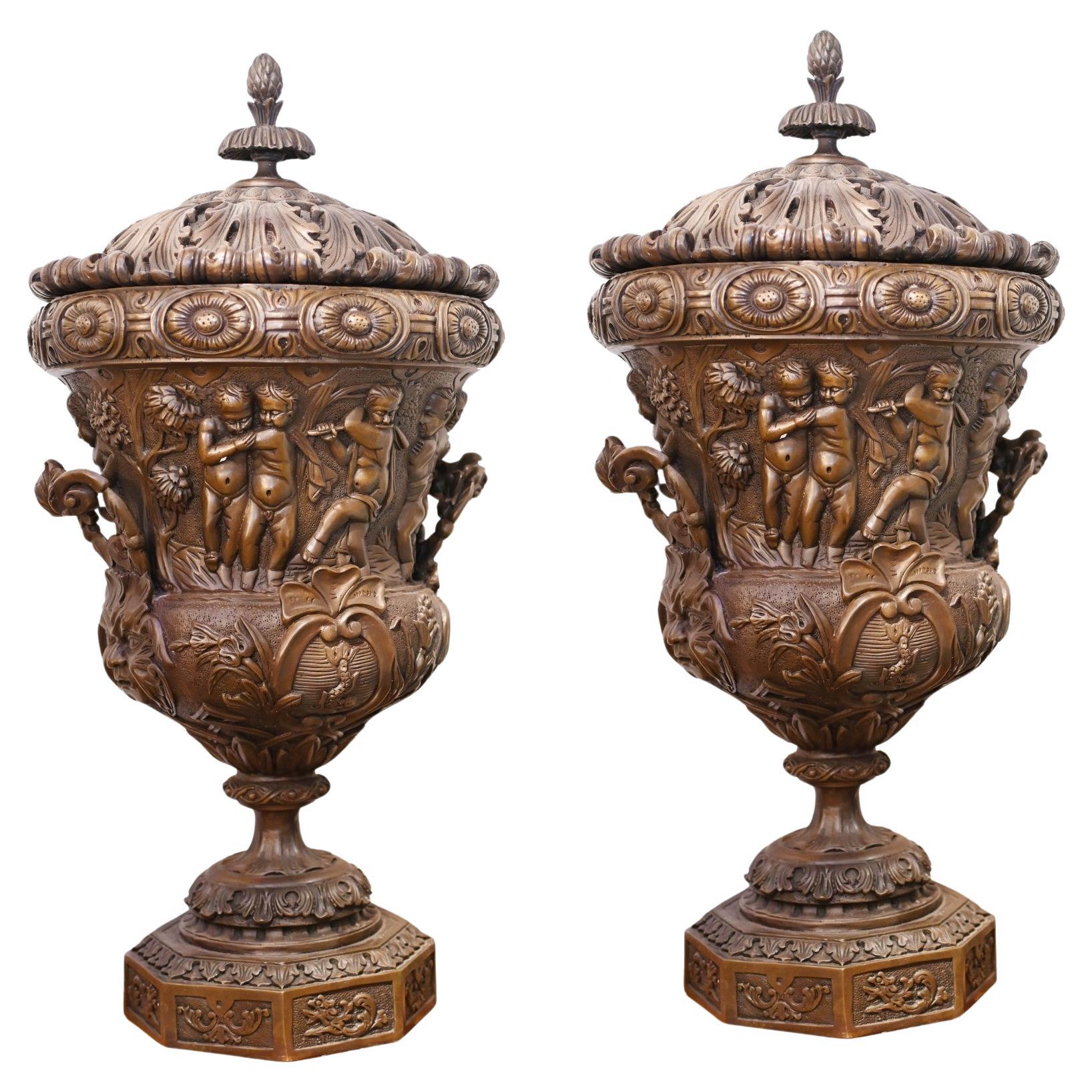
Monumental Pair French 19th Century Putto Flambeaux Urns Torchere Urn Sculptures

Circa: 1894

$1,250,000
£934,958.78
€1,093,046.03
CA$1,767,060.75
A$1,775,241.15
CHF 1,023,975.45
MX$21,603,795.08
NOK 11,894,899.58
SEK 12,066,090
DKK 8,171,156.25

About the Item

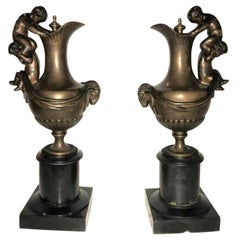
A Monumental Museum Quality Pair of French 19th Century Figural Gilt and Patinated Bronze Rosso Granite Marble Flambeaux Urns, each depicting a pair of standing allegorical and whimsical playful children (Putti) holding a flaming urn, by René Rozet (French, 1858-1939) in the style of Claude Michel Clodion (French, 1738 - 1814) and in the manner of Alfred Emmanuel Louis Beurdeley (1847-1919). One base is signed and dated: R. Rozet, 1894, the other signed: R. Rozet. Each raised on an later octagonal black marble pedestal. Circa: Paris, 1894. The Paris-born sculptor René Rozet (1859-1939) trained with classmate Louis Majorelle at the Academie de Beaux-Arts under renowned sculptor Aimé Millet. He exhibited regularly at the Paris Salon as well as the Salon des Artistes Français, where he was awarded Hors Concours and a gold medal in 1927. He was awarded the Légion d'Honneur in 1912. Literature: BENEZIT, E., Dictionnaire critique et documentaire des peintres, sculpteurs, dessinateurs et graveurs, tome 12, Paris, 1999, S. 63. Claude Michel Clodion (French, 1738 - 1814) - The son-in-law of sculptor Augustin Pajou, Clodion trained in Paris in the workshops of his uncle and Jean-Baptiste Pigalle, the most successful sculptor of the time. Upon winning the Prix de Rome, he moved to Italy, sharing a studio with Jean-Antoine Houdon and studying antique, Renaissance, and Baroque sculpture. A highly skillful modeler of clay, Clodion was intensely affected by the new interest in collecting terracottas. While terracotta had been traditionally used to make sketches for larger works in more permanent and expensive materials, terracotta sculptures could now be seen as independent works of art revealing the artist's inspiration and touch. Clodion's quickly executed yet detailed terracottas were, as his earliest biographer records, "bought by amateurs even before they were finished." Among his clients, Catherine II of Russia unsuccessfully attempted to bring him to her court. In 1771 Clodion returned to Paris, where he continued to produce mostly in terracotta. He also worked with his brothers in other media, decorating objects such as candelabra, clocks, and vases. Drawing primarily from pagan antiquity, he created light-hearted terracotta sculptures that epitomized the Rococo style. Late in his life, when Neoclassial works were more popular, Clodion adjusted his style and worked on major public monuments in Paris. Alfred Emmanuel Louis Beurdeley (1847-1919) - Specializing in reproductions of the most magnificent articles from the Garde-Meuble National, the Beurdeley firm exhibited and won awards at all of the major international exhibitions during the second half of the nineteenth century. The quality and skill employed in production was of exceptional quality; their bronze mounts with mercury gilding and hand chasing were often difficult to distinguish from late eighteenth-century examples, and were considered the finest in Paris. The firm was pioneered by Jean Beurdeley (1772-1853), later managed by his son Louis-Auguste-Alfred, and finally imparted to his son Alfred-Emmanuel-Louis in 1875. The firm was established at 32 and 34, rue Louis-Le-Grand, and also owned the pavillion de Hanovre, where it was based while Alfred-Emmanuel-Louis added two additional workshops at 20 and 24, rue Dautancourt by 1875. The Beurdeley workshops closed in 1896, although still partially active until 1898 when the stock was sold over a number of auctions conducted by the Galerie Georges Petit of Paris. Two auction catalogues of the collection were published in 1895 and sales were held between March 6-8 and May 27-28. Among Beurdeley's most prestigious clients were Emperor Napoleon III and Empress Eugénie, the duc D'aumale, Richard Wallace, the Duc and Princess d'Hamilton, Tsarine Alexandra Féodorovna, The Rothschild and Vanderbilt dynasties and the Metropolitan Club, New York. Overall Height: 8 feet 4 1/2 inches (255.3 cm) Torchere Height: 74 1/2 inches (189.3 cm) Torchere Width: 23 1/2 inches (59.7 cm) Pedestal Height: 26 inches (66 cm)
  • Creator:
    René Rozet (1859 - 1939, French)
  • Creation Year:
    Circa: 1894
  • Dimensions:
    Height: 100.5 in (255.27 cm)Width: 23.5 in (59.69 cm)Depth: 23.5 in (59.69 cm)
  • Medium:
  • Movement & Style:
  • Period:
  • Condition:
    A truly stunning pair of torchere sculptures in great condition, some minor rubbing wear consistent with its age & use. The black marble pedestal stands are not antique. A very impressive and quite heavy sculptures requires special handling.
  • Gallery Location:
    LA, CA
  • Reference Number:
    Seller: A12791stDibs: LU2755215015522

More From This Seller

View All
Italian 19th Century Carrara Marble Sculpture " Young Beauty Going for a Swim"

Italian 19th Century Carrara Marble Sculpture " Young Beauty Going for a Swim"

By Emilio Fiaschi

Located in LA, CA

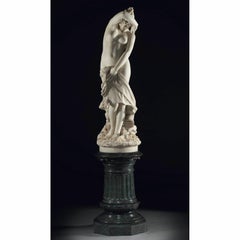
A very fine Italian 19th century Carrara marble sculpture depicting a young beauty going for a Swim standing on the steps of a dock, raised on its original carved green marble pedest...

Category

Late 19th Century Academic Figurative Sculptures

Materials

Marble

A Life-Size Italian 19th C. Marble Sculpture Children in a Crib by A. Tantardini

A Life-Size Italian 19th C. Marble Sculpture Children in a Crib by A. Tantardini

Located in LA, CA

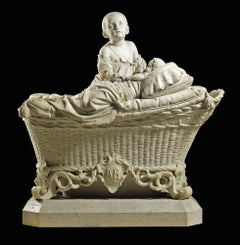
Antonio Tantardini (Italian, 1829-1879) An extraordinary Italian 19th century life-size carved Carrara white marble sculpture of "A Young Child and a baby in a wicker crib" - A Risorgimento Allegory subject. The older child's medallion inscribed with an interlocked XV and Garibaldi, the crib monogrammed: AR. Signed and dated: A.nio Tantanrdini F.ce / 1863. Circa: Florence, 1863. This sculpture includes a recent custom-made veined black marble pedestal stand. (The 2 items description mean the sculpture and pedestal, which are sold as sold a set.) In a country famed for its skilled carvers and working in an age when virtuoso carving technique was highly prized, Antonio Tantardini was one of the very best exponents of master carvers in nineteenth century Italy. Vicario describes Tantardini's skill as 'un abilità tecnica stupefacente'. The present amazing quality marble group epitomizes Tantardini's exceptional talents as a carver. Lesser sculptors might have shied away from attempting to carve a life-size wicker crib in marble, but Tantardini has clearly relished the Challenge. The result is a stunning achievement of verismo Italian sculpture. This marble group, however, is more than a paradigm of Italian marble carving, it is also a prime example of the use of Risorgimento allegory in Italian sculpture of the 1860s. Famous sculptural Risorgimento allegories include Raffaelle Monti...

Category

19th Century Academic Figurative Sculptures

Materials

Marble

Italian 19th Carved Marble Figure of a Nude Young Bather Girl by Pietro Bazzanti

Italian 19th Carved Marble Figure of a Nude Young Bather Girl by Pietro Bazzanti

By Pietro Bazzanti

Located in LA, CA

Pietro Bazzanti - Barzanti (Italian, 1825-1895) "After the Bath" - a fantastic quality and large carved white Carrara marble figure of a semi-nude young maiden standing by the sea-shore. The smiling and posing young beauty, with bare breasts and back, her right arm juxtaposed over her head, while holding a blanket over her waist with her left hand and standing barefoot by a rocky seawall and wavy shoreline. Signed 'P. Barzanti/Florence' (on reverse) and raised on a cylindrical swiveling carved verde antico solid marble pedestal. circa: Florence, 1880-1890. Pietro Bazzanti or Barzanti (Italian, 1825-1895) was a 19th Century Italian sculptor born in Florence. Together with his brother, Niccolò Bazzanti (Firenze, 1802-1869) who was also a sculptor, they both worked the sprawling Florentine studio 'Pietro Bazzanti e Figlio' a hugely successful sculpture studio, operated within the family at their gallery on Lungarno Corsini until the mid-twentieth century. The studio was a place where many talented professors and apprentice sculptors specialized in sculpting marble genre scenes and allegorical figures as well as copies of antique and Renaissance sculpture catered to a prominent international clientele which included European and Russian aristocracy, and the Industrial fortunes being made in England and Americas drove considerable export demand. In 1861 the studio was awarded the medal for 'Ercole con cinghiale sulla spalla' (Hercules with boar on shoulder), 'Due Cani' (Two dogs) and 'Cinghiale' (Boar) sculptures at the National Exposition in Florence. In 1874 he exhibits his works in London and in 1876 in Philadelphia. Bazzanti frequently returned to the subject of 'After the Bath' or 'The Bather' in his works, having carved examples of the bathing Venus after the Antique and in dynamic and dramatic compositions such as the present sculpture. The finely-detailed work relates closely to popular figures produced by Bazzanti’s contemporary, Cesar Lapini, whose La Sopresa depicts a young woman stepping back from approaching waves. The sculptor’s penchant for realism is on full display with the contrasting matte and highly-polished finishes of the gently lapping waves at the figure’s feet, to the jutting rocks and soft skin. Elegant handling of textures is further exemplified in the draped fringe of the cloth. This monumental and Fine work is illustrated in situ at Bazzanti’s studio circa 1900 among other fashionable works of the period. Notes: Pietro Bazzanti was also known as Pietro Barzanti. There are conflicting dates of Pietro Bazzanti/Barzanti's birth/death year. Some auction houses and art galleries have described 'Pietro Barzanti' as Italian, 1842–1881 and Pietro Bazzanti as Italian, 1825-1895. However, according to Alfonso Panzetta – Nuovo Dizionario degli Scultori Italiani dell’ottocento e del Primo Novecento – 2003 Edition –Page 78, 'Pietro Barzanti' was in fact 'Pietro Bazzanti' one and the same, and it questions his year of his birth/death as "Firenze (?), ?, ?." thus we believe that the Italian, 1825-1895 description is the most plausible. Literature: Alfonso Panzetta – Nuovo Dizionario degli Scultori Italiani dell’ottocento e del Primo Novecento – 2003 Edition –Page 78. Auctions: Another example of this sculpture, probably also Pietro Bazzanti but almost a foot shorter (Height 44¾ in. (113.5 cm), unsigned and without its pedestal, was sold at Christie's New York, 19th Century Furniture, Sculpture, Works of Art and Ceramics Sale...

Category

19th Century Academic Nude Sculptures
Materials

Marble

Pair 19th Century French Whimsical Oil on Canvas  "Cherubs and Putti Children"

Pair 19th Century French Whimsical Oil on Canvas "Cherubs and Putti Children"

By Charles Joshua Chaplin

Located in LA, CA

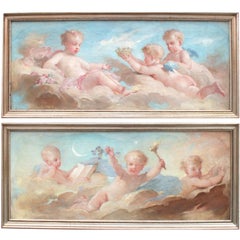
Charles Joshua Chaplin (French, 1825-1891) A Very Fine and Charming Pair of 19th Century French Whimsical Oils on Canvas of Cherubs and Putti, after François Boucher (French, 1703–17...

Category

19th Century Academic Figurative Paintings

Materials

Canvas, Oil

You May Also Like

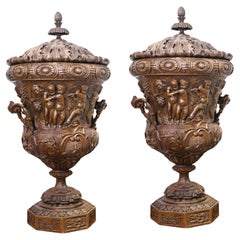
A Monumental Pair of French 19th Century Children Urns Torcheres Urn Sculptures

A Monumental Pair of French 19th Century Children Urns Torcheres Urn Sculptures

By René Rozet 1

Located in Los Angeles, CA

A Monumental Museum Quality Pair of French 19th Century Figural Gilt and Patinated Bronze Rosso Granite Marble Flambeaux Urns Torcheres, each depicting a pair of standing allegorical and whimsical playful children (Putti) holding a flaming urn, by René Rozet...

Category

Antique 1890s French Louis XV Figurative Sculptures

Materials

Granite, Bronze

Pair of 19th Century Urns on Marble Stands Bearing Cherubs and Rams Heads

Pair of 19th Century Urns on Marble Stands Bearing Cherubs and Rams Heads

Located in Stamford, CT

Pair of 19th century French urns on marble stands bearing cherubs and rams heads. Each of these finely chased and bronze patinated urns or water pictures were previously mounted as table lamps and can easily be converted again. The solid black pedestal column...

Category

Antique Late 19th Century French Belle Époque Figurative Sculptures

Materials

Bronze

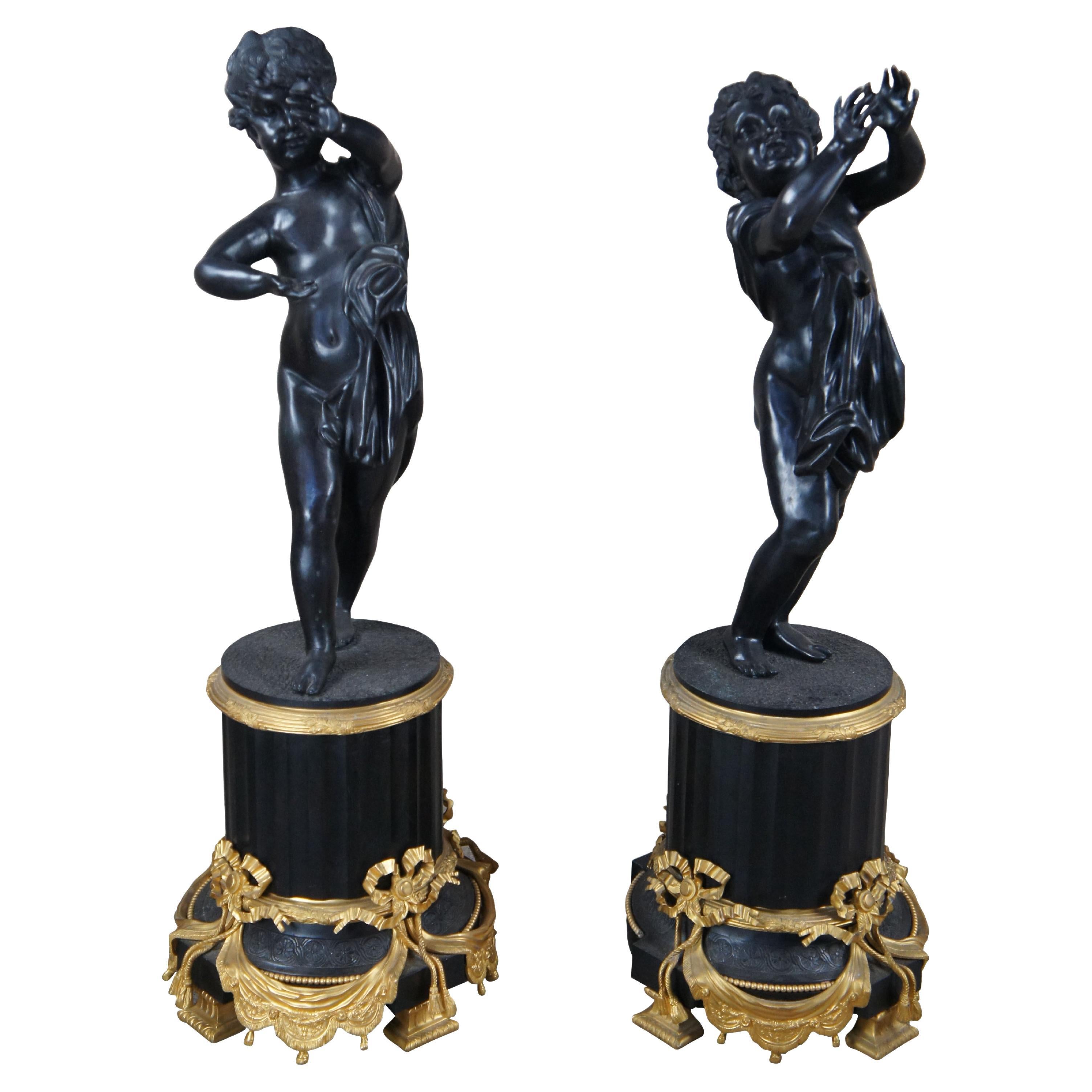
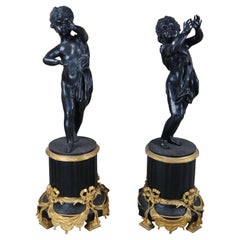
2 Italian Neoclassical Louis XV Bronze Cherub Sculptures Statues 45"

2 Italian Neoclassical Louis XV Bronze Cherub Sculptures Statues 45"

Located in Dayton, OH

Pair of Monumental Italian Neoclassical Cherub Putti Sculptures. Made from bronze with ebonized and gilt detail. Each raised over a classical fluted and footed column plinth with orn...

Category

20th Century Neoclassical Figurative Sculptures

Materials

Bronze

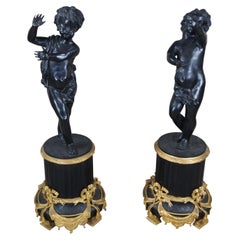
2  Italian Neoclassical Louis XV Bronze Cherub Sculptures Statues 45"

2 Italian Neoclassical Louis XV Bronze Cherub Sculptures Statues 45"

Located in Dayton, OH

Pair of Monumental Italian Neoclassical Cherub Putti Sculptures. Made from bronze with ebonized and gilt detail. Each raised over a classical fluted and footed column plinth with or...

Category

20th Century Neoclassical Figurative Sculptures

Materials

Bronze