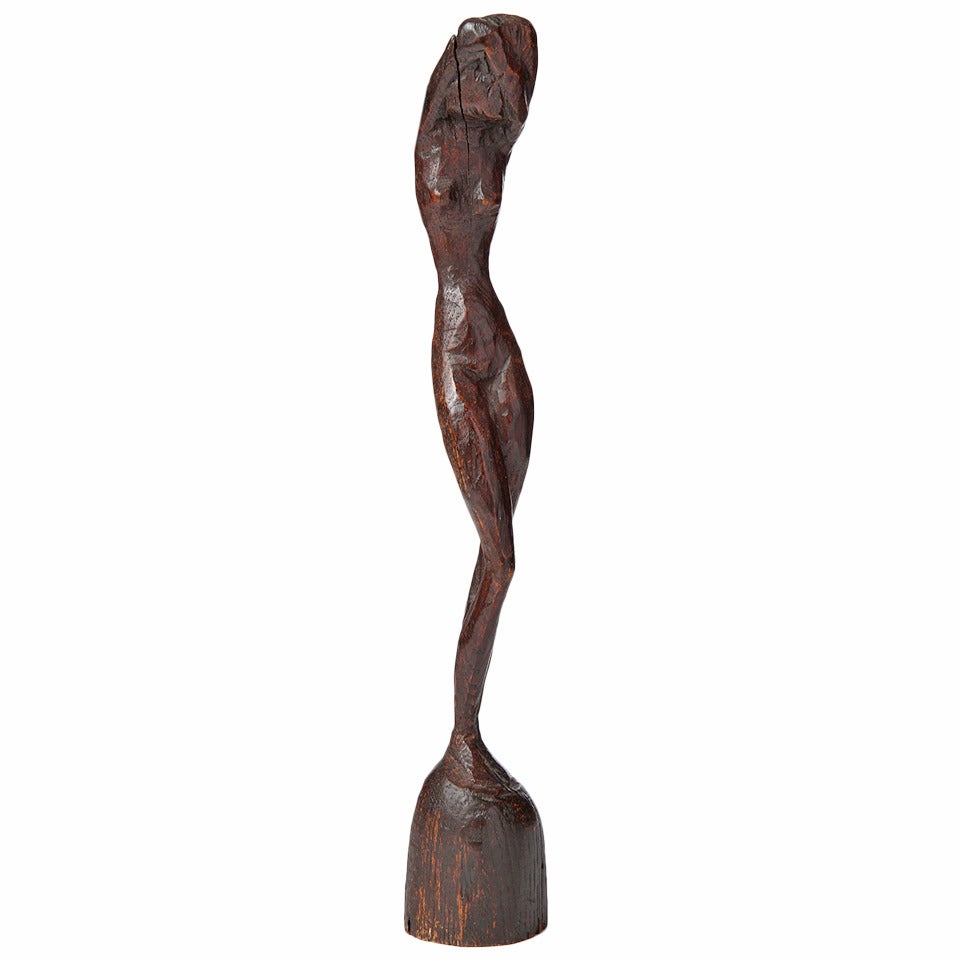
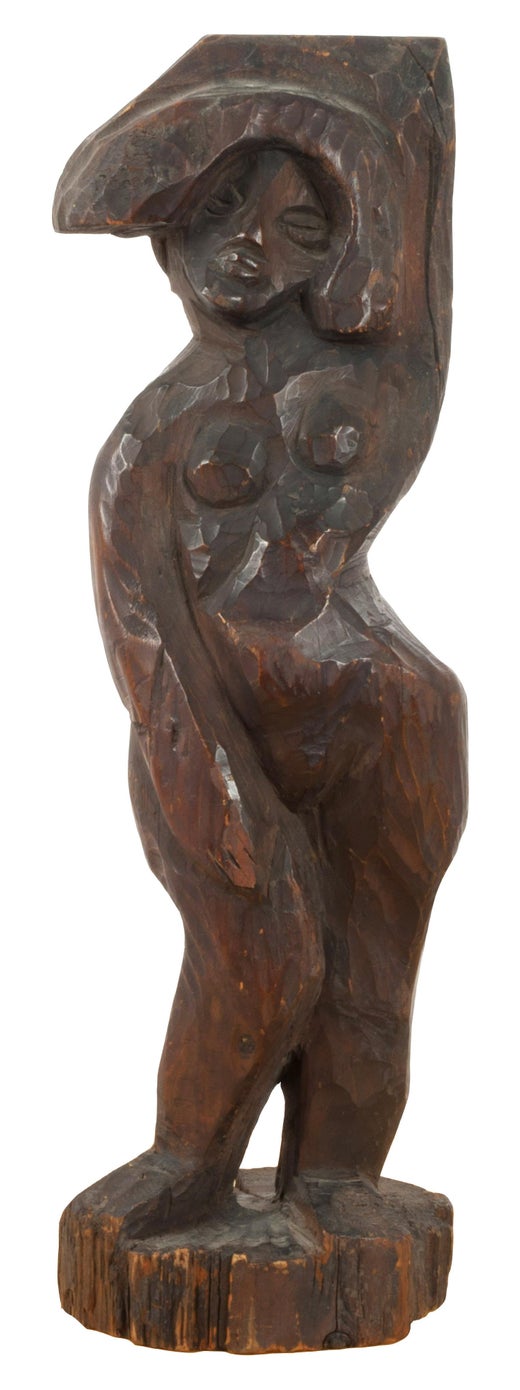
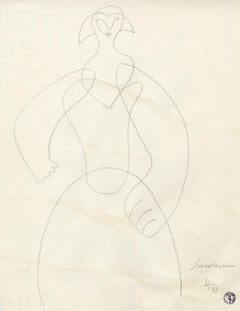
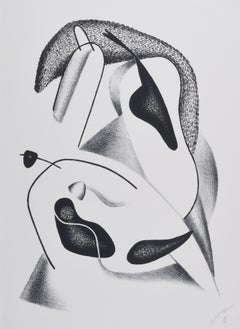
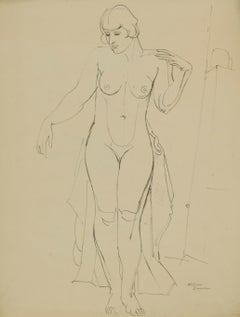
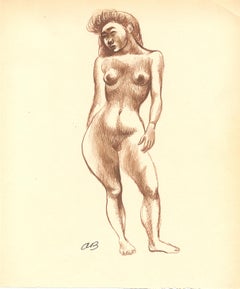
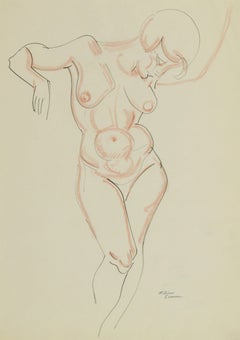
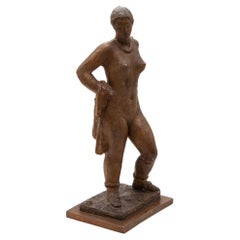
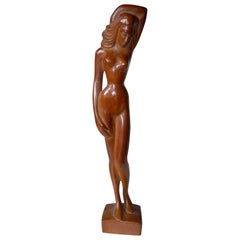
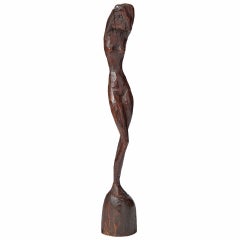
Standing Female Nude
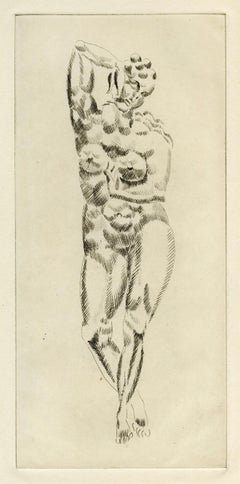
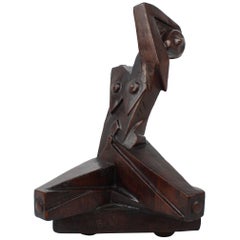
After Alexander Archipenko Negress (La Negresse)
Wood carving, c. 1913
Unsigned
Provenance: the Artist's Estate
Brenda Kuhn (his daughter)
Kennedy Galleries
Solander O'Reilly Galleries
Private Collection, PA
Illustrated: "Walt Kuhn, Painter, His Life and Work, by Phillip Rhys Adams, page 67, plate 27, Courtesy of Kennedy Galleries-Kuhn Estate (see photo)
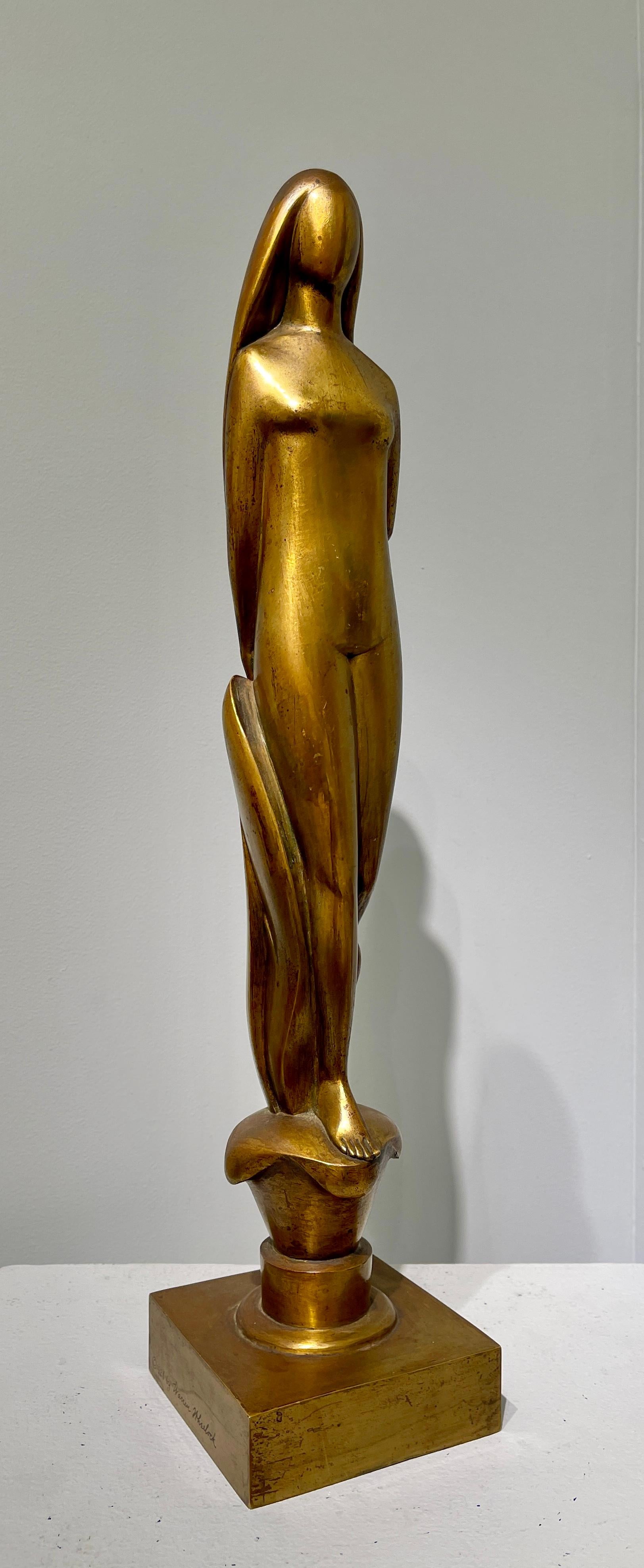
This work is directly inspired by an Archipenko sculpture, Negress (La Negresse), illustrated in the 1913 Armory Show catalog (reproduced below).
Walt Kuhn's Wood Carvings: Birds, Circus Figures, and Modernist Sculpture
Although Walt Kuhn (1877–1949) is best remembered as a painter and as one of the principal organizers of the landmark Armory Show of 1913, he also created a remarkable body of carved and painted wooden sculpture that occupied an important place within his artistic practice. Produced primarily during the 1910s and 1920s, these unique carvings depict birds, masks, clowns, circus performers, dancers, and other folk-inspired figures. Their direct carving, simplified forms, and expressive surfaces reveal an artist deeply engaged with both American folk traditions and the emerging language of modernism.
The sculptures share many of the qualities that distinguish Kuhn's paintings. His carved circus figures, in particular, anticipate the iconic performers that would later dominate his canvases. Like his melancholic clowns, acrobats, and show people of his paintings, the carved figures possess a striking psychological presence. Rather than portraying performers in action, Kuhn emphasized their individuality and inner character, reducing forms to their essential volumes while preserving a sense of dignity and humanity. These sculptures suggest that Kuhn's lifelong fascination with circus life was not merely thematic but reflected a deeper interest in the expressive potential of unconventional personalities existing outside mainstream society.
Equally significant are Kuhn's carvings of birds native to Maine, where he lived. These were created and given to his daughter Brenda who preserved them. Far removed from naturalistic representation, these sculptures transform familiar avian subjects into highly stylized forms characterized by compact masses, exaggerated silhouettes, and boldly simplified contours. In their economy of means, the bird carvings reveal Kuhn's appreciation for folk carving traditions and his attraction to the expressive power of direct observation distilled into abstract form. The birds occupy a position between sculpture and object, combining decorative charm with a distinctly modernist concern for shape, volume, and surface. Many scholars have noted that these carvings embody the same search for essential form that animated modernist sculpture on both sides of the Atlantic during the early twentieth century.
Kuhn's interest in sculpture developed alongside his exposure to European modernism. The noted collector John Quinn (1870–1924), one of the most influential patrons of modern art in America, acquired examples of Kuhn's modernist carvings for his collection. Quinn also owned Constantin Brancusi's celebrated Portrait of Mlle. Pogany, a work selected by Kuhn for exhibition at the Armory Show. According to estate records and subsequent scholarship, Brancusi's sculpture served as the inspiration for Kuhn's carved Mask (Private Collection), illustrating the direct impact of European avant-garde sculpture on Kuhn's own experiments in carving. Kuhn also carved modernist works after Archipenko, Toulouse-Lautrec, Gauguin and Picasso.
The artist's sculptural work is documented in Philip Rhys Adams's authoritative study, Walt Kuhn, Painter: His Life and Work, where examples are illustrated and discussed (p. 67, pl. 27). Adams recognized the carvings as an important but often overlooked aspect of Kuhn's creative achievement, demonstrating how sculpture provided an alternative vehicle for exploring the expressive simplification that characterized his paintings and drawings.
Examples of Walt Kuhn's carved sculpture are known in the collections of the Smithsonian Institution and the Heckscher Museum of Art. Additional carvings remained in the artist's estate and descended to his daughter, Brenda Kuhn, from whom a significant group entered private collections..
A notable group of fifteen carvings descended directly through the artist's family. Following Kuhn's death, the works passed to his daughter, Brenda Kuhn, and remained in the Kuhn Estate. Kennedy Galleries of New York, representatives of the estate during the 1960s, published an illustrated catalogue of estate holdings in 1967. Representation later transferred to Barridoff Galleries of Portland, Maine, in partnership with Salander-O'Reilly Galleries of New York, which published a monographic catalogue on the artist in 1984. Three early carvings dating to approximately 1913 retain Salander-O'Reilly labels, and several works from this estate group have appeared at auction since 2000, helping to renew scholarly and collector interest in Kuhn's sculptural production.
Today, Kuhn's carved birds and circus figures are increasingly recognized as among the most personal works of his career. Bridging American folk art, direct carving, and early modernist experimentation, they provide an intimate counterpart to the artist's paintings and reveal a sculptor capable of transforming humble subjects into powerful expressions of character, form, and imagination.