Want more images or videos?
Request additional images or videos from the seller
1 of 9

Kumikaho Oshima
Elegy in Plastic

2020

$5,871.74
£4,365.19
€5,250VAT Included
CA$8,231.62
A$8,357.91
CHF 4,737.92
MX$101,816.80
NOK 56,036.90
SEK 56,053.19
DKK 38,121.63

About the Item

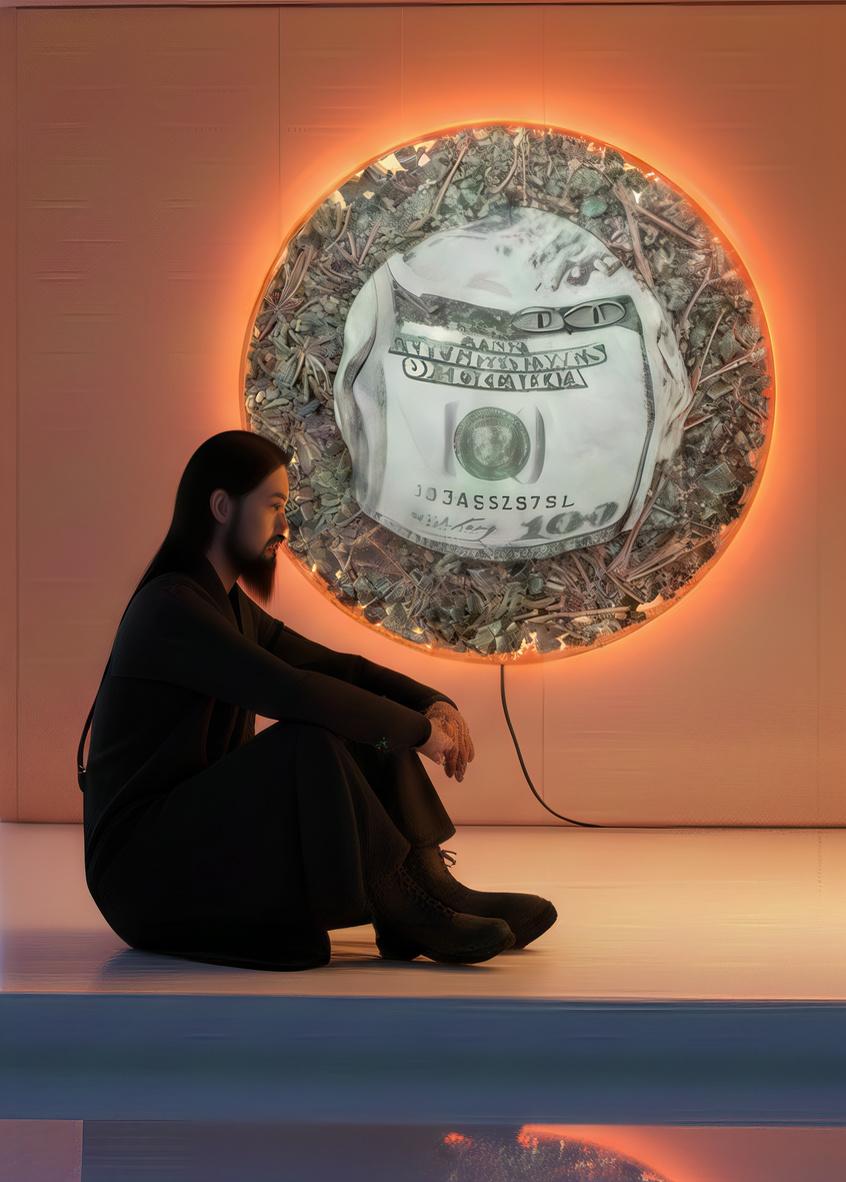
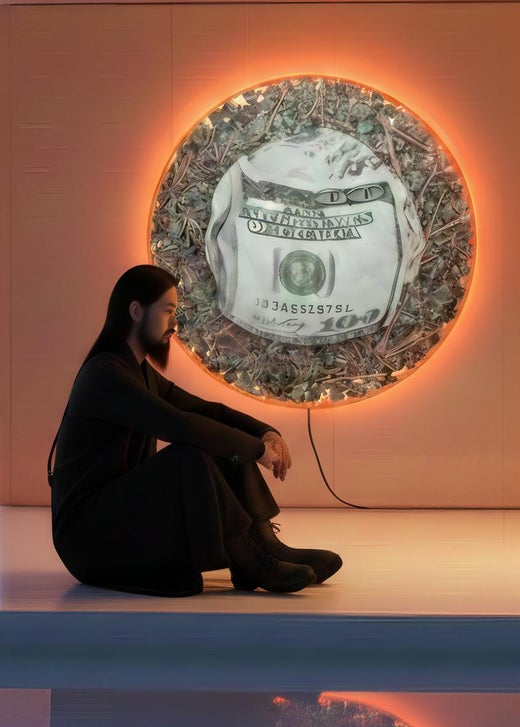
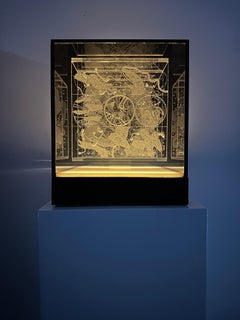
Elegy in Plastic is a striking illuminated artwork by Kumikaho Oshima from the series Luminous Transactions : Barbie Chronicles in Currency Boxes, where the artist stages a dense accumulation of plastic Barbie dolls inside a LED-backlit case whose inner walls are printed with skull motifs derived from American dollar bill engravings. The compressed arrangement of the dolls generates a tactile visual field, oscillating between playful familiarity and conceptual unease, inviting viewers to reconsider the emotional weight of mass-produced icons. The composition emphasizes repetition as a narrative device: identical bodies layered together form a collective silhouette that evokes both abundance and erasure of individuality. By enclosing these figures within a luminous frame, Oshima transforms the dolls into artifacts of cultural memory, suggesting how globalized beauty standards are circulated, archived, and internalized. The Barbie figure, once a symbol of aspiration, becomes here a reflective surface for questioning identity construction in contemporary society. The skull imagery printed on the interior walls introduces a subtle memento mori, counterbalancing the pastel tones of the dolls with a reminder of impermanence. This juxtaposition generates a powerful dialogue between vitality and fragility, consumer desire and existential awareness. The LED glow enhances this tension, casting soft shadows that animate the plastic forms while exposing their artificiality. Within the broader framework of Neo-Pop aesthetics, the artwork explores how economic symbolism and pop culture imagery intersect to shape collective imagination. Oshima’s choice to isolate Barbie figures—without the simultaneous presence of currency—creates a focused meditation on projection, aspiration, and the psychological imprint of standardized femininity. The viewer is encouraged to navigate the layered meanings between nostalgia, commodification, and self-representation. As a major member of the CrazyNoodles studio, founded by Hiro Ando, Oshima contributes to a contemporary dialogue that merges light, repetition, and iconic imagery into analytical visual systems. Her practice reveals how cultural symbols can be reframed to expose the emotional and ideological structures beneath their surface appeal. Through Elegy in Plastic, the artist constructs a contemplative environment where accumulation becomes metaphor, illumination becomes inquiry, and the familiar becomes subtly unsettling. The work stands as a refined example of Japanese Neo-Pop’s ability to transform everyday objects into vehicles for introspection. Through its precise composition, layered symbolism, and luminous presence, Elegy in Plastic asserts itself as a highly collectible piece. A work particularly suited for collectors of contemporary Japanese art, Neo-Pop, and artworks exploring identity, cultural memory, and the psychology of visual consumption. LITERATURE ABOUT THE SERIE "Luminous Transactions : Barbie Chronicles in Currency Boxes" In the series Luminous Transactions : Barbie Chronicles in Currency Boxes, Kumikaho Oshima constructs a sharp visual inquiry into the nature of value—economic, symbolic, and emotional—through illuminated enclosures where Barbie imagery and U.S. currency become suspended signs. The LED-backlit cases operate as contemplative chambers in which circulation is paused, allowing viewers to examine how desire is manufactured and archived. Within these luminous boundaries, money shifts from instrument of exchange to visual texture, while Barbie emerges as a cultural archetype, revealing how aspiration and recognition intertwine in contemporary consciousness. Formally, the series is driven by repetition and stratification. Compressed layers of banknotes create uneven reliefs that capture light unpredictably, while printed Barbie portraits on the inner walls establish an iconographic counterpoint. Oshima orchestrates a dialogue between material evidence and projected identity: currency evokes measurable success, whereas Barbie embodies the constructed ideal. This duality underscores how modern identity is negotiated between what can be quantified and what must be imagined. Light plays a conceptual role beyond illumination. The LED glow exposes the dissonance between surface allure and symbolic weight, transforming accumulation into an archive of collective belief rather than a celebration of abundance. In this suspended environment, viewers are encouraged to reflect on how wealth is staged, preserved, and interpreted, recognizing the subtle choreography between visibility and perceived worth. Situated within the broader language of Japanese Neo-Pop, the series examines globalization’s imprint on visual psychology, particularly among younger generations. Universal icons—the American dollar and the globally recognized doll—intersect to reveal the standardization of aspiration and the fragility of cultural reference points. Oshima suggests that identity increasingly forms through circulating images, where validation depends as much on social perception as on symbolic capital. As a major member of the CrazyNoodles studio, founded by Hiro Ando, Oshima advances an aesthetic in which light, accumulation, and popular iconography function as analytical instruments. Luminous Transactions ultimately reads as a sensitive cartography of contemporary desire, transforming familiar symbols into reflective surfaces that illuminate the silent circulation of value, memory, and projected identity within today’s image-saturated societies.

More From This Seller

View All
Powerful Dolls

Powerful Dolls

By Kumikaho Oshima

Located in PARIS, FR

Powerful Dolls is a luminous artwork by Kumikaho Oshima from the series Luminous Transactions : Barbie Chronicles in Currency Boxes, where the artist presents a dense accumulation of...

Category

2010s Contemporary Sculptures

Materials

Plastic, Plexiglass, LED Light

Wealthy Trio

Wealthy Trio

By Kumikaho Oshima

Located in PARIS, FR

Wealthy Trio is a luminous artwork by Kumikaho Oshima from the series Luminous Transactions : Barbie Chronicles in Currency Boxes, where the artist stages a dense accumulation of U.S...

Category

2010s Contemporary Sculptures

Materials

Plexiglass, Paper, LED Light

Shuya 5 : Ethereal Temptations and Sculpted Desires

Shuya 5 : Ethereal Temptations and Sculpted Desires

By Aya Toshikawa

Located in PARIS, FR

Shuya 5: Ethereal Temptations and Sculpted Desires is a white marble sculpture by Japanese Neo-Pop artist Aya Toshikawa, created as part of her sculptural series Sensual Marble Elega...

Category

2010s Contemporary Sculptures

Materials

Marble

Ephemeral Earnings

Ephemeral Earnings

By Kumikaho Oshima

Located in PARIS, FR

Ephemeral Earnings is a wall-mounted sculpture by Kumikaho Oshima from the series Dollar Dreams in Neon Barbie World, where the artist positions a Barbie figure against a dense backg...

Category

2010s Contemporary Mixed Media

Materials

Plastic, Plexiglass, Paper, LED Light, Wax

Ephemeral Elegance

Ephemeral Elegance

By Kumikaho Oshima

Located in PARIS, FR

Ephemeral Elegance is an oil on canvas painting by Kumikaho Oshima from the series Naked Fortunes: Portraits of Barbie and Dollars, where the artist explores the delicate tension bet...

Category

2010s Contemporary Paintings

Materials

Oil

Back to Okiya : An Onyx Silent Ballet

Back to Okiya : An Onyx Silent Ballet

By Ryoko Watanabe

Located in PARIS, FR

Back to Okiya : An Onyx Silent Ballet by Ryoko Watanabe unfolds as a suspended apparition, a delicate moment where body, space, and memory converge in a silent choreography. Part of ...

Category

2010s Contemporary Sculptures

Materials

Resin

You May Also Like

Japanese Contemporary Art By Kojun - Shiko 10

Japanese Contemporary Art By Kojun - Shiko 10

By Kojun

Located in Paris, IDF

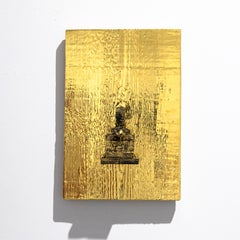
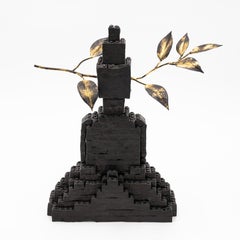
Lego, gold leaf (24k, 22.66k), copper wire, wood This collaborative work, which began with a common interest in Buddhism, explored the idea of expressing the sacred within everyday life. As artist and Zen monk...

Category

2010s Conceptual Still-life Sculptures

Materials

Gold Leaf, Wire

Floating Images

Floating Images

Located in Wilton Manors, FL

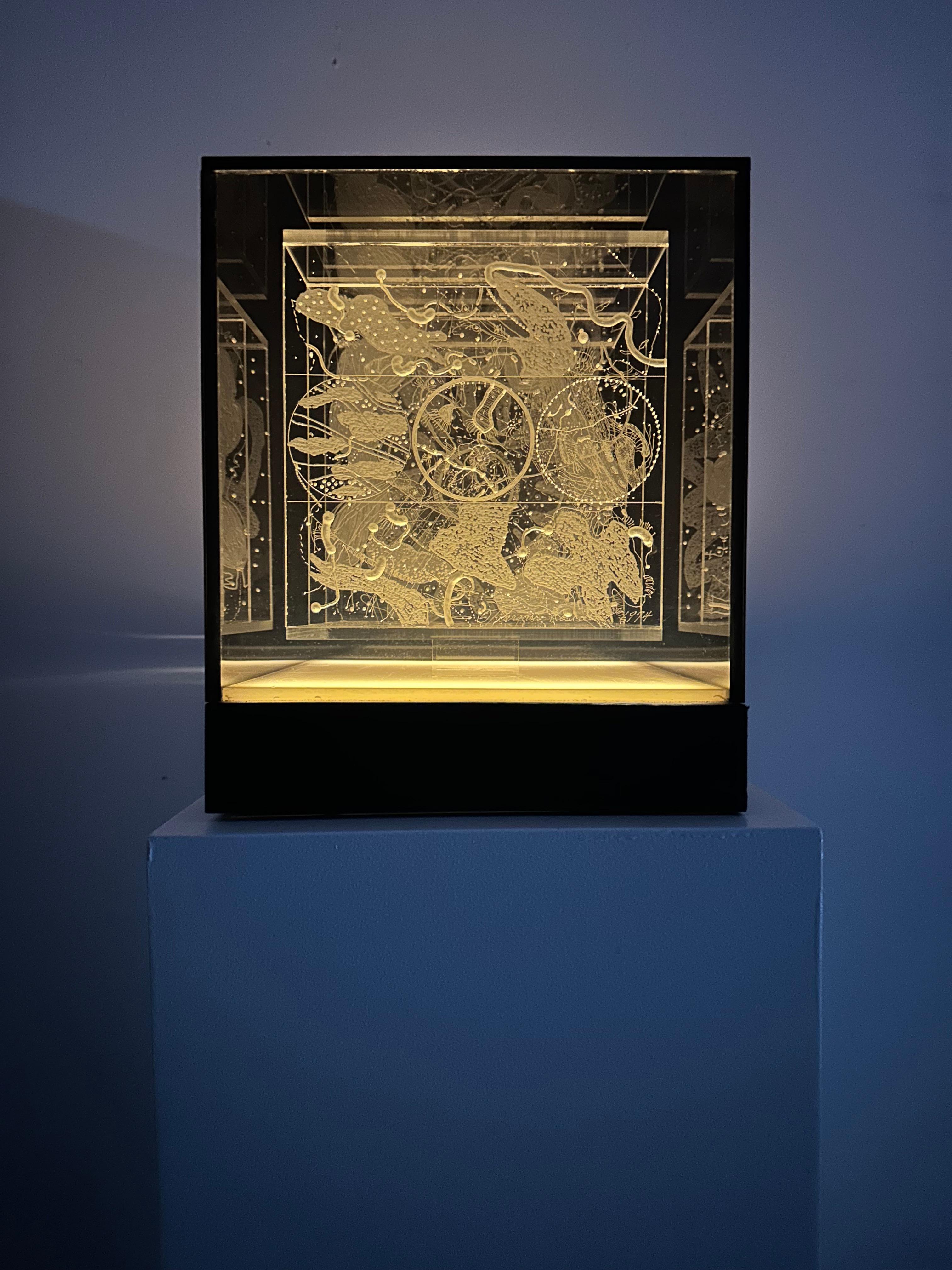
Margaret Koscielny (b.1940). Floating Images, 1974. Plexiglass sculpture. !0 x 10 x 10 images. Light base is new. Margaret Koscielny's work has been recognized in Who's Who in American Art; International Who's Who; Contemporary American Sculptors: An Illustrated Bio-Bibliographical Dictionary; Dictionary of American Women Sculptors; with articles in Kalliope (interview, photographs), The Florida Times-Union, Jacksonville Journal, Jacksonville Magazine; St. Petersburg Times; Atlanta Constitution and Journal; essays, by Joseph Jeffers Dodge, Drawings in Light and Space ; and Elihu Edelson, Arts Assembler; and reviewed in various newspapers, including a general review by John Canady, for The New York Times, of the American Drawing Competition, Moore College of Art, Philadelphia, (in which Koscielny was a participant). Influences and Early Background A native of Florida, Margaret Koscielny grew up in a family of classical musicians. Her mother, a violinist, was a descendent of an American Revolutionary war hero who, according to family legend, was related to William Pitt, the Elder, Prime Minister of Great Britain. Her father, a violist, was a graduate of the Leipzig Conservatory, emigrating to the US in 1929, where he became a music pioneer in Florida, teaching, directing bands and orchestras, and developing music education for string ensembles in the public schools. Her sister, Anne Koscielny, a concert pianist, was also a professor of piano for over 4 decades. Her step-brother, Gordon Epperson, was a prominent cellist, writer and college professor. Her niece, Cécile Audette, is a singer and choral conductor, and her grandniece, Renée, a violinist. Both sets of grandparents were musical, as well. This has influenced Koscielny's work the most, as it has provided inspiration and a sense of layers and the element of time in the construction and architecture of her work. Early Education and Career, 1960's Margaret Koscielny began her art studies at Texas Woman's University with Toni La Salle, (a student of Hans Hoffman). La Salle was the first, and most important influence on Koscielny's approach to drawing and art. Ms. La Salle's paintings reflected the ideas she developed under Hoffman's instruction, and she was Koscielny's first encounter with an Abstract Expressionist painter. Koscielny then attended the University of Georgia, where she earned the degrees of Bachelor of Arts in Art History and Master of Fine Arts in Art. Printmaking and drawing were the primary interests of her graduate work while studying with Charles Morgan, (a student of Jimmy Ernst, son of Max Ernst, the Surrealist). German Expressionism, surrealism and Abstract Expressionism were important influences during this time. The painters, Howard Thomas, James Herbert, and a fellow student, Jim Sitton were important mentors. She began, independently, the exploration of a technique evolved from printmaking combined with transparent media, and created her first "three-dimensional drawing-sculpture" in 1966. During the next two decades, Plexiglas was to be her primary format for drawings engraved, lighted and formed into assemblages. Teacher, Museum Curator, Artist, 1970's After a brief career teaching in public and private schools as well as Jacksonville University, she became Assistant to the Director of the Cummer Museum of Art and Gardens, (then called Ninah M. H. Cummer Gallery of Art). Margaret Koscielny was responsible for the organization and installation of exhibitions, publications, the training of Docents, and lectures on art history. During that time she also appeared regularly on television to discuss works of art in the museum's permanent collection. In December of 1973, Koscielny made a solo month-long tour of 9 major artistic capitals of Russia and the Ukraine in the former Soviet Union. This journey became the subject of nine lectures to capacity audiences at the Cummer Museum. She left the museum in 1974 to focus her activities primarily on her artwork. The 1970's were a time of numerous commissions, private and corporate for Koscielny, and she won the first National Endowment for the Arts grant in conjunction with the Florida Arts Council in 1975. This allowed her to execute three large sculptures in plexiglas which were exhibited at the Cummer Museum in 1976. Numerous other exhibitions throughout the Southeast followed. She also founded an independent group of 10 artists, Art Celebration! in 1973, because of the lack of galleries in Jacksonville.The success of the group's exhibition over a 5 year period precipitated new galleries to be established. Koscielny finished the decade with an invitation for a One Person Show at Vanderbilt University, also winning an international competition for the new Atlanta Hartsfield International Airport in 1979-80. She was one of only 3 women out of 13 artists, chosen from 500 competitors.The resulting three-dimensional assemblage, "Whole Sight," was in four parts, each 9 x 13 feet. They were installed on four walls over a descending 40 foot escalator. In late 1979, she was invited to produce and design an original ballet...

Category

1970s Abstract Abstract Sculptures
Materials

Plexiglass

Design Object, Polyester Resin

Design Object, Polyester Resin

Located in PARIS, FR

Born in Baghdad in 1939, Dia Azzawi started his artistic career in 1964, after graduating from the Institute of Fine Arts in Baghdad and completing a degree...

Category

2010s Abstract Sculptures

Materials

Resin

Japanese Contemporary Art By Kojun - Shiko 11

Japanese Contemporary Art By Kojun - Shiko 11

By Kojun

Located in Paris, IDF

Lego, gold leaf (24k, 22.66k), copper wire, wood This collaborative work, which began with a common interest in Buddhism, explored the idea of expressing the sacred within everyday life. As artist and Zen monk...

Category

2010s Conceptual Still-life Sculptures

Materials

Wire, Gold Leaf

Japanese Contemporary Art By Kojun - Shiko 3

Japanese Contemporary Art By Kojun - Shiko 3

By Kojun

Located in Paris, IDF

Lego, bayberry wood, copper wire, cashew lacquer, gold leaf This collaborative work, which began with a common interest in Buddhism, explored the idea of expressing the sacred within everyday life. As artist and Zen monk...

Category

2010s Conceptual Still-life Sculptures

Materials

Gold Leaf

Alat

Alat

By Kosso Eloul

Located in Toronto, Ontario

Kosso Eloul (1920-1995) is one of our favorite sculptors and an important contributor to public art in Toronto. In addition to the numerous public sculptures in Toronto by Eloul, his works can be found in many other prominent open spaces around the world, from California to Israel. Most familiar with Eloul associate his work with his signature forms; large brushed aluminum (or steel) angled rectangles. However his earlier work was realized in stone. This fine sculpture, a form that is revisited and eventually created in metal, is made of Jerusalem Stone...

Category

1960s Minimalist Abstract Sculptures
Materials

Stone