
Want more images or videos?
Request additional images or videos from the seller
1 of 12

Michael Garman
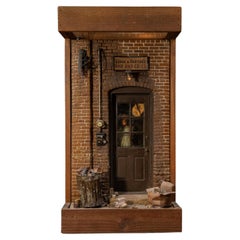
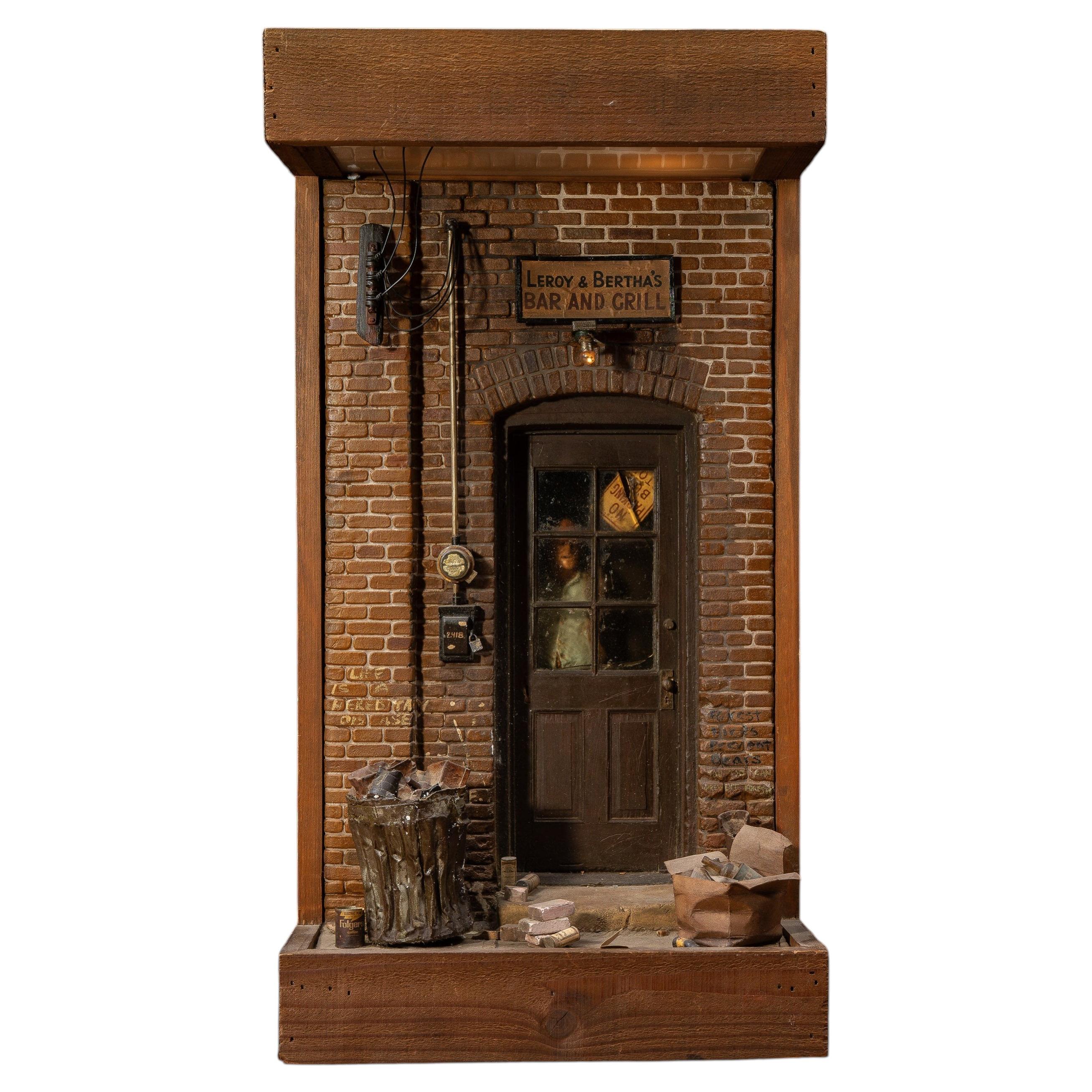
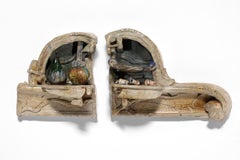
Michael German "Leroy & Bertha's Bar and Grill" Mixed Media Sculpture Folk Art

$3,800
£2,873.15
€3,363.84
CA$5,406.46
A$5,499.35
CHF 3,156.07
MX$66,108.69
NOK 36,815.41
SEK 37,161.99
DKK 25,147.80

About the Item

During the 1960s America’s storytelling sculptor, Michael Garman, lived a vagabond lifestyle on the cheap and in the run-down neighborhoods of Dallas, San Francisco, Philadelphia and Colorado Springs. Initially, he created one-of-a-kind sculptures. And, as his technique improved, his sculptures became more detailed. Inspired by the people he met on his hitchhiking journey Michael’s early work depicted simple street moments – a tailor mending a garment, a woman on a bench, two ladies gossiping under an umbrella. “Leroy and Bertha’s Bar and Grill” is an example of his enchantment with the underside of life that he had embraced giving him the freedom to move, see and experience whatever he chose. Born in Fort Worth in 1938 and raised in Arlington, Texas at eight he began creating little pipe-cleaner men. “I would twist pipe cleaners around pipe cleaners to make the muscles, arms and legs, and other features just right,” Michael Garman recalls “I used my mother’s sewing machine to design little cavalry uniforms and cowboy boots. I carved horses out of wood so that some of my guys were mounted. Then I’d gather up all my characters on my bed like a battle scene. I had guns and cannons and horses. Then the great battle began and my hero would get shot. I would arrange him just so, as he was dying. And I would cry and cry for him. I mean, I’d really be sobbing. And then I would scoop them all up and do it over again.” This story, told by Michael Garman in 1959, was his start becoming America’s Storyteller Sculptor. In ’59 he hitchhiked into Mexico with $35 in his pocket and his Nikon camera for what he thought would be a two-week sojourn. When his money ran out, he would charm his way into a restaurant, offering to sweep the floor or something for a bit to eat or a drink. More often than not, the owner would give him a meal and a place to sleep. “No one I asked hired me, but everyone fed me.” He hitchhiked his way further south through Central and South America. Two years later, he had traveled all the way to Santiago, Chile where he talked his way for free into the School of Fine Arts. It was here that he discovered his talent for sculpting. “I would sculpt my characters, street people, vendors and such,” Michael Garman relates, “and the school would fire them for free. Then I would go door to door and sell them for five or ten dollars.” As he had done in South America, as soon as he had a few sculptures finished, he would load them on his motor scooter and sell them door-to-door. Though he eventually made good money, Michael admitted to a growing emptiness. “I began to miss my own work,” he admits. “I discovered that I needed to be surrounded by my little characters, my pals. I still do to this day. I can’t live without my figures around me.” And so he decided to master the art of reproduction. “Writers do it. Musicians and filmmakers too. Could you imagine if John Steinbeck had only written one copy of The Grapes of Wrath?” Michael asks. “And only one person, one rich muckity-muck was able to read those words?! What a crime that would be. What a loss! As a sculptor, I can do the same thing that a writer or a musician does. I can publish my art. The trick is to make sure that every reproduced copy is just as detailed, just as rich and just as authentic as the original. Sure, it’s hard to master. But it’s supposed to be hard. That’s what makes it fun.” In the late 1960s, Michael Garman moved into the SoMa (South of Market St. – cheaper area) region of San Francisco where he found a studio above an old print shop. “Man, I landed in the center of wino town,” Garman recalled. “I loved it.” Inspired by the neighborhood, Michael’s sculptures began to become more realistic, gritty, and honest. Soon he began working at a local theatre company. It was here that he learned stage craft, illusion, as well as good business. “It was an important time in my life; that was my Harvard Business School,” Garman relates. After years spent as a real-life vagabond throughout North and South America, Michael Garman eventually settled in Colorado Springs in 1971. It was here that he perfected his gritty, Americana style. He also began a 40-year project to bring to life his vagabond experiences with a new art form – sculptural theater. He began work on Magic Town in 1975, and opened it 10 years and 1 million dollars later. “It’s a work-in-progress,” he admitted. And over the following three decades, Michael has added magical illusions, holographic effects, detailed alleyways and more. “Think of a 3,000 square-foot dollhouse,” Michael describes. “A gritty blend of Walt Disney and Norman Rockwell.” Peek into a window and you might see a woman teaching piano lessons. Then the Magic-Town fade. A few seconds later, the lights come up and all the figures in the scene have changed. Now, as you peer into the window, you discover Michael Garman himself, back in his San Francisco studio sculpting a favorite piece – Flying Leather. Each scene captures a moment in time – a pool player leans into his shot, hoboes warm themselves by a garbage-can fire, a baseball team celebrates their victory at the local pub, three men sneak into the alley to play craps, and a weary short-order cook steps outside for a smoke break as a pretty girl plays the Wurlitzer. In addition to building Magic Town, Michael Garman has dedicated the past fifty years to creating hundreds of sculptures that honor American heroes from all walks of life. Among his many sculpture series – Early American, Military, Firefighters, Linemen, Law Enforcement, Western, and many more – a theme emerges. Michael Garman’s art pays tribute to the extraordinary everyday heroes all around us: the firefighters, soldiers and police who run into danger, the doctors who treat our wounds, the lonely cowboy facing the long trail ahead, and the down-but-never-out street character with a twinkle in his eye. All of his nearly 500 sculptures are reproduced by hand in Colorado Springs. Michael Garman’s inspiration has always been to tell an honest story, and recreate it in an honest way. This is Michael Garman’s “Art for the People.”
  • Creator:
    Michael Garman
  • Dimensions:
    Height: 27.25 in (69.22 cm)Width: 18.75 in (47.63 cm)Depth: 10 in (25.4 cm)
  • Medium:
  • Movement & Style:
  • Period:
  • Condition:
  • Gallery Location:
    Detroit, MI
  • Reference Number:
    1stDibs: LU128618595532

More From This Seller

View All
"THE MANTEL SERIES" John Glick Stoneware Objets d'Art Intimate Indoor/Outdoor

"THE MANTEL SERIES" John Glick Stoneware Objets d'Art Intimate Indoor/Outdoor

By John Glick 1

Located in Detroit, MI

SALE ONE WEEK ONLY John Glick is well-known for his beautifully rendered functional pieces of art. His decorative pieces, especially his large pots, are breathtakingly powerful objects. Glick's creative genius, however, is most exquisitely shown in this unique grouping of objets d'art. The Wall Hanging has a lovely classical scroll shelf. The objets on the shelf include an apple and pear - both fruits frequently rendered by artists from the Dutch Masters to Cezanne because of their perfectly balanced shape and rich colors. In addition is a small Greek or Roman styled dish used as an oil lamp. The other three objets are mysterious twisted tube-like organic shapes. John Glick, at one of his richest, creative bests. The objets are of various sizes, movable and can be displayed as desired. The size given is the overall size of both pieces and the objets d'art. "The works in John Glick’s “Mantel Series” are still life tableaux comprised of ordinary, yet intriguing objects that imply a history of people interacting with objects and each other over time. Imagine a lettr or poem from a loved one, once read, tucked among other fabourite things for safekeeping. Or a salty treasure carried in a dampened pocket and later deposited on a cottage shelf to dry, crackle and change. In essence, the mantels hold suggestive collections in which most people can find a part of themselves a link to a personal memory and a connection to a lost moment in time. His body of work, The Mantel Series, was partially inspired by a memory of a salt box that hung near his grandmother’s kitchen wood stove. For Glick, the unassuming little box, with its pleasing enigmatic shape and wooden lid, conjured pleasant boyhood memories, nostalgia for home and hearth, and vivid awareness of history. Upon his wall-based mantels, the artist placed a well-honed repertoire of distinct objects, all deftly crafted of clay, that become characters in his unspoken drama, each form playing off the others in the ensemble.” Plum Tree Pottery...

Category

1990s American Modern Still-life Sculptures

Materials

Ceramic, Glaze

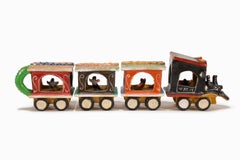
"El Tren" Ceramic, Glaze, Colors, Mexican Folk Art, Four Sections

"El Tren" Ceramic, Glaze, Colors, Mexican Folk Art, Four Sections

Located in Detroit, MI

SALE ONE WEEK ONLY "El Tren" is a whimsical and playful rendition of a train. It is beautifully glazed in various colors. This particular ceramic was from the collection of Jane and Richard Knight’s Estate. Jane Knight was a famous fiber and textile artist. Richard was a photographer who worked for Eliel Saarinen and Alexander Girard. The Knights and Girard became close friends and it was Girard who gifted “Santa Cruz De Las Huertas Jalisco” to the Knights. Alexander Girard left his personal collection to the Museum of International Folk Art, Santa Fe, NM. The Girards eventually amassed a collection of more than 106,000 objects from across the globe. Their 1978 gift of this collection to the Museum of International Folk art quintupled the size of their collection and prompted the construction of a new wing, which opened in 1982 and houses a mere 10% of the Girard Collection in the permanent exhibition Multiple Visions: A Common Bond, which was designed by Alexander Girard himself. This collection includes numerous multiples and is notable for its great breadth, including traditional arts, popular arts, and paper ephemera. “I believe we should preserve this evidence of the past, not as a pattern for sentimental imitation,” Girard once said, “but as nourishment for the creative spirit of the present.” Indeed, folk art was an important inspiration for Girard’s design work. The renowned Candelario Medrano...

Category

1950s Folk Art Still-life Sculptures

Materials

Ceramic, Glaze

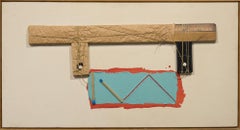
"Measuring Blue" Mixed Media, 3-Dimensional, Small Wood Sculptures

"Measuring Blue" Mixed Media, 3-Dimensional, Small Wood Sculptures

Located in Detroit, MI

"Measuring Blue" is a mixed media 3-dimensional collage with creatively hand-made oversized objects of a school ruler, dominos, and matches. These objects were hand crafted by the ar...

Category

1980s Expressionist Mixed Media

Materials

Wood, Thread, Plastic, Paper, Acrylic

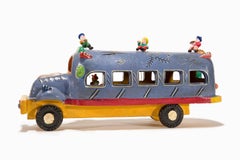
“Santa Cruz de las Huertas Jalisco”, Ceramic, Glaze, Colors, Mexican Folkart

“Santa Cruz de las Huertas Jalisco”, Ceramic, Glaze, Colors, Mexican Folkart

Located in Detroit, MI

SALE ONE WEEK ONLY “Santa Cruz de las Huertas Jalisco” is a whimsical, charming and colorfully ceramic rendition painted blue and red of a local bus that traversed the town where the artist Candelario Medrano...

Category

Mid-20th Century Folk Art Figurative Sculptures

Materials

Ceramic, Glaze

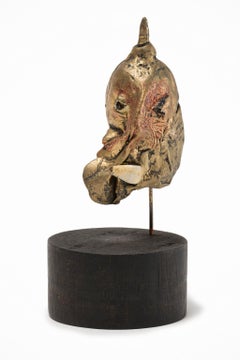
Statuette, Metal Sculpture, Psychological and Naturalistic

Statuette, Metal Sculpture, Psychological and Naturalistic

By Umberto Del Negro

Located in Detroit, MI

This small metal statuette exemplifies the Italian artist Umberto Del Negro's interest in playing with the themes of civilization and nature. From multiple angles this piece could ap...

Category

Late 20th Century Figurative Sculptures

Materials

Metal

Umberto Del Negro "Prove (Evidence)" Pottery Plaque Series

Umberto Del Negro "Prove (Evidence)" Pottery Plaque Series

By Umberto Del Negro

Located in Detroit, MI

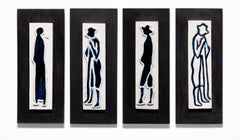
These four ceramic plaques on wood are an exquisite set piece from the Italian artist Umberto Del Negro. Its title "Prove" is Italian for "Evidence". One interpretation is that it re...

Category

Late 20th Century Figurative Sculptures

Materials

Ceramic, Wood

You May Also Like

Back Door  1970s Michael Garman "Cityscape" Sculpture

Back Door 1970s Michael Garman "Cityscape" Sculpture

Located in Dekalb, IL

c. 1970s-1980s; Michael Garman - Manitou Springs, Colorado Handcrafted mixed-media illuminated diorama from Michael Garman's celebrated Cityscape series, depicting the rear entrance of the fictional Leroy and Bertha's Bar and Grill. Titled "Back Door", this composition is one of several variations derived from Garman's original Back Door scene, first introduced in 1975 and later expanded with additional characters and narrative details. Constructed within a shadowbox-style case, the piece incorporates hand-painted architectural elements, miniature figures, signage, furnishings, and integrated lighting to create one of Garman's signature nostalgic slices of everyday American life. Michael Garman founded his studio in Manitou Springs, Colorado, in the early 1970s, earning national recognition for his handcrafted Western and Americana sculptures...

Category

Mid-20th Century American Other Sculptures and Carvings

Materials

Composition

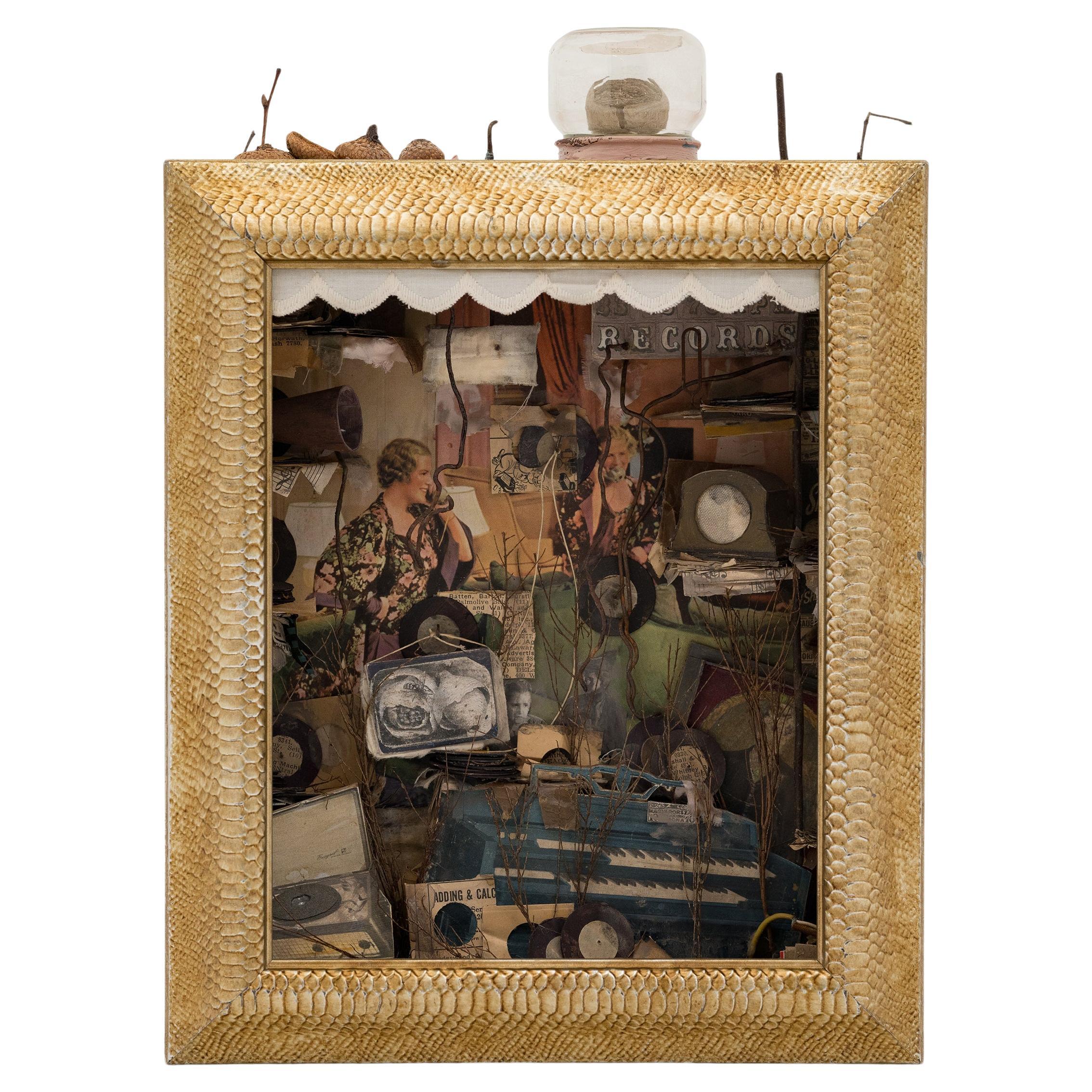
"Retablo No. 5 (An Attic of Records)" by Patrick Fitzgerald

"Retablo No. 5 (An Attic of Records)" by Patrick Fitzgerald

By Patrick Fitzgerald

Located in Chicago, IL

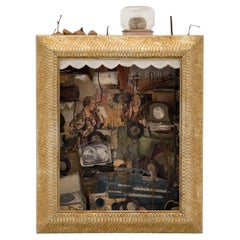
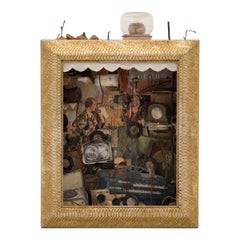
The intricate retablos of contemporary artist Patrick Fitzgerald are his means of paying homage to the musicians that inspired him throughout his life. Derived from Mexican votive...

Category

21st Century and Contemporary American Folk Art Figurative Sculptures

Materials

Other

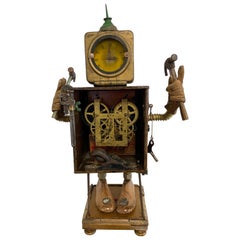
Linda Semple "Time to Make Something" Folk Art Sculpture

Linda Semple "Time to Make Something" Folk Art Sculpture

Located in Palm Springs, CA

A wonderful outsider art sculpture by the noted artist Linda Semple. This piece is titled "Time to Make Something". It probably dates to the 1990's. It is titled and signed on the ba...

Category

20th Century American Outsider and Self Taught Art

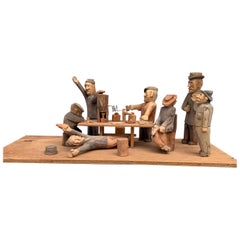
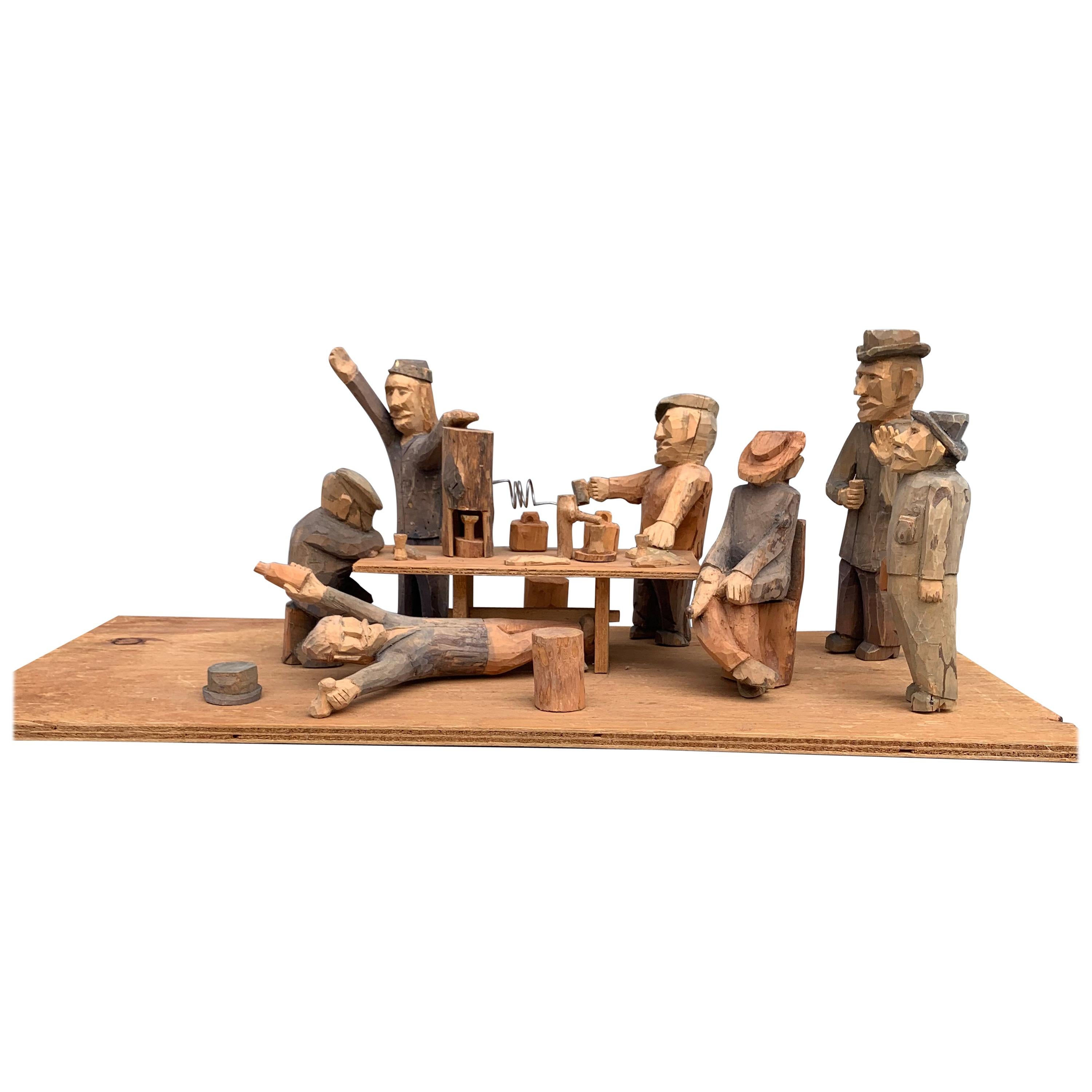
1950s Folk Art Sculpture Group Of Drunk Swedes At Bar Scene

1950s Folk Art Sculpture Group Of Drunk Swedes At Bar Scene

Located in Haddonfield, NJ

1950s Folk Art wood carving of a group of drunk Swedes at a bar scene with fish and alcohol fermentation.

Category

Mid-20th Century Swedish Folk Art Sculptures and Carvings

Materials

Pine

Linda Stein, Starting from Canal Street 008 - Mixed Media Collage Wall Sculpture

Linda Stein, Starting from Canal Street 008 - Mixed Media Collage Wall Sculpture

By Linda Stein

Located in New York, NY

Linda Stein, Starting from Canal Street 008 - Mixed Media Collage Wall Sculpture These wall constructions and dioramas were made in the 1970s when Linda Stein was also working on he...

Category

1970s Contemporary Figurative Sculptures

Materials

Mirror, Wood, Paper, Mixed Media