Hudson River School Art

HUDSON RIVER SCHOOL STYLE

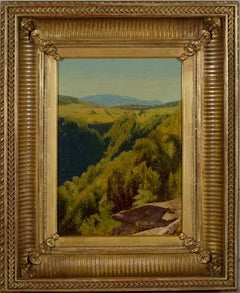
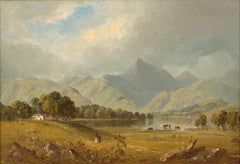
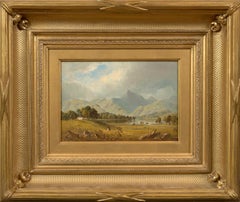
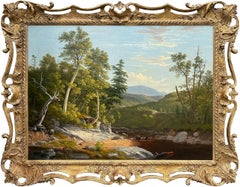
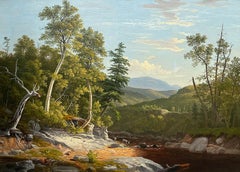
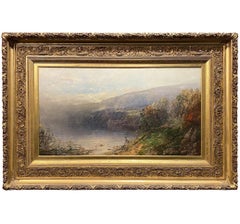
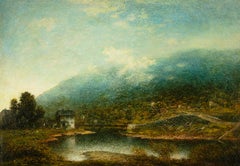
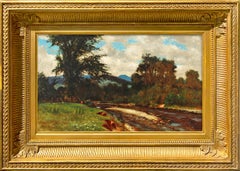
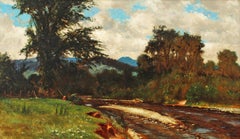
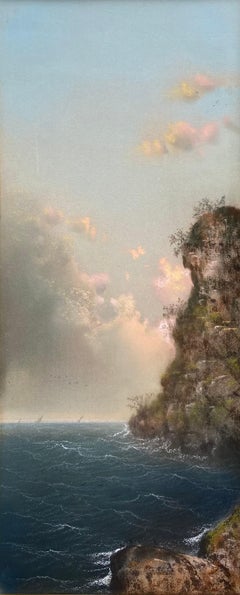
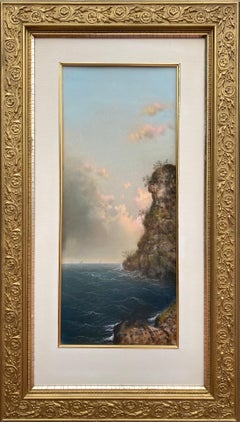
Considered the first major American painting movement, the Hudson River School emerged in the first half of the 19th century with landscape paintings that celebrated the young country’s natural beauty. Most of its leading painters were based in New York City where they exchanged ideas and traveled to the nearby Hudson River Valley and Catskills Mountains to re-create their vistas. At a time when the city was increasingly dense, the Hudson River School artists extolled the vast and pristine qualities of the American landscape, a sentiment that would inform the conservation movement.

American art was dominated by portraiture and historical scenes before Thomas Cole, the founder of the Hudson River School, began painting the Catskill Mountains in 1825. While the Hudson River School was informed by European art aesthetics, particularly the British focus on the sublime in nature, it was a style imbued with nationalism. The landscape painters who followed and studied under Cole would expand their focus from the Northeastern United States to places across the country, their work shared through prints and portfolios promoting an appreciation for the American wilderness — Niagara Falls, the mountain ranges that dot the American West and more — as the style blossomed during the mid-19th century.

Cole’s student Frederic Edwin Church as well as painters such as Albert Bierstadt, John Frederick Kensett, Asher Brown Durand and others became prominent proponents of the Hudson River School. The American art movement also had close ties to the literary world, including to authors like William Cullen Bryant, Henry David Thoreau and James Fenimore Cooper who wrote on similar themes. Although by the early 1900s the style had waned, and modernism would soon guide the following decades of art in the United States, the Hudson River School received renewed interest in the late 20th century for the dramatic way its artists portrayed the world.

Find a collection of authentic Hudson River School paintings, drawings and watercolors and more art on 1stDibs.

to
37
98
51
48
30
21
Overall Width
to
Overall Height
to
2
209
31
6
8
2
5
1
2
1
2
117,899
64,516
56,624
28,646
14,584
9,627
6,895
6,034
4,183
3,158
2,548
2,314
2,145
600
184
60
2
79
73
55
30
29
23
23
21
20
19
15
14
13
12
9
8
8
7
7
7
229
215
138
131
38
4
4
3
3
3
194
4
245
3
Style: Hudson River School
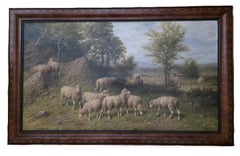
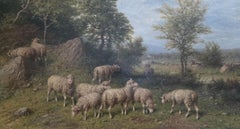
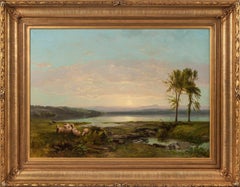
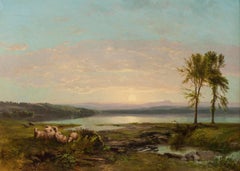
Sheep in Pasture
Sheep in Pasture

Sheep in Pasture

Located in Saratoga Springs, NY

George Riecke (1848–1930) Pastoral Landscape with Sheep Oil on canvas, 26 × 46 inches (32 × 52 inches framed) Signed lower right George Riecke’s pastora...

Category

1890s Hudson River School Art

Materials

Canvas, Oil

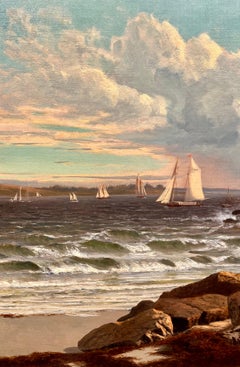
Rocky Shore Walk, Oil on Canvas, Hudson River School, Mid-19th Century

Rocky Shore Walk, Oil on Canvas, Hudson River School, Mid-19th Century

Located in Fredericksburg, VA

With masterful precision and a keen eye for atmosphere, Frederic Rondel captures the rugged beauty of the coastline in Walking Along a Rocky Shore. The painting depicts a windswept s...

Category

Mid-19th Century Hudson River School Art

Materials

Oil, Canvas

Distant Horizon
Distant Horizon

Distant Horizon

By Edward Moran

Located in Saratoga Springs, NY

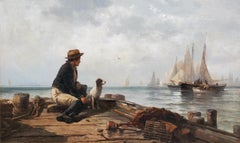
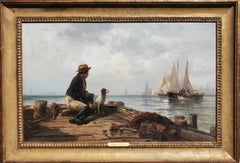
Edward Moran (American, 1829 - 1901) Boy with Dog on Dock Oil on canvas Signed lower left 22 x 36 inches Provenance: Sotheby's Sale no. 3255 Oct. 27-28, 1977 Page 58 Price on reques...

Category

Late 19th Century Hudson River School Art

Materials

Canvas, Oil

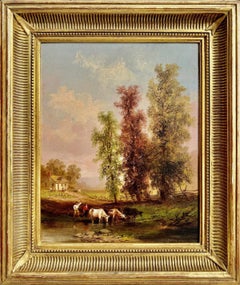
Cows Grazing in Field

Cows Grazing in Field

By George Wright

Located in Fredericksburg, VA

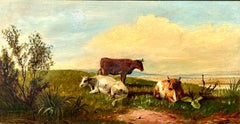
This serene Hudson River School painting by George Wright captures a peaceful moment of pastoral life, where three cows rest and graze under a wide, luminous sky. The composition gen...

Category

Late 19th Century Hudson River School Art

Materials

Canvas, Oil

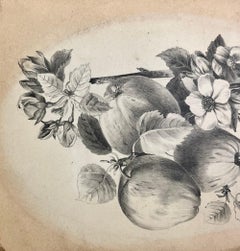
Apple Branch Botanical Still Life Sketch

Apple Branch Botanical Still Life Sketch

Located in Fredericksburg, VA

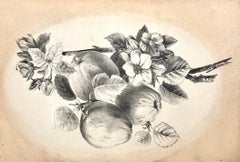
A beautifully rendered 19th-century graphite study, this apple branch sketch from the notebook of Virginia Granbery captures the quiet elegance of botanical draftsmanship. The compos...

Category

19th Century Hudson River School Art

Materials

Paper, Pencil

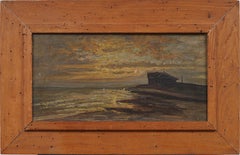
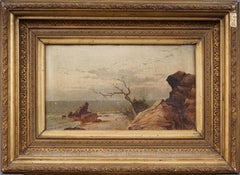
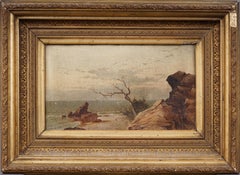
American School Long Island Sunset Beach Scene Seascape Framed Original Painting

American School Long Island Sunset Beach Scene Seascape Framed Original Painting

Located in Buffalo, NY

Antique American seascape sunset oil painting. Oil on canvas, lain to masonite. Framed. Measuring: 17 by 26 inches overall, 10 and 20 by painting alone. Unsigned. Excellent conditi...

Category

1920s Hudson River School Art

Materials

Oil

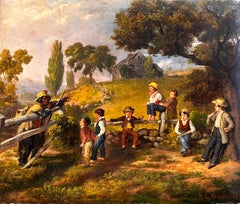
A Friend of a Friend (oil painting of young boys in landscape)

A Friend of a Friend (oil painting of young boys in landscape)

Located in Fredericksburg, VA

Richard Law Hinsdale (1832–1874) was an American painter known for his contributions to landscape and genre painting during the mid-19th century, mostly in the Hudson River School. He received brief instruction from Alexander Emmons, Philip Hewins and Jared B Flagg as well as being exhibited in American art...

Category

Mid-19th Century Hudson River School Art

Materials

Canvas, Oil

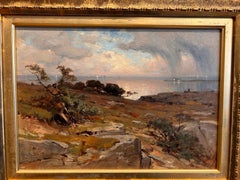
"Passing Shower" Oil Painting, Hudson River School, Late 19th Century

"Passing Shower" Oil Painting, Hudson River School, Late 19th Century

Located in Fredericksburg, VA

George Smillie (1840-1921) was an American landscape painter renowned for his serene and meticulously detailed depictions of the natural world. Smillie’s work is characterized by its...

Category

Late 19th Century Hudson River School Art

Materials

Oil, Canvas

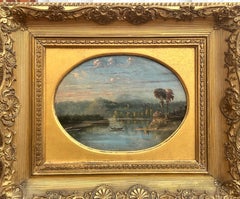
Southern Landscape Oil Painting Hudson River School

Southern Landscape Oil Painting Hudson River School

Located in Fredericksburg, VA

Copyright 2023 Michael F. Meyer All rights Reserved. This painting, signed RSD on right side, has been verified by the late expert on Robert S. Duncanson, Joseph Ketner and comes with an authentication letter. This painting has exhibited and is published in Robert S. Duncanson and His Courageous Southern Travels. This painting is one of the many beautiful southern landscape scenes that Robert S. Duncanson painted in his courageous travels south. "Robert S. Duncanson born in 1819, was an African American Hudson River School artist who painted the south before the Civil War, until his death in 1872. Although widely famous during his lifetime, this forgotten artist’s courageous journey through the antebellum south has never before been exhibited or researched until now. His brilliance was in creating captivating landscape paintings that come alive to the viewer, by focusing on the minute details of nature and of the stories he wished to communicate. Robert Duncanson...

Category

Mid-19th Century Hudson River School Art

Materials

Canvas, Oil

Landscape of Children Playing Baseball titled "Baseball Beneath the Hills"

Landscape of Children Playing Baseball titled "Baseball Beneath the Hills"

By Virginia Granbery

Located in Fredericksburg, VA

This charming Hudson River School study by Virginia Granbery captures a tender and distinctly American moment: children playing baseball in a sunlit clearing. Painted by one of the f...

Category

Late 19th Century Hudson River School Art

Materials

Canvas, Oil

The Prediction
The Prediction

The Prediction

By Harry Roseland

Located in Saratoga Springs, NY

HARRY ROSELAND (1867–1950) The Prediction Signed lower left (please note: In the image of the signature shows to be faint but by the naked eye is clearly discernable) Oil on canva...

Category

1890s Hudson River School Art

Materials

Oil, Canvas

Sunset Landscape, 1868

Sunset Landscape, 1868

Located in New York, NY

F. Alexander Wust paints a stellar sunset over a hillside with light red color in his artwork entitled, “Sunset Landscape.”

Category

19th Century Hudson River School Art

Materials

Canvas, Oil

Autumn Landscape
Autumn Landscape

Autumn Landscape

By William Louis Sonntag Sr. 1

Located in Milford, NH

A wonderful Autumn landscape likely of the Hudson River Valley by the revered American artist William Louis Sonntag (1822-1900). Sonntag was born near Pittsburgh, PA and moved to Cincinnati, OH in the 1840’s to study art. He studied for a brief time with G. Frankenstein at the Cincinnati Academy of Fine Art and his idealized paintings of American wilderness and visionary paintings of imagined European ruins were commercially successful. He traveled twice to Europe in the 1850’s to improve his skills, eventually settling in New York City. He joined the National Academy of Design, where he exhibited his works for forty years. His mature works identify him with the Hudson River School of landscape painters. A romantic and naturalistic painter of his surroundings, Sonntag also created idealized paintings of Roman ruins, recalling his European trips of earlier years. Sonntag was an Associate (1860) and Academician (1861) at the National Academy of Design, and a member of the American Watercolor Society, Artists Fund Society, and the American Art Union...

Category

19th Century Hudson River School Art

Materials

Canvas, Oil

Early 20th Century Sierra Mountains & Stream Landscape, Signed

Early 20th Century Sierra Mountains & Stream Landscape, Signed

Located in Soquel, CA

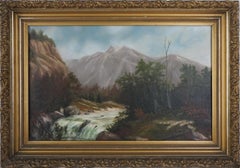
1920s Connecticut Mountains & Stream Oil Painting Landscape, Signed "L. Hamilton" Scenic Connecticut Mountains landscape with stream in foreground with a small waterfall capture...

Category

Early 1900s Hudson River School Art

Materials

Linen, Oil, Stretcher Bars

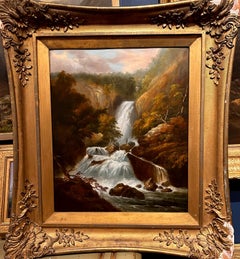
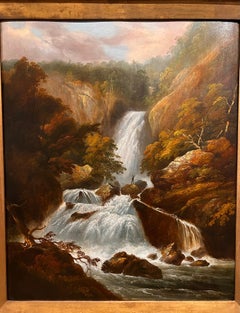
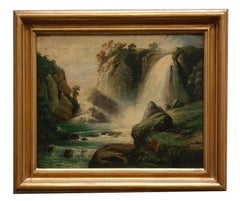
Waterfalls of Hot Springs, VA

Waterfalls of Hot Springs, VA

By William Guy Wall

Located in Fredericksburg, VA

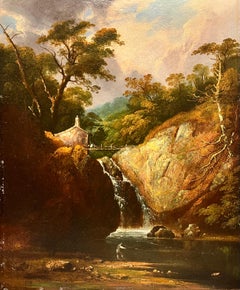
This richly detailed Hudson River School painting by William Guy Wall presents a striking view of a waterfall near Hot Springs, Virginia. Painted with warm, earthy tones and a glowin...

Category

Mid-19th Century Hudson River School Art

Materials

Canvas, Oil

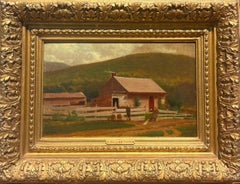
Oil Landscape of Cabin In the Mountains

Oil Landscape of Cabin In the Mountains

By William Hart

Located in Fredericksburg, VA

William Hart was an influential figure in the art world, best known for his contributions as a landscape painter during the 19th century. Born in Paisley, Scotland, in 1823, Hart imm...

Category

Late 19th Century Hudson River School Art

Materials

Canvas, Oil

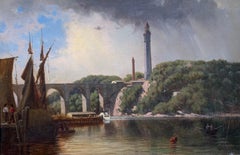
High Bridge and Croton Waterworks (Harlem River)

High Bridge and Croton Waterworks (Harlem River)

Located in Wilton Manors, FL

Stunning Hudson River School landscape by George Lafayette Clough (1824-1901). High Bridge and Croton Waterworks, Harlem River, ca. 1870. Oil on canvas measures 14 x 21 inches; 26 x 33 inches in original frame. Signed lower left. Old repair of small diagonal puncture measuring 1/2 inch in length to the right of ship sail. Otherwise no damage or conservation to painting. Original frame has several areas of damage and loss and will require conservation. George Lafayette Clough was born September 18, 1824, in Auburn, New York, and was that city's leading landscapist and, known as a Hudson River School painter, became Auburn's most noted resident painter of the mid-century. His mother was widowed shortly after his birth, and he was raised without paternal influence. He had little formal education and was employed by the age of ten. By age fifteen he had taken up painting, and his first and informal art influence came from the portraitist, Randall Palmer. In 1844 Clough opened his own studio in Auburn. About that time Charles Loring Elliott...

Category

19th Century Hudson River School Art

Materials

Oil

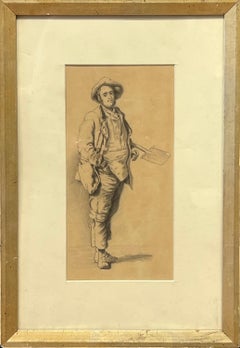
Portrait of Man with Shovel

Portrait of Man with Shovel

Located in Fredericksburg, VA

This painting depicts a man standing confidently with a shovel. This is an American School, likely Hudson River School drawing from the 1860s or 1870s. This 19th century unsigned painting...

Category

Mid-19th Century Hudson River School Art

Materials

Paper, Graphite

View of South Pond, New York, 1879 by Ida H. Stebbins (American, b. 1851)

View of South Pond, New York, 1879 by Ida H. Stebbins (American, b. 1851)

Located in New York, NY

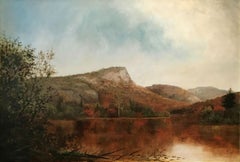
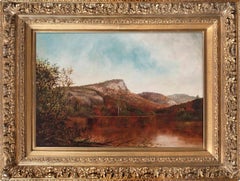
Painted by Hudson River School artist Ida H. Stebbins (b. 1851), "View of South Pond, New York," 1879 is oil on canvas, measures 23 x 33 1/2 inches, and is signed and dated 1879 at the lower left. The work is framed in an elegant Barbizon style frame and ready to hang. Ida H. Stebbins was born in January 1851 in Chelsea, Massachusetts to Mary and Isaac Stebbins, a teacher. Though scant records remain of Stebbins’ artistic training or career, various personal details of her life have been gleaned from contemporary newspapers and federal documents. By the time View of South Pond, New York was painted in 1879, she was living in Boston. Like many artists of her generation, Stebbins likely traveled throughout the Northeast region, gaining inspiration for her paintings from the landscape of New England and New York. Stebbins was likely visiting upstate New York when she painted this sweeping view of South Pond and the surrounding mountains near Long Lake in the Adirondacks just south of Deerland. Here, Stebbins captures the stunning vermillion, burnt orange and brown tones of the autumn landscape with the style and precise rendering often seen in paintings produced by the Hudson River School. Shortly after the completion of View of South Pond, New York, Stebbins married Frank H. Slack, a clerk, in her hometown of Chelsea on December 14, 1881 at the age of thirty. The couple moved to Hotel Comfort in Boston, where their son, Roland Stewart Slack was born on May 22, 1883. It seems likely that her husband died in the mid-1880s since on December 3, 1889, records indicate that Ida and Roland changed their last name back to her maiden name of Stebbins. Roland Stewart Stebbins (1883-1974) inherited his mother’s interest in art, studying at the Pennsylvania Academy of the Fine Arts, Columbia University in New York, and the Art Students League of New York. He also studied at the Académie de la Grand Chaumière and the Munich Academy of Fine Arts. Today, he is remembered for his marine and genre paintings and for his legacy as a respected professor of art education at the University of Wisconsin, Madison. On January 1, 1890, Ida married her second husband, Timothy Jarvis, in Somerville, Massachusetts. Their daughter, Ida Hazel Jarvis, was born soon after in 1893. However, the child suffered paralysis from a brain tumor...

Category

19th Century Hudson River School Art

Materials

Canvas, Oil

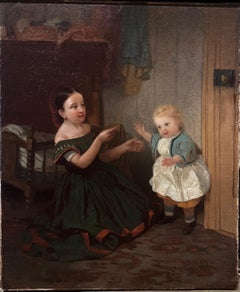
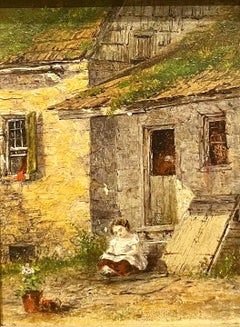
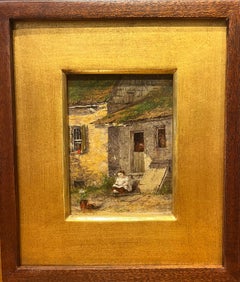
Little Girl Reading by House

Little Girl Reading by House

By Edward Lamson Henry

Located in Fredericksburg, VA

"Reading After School," attributed to Edward Lamson Henry, offers a glimpse into the everyday moments of 19th-century American life. Known for his meticulous detail and his ability t...

Category

Late 19th Century Hudson River School Art

Materials

Oil, Board

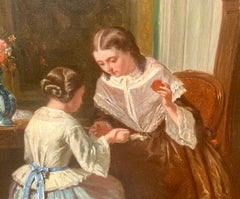
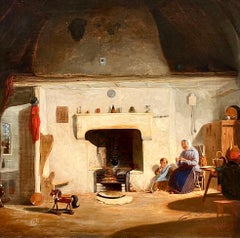
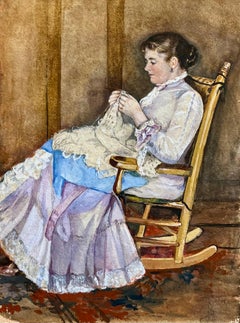
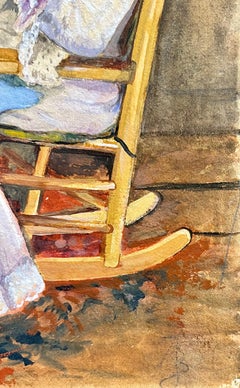
Portrait of Young Woman Sewing in a Rocking Chair

Portrait of Young Woman Sewing in a Rocking Chair

Located in Fredericksburg, VA

"Young Lady Sewing on Rocking Chair" by an 1860s American School artist is a charming watercolor painting that captures a traditionally domestic moment...

Category

Mid-19th Century Hudson River School Art

Materials

Paper, Watercolor

Resting Beneath the Trees by the Stream

Resting Beneath the Trees by the Stream

Located in Fredericksburg, VA

George Owen's "Resting Beneath the Trees by the Stream" is a quintessential Hudson River School painting that encapsulates the majesty and sublime beauty of the American landscape. T...

Category

Mid-19th Century Hudson River School Art

Materials

Canvas, Oil

"Greek Ruins"

"Greek Ruins"

By Franklin D. Briscoe

Located in Lambertville, NJ

Signed Lower Right Known for his marine, history, and portrait paintings, Franklin Briscoe was born in Baltimore, Maryland and at age four moved with his family to Philadelphia where he later became a student of Edward Moran and where eventually he settled his studio. Briscoe made extended ocean voyages, including trips to Europe where he saw much painting in galleries, and from these adventures and observations developed his landmark paintings of the ocean and ships in all kinds of weather conditions. In 1885, he painted an historical mural that was in ten panels, a total of 230 feet long, and 13 feet tall--"The Battle of Gettysburg...

Category

19th Century Hudson River School Art

Materials

Canvas, Oil

“Worcester, Massachusetts”

“Worcester, Massachusetts”

Located in Southampton, NY

Oil on wood panel painting of a Worcester, Massachusetts view by local resident artist Mabel Blake. Signed M. Blake lower left. Circa 1880. Condition is good. The bucolic scene depicts a man in a boat...

Category

1880s Hudson River School Art

Materials

Oil, Board

Road-Side View (View in Wisconsin)

Road-Side View (View in Wisconsin)

By Seth Eastman

Located in New York, NY

Label on stretcher bar: No. 175. / AMERICAN ART-UNION. /Road-Side View / Painted by / Seth Eastman / Distributed December 20, 1850.

Category

19th Century Hudson River School Art

Materials

Oil

"Grand Manan" Harrison Bird Brown, Maine Landscape, Hudson River School Seascape

"Grand Manan" Harrison Bird Brown, Maine Landscape, Hudson River School Seascape

By Harrison Bird Brown

Located in New York, NY

Harrison Bird Brown (1831 - 1915) Grand Manan Oil on canvas 12 x 20 inches Signed with initials lower left Harrison Bird Brown was born in 1831 in Portland, Maine, and is best known for his White Mountain landscapes and marine paintings of Maine's Casco Bay...

Category

Late 19th Century Hudson River School Art

Materials

Canvas, Oil

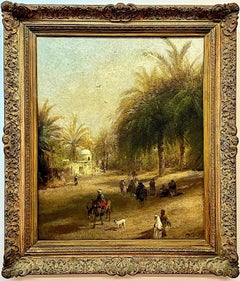
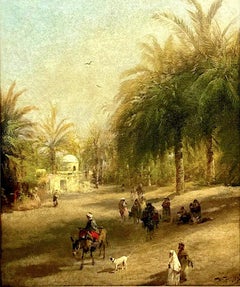
"Outskirt Village Near Tangier, North Africa"

"Outskirt Village Near Tangier, North Africa"

By Hermann Ottomar Herzog

Located in San Francisco, CA

Both romantic and realistic, this timeless work by Herman Herzog was painted more than a century ago near Morocco’s Atlantic coast city of Tangiers, a sentinel to the Strait of Gibra...

Category

Early 20th Century Hudson River School Art

Materials

Canvas, Oil

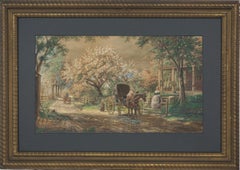
Rare 19th Century Watercolor and Platinotype -- Coming Home

Rare 19th Century Watercolor and Platinotype -- Coming Home

By Edward Lamson Henry

Located in Soquel, CA

Rare 19th Century Watercolor and Platinotype -- Coming Home Wonderful and rare 19th Century watercolor and platinotype (Watercolor over Platinum photograph) attributed to Edward Lamson Henry...

Category

Late 19th Century Hudson River School Art

Materials

Watercolor, Paper, Platinum

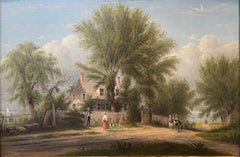
Rapelyea House, New York, William Rickarby Miller, Hudson River School Landscape

Rapelyea House, New York, William Rickarby Miller, Hudson River School Landscape

By William Rickarby Miller

Located in New York, NY

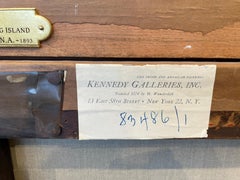
William Rickarby Miller Rapelyea House, New York, 1884 Signed and dated lower left Oil on canvas 20 x 30 inches Provenance: Kennedy Galleries, New York Born in Staindrop, County Durham, England, he was a portrait and landscape painter, especially appreciated for watercolor painting, which he sold through the American Art Union...

Category

1880s Hudson River School Art

Materials

Canvas, Oil

Antique American Hudson River School Coastal Beach Landscape Oil Painting

Antique American Hudson River School Coastal Beach Landscape Oil Painting

Located in Buffalo, NY

Impressive early American modernist abstract oil painting. Framed. Oil on canvas. Signed. Image size, 9.25H by 15L. Artist Bio: This following biography was researched, compiled...

Category

1870s Hudson River School Art

Materials

Canvas, Oil

The Jolly Flat Boat Men

The Jolly Flat Boat Men

By George Caleb Bingham

Located in Missouri, MO

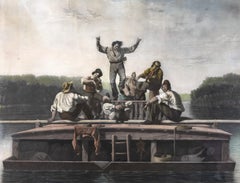
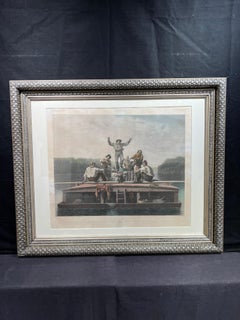
The Jolly Flat Boat Men, 1847 After George Caleb Bingham (American, 1811-1879) Engraved by Thomas Doney (French, active New York 1844-1849) Engraving with Hand-Coloring Published by The American Art-Union, New York (1838-1851) Printed by Powell and Co. 18 x 24 inches 32 x 38 inches with frame In 1847, the American Art-Union purchased Bingham’s painting "The Jolly Flat Boat Men" (1846; National Gallery of Art) directly from the artist. The subscription-based organization, founded in 1838 as the Apollo Association, boasted nearly ten-thousand members at this date. For an annual fee of five dollars, each received a large reproductive engraving and was entered in a lottery to win original artworks exhibited at the Art-Union’s Free Gallery. Aimed at educating the public about contemporary American art, the organization developed an impressive distribution network that reached members in every state. The broad circulation of the Art-Union's print helped to establish Bingham's reputation and made his river scene famous. Born in Augusta County, Virginia in the Shenandoah River Valley, George Caleb Bingham became known for classically rendered western genre, especially Missouri and Mississippi River scenes of boatmen bringing cargo to the American West and politicians seeking to influence frontier life. One of his most famous river genre paintings was The Jolly Flatboatmen completed in several versions in 1846. This first version of this painting is in the Manoogian Collection at the National Gallery of Art. Fame resulted for this work when it was exhibited in New York at the American Art Union whose organizers made an engraving of 10,000 copies and distributed it to all of their members. Paintings such as Country Politician (1849) and County Election (1852) and Stump Speaking (1854) reflected Bingham's political interests. In 1819, as an eight-year old, he moved to Boon's Lick, Missouri with his parents and grandfather who had been farmers and inn keepers in the Shenandoah Valley near Rockingham, Virginia. Reportedly as a child there, he took every opportunity to escape supervision to travel the River and watch the marine activity. His father died in 1827, when his son was sixteen years old. His mother had encouraged his art talent, but art lessons were not easily obtainable. In order to earn money, he apprenticed to a cabinet maker but determined to become an artist. By 1835, he had a modest reputation as a frontier painter and successfully charged twenty dollars per portrait in St. Louis. "His portraits had become standard decorations in prosperous Missouri homes." (Samuels 46). In 1836, he moved to Natchez, Mississippi and there had the same kind of career, only was able to charge forty dollars per portrait. He remained largely self taught until 1837, when he, age 26 and using the proceeds from his portraiture, studied several months at the Pennsylvania Academy of the Fine Arts. He later said that he learned much of his atmospheric style and classically balanced composition by copying paintings in collections in St. Louis and Philadelphia and that among his most admired painters were Thomas Cole, John Vanderlyn, and William Sidney Mount. Between 1856 and 1859, Bingham traveled back and forth to Dusseldorf, Germany, where he studied the work of genre painters. Some critics think these influences were negative on his work because during that time period, he abandoned his luminist style that had brought him so much public affirmation. Bingham credited Chester Harding (1792-1866) as being the earliest and one of the most lasting influences on his work. Harding,a leading portraitists when Bingham was a young man, had a studio in Franklin, near Bingham's home town. In 1822, when Bingham was ten years old, he watched Harding finish a portrait of Daniel Boone. Bingham recalled that watching Harding with the Boone portrait was a lasting inspiration and that it was the first time he had ever seen a painting in progress. Harding suggested to Bingham that he begin doing portraiture by finding subjects in the river men, which, of course, opened the subject matter that established fame and financial success for Bingham. Harding also encouraged Bingham to copy with paint engravings. He later painted two portraits of Boone but, contrary to the assertions of some scholars, he did not do Boone portraits in the company of Harding. Bingham's portraits of Boone are not located, but one of them, a wood signboard for a hotel in Boonville circa 1828 to 1830, showed a likeness of Boone in buckskin dress...

Category

1840s Hudson River School Art

Materials

Engraving

"Building the Allegheny Railroad, Pennsylvania" Alfred Wall, Scalp Level School

"Building the Allegheny Railroad, Pennsylvania" Alfred Wall, Scalp Level School

Located in New York, NY

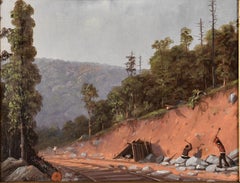
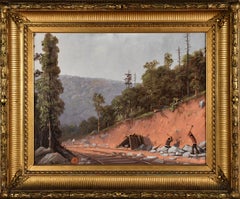
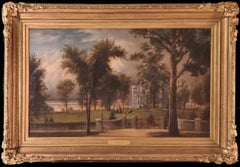
Alfred S. Wall (American, 1825-1896) Untitled (Building the Railroad), 1859 Oil on canvas 14 1/2 x 18 1/2 inches Signed and dated lower left For Christmas, 2008, the Pittsburgh Post-Gazette featured Alfred Wall's painting, Old Saw Mill from the collection of the Westmoreland Museum of American Art in Greensburg, PA. It was painted in 1851 in the town of Lilly, Pennsylvania in the Allegheny Mountains. The newspaper description stated that "though the saw mill is long gone, it still conveys all the warmth and coziness of this time of year. The article, written by Patricia Lowry, continued: At first glance, Alfred S. Wall's painting of a saw mill in snowy woods triggers nostalgia for the coziness of a log cabin, the smell of a wood-burning fire and the warming of chilled hands and feet beside it. But as sentimental as it seems on the surface, Mr. Wall's painting has a deeper and unexpected context. This is more than a painting about sled-riding children and early industry planted in the middle of virgin forest. Intended or not, this is a painting about conquering the great divide of the Allegheny Mountains. For the third consecutive year, the Post-Gazette features a winter-scene painting on the cover of the Christmas Day newspaper. This year's painting, Old Saw Mill, was selected by co-publisher and editor-in-chief John Robinson Block and executive editor David Shribman during a visit to the Westmoreland Museum of American Art in Greensburg. Mr. Wall, listed as a portrait painter in the 1850 census, was about 26 when he painted Old Saw Mill in 1851. The self-taught artist was born in Mount Pleasant, Westmoreland County, to William and Lucy Wall, who'd emigrated from England around 1820. An artistic sensibility ran in the family: William was a sculptor who carved ornate tombstones here; Alfred's children, A. Bryan and Bessie, were landscape painters, as was Alfred's older brother, William Coventry Wall. For more than a century the Walls formed a prominent art dynasty in Pittsburgh, and Alfred, eventually a partner in the city's most prestigious art gallery, was well known as a painter, dealer and restorer. In Old Saw Mill, two wood cutters, each holding an axe, meet outside the mill; one points in the direction of the forest. On the other side of the stream, one child pulls another down the hillside on a sled. Just behind the hill's slope, the roof of a building appears, perhaps the home of the sawyer. The luminous, late afternoon light comes from the northwest, casting lengthening shadows on the snow under a darkening sky. The saw mill in "Old Saw Mill" likely would have been impossible to track down had Mr. Wall, presumably, not written on the back of the painting: "old saw mill near Jct. 4, Portage RR, Pa." "There was no Junction 4," said Mike Garcia, park ranger at the Allegheny Portage Railroad National Historic Site, about 90 miles east of Pittsburgh near Gallitzen, Cambria County. "But there was an Inclined Plane No. 4 at Lilly, and there was a saw mill there." In fact, there were at least six saw mills at Lilly over the years, said longtime resident Jim Salony, president of the Lilly-Washington Historical Society. But when he saw an image of the painting, Mr. Salony had no trouble coming up with a location. While there are no known photographs of the saw mill, he believes it stood near the intersection of Portage and Washington streets, next to Bear Rock Run. Mr. Salony, retired academic dean at Mount Aloysius College, didn't know exactly when the mill was torn down, but it's been gone since at least the late 1800s. He was pleased to learn of the painting, even though that knowledge came too late for inclusion in a new book about Lilly, The Spirit of a Community, for which he served as primary author and editor. It runs to more than 700 pages. For a little town -- population 869 last year -- Lilly has a lot of history. Nestled in a bowl on the western slope of the Allegheny Mountains about 3 miles south of Cresson, Lilly was first settled in 1806 by Joseph Meyer and his family, who named their 332-acre land patent Dundee. Although the Meyers had left by 1811, other settlers followed, but the community didn't flourish until the 1830s, when the Allegheny Portage Railroad began its 23-year-run through the town. For 200 years the Alleghenies had stood as an impediment to trade and travel between Pittsburgh and the east. A canal from Philadelphia to Pittsburgh would change that and compete with New York's Erie Canal. But a portage railroad would have to be built, on which teams of horses would lead the canal boats over the mountains. Engineer Sylvester Welch began his surveying from the small settlement at Lilly. The railroad would require 10 inclined planes, some quite steep, between Hollidaysburg and Johnstown. To build it, trees had to be cut along a 120-foot-wide right-of-way for 36 miles, along which track and engine houses had to be built. William Brown, who owned the saw mill on Bear Rock Run, built at least one of the engine houses at Inclined Plane No. 4; an 1834 contract also included fencing the dwelling lots at the head and foot of the plane. Lilly is located at what was the foot of Inclined Plane No. 4., giving the community one of its early informal names, Foot of Four. Named in 1883 for Richard Lilly, who'd completed the grist mill there, Lilly had another early name: Hemlock, so dubbed by a Portage Railroad traveler who smelled the bark stripped from the trees at the saw mill. Because there isn't another Allegheny Portage Railroad location like it, where a cut in the mountains opens into a bowl, Mr. Salony thinks it was Lilly that Charles Dickens wrote about following his trip from Harrisburg to Pittsburgh on the Pennsylvania Canal in late March 1842, describing what he saw after emerging from "the bottom of the cut": "It was very pretty while traveling, to look down into a valley full of light and softness, catching glimpses through the tree-tops of scattered cabins; children running to the doors; dogs bursting out to bark, who we could see without hearing; terrified pigs scampering homeward; families sitting out in their rude gardens; cows gazing upward with a stupid indifference; men in their shirt-sleeves looking on at their unfinished houses, planning out to-morrow's work; and we riding onward, high above them, like a whirlwind." To get to Lilly, Mr. Wall may have taken the Pennsylvania Canal from his home in Allegheny City, now the North Side. He'd married young, at 21, to Sarah Carr in 1846, the same year he began his career as an artist. By 1880 they were living in a brick townhouse at 104 (later 814) Arch St., now demolished. Across the river in Pittsburgh he shared a studio at 67 Fourth Ave. with his brother William; they later moved to Burke's Building, today the city's oldest office building at 209-211 Fourth. But often they worked outdoors, sometimes as part of the colony of artists that grew up around painter George Hetzel beginning in the late 1860s at Scalp Level...

Category

1850s Hudson River School Art
Materials

Canvas, Oil

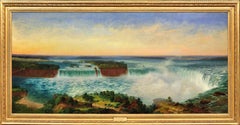
Niagara Falls 1870s Large Panoramic Oil Painting New York State And Ontario

Niagara Falls 1870s Large Panoramic Oil Painting New York State And Ontario

Located in Sutton Poyntz, Dorset

Alexandre Le Bihan. French ( b.1839 - d.1924 ). Niagara Falls. Oil On Canvas. Signed Lower Left. Image size 23.2 inches x 49.2 inches ( 59cm x 125cm ). Frame size 28.9 inches x 55.1...

Category

Late 19th Century Hudson River School Art

Materials

Canvas, Oil

“Seaside Cliffs, California”

“Seaside Cliffs, California”

By George Douglas Brewerton

Located in Southampton, NY

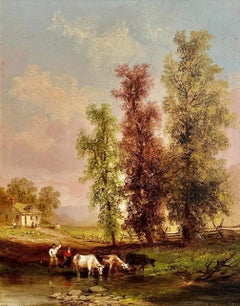
Beautiful original pastel on archival card stock from Paris of the craggy seaside cliffs of California by the well known Hudson River artist, George Douglas Bremerton. Signed lower left. Circa 1880. Condition is excellent. Under glass. The artwork is housed in its original ornate scroll designed frame. Overall framed measurements are 33 by 19 inches. Provenance: A East Coast Florida estate. George Douglas Brewerton received lessons in art from Prof. Robert W. Weir at West Point where his father was Superintendent. In 1874, he was detailed to San Francisco as an officer in the Stevenson Regiment. In 1848, he underwent many adventures in Western deserts and mountains with Kit Carson, who crossed the country with news of the California Gold Rush. After serving as an aide to Gen. Rufus Saxton during the Civil War, Brewerton called himself “Colonel,” although he never received an army commission...

Category

1870s Hudson River School Art
Materials

Pastel, Archival Paper

Hudson River School art for sale on 1stDibs.
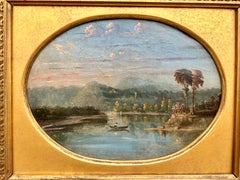
Find a wide variety of authentic Hudson River School art available for sale on 1stDibs. Works in this style were very popular during the 21st Century and Contemporary, but contemporary artists have continued to produce works inspired by this movement. If you’re looking to add art created in this style to introduce contrast in an otherwise neutral space in your home, the works available on 1stDibs include elements of blue, orange, purple and other colors. Many Pop art paintings were created by popular artists on 1stDibs, including Ralph Albert Blakelock, Jane Bloodgood-Abrams, Jasper Francis Cropsey, and John Frederick Kensett. Frequently made by artists working with Paint, and Oil Paint and other materials, all of these pieces for sale are unique and have attracted attention over the years. Not every interior allows for large Hudson River School art, so small editions measuring 2 inches across are also available. Prices for art made by famous or emerging artists can differ depending on medium, time period and other attributes. On 1stDibs, the price for these items starts at $400 and tops out at $875,000, while the average work sells for $13,267.