Charles Quest Art

1904-1993

Charles Quest, a successful artist, and fine art instructor, worked in a variety of mediums including mosaic, stained glass, mural painting, and sculpture, but remains best known as a printmaker. Quest grew up in St. Louis, his talent evident as a teenager when he began copying the works of masters such as Michelangelo on his bedroom walls. He studied at the Sam Fox School of Design & Visual Arts at Washington University where he later taught from 1944–71. He traveled to Europe after his graduation in 1929, and studied at the Académie de la Grande Chaumière and Académie Colarossi, Paris, continuing to draw inspiration from the works of the Old Masters. After returning to St. Louis, Quest received several commissions to paint murals in public buildings, schools, and churches, including one from Joseph Cardinal Ritter to paint a replica of Velázquez's Crucifixion over the main altar of the Old Cathedral in St. Louis.

Quest soon became interested in the woodcut medium which he apparently learned through his study of J. J. Lankes' A Woodcut Manual (1932) and Paul Landacre's articles in the American Artist magazine since no artists in St. Louis were working in wood at that time. Quest also revealed that for him, woodcutting and engraving were ‘more enjoyable than any other means of expression.’ In the late 1940s, his graphic works began attracting a lot of critical attention — several of his woodcuts won prizes and were acquired by major American and European museums. His wood engraving entitled Lovers was included in the American Federation of Art's traveling print exhibition in 1947. Two years later Quest's two prize-winning prints, Still Life with Grindstone and Break Forth into Singing were exhibited in major American museums in a traveling show organized by the Philadelphia Print Club. His work was included in the Chicago Art Institute's exhibition, Woodcut Through Six Centuries and the print Still Life with Vise, which was purchased by the Museum of Modern Art in New York. In 1951, he was invited by artist-curator Jacob Kainen to exhibit 30 wood engravings and color woodcuts in the Graphic Arts Division of the Smithsonian's National Museum (now known as the American History Museum). This one-man exhibition was a remarkable achievement for Quest, who had been working in the medium for only about 10 years.

In the press release for the show, Kainen praised the ‘technical refinement’ of Quest's work. “He obtains a great variety of textural effects through the use of the graver, and these dense or transparent grays are set off against whites or blacks to achieve sparkling results. His work has the handsome qualities characteristic of the craftsman and designer,” noted Kainen. At the time of the Smithsonian exhibition, Quest's work was represented by three New York galleries in addition to one in his hometown. He had also won 38 prizes, and his prints were in the collections of the Library of Congress, the Art Institute of Chicago, the Metropolitan Museum and the Philadelphia Museum of Art. In cooperation with the Art in Embassies program, his color woodcuts were displayed at the American Embassy in Paris in 1951. Recognition at home came in 1955 with his first solo exhibition in St. Louis. Press coverage of the show heralded the growth of graphic arts toward rivaling painting and sculpture as a major independent medium.

Quest retired from teaching in 1971 and made relatively few prints in his later years, as the rigors of the medium were too demanding. He moved to Tryon, North Carolina, with his wife Dorothy, an artist and portrait painter, and remained active as a painter until he died in 1993. An exhibition of his prints at the Bethesda Art Gallery in 1983 attracted the interest of Curator Emeritus Joseph A. Haller, S. J., who began purchasing his work for the University's collection. In 1990, Georgetown University Library's Special Collections Division became the grateful recipient of a large body of Quest's work including prints, drawings, paintings, sculpture, and stained glass, as well as his archive of correspondence and professional memorabilia. These extensive holdings, including some 260 of his fine prints, provide a rich opportunity for further study and appreciation of this versatile and not-to-be-forgotten mid-Western American artist of the 20th century.

to
2
1
Overall Width
to
Overall Height
to
3
2
2
1
2
1
1
1
2
1
1
1
1
3
11,246
2,855
2,494
1,443
1
3
Artist: Charles Quest
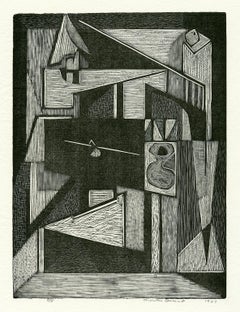
Underwater — Mid-century Modern

Underwater — Mid-century Modern

By Charles Quest

Located in Myrtle Beach, SC

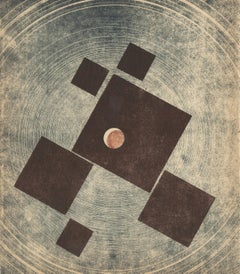
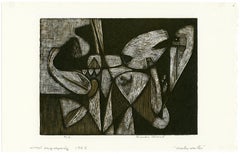
Charles Quest, 'Underwater', 1948, chiaroscuro wood engraving, edition 12. Signed, titled, dated and numbered '3/12' in pencil. A fine, richly-inked impression, in dark brown and warm black, on off-white wove paper, with full margins (5/8 to 1 1/2 inch), in excellent condition. Scarce. ABOUT THE ARTIST Charles Quest, painter, printmaker, and fine art instructor, worked in various mediums, including mosaic, stained glass, mural painting, and sculpture. Quest grew up in St. Louis, his talent evident as a teenager when he began copying the works of masters such as Michelangelo on his bedroom walls. He studied at the Washington University School of Fine Arts, where he later taught from 1944 to 1971. He traveled to Europe after his graduation in 1929 and studied at La Grande Chaumière and Academie Colarossi, Paris, continuing to draw inspiration from the works of the Old Masters. After returning to St. Louis, Quest received several commissions to paint murals in public buildings, schools, and churches, including one from Joseph Cardinal Ritter, to paint a replica of Velasquez's Crucifixion over the main altar of the Old Cathedral in St. Louis. Quest soon became interested in the woodcut medium, which he learned through his study of J. J. Lankes' A Woodcut Manual (1932) and Paul Landacre's articles in American Artist magazine ‘since no artists in St. Louis were working in wood’ at that time. Quest also revealed that for him, wood cutting and engraving were ‘more enjoyable than any other means of expression.’ In the late 1940s, his graphic works began attracting critical attention—several of his woodcuts won prizes and were acquired by major American and European museums. His wood engraving entitled ‘Lovers’ was included in the American Federation of Art's traveling print exhibition in 1947. Two years later, Quest's two prize-winning prints, ‘Still Life with Grindstone’ and ‘Break Forth into Singing’, were exhibited in major American museums in a traveling show organized by the Philadelphia Print Club. His work was included in the Chicago Art Institute's exhibition, ‘Woodcut Through Six Centuries’, and the print ‘Still Life with Vise’ was purchased by the Museum of Modern Art in New York. In 1951 he was invited by artist-Curator Jacob Kainen to exhibit thirty wood engravings and color woodcuts in a one-person show at the Smithsonian's National Museum (now known as the American History Museum). Kainen's press release praised the ‘technical refinement’ of Quest's work: ‘He obtains a great variety of textural effects through the use of the graver, and these dense or transparent grays are set off against whites or blacks to achieve sparkling results. His work has the handsome qualities characteristic of the craftsman and designer.’ At the time of the Smithsonian exhibition, Quest's work was represented by three New York galleries in addition to one in his home town. He had won 38 prizes, and his prints were in the collections of the Library of Congress, the Chicago Art Institute, the Metropolitan Museum, and the Philadelphia Museum of Art. In cooperation with the Art in Embassies program, his color woodcuts were displayed at the American Embassy in Paris in 1951. Recognition at home came in 1955 with his first solo exhibition in St. Louis. Press coverage of the show heralded the ‘growth of graphic arts toward rivaling painting and sculpture as a major independent medium’. An exhibition of his prints at the Bethesda Art Gallery in 1983 attracted Curator Emeritus Joseph A. Haller, S.J., who began purchasing his work for Georgetown University's collection. In 1990 Georgetown University Library's Special Collections Division was the recipient of a large body of Quest's work, including prints, drawings, paintings, sculpture, stained glass, and his archive of correspondence and professional memorabilia. These extensive holdings, including some 260 of his fine prints, provide a rich opportunity for further study and appreciation of this versatile and not-to-be-forgotten mid-Western American artist...

Category

1940s American Modern Charles Quest Art

Materials

Woodcut

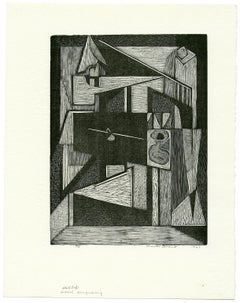
Still Life — Mid-century Modern

Still Life — Mid-century Modern

By Charles Quest

Located in Myrtle Beach, SC

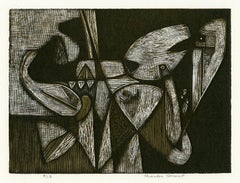
Charles Quest, 'Still Life', 1947, wood engraving, edition 8. Signed, dated, and numbered '3/8' in pencil. Titled and annotated 'wood engraving' in the bottom left margin. A fine impression, on off-white wove paper, with full margins (1 to 2 inches), in excellent condition. Scarce. Matted to museum standards, unframed. ABOUT THE ARTIST Charles Quest, painter, printmaker, and fine art instructor, worked in various mediums, including mosaic, stained glass, mural painting, and sculpture. Quest grew up in St. Louis, his talent evident as a teenager when he began copying the works of masters such as Michelangelo on his bedroom walls. He studied at the Washington University School of Fine Arts, where he later taught from 1944 to 1971. He traveled to Europe after his graduation in 1929 and studied at La Grande Chaumière and Academie Colarossi, Paris, continuing to draw inspiration from the works of the Old Masters. After returning to St. Louis, Quest received several commissions to paint murals in public buildings, schools, and churches, including one from Joseph Cardinal Ritter, to paint a replica of Velasquez's Crucifixion over the main altar of the Old Cathedral in St. Louis. Quest soon became interested in the woodcut medium, which he learned through his study of J. J. Lankes' A Woodcut Manual (1932) and Paul Landacre's articles in American Artist magazine ‘since no artists in St. Louis were working in wood’ at that time. Quest also revealed that for him, wood cutting and engraving were ‘more enjoyable than any other means of expression.’ In the late 1940s, his graphic works began attracting critical attention—several of his woodcuts won prizes and were acquired by major American and European museums. His wood engraving entitled ‘Lovers’ was included in the American Federation of Art's traveling print exhibition in 1947. Two years later, Quest's two prize-winning prints, ‘Still Life with Grindstone’ and ‘Break Forth into Singing’, were exhibited in major American museums in a traveling show organized by the Philadelphia Print Club. His work was included in the Chicago Art Institute's exhibition, ‘Woodcut Through Six Centuries’, and the print ‘Still Life with Vise’ was purchased by the Museum of Modern Art in New York. In 1951 he was invited by artist-Curator Jacob Kainen to exhibit thirty wood engravings and color woodcuts in a one-person show at the Smithsonian's National Museum (now known as the American History Museum). Kainen's press release praised the ‘technical refinement’ of Quest's work: ‘He obtains a great variety of textural effects through the use of the graver, and these dense or transparent grays are set off against whites or blacks to achieve sparkling results. His work has the handsome qualities characteristic of the craftsman and designer.’ At the time of the Smithsonian exhibition, Quest's work was represented by three New York galleries in addition to one in his home town. He had won 38 prizes, and his prints were in the collections of the Library of Congress, the Chicago Art Institute, the Metropolitan Museum, and the Philadelphia Museum of Art. In cooperation with the Art in Embassies program, his color woodcuts were displayed at the American Embassy in Paris in 1951. Recognition at home came in 1955 with his first solo exhibition in St. Louis. Press coverage of the show heralded the ‘growth of graphic arts toward rivaling painting and sculpture as a major independent medium’. An exhibition of his prints at the Bethesda Art Gallery in 1983 attracted Curator Emeritus Joseph A. Haller, S.J., who began purchasing his work for Georgetown University's collection. In 1990 Georgetown University Library's Special Collections Division was the recipient of a large body of Quest's work, including prints, drawings, paintings, sculpture, stained glass, and his archive of correspondence and professional memorabilia. These extensive holdings, including some 260 of his fine prints, provide a rich opportunity for further study and appreciation of this versatile and not-to-be-forgotten mid-Western American artist...

Category

1940s American Modern Charles Quest Art

Materials

Woodcut

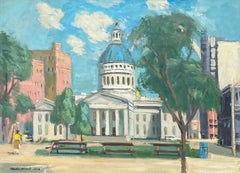
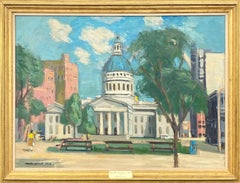
The Old Courthouse
The Old Courthouse

The Old Courthouse

By Charles Quest

Located in Missouri, MO

The Old Courthouse, 1968 By. Charles Quest (American, 1904-1993) Signed and Dated Lower Left 32 x 44 inches 38.25 x 50.25 inches with frame Born in Troy, New York, Charles Quest was...

Category

20th Century American Impressionist Charles Quest Art

Materials

Canvas, Oil

Related Items
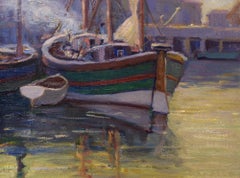
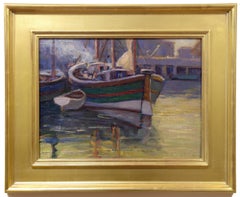
Harborfront, American Impressionist, 20th Century, Wooden Sailing Ships at Dock

Harborfront, American Impressionist, 20th Century, Wooden Sailing Ships at Dock

Located in Wiscasset, ME

In "Harborfront" the artist uses colorful, impressionist brushstrokes to bring a working waterfront to life.

Category

20th Century American Impressionist Charles Quest Art

Materials

Canvas, Oil, Board

Swatch : Color Explosion - Original lithograph (Mourlot, 1992)

Swatch : Color Explosion - Original lithograph (Mourlot, 1992)

By Sam Francis

Located in Paris, IDF

Sam FRANCIS Color explosion, 1992 Original lithograph Unsigned On Arches vellum 86.5 x 29.5 cm Numbered on the back Authenticated by Moulot blind stamp INFORMATION : Edited by Gale...

Category

1990s American Modern Charles Quest Art

Materials

Lithograph

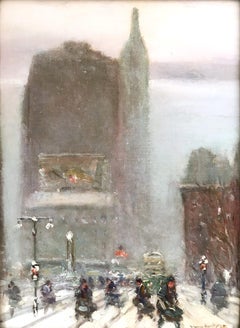
"Madison Square on 5th Avenue and 23rd Street" Impressionist Winter Street Scene

"Madison Square on 5th Avenue and 23rd Street" Impressionist Winter Street Scene

By Johann Berthelsen, 1883-1972

Located in New York, NY

A truly stunning jewel and pertinent example of Berthelsen's charming New York City winter scenes depicting Madison Square Park on 5th Avenue and 23rd Street. An iconic scene that so...

Category

Mid-20th Century American Impressionist Charles Quest Art

Materials

Canvas, Oil, Board

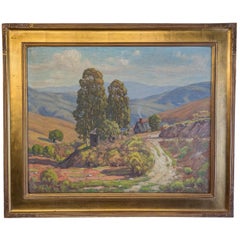
American Impressionist Oil on Canvas Painting "California Highlands" Los Angeles

American Impressionist Oil on Canvas Painting "California Highlands" Los Angeles

By Charles Smith

Located in Portland, OR

A very attractive California Impressionist oil on canvas painting by Charles L. A. Smith, "California Highlands", dated 1930. This very attractive large painting by one of the foremo...

Category

1930s American Impressionist Charles Quest Art

Materials

Canvas, Oil

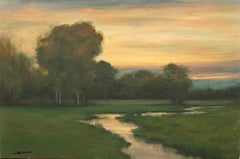
"Sunset on the Marsh" Dennis Sheehan, Dusk, Sunset Reflections, Natural Beauty

"Sunset on the Marsh" Dennis Sheehan, Dusk, Sunset Reflections, Natural Beauty

By Dennis Sheehan

Located in New York, NY

Dennis Sheehan Sunset on the Marsh, Summer, circa 2025 Signed lower left Oil on canvas 20 x 30 inches Dennis Sheehan was born in Boston in 1950. His work is based upon the Barbizon...

Category

2010s American Impressionist Charles Quest Art

Materials

Canvas, Oil

"Taos" - Original Oil Landscape Painting on Canvas

"Taos" - Original Oil Landscape Painting on Canvas

By Sparky LeBold

Located in Denver, CO

ARTIST STATEMENT Sparky LeBold has made a name for himself both in America and abroad over the course of his stellar career.  Since graduating from Art Center College of Design in P...

Category

2010s American Impressionist Charles Quest Art

Materials

Canvas, Oil

"New England Sunset" Dennis Sheehan, Water Reflections, Bright Dusk Skyscape

"New England Sunset" Dennis Sheehan, Water Reflections, Bright Dusk Skyscape

By Dennis Sheehan

Located in New York, NY

Dennis Sheehan New England Sunset, circa 2025 Signed lower left Oil on canvas 36 x 48 inches Dennis Sheehan was born in Boston in 1950. His work is based upon the Barbizon School w...

Category

2010s American Impressionist Charles Quest Art

Materials

Canvas, Oil

"Autumn Chill" Dennis Sheehan, Skyscape, Fall Countryside, Atmospheric Scene

"Autumn Chill" Dennis Sheehan, Skyscape, Fall Countryside, Atmospheric Scene

By Dennis Sheehan

Located in New York, NY

Dennis Sheehan Autumn Chill, circa 2025 Oil on canvas 20 x 24 inches Dennis Sheehan was born in Boston in 1950. His work is based upon the Barbizon School with faithful adherence t...

Category

2010s American Impressionist Charles Quest Art

Materials

Canvas, Oil

"Rising Moon" Dennis Sheehan, Dusk Marsh Landscape, Purple Sky, Full Moon

"Rising Moon" Dennis Sheehan, Dusk Marsh Landscape, Purple Sky, Full Moon

By Dennis Sheehan

Located in New York, NY

Dennis Sheehan Rising Moon, circa 2025 Signed lower left Oil on canvas 24 x 36 inches Dennis Sheehan was born in Boston in 1950. His work is based upon the Barbizon School with fai...

Category

2010s American Impressionist Charles Quest Art

Materials

Canvas, Oil

The Trees at the  George Ranch   Texas Landscape  Oil  American Impressionism

The Trees at the George Ranch Texas Landscape Oil American Impressionism

By Steve Parker

Located in Houston, TX

Framed 19.5" x 25.5" The Trees at the George Ranch is an American impressionist landscape painting that was painted near Richmond TX which is about 30 miles from Houston. The Tree...

Category

2010s American Impressionist Charles Quest Art

Materials

Cotton Canvas, Oil

Untitled
Untitled

Untitled

By Charles William Smith

Located in Fairlawn, OH

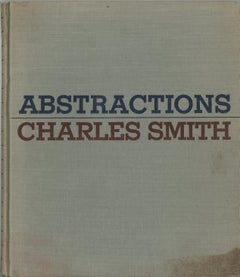
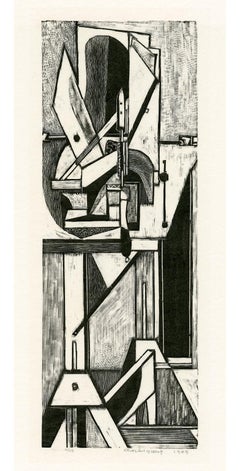
Untitled Color woodcut, 1939 Unsigned as issued Signed and dedicated by the artist on the justification page (see photo) From: Abstractions By Charles Smith Forward by Carl O. Schnie...

Category

1930s American Modern Charles Quest Art

Materials

Woodcut

"Corner of my Garden" Leon Foster Jones, Impressionist, Blooming Spring Flora

"Corner of my Garden" Leon Foster Jones, Impressionist, Blooming Spring Flora

Located in New York, NY

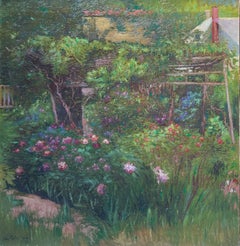
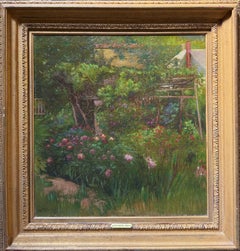
Leon Foster Jones Corner of my Garden, 1902 Signed and dated lower left Oil on canvas 26 x 25 inches Provenance Goldfield Galleries, Los Angeles, California Private Collection, Virginia Beach, Virginia Leon Foster Jones was a painter of landscapes, an etcher, a lithographer, and an educator. He was born in Manchester, New Hampshire, his father held the position of overseer in one of the hosiery mills in the Manchester area. In approximately 1901, he married Josephine Currier. During the initial years of their marriage, the couple resided in Concord, New Hampshire. They made Port Jefferson, Long Island, New York their permanent home in 1910, although the artist had begun working there as early as 1907. Numerous sources indicate that throughout his life, Jones gained recognition primarily for his paintings and etchings featuring historical sites across Long Island. His artistic education included four years at the Cowles Art School in Boston, Massachusetts, where he studied under Joseph Rodefer DeCamp...

Category

Early 1900s American Impressionist Charles Quest Art

Materials

Canvas, Oil

Previously Available Items
Work Bench — Mid-century Modern

Work Bench — Mid-century Modern

By Charles Quest

Located in Myrtle Beach, SC

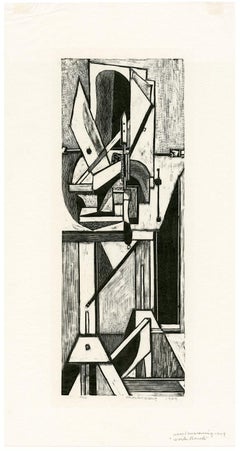
Charles Quest, 'Work Bench', 1949, wood engraving, edition 40. Signed, dated and numbered 9/40 in pencil. Titled and annotated 'wood engraving 1949' in pencil, in the artist’s hand, lower right margin. A fine, richly-inked impression, on off-white wove Japan, with full margins (1 3/4 to 2 inches), in excellent condition. Matted to museum standards, unframed. ABOUT THE ARTIST Charles Quest, a successful artist, and fine art instructor, worked in a variety of mediums including mosaic, stained glass, mural painting, and sculpture, but remains best known as a printmaker. Quest grew up in St. Louis, his talent evident as a teenager when he began copying the works of masters such as Michelangelo on his bedroom walls. He studied at the Washington University School of Fine Arts where he later taught from 1944 to 1971. He traveled to Europe after his graduation in 1929, and studied at La Grande Chaumière and Academie Colarossi, Paris, continuing to draw inspiration from the works of the Old Masters. After returning to St. Louis, Quest received several commissions to paint murals in public buildings, schools, and churches, including one from Joseph Cardinal Ritter to paint a replica of Velasquez's Crucifixion over the main altar of the Old Cathedral in St. Louis. Quest soon became interested in the woodcut medium which he apparently learned through his study of J. J. Lankes' A Woodcut Manual (1932) and Paul Landacre's articles in American Artist magazine ‘since no artists in St. Louis were working in wood’ at that time. Quest also revealed that for him, wood cutting and engraving were ‘more enjoyable than any other means of expression.’ In the late 1940s, his graphic works began attracting a lot of critical attention—several of his woodcuts won prizes and were acquired by major American and European museums. His wood engraving entitled ‘Lovers’ was included in the American Federation of Art's traveling print exhibition in 1947. Two years later Quest's two prize-winning prints, ‘Still Life with Grindstone’ and ‘Break Forth into Singing’ were exhibited in major American museums in a traveling show organized by the Philadelphia Print Club. His work was included in the Chicago Art Institute's exhibition, ‘Woodcut Through Six Centuries’ and the print ‘Still Life with Vise’, was purchased by the Museum of Modern Art in New York. In 1951 he was invited by artist-Curator Jacob Kainen to exhibit thirty wood engravings and color woodcuts in the Graphic Arts Division of the Smithsonian's National Museum (now known as the American History Museum). This one-man exhibition was a remarkable achievement for Quest, who had been working in the medium for only about ten years. In the press release for the show, Kainen praised the ‘technical refinement’ of Quest's work: ‘He obtains a great variety of textural effects through the use of the graver, and these dense or transparent grays are set off against whites or blacks to achieve sparkling results. His work has the handsome qualities characteristic of the craftsman and designer.’ At the time of the Smithsonian exhibition, Quest's work was represented by three New York galleries in addition to one in his home town. He had also won 38 prizes, and his prints were in the collections of the Library of Congress, the Chicago Art Institute, the Metropolitan Museum and the Philadelphia Museum of Art. In cooperation with the Art in Embassies program, his color woodcuts were displayed at the American Embassy in Paris in 1951. Recognition at home came in 1955 with his first solo exhibition in St. Louis. Press coverage of the show heralded the ‘growth of graphic arts toward rivaling painting and sculpture as a major independent medium’. Charles Quest retired from teaching in 1971 and made relatively few prints in his later years, as the rigors of the medium were too demanding. He moved to Tryon, North Carolina, with his wife Dorothy, an artist and portrait painter, and remained active as a painter until his death in 1993. An exhibition of his prints at the Bethesda Art Gallery in 1983 attracted the interest of Curator Emeritus Joseph A. Haller, S.J., who began purchasing his work for the University's collection. In 1990 Georgetown University Library's Special Collections Division became the grateful recipient of a large body of Quest's work including prints, drawings, paintings, sculpture, and stained glass, as well as his archive of correspondence and professional memorabilia. These extensive holdings, including some 260 of his fine prints, provide a rich opportunity for further study and appreciation of this versatile and not-to-be-forgotten mid-Western American artist...

Category

1940s American Modern Charles Quest Art

Materials

Woodcut

Charles Quest art for sale on 1stDibs.

Find a wide variety of authentic Charles Quest art available for sale on 1stDibs. You can also browse by medium to find art by Charles Quest in woodcut print, canvas, fabric and more. Much of the original work by this artist or collective was created during the 20th century and is mostly associated with the modern style. Not every interior allows for large Charles Quest art, so small editions measuring 5 inches across are available. Customers who are interested in this artist might also find the work of Giovanni Pintori, Caroline Durieux, and Paul Sample. Charles Quest art prices can differ depending upon medium, time period and other attributes. On 1stDibs, the price for these items starts at $750 and tops out at $1,500, while the average work can sell for $875.

Artists Similar to Charles Quest