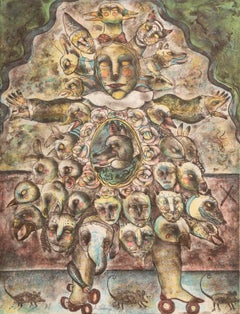
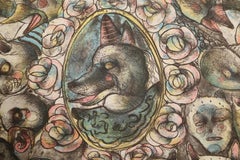
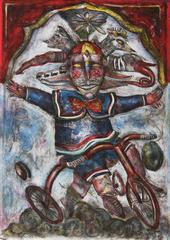
Alejandro Colunga Figurative Prints

Mexican, b. 1948
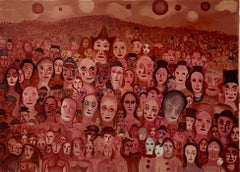
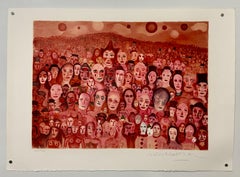
Alejandro Colunga Marín (b. December 11, 1948, Guadalajara, Jalisco) is a self-taught Mexican artist celebrated for his vivid, fantastical prints, paintings and sculptures. He was initially trained aas an architect and also studied music and anthropology—but chose to pursue art independently, drawing on folklore, surrealist traditions, and immersive life experiences Over a career spanning five decades, Colunga has exhibited across the Americas and Europe since 1968. His pieces are acquired by major institutions like the Museo Amparo (Puebla), San Antonio Museum of Art, Nassau County Museum of Art, and publicly installed in Guadalajara and Puerto Vallarta. Recognized with awards such as the Minerva a las Artes (1988), Jalisco a las Artes (1994), and an architecture prize for “La Sala de los Magos,” his work continues to be a beloved synthesis of Mexican cultural identity, theatricality, and magical realism . His art remains an enduring celebration of imagination, inviting audiences into a surreal world where art, function, folklore, and fantasy collide.
to
1
4
1
Overall Width
to
Overall Height
to
6
9
714
418
384
370
6
4
1
5
1
5
4
4
3
2
1
1
1
1
1
1
5
1
1
1
1
1
4
6
Artist: Alejandro Colunga
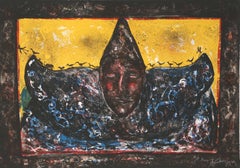
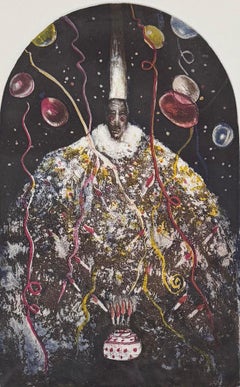
Tomano Monote (Cupcake Boy)

Tomano Monote (Cupcake Boy)

By Alejandro Colunga

Located in Palm Springs, CA

Alejandro Colunga is a renowned Mexican artist born in 1948 in Guadalajara, Jalisco. He is part of the Nueva Mexicanidad movement and is celebrated for his surrealist and fantastical...

Category

1990s Surrealist Alejandro Colunga Figurative Prints

Materials

Etching, Aquatint, Gouache

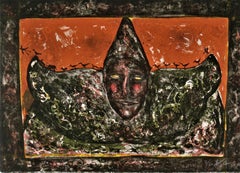
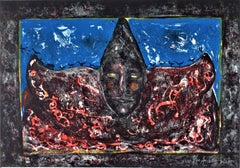
Payaso, Blue, Red and Yellow, 1980.

Payaso, Blue, Red and Yellow, 1980.

By Alejandro Colunga

Located in San Francisco, CA

These artwork title "Payaso blue, Red and Yellow" 1980 are the complete suite of three original lithographs by noted Mexican artist Alejandro Colunga, b.1948. They are hand signed, d...

Category

Late 20th Century Surrealist Alejandro Colunga Figurative Prints

Materials

Lithograph

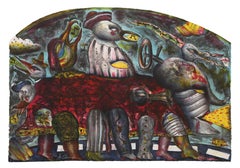
Autobus, Surrealist Lithograph by Alejandro Colunga

Autobus, Surrealist Lithograph by Alejandro Colunga

By Alejandro Colunga

Located in Long Island City, NY

Artist: Alejandro Colunga, Mexican (1948 - ) Title: Autobus Year: 1979 Medium: Lithograph on Arches, signed and numbered in pencil Edition: 110 Size: 25 x 36 in. (63.5 x 91.44 cm)

Category

1980s Surrealist Alejandro Colunga Figurative Prints

Materials

Lithograph

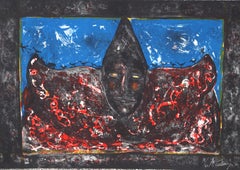
Payaso (Blue), Surrealist Lithograph by Alejandro Colunga

Payaso (Blue), Surrealist Lithograph by Alejandro Colunga

By Alejandro Colunga

Located in Long Island City, NY

Artist: Alejandro Colunga, Mexican (1948 - ) Title: Payaso (Blue) Year: 1980 Medium: Lithograph on Arches, signed and numbered in pencil Edition: 60, AP Size: 22.5 x 32 in. (57.15 x ...

Category

1980s Surrealist Alejandro Colunga Figurative Prints

Materials

Lithograph

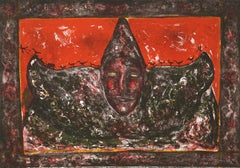
Payaso (Red), Surrealist Lithograph by Alejandro Colunga

Payaso (Red), Surrealist Lithograph by Alejandro Colunga

By Alejandro Colunga

Located in Long Island City, NY

Artist: Alejandro Colunga, Mexican (1948 - ) Title: Payaso (Red) Year: 1980 Medium: Lithograph on Arches, signed and numbered in pencil Edition: 60, AP Size: 22.5 x 32 in. (57.15 x 8...

Category

1980s Surrealist Alejandro Colunga Figurative Prints

Materials

Lithograph

Payaso (Yellow), Surrealist Lithograph by Alejandro Colunga

Payaso (Yellow), Surrealist Lithograph by Alejandro Colunga

By Alejandro Colunga

Located in Long Island City, NY

Artist: Alejandro Colunga, Mexican (1948 - ) Title: Payaso (Yellow) Year: 1980 Medium: Lithograph on Arches, signed and numbered in pencil Edition: 60, AP Size: 22.5 x 32 in. (57.15 ...

Category

1980s Surrealist Alejandro Colunga Figurative Prints

Materials

Lithograph

Related Items
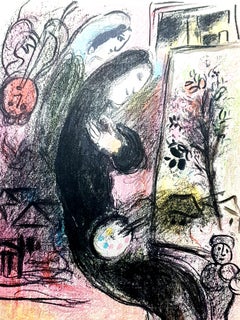
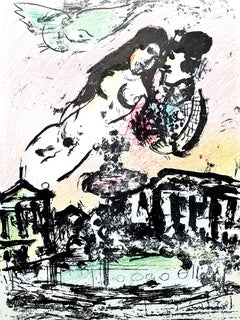
Marc Chagall - Inspiration - Original Lithograph from "Chagall Lithographe" v. 2

Marc Chagall - Inspiration - Original Lithograph from "Chagall Lithographe" v. 2

By Marc Chagall

Located in Collonge Bellerive, Geneve, CH

Marc Chagall Original Lithograph from Chagall Lithographe 1957-1962. VOLUME II. 1963 Dimensions: 32 x 24 cm From the unsigned edition of 10000 copies without margins Reference: Mourlot 398 Condition : Excellent Marc Chagall (born in 1887) Marc Chagall was born in Belarus in 1887 and developed an early interest in art. After studying painting, in 1907 he left Russia for Paris, where he lived in an artist colony on the city’s outskirts. Fusing his own personal, dreamlike imagery with hints of the fauvism and cubism popular in France at the time, Chagall created his most lasting work—including I and the Village (1911)—some of which would be featured in the Salon des Indépendants exhibitions. After returning to Vitebsk for a visit in 1914, the outbreak of WWI trapped Chagall in Russia. He returned to France in 1923 but was forced to flee the country and Nazi persecution during WWII. Finding asylum in the U.S., Chagall became involved in set and costume design before returning to France in 1948. In his later years, he experimented with new art forms and was commissioned to produce numerous large-scale works. Chagall died in St.-Paul-de-Vence in 1985. The Village Marc Chagall was born in a small Hassidic community on the outskirts of Vitebsk, Belarus, on July 7, 1887. His father was a fishmonger, and his mother ran a small sundries shop in the village. As a child, Chagall attended the Jewish elementary school, where he studied Hebrew and the Bible, before later attending the Russian public school. He began to learn the fundamentals of drawing during this time, but perhaps more importantly, he absorbed the world around him, storing away the imagery and themes that would feature largely in most of his later work. At age 19 Chagall enrolled at a private, all-Jewish art school and began his formal education in painting, studying briefly with portrait artist Yehuda Pen. However, he left the school after several months, moving to St. Petersburg in 1907 to study at the Imperial Society for the Protection of Fine Arts. The following year, he enrolled at the Svanseva School, studying with set designer Léon Bakst, whose work had been featured in Sergei Diaghilev's Ballets Russes. This early experience would prove important to Chagall’s later career as well. Despite this formal instruction, and the widespread popularity of realism in Russia at the time, Chagall was already establishing his own personal style, which featured a more dreamlike unreality and the people, places and imagery that were close to his heart. Some examples from this period are his Window Vitebsk (1908) and My Fianceé with Black Gloves (1909), which pictured Bella Rosenfeld, to whom he had recently become engaged. The Beehive Despite his romance with Bella, in 1911 an allowance from Russian parliament member and art patron Maxim Binaver enabled Chagall to move to Paris, France. After settling briefly in the Montparnasse neighborhood, Chagall moved further afield to an artist colony known as La Ruche (“The Beehive”), where he began to work side by side with abstract painters such as Amedeo Modigliani and Fernand Léger as well as the avant-garde poet Guillaume Apollinaire. At their urging, and under the influence of the wildly popular fauvism and cubism, Chagall lightened his palette and pushed his style ever further from reality. I and the Village (1911) and Homage to Apollinaire (1912) are among his early Parisian works, widely considered to be his most successful and representative period. Though his work stood stylistically apart from his cubist contemporaries, from 1912 to 1914 Chagall exhibited several paintings at the annual Salon des Indépendants exhibition, where works by the likes of Juan Gris, Marcel Duchamp and Robert Delaunay were causing a stir in the Paris art world. Chagall’s popularity began to spread beyond La Ruche, and in May 1914 he traveled to Berlin to help organize his first solo exhibition, at Der Sturm Gallery. Chagall remained in the city until the highly acclaimed show opened that June. He then returned to Vitebsk, unaware of the fateful events to come. War, Peace and Revolution In August 1914 the outbreak of World War I precluded Chagall’s plans to return to Paris. The conflict did little to stem the flow of his creative output, however, instead merely giving him direct access to the childhood scenes so essential to his work, as seen in paintings such as Jew in Green (1914) and Over Vitebsk (1914). His paintings from this period also occasionally featured images of the war’s impact on the region, as with Wounded Soldier (1914) and Marching (1915). But despite the hardships of life during wartime, this would also prove to be a joyful period for Chagall. In July 1915 he married Bella, and she gave birth to a daughter, Ida, the following year. Their appearance in works such as Birthday (1915), Bella and Ida by the Window (1917) and several of his “Lovers” paintings give a glimpse of the island of domestic bliss that was Chagall’s amidst the chaos. To avoid military service and stay with his new family, Chagall took a position as a clerk in the Ministry of War Economy in St. Petersburg. While there he began work on his autobiography and also immersed himself in the local art scene, befriending novelist Boris Pasternak, among others. He also exhibited his work in the city and soon gained considerable recognition. That notoriety would prove important in the aftermath of the 1917 Russian Revolution when he was appointed as the Commissar of Fine Arts in Vitebsk. In his new post, Chagall undertook various projects in the region, including the 1919 founding of the Academy of the Arts. Despite these endeavors, differences among his colleagues eventually disillusioned Chagall. In 1920 he relinquished his position and moved his family to Moscow, the post-revolution capital of Russia. In Moscow, Chagall was soon commissioned to create sets and costumes for various productions at the Moscow State Yiddish Theater...

Category

1960s Surrealist Alejandro Colunga Figurative Prints
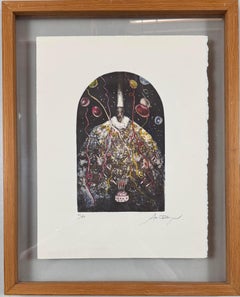
Materials

Lithograph

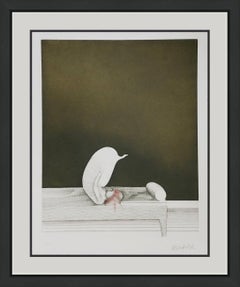
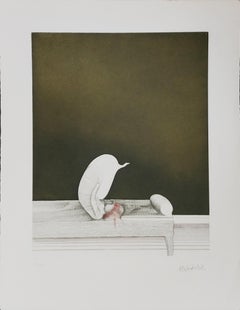
Sofafigur, Etching and Aquatint, Hand Signed, Edition of 95, 29x25 in. Framed

Sofafigur, Etching and Aquatint, Hand Signed, Edition of 95, 29x25 in. Framed

By Paul Wunderlich

Located in Aventura, FL

Hand signed and numbered by the artist. Etching and aquatint on lana paper. Image size 19.3 x 14.9 in. Frame size approx 29 x 25 in. Edition of 95. Certificate of authenticity includ...

Category

1960s Surrealist Alejandro Colunga Figurative Prints

Materials

Etching, Paper, Aquatint

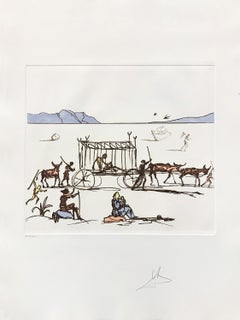
Salvador Dali - The Grand Inquisitor

Salvador Dali - The Grand Inquisitor

By Salvador Dalí­

Located in Collonge Bellerive, Geneve, CH

Salvador Dali - The Grand Inquisitor - Original Signed Engraving Handsigned in pencil and Numbered Edition: F195/195 - Printer: Atelier Rigal. - ...

Category

1970s Surrealist Alejandro Colunga Figurative Prints

Materials

Etching

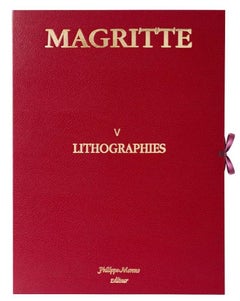
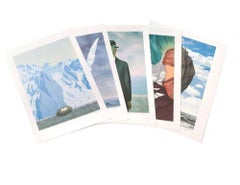
Magritte Portfolio V 20 lithographs- 20th Century, Surrealist, Figurative Print

Magritte Portfolio V 20 lithographs- 20th Century, Surrealist, Figurative Print

By (after) René Magritte

Located in Sint-Truiden, BE

Complete set of 20 color lithographs in a beautiful burgundy board with ties, plate-signed by Magritte and numbered from the edition of 275. The lithograph features the dry stamps of the Magritte Foundation & ADAGP and is countersigned in pencil by Mr. Charly Herscovici, President of the Magritte Foundation, Chairman of the Magritte Museum and unique representative of the Magritte Succession. A proof of edition is printed on the back of the lithograph, guaranteeing its authenticity. Magritte was a Belgian surrealist artist whose witty and thought-provoking images challenged observers? preconditioned perceptions of reality. Magritte's work frequently displays a juxtaposition of ordinary objects in an unusual context, giving new meanings to familiar things.Magritte grew up in a simple and somewhat tragic household. His father was a modest tailor. His mother, who was mentally unsound, committed suicide in the year 1912. Magritte started drawing at a young age, and his first paintings, produced c. 1915, were Impressionistic in style.Magritte first worked as a draughtsman in a wallpaper factory and, in the year 1922, fell in love with and married Georgette Berger. In 1926, Magritte signed...

Category

20th Century Surrealist Alejandro Colunga Figurative Prints

Materials

Lithograph

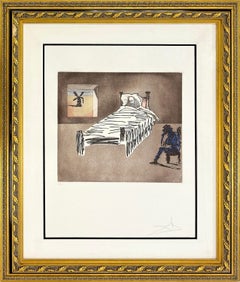
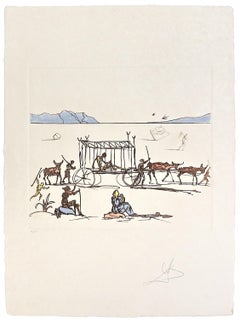
Le Legacy Aquatint Etching on Japon Paper, Signed, 4/150, 20th Century

Le Legacy Aquatint Etching on Japon Paper, Signed, 4/150, 20th Century

By Salvador Dalí­

Located in Aventura, FL

Aquatint and etching on Japon paper from Historia de Don Quixote de la Mancha. Hand signed lower right by Salvador Dali. Hand numbered 4/150 lower left. Sheet size: 29.875 x 22.12...

Category

1980s Surrealist Alejandro Colunga Figurative Prints

Materials

Paper, Etching, Aquatint

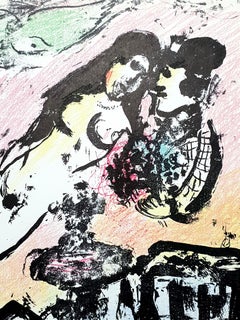
Marc Chagall - Original Lithograph

Marc ChagallMarc Chagall - Original Lithograph, 1963

$1,453

H 9.45 in W 12.6 in D 0.04 in

Marc Chagall - Original Lithograph

By Marc Chagall

Located in Collonge Bellerive, Geneve, CH

Marc Chagall Original Lithograph 1963 Dimensions: 32 x 24 cm Reference: Chagall Lithographe 1957-1962. VOLUME II. Condition : Excellent Marc Chagall (born in 1887) Marc Chagall was born in Belarus in 1887 and developed an early interest in art. After studying painting, in 1907 he left Russia for Paris, where he lived in an artist colony on the city’s outskirts. Fusing his own personal, dreamlike imagery with hints of the fauvism and cubism popular in France at the time, Chagall created his most lasting work—including I and the Village (1911)—some of which would be featured in the Salon des Indépendants exhibitions. After returning to Vitebsk for a visit in 1914, the outbreak of WWI trapped Chagall in Russia. He returned to France in 1923 but was forced to flee the country and Nazi persecution during WWII. Finding asylum in the U.S., Chagall became involved in set and costume design before returning to France in 1948. In his later years, he experimented with new art forms and was commissioned to produce numerous large-scale works. Chagall died in St.-Paul-de-Vence in 1985. The Village Marc Chagall was born in a small Hassidic community on the outskirts of Vitebsk, Belarus, on July 7, 1887. His father was a fishmonger, and his mother ran a small sundries shop in the village. As a child, Chagall attended the Jewish elementary school, where he studied Hebrew and the Bible, before later attending the Russian public school. He began to learn the fundamentals of drawing during this time, but perhaps more importantly, he absorbed the world around him, storing away the imagery and themes that would feature largely in most of his later work. At age 19 Chagall enrolled at a private, all-Jewish art school and began his formal education in painting, studying briefly with portrait artist Yehuda Pen. However, he left the school after several months, moving to St. Petersburg in 1907 to study at the Imperial Society for the Protection of Fine Arts. The following year, he enrolled at the Svanseva School, studying with set designer Léon Bakst, whose work had been featured in Sergei Diaghilev's Ballets Russes. This early experience would prove important to Chagall’s later career as well. Despite this formal instruction, and the widespread popularity of realism in Russia at the time, Chagall was already establishing his own personal style, which featured a more dreamlike unreality and the people, places and imagery that were close to his heart. Some examples from this period are his Window Vitebsk (1908) and My Fianceé with Black Gloves (1909), which pictured Bella Rosenfeld, to whom he had recently become engaged. The Beehive Despite his romance with Bella, in 1911 an allowance from Russian parliament member and art patron Maxim Binaver enabled Chagall to move to Paris, France. After settling briefly in the Montparnasse neighborhood, Chagall moved further afield to an artist colony known as La Ruche (“The Beehive”), where he began to work side by side with abstract painters such as Amedeo Modigliani and Fernand Léger as well as the avant-garde poet Guillaume Apollinaire. At their urging, and under the influence of the wildly popular fauvism and cubism, Chagall lightened his palette and pushed his style ever further from reality. I and the Village (1911) and Homage to Apollinaire (1912) are among his early Parisian works, widely considered to be his most successful and representative period. Though his work stood stylistically apart from his cubist contemporaries, from 1912 to 1914 Chagall exhibited several paintings at the annual Salon des Indépendants exhibition, where works by the likes of Juan Gris, Marcel Duchamp and Robert Delaunay were causing a stir in the Paris art world. Chagall’s popularity began to spread beyond La Ruche, and in May 1914 he traveled to Berlin to help organize his first solo exhibition, at Der Sturm Gallery. Chagall remained in the city until the highly acclaimed show opened that June. He then returned to Vitebsk, unaware of the fateful events to come. War, Peace and Revolution In August 1914 the outbreak of World War I precluded Chagall’s plans to return to Paris. The conflict did little to stem the flow of his creative output, however, instead merely giving him direct access to the childhood scenes so essential to his work, as seen in paintings such as Jew in Green (1914) and Over Vitebsk (1914). His paintings from this period also occasionally featured images of the war’s impact on the region, as with Wounded Soldier (1914) and Marching (1915). But despite the hardships of life during wartime, this would also prove to be a joyful period for Chagall. In July 1915 he married Bella, and she gave birth to a daughter, Ida, the following year. Their appearance in works such as Birthday (1915), Bella and Ida by the Window (1917) and several of his “Lovers” paintings give a glimpse of the island of domestic bliss that was Chagall’s amidst the chaos. To avoid military service and stay with his new family, Chagall took a position as a clerk in the Ministry of War Economy in St. Petersburg. While there he began work on his autobiography and also immersed himself in the local art scene, befriending novelist Boris Pasternak, among others. He also exhibited his work in the city and soon gained considerable recognition. That notoriety would prove important in the aftermath of the 1917 Russian Revolution when he was appointed as the Commissar of Fine Arts in Vitebsk. In his new post, Chagall undertook various projects in the region, including the 1919 founding of the Academy of the Arts. Despite these endeavors, differences among his colleagues eventually disillusioned Chagall. In 1920 he relinquished his position and moved his family to Moscow, the post-revolution capital of Russia. In Moscow, Chagall was soon commissioned to create sets and costumes for various productions at the Moscow State Yiddish Theater...

Category

1960s Surrealist Alejandro Colunga Figurative Prints
Materials

Lithograph

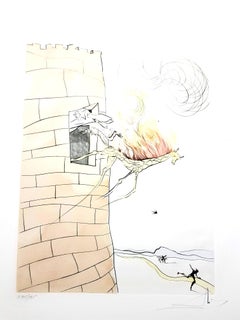
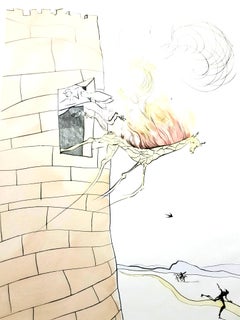
Judgement Aquatint Etching on Japon Paper, Signed, 63/150, Excellent

Judgement Aquatint Etching on Japon Paper, Signed, 63/150, Excellent

By Salvador Dalí­

Located in Aventura, FL

Aquatint and etching on Japon paper from Historia de Don Quixote de la Mancha. Hand signed lower right by Salvador Dali. Hand numbered 63/150 lower left. Sheet size: 29.875 x 22.1...

Category

1980s Surrealist Alejandro Colunga Figurative Prints
Materials

Paper, Etching, Aquatint

Judgement Aquatint Etching on Arches Paper, Signed, Edition 217/300

Judgement Aquatint Etching on Arches Paper, Signed, Edition 217/300

By Salvador Dalí­

Located in Aventura, FL

Aquatint and etching on Arches paper from Historia de Don Quixote de la Mancha. Hand signed lower right by Salvador Dali. Hand numbered from the edition of 300 lower left. Edition...

Category

1980s Surrealist Alejandro Colunga Figurative Prints
Materials

Paper, Etching, Aquatint

French Surrealist Lithograph Legendary Mime Marcel Marceau Third Eye Surrealism

French Surrealist Lithograph Legendary Mime Marcel Marceau Third Eye Surrealism

By Marcel Marceau

Located in Surfside, FL

Le Troisième Oeil (The Third Eye) Lithograph on Arches paper Hand signed and numbered 1981 Dimensions: 21.5 X 30 inches Marcel Marceau (French: born Marcel Mangel; 1923 – 2007) was ...

Category

1980s Surrealist Alejandro Colunga Figurative Prints
Materials

Lithograph

Salvador Dalí(1904–1989) - Etching and lithograph with embossing on paper - 1974

Salvador Dalí(1904–1989) - Etching and lithograph with embossing on paper - 1974

By Salvador Dalí­

Located in Varese, IT

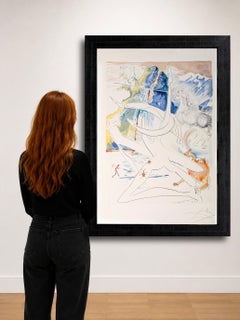
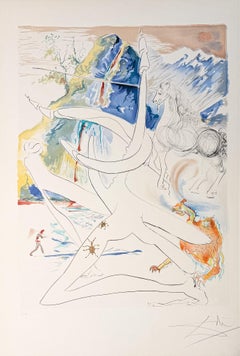
L’unicorne laser désintégre les cornes de rhinoceros cosmique (from ‘La Conquête du Cosmos’) Colour etching and lithograph with embossing on paper from ‘La Conquête du Cosmos’, edit...

Category

1970s Surrealist Alejandro Colunga Figurative Prints
Materials

Paper, Etching, Lithograph

Agar dans le désert

Agar dans le désert

By Marc Chagall

Located in Paris, FR

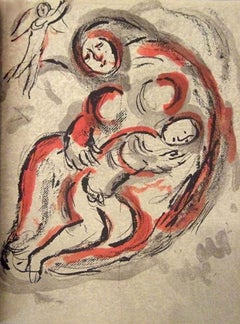
Original lithograph by Marc Chagall from The Bible of 1960 "Agar dans le désert" Unsigned 35 x 26 cm Excellent condition

Category

1960s Surrealist Alejandro Colunga Figurative Prints
Materials

Lithograph

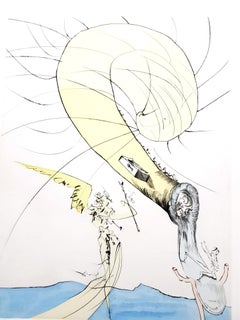
Salvador Dali - Freud with a Snail's Head - Original Signed Engraving

Salvador Dali - Freud with a Snail's Head - Original Signed Engraving

By Salvador Dalí­

Located in Collonge Bellerive, Geneve, CH

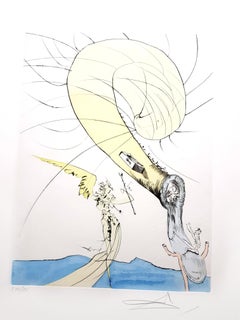
Salvador Dali - Freud with a Snail's Head - Original Signed Engraving Handsigned in pencil and Numbered Edition: F195/195 - Printer: Atelier Rigal. - Paper: Rives vellum ; each etch...

Category

1970s Surrealist Alejandro Colunga Figurative Prints
Materials

Etching

Previously Available Items
Nina con Vestido de Animalitos by Alejandro Colunga

Nina con Vestido de Animalitos by Alejandro Colunga

By Alejandro Colunga

Located in Long Island City, NY

Artist: Alejandro Colunga, Mexican (1948 - ) Title: Nina con Vestido de Animalitos Year: 1979 Medium: Lithograph on Arches, signed and numbered in pencil Edition: 110, AP Size: 30 x ...

Category

1970s Surrealist Alejandro Colunga Figurative Prints
Materials

Lithograph

Clown on Tricycle

Clown on Tricycle

By Alejandro Colunga

Located in Long Island City, NY

Artist: Alejandro Colunga, Mexican (1948 - ) Title: Clown on Tricycle Medium: Lithograph, signed and numbered in pencil Edition: 8/110 Size: 34.5 in. x 25 in. (87.63 cm x 63.5 cm)

Category

1980s Surrealist Alejandro Colunga Figurative Prints
Materials

Lithograph

Alejandro Colunga figurative prints for sale on 1stDibs.
Find a wide variety of authentic Alejandro Colunga figurative prints available for sale on 1stDibs. You can also browse by medium to find art by Alejandro Colunga in lithograph and more. Much of the original work by this artist or collective was created during the 20th century and is mostly associated with the Surrealist style. Not every interior allows for large Alejandro Colunga figurative prints, so small editions measuring 32 inches across are available. Customers who are interested in this artist might also find the work of Dorothea Tanning, Molly McKee, and Roland Topor. Alejandro Colunga figurative prints prices can differ depending upon medium, time period and other attributes. On 1stDibs, the price for these items starts at $680 and tops out at $4,000, while the average work can sell for $850.