Arthur Wesley Dow Landscape Prints

to
3
Overall Width
to
Overall Height
to
1
4
182
152
150
130
2
1
1
2
1
2
2
2
1
1
2
1
2
1
Artist: Arthur Wesley Dow
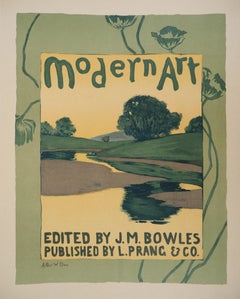
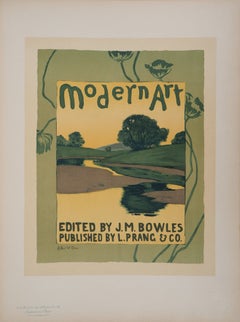
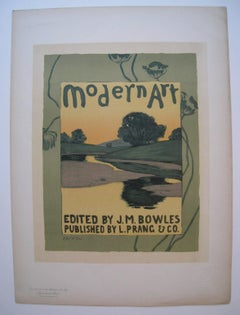
Modern Art

Modern Art

By Arthur Wesley Dow

Located in New York, NY

Dow, Arthur Wesley. Modern Art, 1896. Color lithograph. Plate from Maitre de L’affiches. Arthur Wesley Dow, ( American painter, printmaker, photographer,...

Category

1890s Art Nouveau Arthur Wesley Dow Landscape Prints

Materials

Lithograph

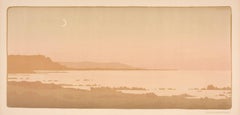
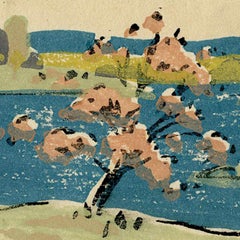
River Reflections
River Reflections

River Reflections

By Arthur Wesley Dow

Located in Fairlawn, OH

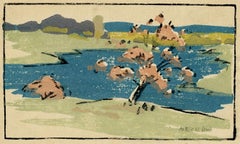
River Reflections Color woodcut, c. 1910 Unsigned Provenance: Dow Family Album, Cincinnati Condition: Excellent Image size: 2 1/2 x 4 inches Sheet size: 3 1/8 x 4 7/8” A color varian...

Category

1910s American Modern Arthur Wesley Dow Landscape Prints

Materials

Woodcut

Related Items
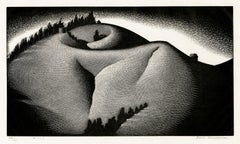
'Hill' — American Modernism, California

'Hill' — American Modernism, California

By Paul Landacre

Located in Myrtle Beach, SC

Paul Landacre, 'Hill', wood engraving, 1936, edition 60 (only 54 printed); only 2 impressions printed in a second edition of 150. Signed, titled, and numbered '49/60' in pencil. Wien...

Category

1930s American Modern Arthur Wesley Dow Landscape Prints

Materials

Woodcut

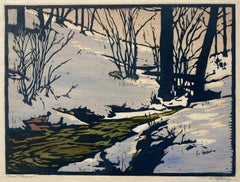
THE THAW
THE THAW

THE THAW

By William Seltzer Rice

Located in Santa Monica, CA

WILLIAM SELTZER RICE (1873 - 1963) THE THAW c 1915-20 Color woodcut, signed and titled in pencil. Image 8 7/8 x 12 inches, sheet 10 3/4 x 14 3/8 inches. On textured fibrous paper. V...

Category

1910s American Modern Arthur Wesley Dow Landscape Prints

Materials

Color, Woodcut

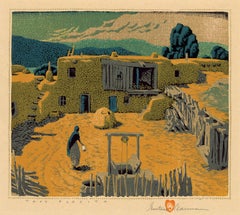
'Taos Placita' — American Southwest Masterwork, Signed Color Woodcut

'Taos Placita' — American Southwest Masterwork, Signed Color Woodcut

By Gustave Baumann

Located in Myrtle Beach, SC

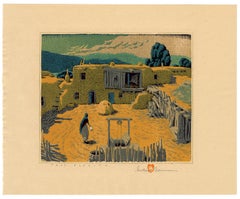
Gustave Baumann, 'Taos Placita', color woodcut, 1947, edition 125. Baumann 132. Signed, titled, and numbered '20-125' in pencil; with the artist’s Hand-in-Heart chop. A superb, richly-inked impression, with fresh colors, on fibrous oatmeal wove paper; the full sheet with margins (2 to 3 1/8 inches); slight rippling at the left sheet edge, in excellent condition. Matted to museum standards, unframed. Image size 9 5/8 x 11 1/4 inches (244 x 286 mm); sheet size 13 1/4 x 17 inches (337 x 432 mm). Collections: Harwood Museum of Art, New Mexico Museum of Art, Phoenix Art Museum, Scottsdale Art Museum, Wichita Art Museum. ABOUT THE ARTIST Gustave Baumann (1881-1971) was a renowned printmaker and a leading figure of the American color woodcut revival whose exquisite craftsmanship and vibrant imagery captured the essence of the Southwest. "A brilliant printmaker, Baumann brought to the medium a full mastery of the craft of woodworking that he acquired from his father, a German cabinetmaker. This craftsmanship was coupled with a strong artistic training that resulted in the handsome objects we see in the exhibition today. After discovering New Mexico in 1918, Baumann began to explore in his woodblock prints of this period the light. color, and architectural forms of that landscape. His prints of this period are among the most beautiful and poetic images of the American West." —Lewis I. Sharp, Director, Denver Art Museum Baumann, the son of a craftsman, immigrated to the United States from Germany with his family when he was ten, settling in Chicago. From 1897 to 1904, he studied in the evenings at the Art Institute of Chicago, working in a commercial printmaking shop during the day. In 1905, he returned to Germany to attend the Kunstwerbe Schule in Munich, where he decided on a career in printmaking. He returned to Chicago in 1906 and worked for a few years as a graphic designer of labels. Baumann made his first prints in 1909 and exhibited them at the Art Institute of Chicago the following year. In 1910, he moved to the artists’ colony in Nashville, Indiana, where he explored the creative and commercial possibilities of a career as a printmaker. In 1915, he exhibited his color woodcuts at the Panama-Pacific International Exposition in San Francisco, winning the gold medal. Among Baumann’s ongoing commercial activities was his work for the Packard Motor Car Company from 1914 to 1920 where he produced designs, illustrations, and color woodcuts until 1923. In 1919, Baumann’s printmaking work dominated the important exhibition of American color woodcuts at the Detroit Institute of Arts. Twenty-six of his prints were included, far more than the works of any other artist. A set of his blocks, a preparatory drawing, and seven progressive proofs complemented the exhibition. That same year, Baumann worked in New York and, over the summer, in Provincetown, Massachusetts. His airy images of Cape Cod employed soft, pastel colors and occasionally showed the influence of the white-line woodcut technique. Many of his Chicago artist friends had traveled to the southwest, and Baumann became intrigued by their paintings, souvenirs, and stories of an exotic place named Taos, New Mexico. In the summer of 1918, he spent the summer in Taos sketching and painting before visiting Santa Fe. Paul Walter, the director of the Museum of New Mexico, offered him a studio in the museum's basement. Inspired by the rugged beauty of the Southwest—the vibrant colors and dramatic landscapes of the region became a central theme in his work, influencing his artistic style and subject matter for the remainder of his career. Later in the decade, he traveled to the West Coast and made prints of California landscape. Baumann's prints became synonymous with the Southwest, capturing the spirit of its place in America's identity with a unique sense of authenticity and reverence. His iconic images of desert vistas, pueblo villages, and indigenous cultures served as visual tributes to the region's rich cultural heritage, earning him a dedicated following among collectors and curators alike. A true craftsman and artist, Baumann completed every step of the printmaking process himself, cutting each block, mixing the inks, and printing every impression on the handmade paper he selected. His dedication to true craftsmanship and his commitment to preserving the integrity of his artistic vision earned him widespread acclaim and recognition within the art world. About the vibrant colors he produced, Baumann stated, “A knowledge of color needs to be acquired since they don’t all behave the same way when ground or mixed...careful chemistry goes into the making of colors, with meticulous testing for permanence. While complicated formulae evolve new colors, those derived from Earth and metal bases are still the most reliable.” In the 1930s, Baumann became interested in puppet theater. He designed and carved his own marionettes and established a little traveling company. From 1943 to 1945, the artist carved an altarpiece for the Episcopal Church of the Holy Faith in Santa Fe. In 1952, a retrospective exhibition of his prints was mounted at the New Mexico Museum of Fine Arts. Throughout his prolific career, Baumann executed nearly four hundred color woodcuts. Baumann’s woodcuts...

Category

1940s American Modern Arthur Wesley Dow Landscape Prints
Materials

Woodcut

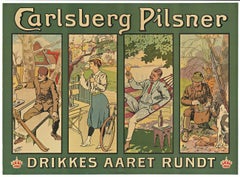
Original Carlsberg Pilsner vintage Danish beer poster.   Drink All Round

Original Carlsberg Pilsner vintage Danish beer poster. Drink All Round

Located in Spokane, WA

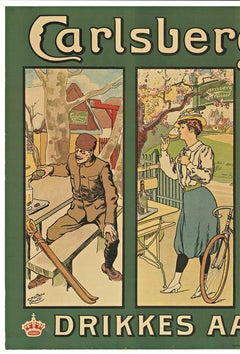
CARLSBERG PILSNER, artist: Carsten Ravn. This professional archival linen-backed lithograph is ready to frame. Carlsberg is synonymous with quality and tradition in the brewing world. Condition A-. Touched-up pin holes in the four corners. Minor touch-up near the bottom left crown emblem. Green is more of an old army green, and lettering is natural, unbleached, tan colored. Carlsberg Pilsner DRINK ALL YEAR ROUND The horizontal poster shows four scenes of people enjoying their beer: a skier, a cycling woman, a dandy, and a hunter. Above them is the inscription “Carlsberg Pilsner“ and below it “DRIKKES AARET RUNDT.” The latter makes it clear that you can drink it all year round. The four scenes also show the four seasons and that you can always drink Carlsberg Pilsner. (Text is in Danish). Carlsberg’s first brewery was just outside Copenhagen and was opened in 1847. However, it wasn't until 1904 that Carlsberg pilsner is brewed for the first time This 1908 poster...

Category

Early 1900s Art Nouveau Arthur Wesley Dow Landscape Prints

Materials

Lithograph

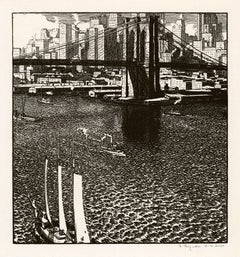
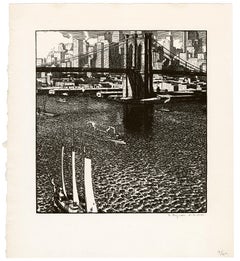
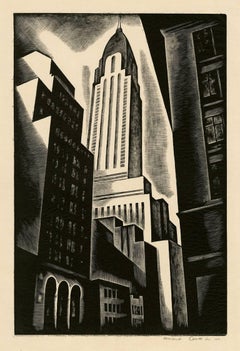
Brooklyn Bridge, NY — Early 20th Century Signed Modernist Wood Engraving

Brooklyn Bridge, NY — Early 20th Century Signed Modernist Wood Engraving

By Rudolph Ruzicka

Located in Myrtle Beach, SC

Rudolph Ruzicka, 'Brooklyn Bridge, N. Y.', 1915, wood engraving, edition 35. Signed and annotated 'd. Sc. imp.' (designed, engraved, printed by the artist) in pencil. Numbered 14/35 ...

Category

1910s American Modern Arthur Wesley Dow Landscape Prints
Materials

Woodcut

La Pointe de Bretteville

La Pointe de Bretteville

By Paul Berthon

Located in Fairlawn, OH

La Pointe de Bretteville Color lithograph, 1899 Signed in the stone upper right Publisher: Sagot, Paris Edition: Edition: about 200 (per Arwas) References And Exhibitions: Arwas 33 2...

Category

1890s Art Nouveau Arthur Wesley Dow Landscape Prints

Materials

Lithograph

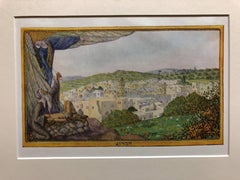
Rare Judaica Chevron Bezalel Zeev Raban Chromolithograph (made in Palestine)

Rare Judaica Chevron Bezalel Zeev Raban Chromolithograph (made in Palestine)

By Zeev Raban

Located in Surfside, FL

Jerusalem's Bezalel School The Bezalel Academy of Arts and Design, was founded in 1906 by Boris Schatz. In 1903, Schatz met Theodore Herzl and became an ardent Zionist. At the Zionis...

Category

Early 20th Century Art Nouveau Arthur Wesley Dow Landscape Prints

Materials

Lithograph

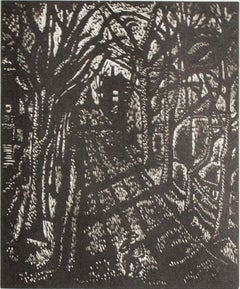
Modern American Industrial Landscape

Modern American Industrial Landscape

Located in Buffalo, NY

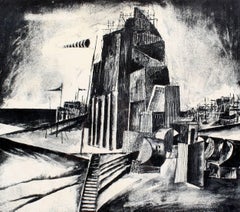
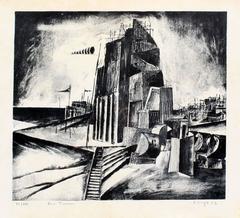
An original woodblock print dated 1965, titled "Our Town" but signed illegibly.

Category

1960s American Modern Arthur Wesley Dow Landscape Prints
Materials

Paper, Woodcut

Previously Available Items
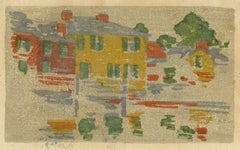
Nabby’s Point
Nabby’s Point

Nabby’s Point

By Arthur Wesley Dow

Located in Fairlawn, OH

Nabby’s Point Color woodcut, c. 1900 Signed in pencil lower right of image (see photos) Stamped on reverse of mount: "Estate of Arthur Wesley Dow" (see photo) A color variant printin...

Category

Early 1900s American Modern Arthur Wesley Dow Landscape Prints
Materials

Woodcut

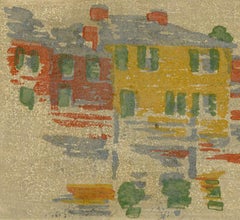
Above the Old Dock, Ipswich

Above the Old Dock, Ipswich

By Arthur Wesley Dow

Located in Fairlawn, OH

A variant color printing with bright colors. Unsigned Provenance: Estate of the Artist Hirschl & Adler Galleries, New York, NY (label)

Category

19th Century Arthur Wesley Dow Landscape Prints
Arthur Wesley Dow landscape prints for sale on 1stDibs.

Find a wide variety of authentic Arthur Wesley Dow landscape prints available for sale on 1stDibs. You can also browse by medium to find art by Arthur Wesley Dow in lithograph, woodcut print and more. Much of the original work by this artist or collective was created during the 20th century and is mostly associated with the modern style. Not every interior allows for large Arthur Wesley Dow landscape prints, so small editions measuring 4 inches across are available. Customers who are interested in this artist might also find the work of and Adolphe Willette. Arthur Wesley Dow landscape prints prices can differ depending upon medium, time period and other attributes. On 1stDibs, the price for these items starts at $776 and tops out at $9,800, while the average work can sell for $2,200.