Barbara Latham Art

American, 1896-1989
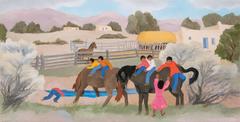
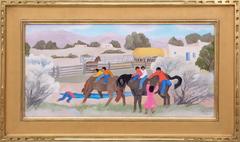
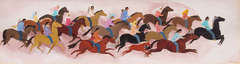
Beginning her career as a commercial artist, Barbara Latham travelled to Taos in 1925 seeking material for a greeting card. Serendipitously, she also found her life partner, Howard Cook, who was similarly looking for ideas for illustrations. Perhaps both were fueled in their quest by the tales of their mutual teacher, Andrew Dasburg, who knew of the energy and stimulation of this artist community. Observing local people and customs, Latham created genre scenes that offer a window into this now-vanished time and place. Her lively illustrations for numerous children’s books are a significant contribution to that graphic art in the mid-20th century. Born in Walpole, Massachusetts, Latham’s student days included Norwich Art School and Pratt Institute in Brooklyn; but it was contact with the charismatic Dasburg at the Art Students League in Woodstock that opened her world and her view of art. Getting work with companies like Norcross Publishing and Forum magazine, she eventually made her way to Taos. Among all the spirited young artists gathered there, she met Howard Cook, who was designing illustrations for Willa Cather’s Death Comes to the Archbishop. The two married in Santa Fe and began a nomadic life together. The young couple made their way to Paris, a likely destination for modernist artists. Upon receiving a Guggenheim to study fresco painting in 1932, Cook, along with Latham, took an alternative direction and headed to Taxco, Mexico. At this time, Mexican muralists, such as Diego Rivera, were capturing the attention of progressive artists. During the Depression, both Cook and Latham aligned themselves with a populist ideal. Latham contributed work, such as Fording the Stream and Bear Family, to the American Artists Group, which was founded to produce original prints at affordable prices. When Latham settled in Taos, she was committed to an art of and for the people. Rather than a romanticized re-creation, her choice of subjects was based in common everyday activities, favoring those which brought people together. Providing a livelihood, Latham’s illustrations for children’s books reflected her heartfelt belief in the availability of art for all, and her style of open brushwork contributed to a modernist transformation of this graphic art. After World War II, Latham experimented with Surrealism and abstraction. Many of her painted genre scenes of the fifties simplify forms in order to intensify the interplay of color and shapes. With minimal background, figures are elegantly drawn to an essence, which seems to both capture their actions and take them out of time. Riders on horses have the same linear classicism of Parthenon sculptures, and the brilliance of figure groupings separate them from the background like a frieze. Latham and Cook had a long-lived marriage, which was grounded in keeping their creative life separate. Latham even confessed that she did not recognize some of her husband’s work upon exhibition. In 1976, the couple moved to Santa Fe, which became their final home. ©David Cook Galleries, LLC
to
4
Overall Width
to
Overall Height
to
4
3
4
4
3
2
1
1
1
1
4

Use search to find more

4
12,169
2,900
2,541
1,703

Use search to find more

Artist: Barbara Latham
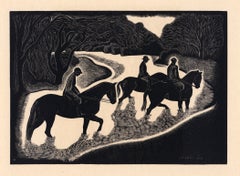
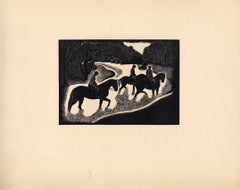
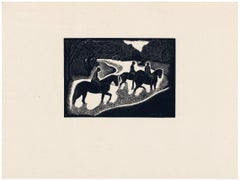
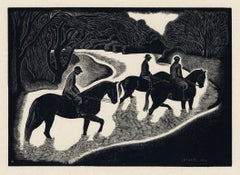
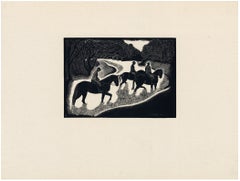
Fording the Stream — 1936 Taos Regionalist Wood Engraving, Woman Artist

Fording the Stream — 1936 Taos Regionalist Wood Engraving, Woman Artist

By Barbara Latham

Located in Myrtle Beach, SC

Barbara Latham, 'Fording the Stream', wood engraving, edition not stated, 1936. Signed and dated in the block, lower right. A fine, richly-inked impression, on cream wove Japan paper...

Category

1930s American Modern Barbara Latham Art

Materials

Woodcut

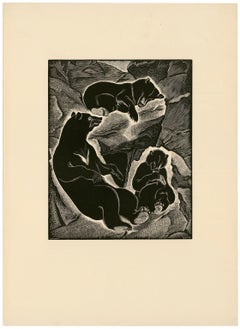
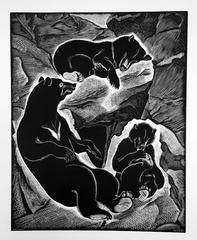
Bear Family — 1937 Original Wood Engraving, Woman Artist

Bear Family — 1937 Original Wood Engraving, Woman Artist

By Barbara Latham

Located in Myrtle Beach, SC

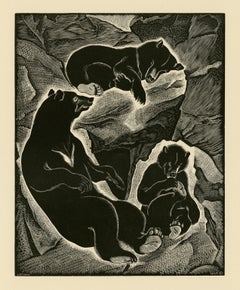
Barbara Latham, 'Bear Family', wood engraving, edition not stated, 1937. Signed in the block, lower left. Dated in the block, lower right. A fine, richly-inked impression, on cream w...

Category

1930s American Modern Barbara Latham Art

Materials

Woodcut

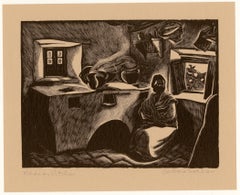
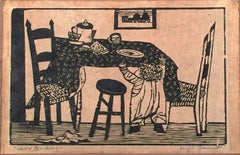
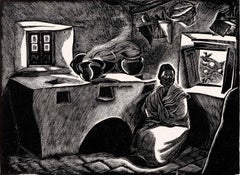
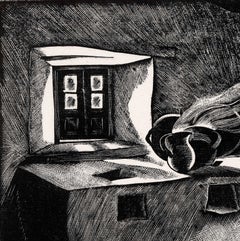
Our Mexican Kitchen — 1932 Signed Wood Engraving, Woman Artist

Our Mexican Kitchen — 1932 Signed Wood Engraving, Woman Artist

By Barbara Latham

Located in Myrtle Beach, SC

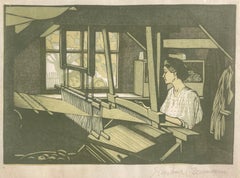
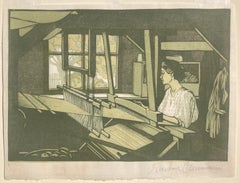
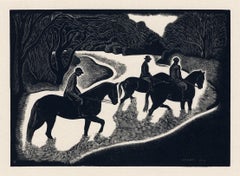
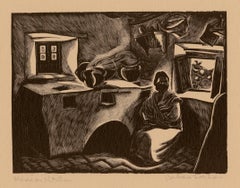
Barbara Latham, 'Our Mexican Kitchen', wood engraving, edition not stated but small, 1932. Signed and titled in pencil. A fine richly-inked impression, on tan wove paper, with full margins (5/8 to 7/8 inch), in excellent condition. Matted to museum standards, unframed. Image size: 5 5/8 x 7 5/8 inches (143 x 194 mm); sheet size 7 1/4 x 9 inches (184 x 229 mm). An impression of this work is held in the collection of the Metropolitan Museum of Art. ABOUT THIS WORK During the late 1920s and early 1930s, Latham traveled extensively with her husband, the artist–printmaker Howard Cook, working for periods in Mexico, Europe, and the American South. These experiences broadened her artistic vision while reinforcing her commitment to creating modernist works rooted in direct observation. 'Mexican Kitchen' (also known as 'Our Mexican Kitchen') exemplifies Latham's technical mastery and assured compositional sense. Transforming an ordinary domestic interior into a compelling modernist composition, she employs strong structural rhythms, subtle tonal contrasts, and carefully balanced forms to create a dynamic space imbued with an intimate sense of everyday life. ABOUT THE ARTIST Barbara Latham (1896–1989) was an American printmaker, painter, and illustrator whose work is closely associated with the Regionalist movement and the broader development of American graphic art in the first half of the twentieth century. Born in Walpole, Massachusetts, she pursued her early studies at the School of the Museum of Fine Arts, Boston, and later in New York, where she became part of a generation of artists committed to depicting American subjects with unembellished clarity and conviction. Latham's formation as an artist coincided with a period of renewed interest in printmaking as a primary medium of expression. Working principally in lithography and wood engraving, she developed a disciplined approach grounded in draftsmanship and strong compositional integrity. Her work reflects direct engagement with the American scene, particularly the rural environments of New England, the American South, and later the Southwest, where she worked from direct observation. By the 1930s and 1940s, Latham had established a distinctive voice within American Regionalism. Her prints depict landscapes, village life, and shared human experience with an unusual balance of modernist design and emotional accessibility. Rather than romanticizing rural subjects, Latham approached them with empathy and quiet humanism, finding dignity and beauty in ordinary moments. This combination of formal restraint and genuine warmth remains one of the defining qualities of her work. Technically, Latham's lithographs are notable for their subtle tonal gradations and ability to evoke atmosphere without sacrificing clarity. Her wood engravings demonstrate a decisive economy of line, simplified forms, and masterful control of black and white to create compositions of remarkable graphic strength. Across both media, her work reflects exceptional technical expertise anchored by a deep commitment to balanced design and visual integrity. In addition to her work as a fine artist, Latham enjoyed a distinguished career as an illustrator. She designed greeting cards for the Norcross Publishing Company and contributed illustrations to such publications as Forum magazine and The New York Times Sunday Magazine. She also earned widespread recognition as a children's book illustrator. Her book 'Maggie' was selected by the American Institute of Graphic Arts as one of the outstanding illustrated books produced between 1945 and 1950, reflecting the same clarity of design and sympathetic observation that characterize her prints. Following her move to Taos, New Mexico, Latham became associated with the community of artists known as the Taos Moderns. There she expanded her work in painting, producing luminous landscapes and scenes of Southwestern life that complemented her achievements in printmaking. Her New Mexico paintings...

Category

1930s American Modern Barbara Latham Art
Materials

Woodcut

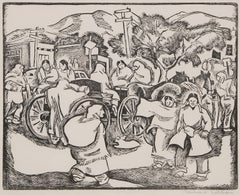
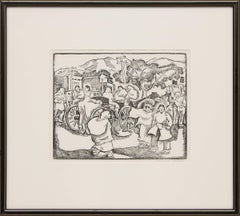
Barbara Latham Saturday Morning, Taos Plaza, 1950s Modernist Linocut

Barbara Latham Saturday Morning, Taos Plaza, 1950s Modernist Linocut

By Barbara Latham

Located in Denver, CO

A lively and distinctive 1950s modernist linocut by Barbara Latham (1896–1989), Saturday Morning (Market, Taos Plaza, New Mexico) captures the energy of everyday life in the historic...

Category

Mid-20th Century American Modern Barbara Latham Art

Materials

Linocut

Related Items
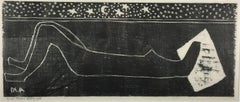
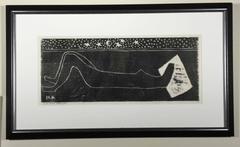
NIGHT NUDE
NIGHT NUDE

Milton AveryNIGHT NUDE, 1953

$16,000

H 16 in W 30 in D 2 in

NIGHT NUDE

By Milton Avery

Located in Portland, ME

Avery, Milton. NIGHT NUDE. Woodcut, 1953. Edition of 25 in black and white (there were a further 25 printed in black and blue). Signed, dated and numbered "6/25" in pencil, and also ...

Category

1950s American Modern Barbara Latham Art

Materials

Woodcut

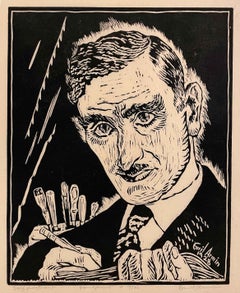
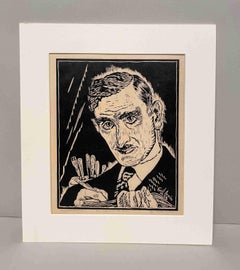
A 1928 Modernist Woodcut, Self-Portrait of Notable Chicago Modernist Emil Armin

A 1928 Modernist Woodcut, Self-Portrait of Notable Chicago Modernist Emil Armin

By Emil Armin

Located in Chicago, IL

A 1928 woodcut on paper of a self-portrait of notable Chicago Modernist artist, Emil Armin. Artwork size: 10 1/2" x 8". Archivally matted to: 12 1/2" x 14 1/2. Signed, titled and numbered in pencil. Edition 7/30. Emil Armin was born in Radautz, Austria in 1883. By the age of 10, Armin was orphaned and was raised by his older siblings. He supported himself by working in restaurants and drew in his spare time. In 1905, at the age of 21, Armin immigrated to Chicago. He began studying at the Art Institute of Chicago in 1907, but financial difficulties forced him to start and stop a number of times, finally graduating in 1920. He studied with George Bellows and Randall Davey. Armin was an integral part of Chicago’s 57th Street Art Colony and exhibited in both the more avant-garde Chicago No-Jury Society Shows, as well as the more formal and conventional Chicago Society of Artists Exhibitions, the Chicago Renaissance Society and Art Institute of Chicago (1922-1949) exhibitions. He taught at Hull House...

Category

1920s American Modern Barbara Latham Art

Materials

Paper, Woodcut

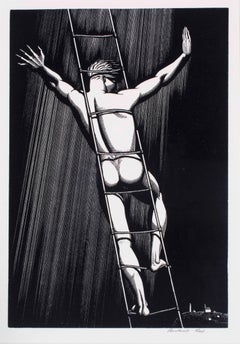
HAIL AND FAREWELL

Rockwell KentHAIL AND FAREWELL, 1930

$4,800

H 20 in W 16 in D 2 in

HAIL AND FAREWELL

By Rockwell Kent

Located in Portland, ME

Kent, Rockwell. HAIL AND FAREWELL. Burne-Jones 55. Wood engraving, 1930. Edition of 120. 8 x 5 1/2 inches, 203 x 140 mm. Signed in pencil. In excellent condition.

Category

1930s American Modern Barbara Latham Art

Materials

Woodcut

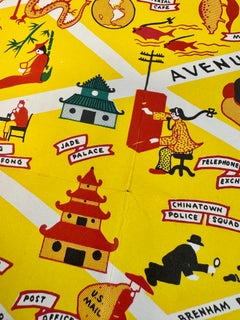
1939 Pictorial Map of Chinatown San Francisco World’s Fair Golden Gate Bridge

1939 Pictorial Map of Chinatown San Francisco World’s Fair Golden Gate Bridge

Located in Yardley, PA

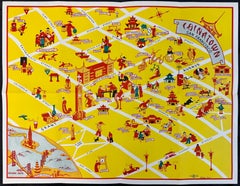
A vibrant pictorial map of San Francisco’s Chinatown, created by Ethel Chun in 1939. It is rendered in striking tones of traditional Chinese red and yellow. Oriented with west at the...

Category

1930s American Modern Barbara Latham Art

Materials

Paper

Letterio Calapai, (Sky Abstraction), 1957, mid-century wood engraving

Letterio Calapai, (Sky Abstraction), 1957, mid-century wood engraving

By Letterio Calapai

Located in New York, NY

Letterio Calapai is widely recognized as a major American artist of the twentieth century. He is widely respected as a printmaker, especially for engravings and wood engravings, and ...

Category

1950s American Modern Barbara Latham Art

Materials

Woodcut

20th century woodcut ink black and white figures musical instruments dramatic

20th century woodcut ink black and white figures musical instruments dramatic

By Robert Franz Von Neumann

Located in Milwaukee, WI

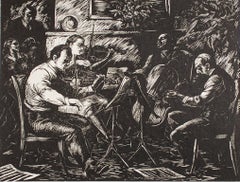
"Chamber Music" is an original wood engraving by Robert Franz von Neumann. It features a room full of men in the thralls of creating music together. A small audience stands outside their circle. Image: 5.5" x 7" Framed: 14" x 15.56" 1888 - 1976 Born in Rostock, Mecklenburg, Germany, Robert von Neumann...

Category

1930s American Modern Barbara Latham Art

Materials

Woodcut

Ted Witonski, NYC (Chelsea) skyline intaglio

Ted Witonski, NYC (Chelsea) skyline intaglio

Located in New York, NY

An Ohio native Witonski made his home in the Chelsea neighborhood of New York City and this subject may well be a Chelsea scene. But mostly it is a homage to intaglio printmaking. It...

Category

1930s American Modern Barbara Latham Art

Materials

Intaglio

THE RUG WEAVER
THE RUG WEAVER

Gustave BaumannTHE RUG WEAVER, 1910

$2,250

H 9 in W 13.125 in

THE RUG WEAVER

By Gustave Baumann

Located in Santa Monica, CA

GUSTAVE BAUMANN (1881 – 1971) THE RUG WEAVER, 1910 (Chamberlain 26) Color woodcut signed in pencil. Unnumbed from an edition 100 as published in the Hills o’ Brown...

Category

1910s American Modern Barbara Latham Art

Materials

Woodcut

Amos
Amos

Leonard BaskinAmos, 1960

$950

H 23 in W 27 in D 0.75 in

Amos

By Leonard Baskin

Located in San Francisco, CA

This artwork titled "Amos" 1960 is an original woodcut on paper by noted American artist Leonard Baskin, 1922-2000. It is hand signed, titled and numbered 35/50in pencil by the artis...

Category

Mid-20th Century American Modern Barbara Latham Art

Materials

Woodcut

Walter DuBois Richards, The Lobster Float

Walter DuBois Richards, The Lobster Float

By Walter DuBois Richards

Located in New York, NY

Ohio-born Walter DuBois Richards (1907-2006) was educated at the Cleveland School of Art. He re-located to New York around 1933 where he had a successful career as a commercial artis...

Category

1930s American Modern Barbara Latham Art

Materials

Woodcut

Early Morning
Early Morning

Will BarnetEarly Morning, 1939

$7,500

H 9 in W 15 in

Early Morning

By Will Barnet

Located in Buffalo, NY

A nice rare woodcut by the noted American Artist Will Barnet. This woodcut is from 1939 and is titled and pencil signed on the base "Early Morning", Will...

Category

1930s American Modern Barbara Latham Art

Materials

Paper, Woodcut

CHILD REACHING
CHILD REACHING

CHILD REACHING

By Will Barnet

Located in Portland, ME

Barnet, Will. CHILD REACHING. Szoke 83, Cole 82, Johnson 65. Woodcut, 1940. Edition of 25. Titled and signed in pencil. 7 1/4 x 11 1/4 inches (image), 8 1/8 x 11 1/2 inches (sheet). ...

Category

1940s American Modern Barbara Latham Art

Materials

Woodcut

Previously Available Items
Fording the Stream — 1936 Taos Regionalist Wood Engraving, Woman Artist

Fording the Stream — 1936 Taos Regionalist Wood Engraving, Woman Artist

By Barbara Latham

Located in Myrtle Beach, SC

Barbara Latham, 'Fording the Stream', wood engraving, edition not stated, 1936. Signed and dated in the block, lower right. A fine, richly-inked impression, on cream wove Japan paper...

Category

1930s American Modern Barbara Latham Art

Materials

Woodcut

Fording the Stream — 1936 Southwest Regionalist Wood Engraving

Fording the Stream — 1936 Southwest Regionalist Wood Engraving

By Barbara Latham

Located in Myrtle Beach, SC

Barbara Latham, 'Fording the Stream', wood engraving, edition not stated, 1936. Signed and dated in the block, lower right. A fine, richly-inked impression, on cream wove paper, with full margins (2 3/4 to 4 3/4 inches); in the original American Artists Group folder–mat. Slight toning at the sheet edges; a paper imperfection in the bottom center margin, well away from the image, otherwise in good condition. Unframed. Image size: 6 x 8 1/2 inches (152 x 216 mm); sheet size 13 1/2 x 18 inches (343 x 457 mm). ABOUT THIS WORK During the 1930s, Latham increasingly turned to rural American subjects, distilling scenes of everyday life into compelling compositions. In Fording the Stream, three mounted riders quietly crossing shallow water become the focus of a work that is both dramatic and inviting. Strong contrasts of black and white, together with the sweeping curves of the stream and overhanging trees, create a dynamic modernist composition while conveying a sense of shared purpose, quiet companionship, and the enduring rhythms of rural life. ABOUT THE ARTIST Barbara Latham (1896–1989) was an American printmaker, painter, and illustrator whose work is closely associated with the Regionalist movement and the broader development of American graphic art in the first half of the twentieth century. Born in Walpole, Massachusetts, she pursued her early studies at the School of the Museum of Fine Arts, Boston, and later in New York, where she became part of a generation of artists committed to depicting American subjects with unembellished clarity and conviction. Latham's formation as an artist coincided with a period of renewed interest in printmaking as a primary medium of expression. Working principally in lithography and wood engraving, she developed a disciplined approach grounded in draftsmanship and strong compositional integrity. Her work reflects direct engagement with the American scene, particularly the rural environments of New England, the American South, and later the Southwest, where she worked from direct observation. By the 1930s and 1940s, Latham had established a distinctive voice within American Regionalism. Her prints depict landscapes, village life, and shared human experience with an unusual balance of modernist design and emotional accessibility. Rather than romanticizing rural subjects, Latham approached them with empathy and quiet humanism, finding dignity and beauty in ordinary moments. This combination of formal restraint and genuine warmth remains one of the defining qualities of her work. Technically, Latham's lithographs are notable for their subtle tonal gradations and ability to evoke atmosphere without sacrificing clarity. Her wood engravings demonstrate a decisive economy of line, simplified forms, and masterful control of black and white to create compositions of remarkable graphic strength. Across both media, her work reflects exceptional technical expertise anchored by a deep commitment to balanced design and visual integrity. In addition to her work as a fine artist, Latham enjoyed a distinguished career as an illustrator. She designed greeting cards for the Norcross Publishing Company and contributed illustrations to such publications as Forum magazine and The New York Times Sunday Magazine. She also earned widespread recognition as a children's book illustrator. Her book 'Maggie' was selected by the American Institute of Graphic Arts as one of the outstanding illustrated books produced between 1945 and 1950, reflecting the same clarity of design and sympathetic observation that characterize her prints. Following her move to Taos, New Mexico, Latham became associated with the community of artists known as the Taos Moderns. There she expanded her work in painting, producing luminous landscapes and scenes of Southwestern life that complemented her achievements in printmaking. Her New Mexico paintings...

Category

1930s American Modern Barbara Latham Art
Materials

Woodcut

For a Sunday Ride (New Mexico)

Barbara LathamFor a Sunday Ride (New Mexico)

Sold

H 16.75 in W 19.75 in D 1.25 in

For a Sunday Ride (New Mexico)

By Barbara Latham

Located in Denver, CO

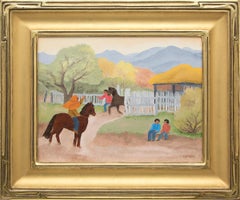
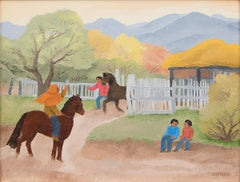
Original vintage oil painting by 20th century New Mexico artist, Barbara Latham (1896-1989), "For a Sunday Ride" depicts a horses and riders in an early autumn New Mexico Landscape w...

Category

20th Century American Modern Barbara Latham Art

Materials

Oil, Canvas

Our Mexican Kitchen
Our Mexican Kitchen

Our Mexican Kitchen

By Barbara Latham

Located in New Orleans, LA

Barbara Latham created this wood engraving of the kitchen in the Taxco, Mexico home she shared with her husband, artist Howard Cook. The house that Barbara and Howard Cook rented from John Evans, the son of Mabel Dodge Luhan, is shown with the Mexican cook who worked for them. It also shows the lemon tree outside their window. Painter, print maker, and children's book illustrator Barbara Latham was born in Walpole, Massachusetts, in 1896. She was raised in Norwich, Connecticut, and studied at the Norwich Free Academy and then attended Pratt Institute from 1915 to her graduation in 1919. She then studied with Andrew Dasburg at the Art Students League's summer school in Woodstock, New York. She spent the early part of her career in New York, where she worked for the Norcross Publishing Company and did illustrations for Forum magazine and the New York Times Sunday magazine. In 1925, Latham went to Taos, New Mexico, for the first time to seek material for illustrations for a greeting card company. She met artist Howard Cook, who was in the process of developing illustrations for Willa Cather's Death Comes to the Archbishop. The couple married in 1927. From 1928 to 1935, they traveled widely including to Mexico; Springfield, Massachusetts; Paris; and Connecticut. In 1933, the couple made their home near Taos. In 1976, they settled in Santa Fe. Latham created prints and paintings of New Mexico subjects: the Taos landscape, views of the town and genre scenes depicting the seasons of rural life including that of the Taos Indians. She also illustrated children's books and did pencil drawings. Latham's illustrations for children's books included those for Pedro, Nina and Perrito, 1939, and Maggie, which was chosen as one of the best books from the period of 1945 to 1950 by the American Institute of Graphic Arts. One of her paintings, Approaching Storm, c. 1930, is an expressive painting emphasizing the orange of the earth and green of trees against the dark, stormy sky. In style, the painting is a blend of the characteristics of the New Mexico landscape, the colorful approach to landscape developed by the original Taos painters...

Category

1930s American Modern Barbara Latham Art
Materials

Wood, Engraving

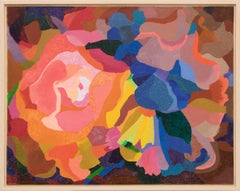
Bouquet, Modernist Abstract Painting Coral, Pink, Orange, Yellow, Blue, Green

Bouquet, Modernist Abstract Painting Coral, Pink, Orange, Yellow, Blue, Green

By Barbara Latham

Located in Denver, CO

Bouquet is an original oil painting by 20th Century New Mexico Modernist woman artist, Barbara Latham (1896-1989), a mid-century modern abstract composition with Coral, Pink, Orange, Yellow, Blue and Green stylized flowers. Presented in a custom frame, outer dimensions measure 25 ½ x 31 ½ x 2 inches; image size is 24 x 29 ¾ inches. Beginning her career as a commercial artist, Barbara Latham travelled to Taos in 1925 seeking material for a greeting card. Serendipitously, she also found her life partner, Howard Cook, who was similarly looking for ideas for illustrations. Perhaps both were fueled in their quest by the tales of their mutual teacher, Andrew Dasburg, who knew of the energy and stimulation of this artist community. Observing local people and customs, Latham created genre scenes that offer a window into this now-vanished time and place. Her lively illustrations for numerous children’s books are a significant contribution to that graphic art in the mid-20th century. Born in Walpole, Massachusetts, Latham’s student days included Norwich Art School and Pratt Institute in Brooklyn; but it was contact with the charismatic Dasburg at the Art Students League in Woodstock that opened her world and her view of art. Getting work with companies like Norcross Publishing and Forum magazine, she eventually made her way to Taos. Among all the spirited young artists gathered there, she met Howard Cook, who was designing illustrations for Willa Cather’s Death Comes to the Archbishop. The two married in Santa Fe and began a nomadic life together. The young couple made their way to Paris, a likely destination for modernist artists. Upon receiving a Guggenheim to study fresco painting in 1932, Cook, along with Latham, took an alternative direction and headed to Taxco, Mexico. At this time, Mexican muralists, such as Diego Rivera, were capturing the attention of progressive artists. During the Depression, both Cook and Latham aligned themselves with a populist ideal. Latham contributed work, such as Fording the Stream and Bear Family, to the American Artists Group, which was founded to produce original prints at affordable prices. The couple also traveled in the Deep South to the Ozarks and to “Alabama’s Black Belt.” When Latham settled in Taos, she was committed to an art of and for the people. Rather than a romanticized re-creation, her choice of subjects was based in common everyday activities, favoring those which brought people together. Taos Pueblo was an ancient, indigenous community, and Latham’s view extended that tradition into a contemporary, multi-ethnic village. Sharing some of the spirit of WPA photographs...

Category

20th Century American Modern Barbara Latham Art
Materials

Oil, Board

Bear Family

Bear Family

By Barbara Latham

Located in New York, NY

Barbara Latham (1896-1988), Bear Family, 1937, wood engraving, unsigned [signed and dated in the block]. Published by American Artists Group. In excellent condition, on an ivory wove paper, the full sheet with full margins, 10 x 8, the sheet 13 x 18 inches. Window matting, with archival board, unattached mylar hinging. A fine impression of this charming image. The American Artists Group was formed in 1934, during the Great Depression, with the express purpose of providing unsigned inexpensive prints which were to be widely distributed. AAG published prints by Ganso, Spruance, Meissner, Ruzicka and Lankes, among many other noted artists. Although the prices of these prints was minimal, sales were sluggish in that economy and editions werenot sold out; most printingswere under 200...

Category

1930s American Realist Barbara Latham Art

Materials

Woodcut

Acequia Madre (New Mexico)

Acequia Madre (New Mexico)

By Barbara Latham

Located in Denver, CO

Oil on canvas. Housed in a custom hand-carved gold leaf frame; outer dimensions measure 17.75 x 29.5 x 1.5 inches. Image measures 12.5 x 24.25 inches. Provenance: Private Collection, Colorado About the Artist: Beginning her career as a commercial artist, Barbara Latham traveled to Taos in 1925 seeking material for a greeting card. Serendipitously, she also found her life partner, Howard Cook, who was similarly looking for ideas for illustrations. Perhaps both were fueled in their quest by the tales of their mutual teacher, Andrew Dasburg, who knew of the energy and stimulation of this artist community. Observing local people and customs, Latham created genre scenes that offer a window into this now-vanished time and place. Her lively illustrations for numerous children's books are a significant contribution to that graphic art in the mid-20th century. Born in Walpole, Massachusetts, Latham's student days included Norwich Art School and Pratt Institute in Brooklyn; but it was contact with the charismatic Dasburg at the Art Students League in Woodstock that opened her world and her view of art. Getting work with companies like Norcross Publishing and Forum magazine, she eventually made her way to Taos. Among all the spirited young artists gathered there, she met Howard Cook, who was designing illustrations for Willa Cather's Death Comes to the Archbishop. The two married in Santa Fe and began a nomadic life together. The young couple made their way to Paris, a likely destination for modernist artists. Upon receiving a Guggenheim to study fresco painting in 1932, Cook, along with Latham, took an alternative direction and headed to Taxco, Mexico. At this time, Mexican muralists, such as Diego Rivera, were capturing the attention of progressive artists. During the Depression, both Cook and Latham aligned themselves with a populist ideal. Latham contributed work, such as "Fording the Stream" and "Bear Family," to the American Artists Group, which was founded to produce original prints at affordable prices. The couple also travelled in the Deep South to the Ozarks and to "Alabama's Black Belt." When Latham settled in Taos, she was committed to an art of and for the people. Rather than a romanticized re-creation, her choice of subjects was based in common everyday activities, favoring those which brought people together. Taos Pueblo was an ancient, indigenous community, and Latham's view extended that tradition into a contemporary, multi-ethnic village. Sharing some of the spirit of WPA photographs...

Category

20th Century Folk Art Barbara Latham Art

Materials

Oil

Starting on a Rabbit Hunt

Starting on a Rabbit Hunt

By Barbara Latham

Located in Denver, CO

Framed dimensions are 15.5 x 41.5 inches. Complimentary Shipping within the United States. Contact us for a quote on international shipping. Same Day Shipping and expedited servic...

Category

1950s Modern Barbara Latham Art
Materials

Oil, Masonite

Barbara Latham art for sale on 1stDibs.
Find a wide variety of authentic Barbara Latham art available for sale on 1stDibs. You can also browse by medium to find art by Barbara Latham in linocut, paint, watercolor and more. Much of the original work by this artist or collective was created during the 20th century and is mostly associated with the modern style. Not every interior allows for large Barbara Latham art, so small editions measuring 14 inches across are available. Customers who are interested in this artist might also find the work of John Taylor Arms, Alfred Bendiner, and Samuel Chamberlain. Barbara Latham art prices can differ depending upon medium, time period and other attributes. On 1stDibs, the price for these items starts at $795 and tops out at $1,600, while the average work can sell for $1,198.
Artists Similar to Barbara Latham