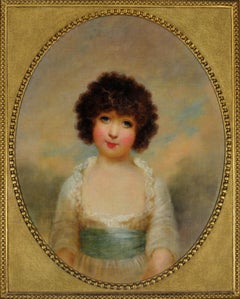
Émile Jean-Horace Vernet Paintings

French, 1789-1863
Émile Jean-Horace Vernet was a French painter of battles, portraits, and Orientalist Arab subjects. He was born to Carle Vernet, another famous painter, who was himself a son of Claude Joseph Vernet. He was born in the Paris Louvre, while his parents were staying there during the French Revolution. Vernet quickly developed a disdain for the high-minded seriousness of academic French art influenced by Classicism, and decided to paint subjects taken mostly from contemporary culture. Therefore, he began depicting the French soldier in a more familiar, vernacular manner rather than in an idealized, Davidian fashion. Some of his paintings that represent French soldiers in a more direct, less idealizing style, include Dog of the Regiment, Trumpeter's Horse, and Death of Poniatowski. He gained recognition during the Bourbon Restoration for a series of battle paintings commissioned by the duc d'Orleans, the future King Louis-Philippe. Critics marvelled at the incredible speed with which he painted. Many of his paintings made during this early phase of his career were "noted for their historical accuracy as well as their charged landscapes." Examples of paintings in this style include his Four Battles series: The Battle of Jemappes (1821), The Battle of Montmirail (1822), The Battle of Hanau (1824), and The Battle of Valmy (1826). Over the course of his long career, Horace Vernet was honoured with dozens of important commissions. King Louis-Philippe was one of his most prolific patrons. His depictions of Algerian battles, such as the Capture of the Smahla and the Capture of Constantine, were well-received, as they were vivid depictions of the French army in the heat of battle. After the fall of the July Monarchy during the Revolution of 1848, Vernet discovered a new patron in Napoléon III of France. He continued to paint representations of the heroic French army during the Second Empire and maintained his commitment to representing war in an accessible and realistic way. He accompanied the French Army during the Crimean War, producing several paintings, including one of the Battle of the Alma, which was not as well received as his earlier paintings. One well known and possibly apocryphal anecdote maintains that when Vernet was asked to remove a certain obnoxious general from one of his paintings, he replied, "I am a painter of history, sire, and I will not violate the truth," hence demonstrating his fidelity to representing war truthfully. Vernet died in his hometown of Paris in 1863.
to
1
1
Overall Width
to
Overall Height
to
1
1
1
1
1
1
1
1
13
764
759
754
636
1
Artist: Émile Jean-Horace Vernet
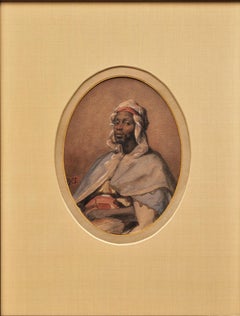
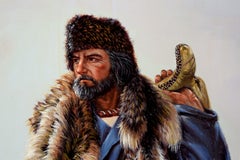
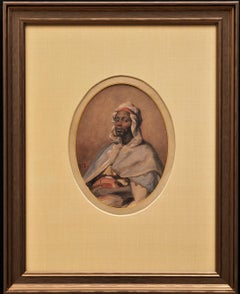
“Orientalist Portrait of an Arab Man” Jean-Horace Vernet (French 1789-1863)

“Orientalist Portrait of an Arab Man” Jean-Horace Vernet (French 1789-1863)

By Émile Jean-Horace Vernet

Located in SANTA FE, NM

“Orientalist Portrait of an Arab Man” Half-length, turned to the left, oval Jean-Horace Vernet (French 1789-1863) Circa 1830s Watercolor heightened with touches of white on paper Sig...

Category

1830s Romantic Émile Jean-Horace Vernet Paintings

Materials

Watercolor

Related Items
Romantic Italian painter - 19th century oil painting, Portrait of a Lady

Romantic Italian painter - 19th century oil painting, Portrait of a Lady

Located in Varmo, IT

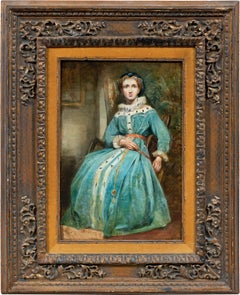
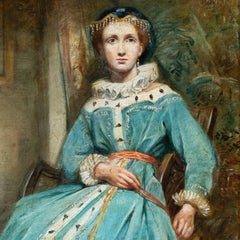
Romantic painter (second half of the 19th century) - Portrait of a Lady in Medieval Costume. 45,5 x 31 cm (without frame) - 74 x 60 cm (with frame). Oil on canvas, in a carved wood...

Category

Mid-19th Century Romantic Émile Jean-Horace Vernet Paintings

Materials

Canvas, Oil

Alfred Émile Léopold Stevens Period Watercolour Picture Portrait

Alfred Émile Léopold Stevens Period Watercolour Picture Portrait

By Alfred Émile Léopold Stevens

Located in Roma, IT

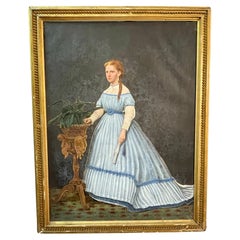
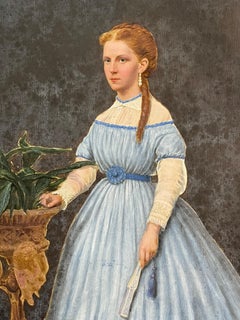
Beautiful painting in gouache technique depicting a distinguished young lady. The noblewoman presents a pose of rare elegance, with one hand resting on a planter and the other holdin...

Category

Late 19th Century Romantic Émile Jean-Horace Vernet Paintings

Materials

Paper, Tempera

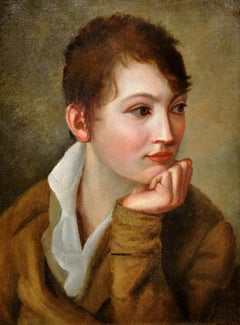
Late 18th Or Early 19th Century Portrait Of La Gamine With Androgynous Charm

Late 18th Or Early 19th Century Portrait Of La Gamine With Androgynous Charm

By Pierre-Paul Prud'hon

Located in Sutton Poyntz, Dorset

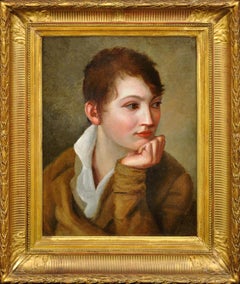
Late 18th Or Early 19th Century European Tradition. La Gamine. Androgynous Charm. Framed Oil On Canvas. Unsigned. Image size 15.6 inches x 11.6 inches ( 39.5cm x 29.5cm ). Frame size...

Category

Late 18th Century Romantic Émile Jean-Horace Vernet Paintings

Materials

Canvas, Oil

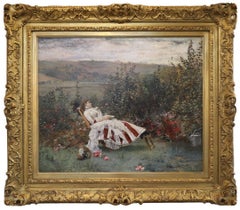
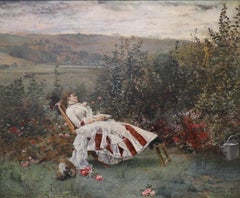
Lost in Her Thoughts, 1890-1892, by Pinckney Marcius-Simons, French Romanticism

Lost in Her Thoughts, 1890-1892, by Pinckney Marcius-Simons, French Romanticism

Located in Grand Rapids, MI

Pinckney Marcius-Simons, (American, French, 1867-1909) Signed: Marcius-Simons, (lower, right) " Lost in Her Thoughts ", circa 1890-1892 Oil on mahogany panel bearing the stamp on verso of " H. Vieille e. Troisgros Sueei, 55 Rue de Laval...

Category

19th Century Romantic Émile Jean-Horace Vernet Paintings

Materials

Oil, Board

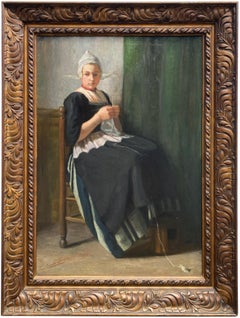
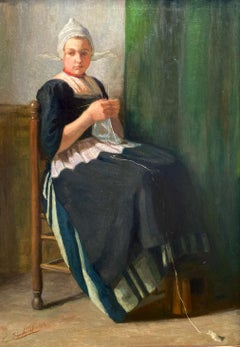
'Young Girl Knitting' by Guillaume Eberhard (1879  – 1949) signed and dated 1906

'Young Girl Knitting' by Guillaume Eberhard (1879 – 1949) signed and dated 1906

Located in Knokke, BE

Eberhard Guillaume 1879 – Maastricht – 1949 Dutch Painter 'Young Girl Knitting' Signature: signed lower left and dated 'G Eberhard 1906' Medium: oil on canvas Dimensions: image siz...

Category

Early 20th Century Romantic Émile Jean-Horace Vernet Paintings

Materials

Canvas, Oil

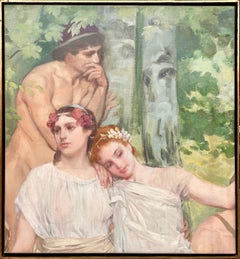
Romantic Portraits, Herman Richir, Brussels 1866 – 1942, Belgian Painter

Romantic Portraits, Herman Richir, Brussels 1866 – 1942, Belgian Painter

Located in Knokke, BE

Romantic Portraits Richir Herman Brussels 1866 – 1942 Belgian Painter Signature: Attributed to Richir Herman Medium: Oil on canvas Dimensions: Image size 67,50 x 62,50 cm, frame size 69,50 x 64,50 cm Biography: Richir Herman Jean Joseph was born in Ixelles (Brussels), on November 4, 1866. He was a Belgian painter of portraits, still lifes, genre paintings, nudes and landscapes. He made decorative paintings to fit into private homes. Richir mainly painted portraits. His clients usually belonged to the higher circles. He portrayed amongst others King Albert and Queen Elisabeth, Cardinal Mercier and Countess d’Oultremont. Less known are the landscape paintings he made Limburg and Kempen, where he regularly stayed with befriended artist Emile Van Doren (1865 – 1949). Herman Richir first studied at the Sint-Joost-ten-Node Academy with Gustave Biot and Charles Hermans, continued his education at the Royal Academy of Fine Arts in Brussels (1884-1889) with the master teacher and artist Jean-Francois Portaels (1818 – 1895). In 1886, during his studies, he won second Prize of Rome for Painting. Richir lived in Schaarbeek. In 1900 he became a teacher of drawing and in 1905 first teacher of painting after nature at the Brussels Academy. He was director there several times 1906-1907, 1910, 1911, 1915-1919, 1925-1927. He was retired in 1927. His pupils included Albert Alleman (1892 – 1933), Éliane de Meuse (1899 – 1993), Paul Hagemans (1884 – 1959), Maurice Mareels (1893 – 1976), Guy Onkelinx (1879 – 1935), Georges Rogy (1897 – 1981), José Storie (1899 – 1961), Charles Swyncop (1895 – 1970), Maurice Schelck...

Category

20th Century Romantic Émile Jean-Horace Vernet Paintings

Materials

Canvas, Oil

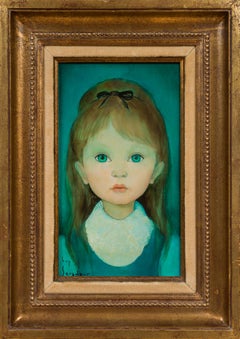
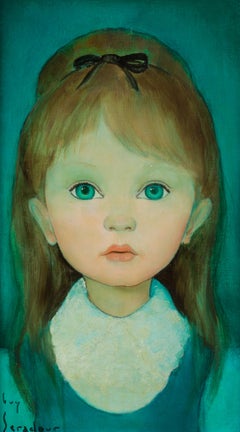
Portrait of a Young Girl – Original Oil on Canvas by Guy Seradour

Portrait of a Young Girl – Original Oil on Canvas by Guy Seradour

By Guy Seradour

Located in Stockholm, SE

In this exquisite original oil on canvas, French artist Guy Seradour portrays a young girl with a masterful and sympathetic eye. The subject’s youthful innocence and quiet grace are ...

Category

Mid-20th Century Romantic Émile Jean-Horace Vernet Paintings

Materials

Canvas, Oil

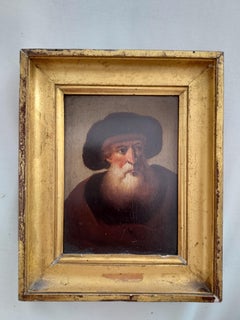
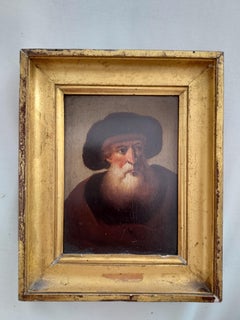
Portrait d'Homme Barbu German School oil on pannel

Portrait d'Homme Barbu German School oil on pannel

$3,509

H 7.09 in W 5.91 in D 0.79 in

Portrait d'Homme Barbu German School oil on pannel

Located in Pasadena, CA

Pretty portrait representing a portrait of an old shepherd from the German school in Dusseldorf . Oil on pannel

Category

19th Century Romantic Émile Jean-Horace Vernet Paintings

Materials

Oil

'Mother and Child' by Edward Portielje (1861 – Antwerp – 1949) Dutch-Belgian

'Mother and Child' by Edward Portielje (1861 – Antwerp – 1949) Dutch-Belgian

Located in Knokke, BE

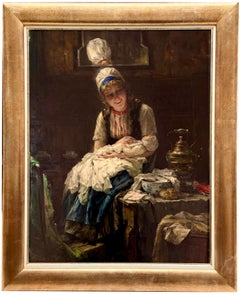
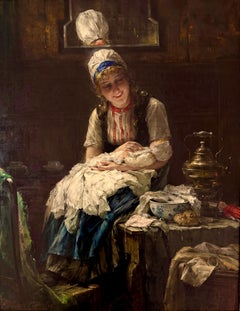
Edward Portielje 1861 – Antwerp – 1949 Dutch-Belgian Painter 'Mother and Child' Signature: signed lower left 'Edward Portielje' Medium: oil on canvas Dimensions: image size 65,5 x 51 cm; frame size 79 x 64,5 cm Biography: Edward Portielje – Belgian genre painter from an Antwerp artist family. Edward Portielje was born in Antwerp on February 8, 1861, and passed away there on December 18, 1949. He came from a distinctly artistic family that had been involved in painting for multiple generations. His works are now held in public collections and museums in Antwerp, Chicago, Melbourne, Sydney, and Bordeaux. The Portielje family had its roots in the Netherlands. Edward’s grandfather owned a bookstore in Amsterdam specializing in luxury engravings. His father, Jan Portielje, however, chose a career in painting and studied at the Antwerp Academy. From the 1850s, Jan gained recognition for his refined portraits of the affluent bourgeoisie: barons, baronesses, and elegant ladies, often with a Spanish or Oriental touch. He even painted a portrait of King Leopold II. After marrying the Antwerp native Eulalia Lemaire, he settled permanently in Antwerp. The couple had five children, including Gerard...

Category

19th Century Romantic Émile Jean-Horace Vernet Paintings

Materials

Canvas, Oil

Charlotte Shore Daughter Of The Governor General Of India Painted In India 1790s

Charlotte Shore Daughter Of The Governor General Of India Painted In India 1790s

By Arthur William Devis

Located in Sutton Poyntz, Dorset

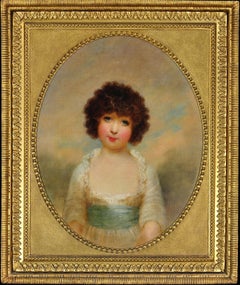
Arthur William Devis. English ( b.1762 - d.1822 ). Portrait Of Charlotte Shore, Daughter Of The Governor General Of India, The 1st Lord Teignmouth. Oil On Canvas. Oval Image size 26.2 inches x 20.5 inches ( 66.5cm x 62cm ). Frame size 34.6 inches x 28.7 inches ( 88cm x 73cm ). Available for sale; this original oil painting is by Arthur William Devis and dates from around 1792 to 1795. This painting was created when the sitter and the artist were both in India, the sitter's father being the Governor General of India from 1793 to 1798. The painting is presented and supplied in a 19th century decorative frame. The painted surfaces and the frame have benefitted from some restoration, cleaning and conservation, which was performed on our instruction, supervision and approval. The canvas is lined. This antique painting is in very good condition, commensurate with its age. It wants for nothing and is supplied ready to hang and display. Provenance: By descent in the family of the sitter. Exhibited: Preston, Harris Museum and Art Gallery, 2000, Arthur William Devis, no.52. Charlotte was the eldest child of the first Baron Teignmouth, a title that was created in 1798 for Sir John Shore. The title became extinct in 1981 on the death of the seventh Baron. This portrait was almost certainly painted by Devis in India at a time when the sitter’s father was Governor General. As such, this is a historically significant piece. John Shore was an anti-slavery campaigner, born in London but brought up in Romford. In 1769 he went to work in Bengal where he was one of the first to learn a number of local languages. In 1785 he returned to England and on 14 February 1786 he married Charlotte, the only daughter of James Cornish, a medical practitioner at Teignmouth. The couple’s first child, Charlotte, the subject of this painting, was born the following year, on January 26, 1787. The family quickly returned to India, where John Shore served as Governor from 1793 to 1798. John and his wife had three sons and six daughters over the following fifteen years. Sir John Shore left Calcutta for the final time in March 1798, sailing back to England with his wife and young family. The family settled in Clapham and Sir John became the first president of the British and Foreign Bible Society. He was involved with the Clapham Sect and their anti-slavery campaign. This adorable original oil on canvas depicts Charlotte, the eldest child and first daughter of the first Lord Teignmouth, aged around five to seven years old. (On the basis that the family returned to England in 1798 when Charlotte would have been 11 years old, this painting was almost certainly created in India, during the time when her father was the Governor General of India. We also know that the artist was painting portraits in India the decade up to 1795, when he returned to England.) Charlotte is an attractive child, with thick dark brown curly hair framing her beautiful angelic features. She has fair skin, rosy cheeks and rosebud lips. Her dark eyes are wide and engaging. She has the sweetest expression on her face and we feel that she is kind and good natured. She is wearing a simple white gown, typical of the day, with a low neckline and three- quarter length sleeves and a pale blue sash around her waist. Arthur William Devis was one of the major English artists of the early nineteenth century, noted particularly for his portraits. His life was dynamic and engaging and he produced some of the definitive images of his generation. Devis was born in London on 10 August 1763, the nineteenth child of the artist Arthur Devis and his wife Elizabeth Faulkner. There were several artists in the family and Devis showed an early genius for art. He received some artistic training from his father and then studied at the Royal Academy Schools where he received a Silver Medal, and the good opinion of Sir Joshua Reynolds. Devis became extremely well-travelled, and even circumnavigated the world; when he was about twenty, he was appointed draughtsman on the British East India Company's ship Antelope in a voyage to the East Indies, under Captain Henry Wilson. The vessel was wrecked off the Pelew Islands, on which the crew took refuge. The island was uninhabited, but the sailors formed a friendly alliance with neighboroughing islanders and took part in the wars of the natives. The crew then built themselves a small vessel and sailed for Macao. During this voyage Devis received two wounds from arrows shot from the coast, one in his body, the other in his check, which caused a permanent injury to his jaw. Devis left the rest of the crew at Macao, spent a year in China, then proceeded to Bengal. He settled in India for ten years, establishing a modestly successful practice and receiving several lucrative commissions from British colonialists, of which this painting of young Charlotte is likely to be one. In 1795 he returned to England and worked with great zeal, earning himself a reputation as a serious artist. He painted a number of important historical pieces, including “The Conspiracy of Babington in the reign of Queen Elizabeth” and “Cardinal Langton and the Barons forcing King John to sign Magna”. He soon became established as one of the most talented British artists of his day. It is known that Devis created other portraits of the Shore family between 1797 and 1817. Devis is particularly noted for being involved in the creation of the posthumous cult of Horatio Nelson. After the battle of Trafalgar, he went out to meet the Victory, and painted the acclaimed piece ‘The Death of Vice-Admiral Lord Viscount Nelson, K.B., in the cockpit of H.M.S. Victory, 21 Oct. 1805.’ For this work Devis made various sketches on board HMS Victory, including of Nelson’s body during the autopsy by Dr. Beatty, the ship’s surgeon. The completed picture has become the definitive image of Nelson’s heroic end; it was engraved by W. Bromley (1812), and presented by the Right Hon. Lord Bexley to the gallery of Greenwich Hospital in 1825. At 8 feet 7 inches by 6 feet 4 inches it is of stunning proportions. Devis’ large oil sketch for the piece was purchased by Queen Victoria, December 1852 Devis was also commissioned by Dr. Beatty to produce a half-length painting of Nelson as Vice Admiral, which was lent to Emma Hamilton, who later lost it whilst travelling. Either the original or a copy of this portrait was exhibited at the Royal Academy two years after the Battle and many copies were made of it, including one in the National Maritime Museum. Devis exhibited a total of sixty-five pictures at the Royal Academy between 1779 and 1821. His equestrian portrait of ‘Alexander Sinclair Gordon, Esq.’, was engraved by Anthony Cardon in 1805; ‘The Battle of Waterloo,’ engraved by John Burnet in 1819; ‘An Indian Interior,’ by P. W. Tomkins in 1797; ‘The Little Mountaineer,’ by E. Scriven in 1809, who also engraved Devis's illustrations to J. J. Howard's translation of the ‘Metamorphoses of Ovid,’ London, 1807. Thus images of Devis’ work have become well known through the years. Today there is a portrait of Arra Kovger by Devis in the British Museum, and a portrait of Governor Herbert (painted in Calcutta in 1791) in the National Portrait Museum. Despite his artistic talent, Devis was seemingly completely incapable of managing his financial affairs. He therefore failed to maintain the status in society that his talent deserved. Where money was concerned, he was generous beyond his means and was sadly declared bankrupt in 1800. In 1804 he was imprisoned for debt. Between 1802 and 1810 he received continual assistance from John Biddulph of Ledbury, but these well-intentioned interventions did not produce the results hoped for, and Devis continued to be hopelessly unreliable. Towards the end of his career he at last began to receive Royal patronage, but it came too late. When he died suddenly from apoplexy in 1822 he left his second wife and young children penniless. He was buried in St. Giles’s churchyard. Works by Arthur Devis are now very much in demand; his depiction of Bengali weavers made an eyecatching £130,000 in a UK auction...

Category

Early 19th Century Romantic Émile Jean-Horace Vernet Paintings
Materials

Canvas, Oil

Émile Jean-horace Vernet paintings for sale on 1stDibs.

Find a wide variety of authentic Émile Jean-Horace Vernet paintings available for sale on 1stDibs.