Eugene Alexis Girardet Paintings

to
1
Overall Width
to
Overall Height
to
1
1
1
1
1
1
1
1
765
759
754
666
1
1
Artist: Eugene Alexis Girardet
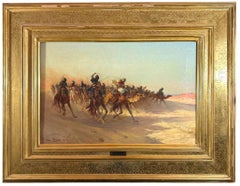
The Charge 19th-century Realism Antique Oil Painting on Canvas, Signed

The Charge 19th-century Realism Antique Oil Painting on Canvas, Signed

By Eugene Alexis Girardet

Located in Jacksonville, FL

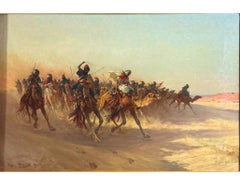
The painting is signed and dated 1894 Description: Eugene Alexis Girardet (1853-1907) was a prominent Swiss painter known for his remarkable attention to detail and his ability to capture vivid and dynamic scenes. Born in Paris, France, Girardet came from a family of artists and received early artistic training from his father, Paul Girardet, and his uncle, Jules Girardet, both respected engravers. He later studied at the prestigious École des Beaux-Arts in Paris, where he honed his skills and developed a deep appreciation for historical and orientalist subjects. He was interred at the Père-Lachaise Cemetery. In addition to several museums in France, his works may be seen at the Dahesh Museum of Art and the National Museum of Fine Arts of Algiers, as well as at museums in Switzerland and New York City. Girardet’s artwork often depicted historical and exotic scenes, particularly focusing on Middle Eastern and North African themes. His meticulous attention to detail and his ability to convey a sense of movement and drama made his works highly sought after. One of his most renowned paintings, “The Charge,” exemplifies his exceptional talent and his ability to create a captivating and immersive experience for viewers. In “The Charge,” Girardet presents an army of Arab camel...

Category

19th Century Academic Eugene Alexis Girardet Paintings

Materials

Canvas, Oil

Related Items
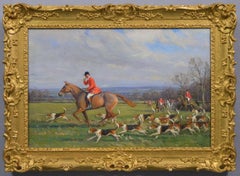
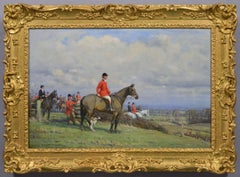
Sporting oil painting of a hunter & hounds

Sporting oil painting of a hunter & hounds

By John Sanderson Wells

Located in Nr Broadway, Worcestershire

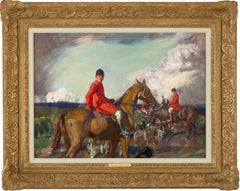
John Sanderson-Wells British, (1872-1955) Gone Away Oil on canvas, signed Image size: 15.5 inches x 23.5 inches Size including frame: 21.75 inches x 29.75 inches An animated sporti...

Category

Early 20th Century Victorian Eugene Alexis Girardet Paintings

Materials

Canvas, Oil

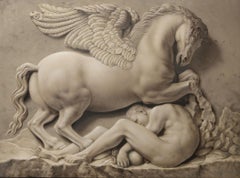
Pegasus and Bellerophon En Grisaille Oil on Canvas, 40x54 Inches

Pegasus and Bellerophon En Grisaille Oil on Canvas, 40x54 Inches

By Philip Melville Courtney

Located in Palm Beach, FL

Pegasus and Bellerophon — En Grisaille Oil on Canvas, after a 16th-Century Italian Relief This large-scale oil on canvas painting by acclaimed American artist Philip Melville Courtn...

Category

2010s Academic Eugene Alexis Girardet Paintings

Materials

Oil

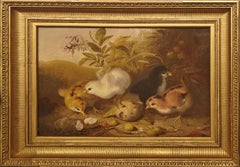
"Feathered Tribe" Mary Russell Smith, 1871 Graceful Academic Chicks Painting

"Feathered Tribe" Mary Russell Smith, 1871 Graceful Academic Chicks Painting

By Mary Russell Smith

Located in New York, NY

Mary Russell Smith Feathered Tribe, 1871 Signed and dated lower left Oil on canvas 9 1/2 x 14 3/4 inches The daughter of theater scenery and landscape painter Russell Smith (1812–1...

Category

1870s Academic Eugene Alexis Girardet Paintings

Materials

Canvas, Oil

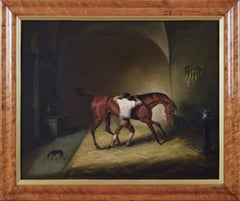
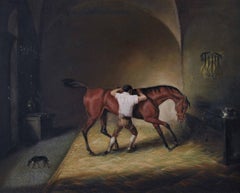
19th Century sporting animal oil painting of a horse & groom in a stable

19th Century sporting animal oil painting of a horse & groom in a stable

By John Ferneley Junior

Located in Nr Broadway, Worcestershire

John Ferneley Jnr British, (1815-1862) Horse & Groom in a Stable Oil on canvas, indistinctly signed Image size: 18.75 inches x 23.25 inches Size including frame: 23.5 inches x 28 inches Provenance: The Parker Gallery, Berkeley St., London A mid-19th century sporting painting of a horse and groom in a stable by John Ferneley Jnr. A stable hand is depicted in the middle of a stall grooming a bay horse. Nearby, a tabby cat can be seen resting on table whilst a small black and tan dog wanders by a door to the left. John Ferneley Junior was born in 1815, at Melton Mowbray, the son of the sporting artist John E Ferneley (1782-1869) and his first wife Sarah. His brother Claude Lorraine Ferneley (1822-1892) and sister Sarah Ferneley...

Category

19th Century Victorian Eugene Alexis Girardet Paintings

Materials

Canvas, Oil

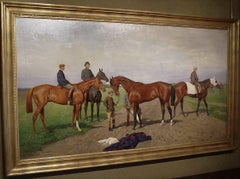
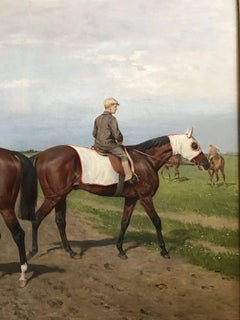
Magnificent early 20th Century Oil Painting of Race horses - At the Gallops

Magnificent early 20th Century Oil Painting of Race horses - At the Gallops

By Julius von Blaas

Located in London, GB

Julius von Blaas (1845-1923) At The Gallops circa 1905 Oil on canvas Signed and dated “Julius von Blass / 1905” (lower left) 110 x 200 cm (140 x 230 cms framed ish) This enormous and grand depiction of horses exercising is an iconic image not only of the edwardien era but also of today’s racing elite. Julius von Blaas was taught by his father Carl von Blaas (1815-1994) and trained in Venice, Florence and Rome. He was also influenced by his celebrated brother Eugen von Blaas...

Category

Early 20th Century Academic Eugene Alexis Girardet Paintings

Materials

Oil

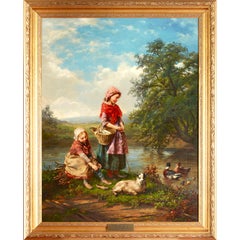
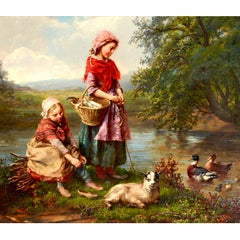
A Fine and Charming 19th Century Oil Canvas "Children Walking the Baby Goat"

A Fine and Charming 19th Century Oil Canvas "Children Walking the Baby Goat"

Located in LA, CA

Henry Joseph Campotosto (Belgium, 1833-1910) A Very Fine Oil on Canvas "Walking the Baby Goat", depicting two young dutch girls by the grassy shore of a river bank, one standing holding a wicker basket and a leash to a resting baby goat, the youngest sitting next to her on a pile of branches tucking her pants, a pair of ducks and ducklings swimming by the tree lined river; within a later giltwood carved frame. Signed (l/r): Campotosto Henry. Circa: Brussels, 1870. Note: The artist is also known as Henri Campotosto Henry or Henri Campotosto was born in Brussels in 1833. He studied in Brussels at the Royal Academy des Beaux-Arts and painted some artworks with Eugène Verboeckhoven (Belgium, 1798-1881). He received a 1st Class Medal at the Academy of Brussels and an honorable mention at the Paris Exhibition of 1860. In 1871 he moved to London with his family and remained there for life. He exhibited his work at the Royal Academy Exhibition until 1874 and at the Suffolk Street Gallery from 1878. In 1880 he took part in the Berlin Academy Exhibition. His daughter Octavia also became a painter, visited Italy, and showed her paintings at the Royal Academy from 1871 to 1874. Henri Campotosto died in London in 1910. High Sales: Christie's New York - Property from an American Collection, "The Bird's Nest" - Lot 247 on October 22, 2008, Sold for $37,500 Bonhams London - 19th Century European, Victorian and British Impressionist Art on 28 September 2016 - Lot 33 "Gathering flowers" Sold for £25,000 ($33,750 USD) Museums: The British Museum - Print of two girls and a lamb and print of two girls by a river bank Literature • E. Benezit Dictionnaire des Peintres, Sculpteurs, Dessinateurs, et Graveurs by Librairie Gründ - 1976 Edition - Volume 2, Page 488. • Maurice W...

Category

19th Century Academic Eugene Alexis Girardet Paintings

Materials

Oil

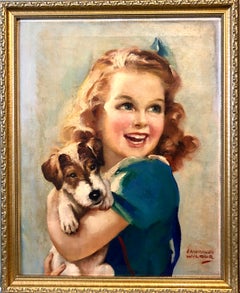
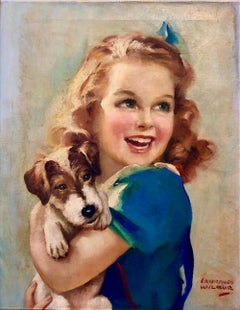
1930s Vintage Oil Painting Girl, Puppy Dog, American Illustrator Lawrence Wilbur

1930s Vintage Oil Painting Girl, Puppy Dog, American Illustrator Lawrence Wilbur

By Lawrence Wilbur

Located in Surfside, FL

A girl and her dog This was possibly used as an advertisement. It is in a great illustrator style. 22 x 18. framed. 19.5 x 15.5 canvas. Lawrence Wilbur (1897 - 1960) was active/l...

Category

1930s American Realist Eugene Alexis Girardet Paintings

Materials

Canvas, Oil

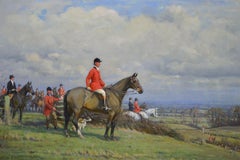
Sporting oil painting of hunters & hounds

Sporting oil painting of hunters & hounds

By John Sanderson Wells

Located in Nr Broadway, Worcestershire

John Sanderson-Wells British, (1872-1955) Gone to Ground Oil on canvas, signed Image size: 15.5 inches x 23.5 inches Size including frame: 21.75 inches x 29.75 inches A well painte...

Category

Early 20th Century Victorian Eugene Alexis Girardet Paintings

Materials

Canvas, Oil

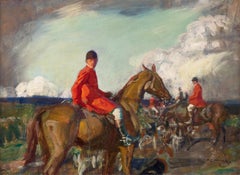
Hunting Scene by Sir Alfred J. Munnings

Hunting Scene by Sir Alfred J. Munnings

Located in New Orleans, LA

Sir Alfred James Munnings 1878-1959 British Hunting Scene Signed “A J Munnings” (lower right) Oil on board The exciting atmosphere of the hunt is masterfully captured in this ex...

Category

20th Century Academic Eugene Alexis Girardet Paintings

Materials

Oil, Board

Whimsical French Folk Art, Naive, Oil Painting  Madeline Marie Christine Clavier

Whimsical French Folk Art, Naive, Oil Painting Madeline Marie Christine Clavier

By Madeline Christine Clavier

Located in Surfside, FL

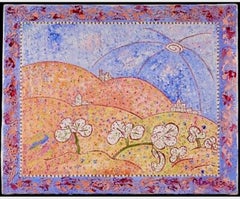
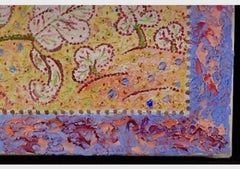
MADELINE CHRISTINE CLAVIER (1913-2015) Signature: Signed lower right & titled verso Medium: Oil on canvas Provenance: The collection of the artist's family Marie Christine Clavier was born in Saigon, Vietnam in 1913 to French parents and lived there for her formative years. She returned to France as a teenager and began to study painting. Her work quickly developed into whimsical paintings of poetry and songs – harmonized in a unique and distinct painting technique. Her work has an impasto feel and a folk art, outsider artist sensibility to it. Similar in style to Maik and other fantasy realists who use animals, flowers and foliage in their artworks. Marie Clavier painted ro herself rather than for profit as she was quite independently wealthy. She exhibited extensively in the United States in the 1970s especially across Connecticut and New York, showing at various galleries and cultural centres. She had numerous solo exhibitions in the 1970’s- notably at the Maison Francaise in New York and New York University. She showed at Galerie Bernheim Jeune in Paris. She won many awards for her work including Gold Medals and Palme D’Or medals. In 1988 the prestigious art publisher Leopard D’Or produced catalogue book on her life and work – by this point she had virtually given up painting. She died in 2015 aged 102. Bernheim-Jeune gallery is one of the oldest art galleries in Paris. Opened on Rue Laffitte in 1863 by Alexandre Bernheim (1839-1915), friend of Delacroix, Corot and Courbet, it changed location a few times before settling on Avenue Matignon. The gallery promoted realists, Barbizon school paintings and, in 1874, the first impressionist and later post-impressionist painters. It closed in 2019. In 1901, Alexandre Bernheim, with his sons, Josse (1870-1941), and Gaston (1870-1953), organized the first important exhibition of Vincent van Gogh paintings in Paris with the help of art critic Julien Leclercq. In 1906, Bernheim-Jeune frères started presenting works by Pierre Bonnard, Edouard Vuillard, Paul Cezanne, Henri-Edmond Cross, Kees van Dongen, Henri Matisse, Le Douanier Rousseau, Raoul Dufy, Maurice de Vlaminck, Amedeo Modigliani, Maurice Utrillo and Georges Dufrenoy. From 1906 to 1925, art critic Félix Fénéon was the director of the gallery and was instrumental in bringing in the art of Georges Seurat and Umberto Boccioni. In 1922, an exhibition brought together works by Alice Halicka, Auguste Herbin, Pierre Hodé, Moise Kisling, Marie Laurencin, Henri Lebasque, Fernand Leger and Henri Matisse. The gallery now exhibits painters and sculptors in the tradition of the École de Paris and artists such as Jean Carzou, Shelomo Selinger or Pollès. Her style is a recognizable, cheerful, whimsical and a happy creation. Naïve art is any form of visual art that is created by a person who lacks the formal education and training that a professional artist undergoes (in anatomy, art history, technique, perspective, ways of seeing). Unlike folk art, naïve art does not necessarily evince a distinct cultural context or tradition. Naïve art is recognized, and often imitated, for its childlike simplicity and frankness. Paintings of this kind typically have a flat rendering style with a rudimentary expression of perspective. One particularly influential painter of "naïve art" was Henri Rousseau (1844–1910), a French Post-Impressionist who was discovered by Pablo Picasso. Naïve art is often seen as outsider art that is by someone without formal (or little) training or degree. While this was true before the twentieth century, there are now academies for naïve art. Naïve art is now a fully recognized art genre, represented in art galleries worldwide. Museums devoted to naïve art now exist in Kecskemét, Hungary; Riga, Latvia; Jaen, Spain; Rio de Janeiro, Brasil; Vicq France and Paris. Another term related to (but not completely synonymous with) naïve art is folk art. There also exist the terms "naïvism" and "primitivism" which are usually applied to professional painters working in the style of naïve art (like Paul Gauguin, Mikhail Larionov, Paul Klee). At all events, naive art can be regarded as having occupied an "official" position in the annals of twentieth-century art since - at the very latest - the publication of the Der Blaue Reiter, an almanac in 1912. Wassily Kandinsky and Franz Marc, who brought out the almanac, presented 6 reproductions of paintings by le Douanier' Rousseau (Henri Rousseau), comparing them with other pictorial examples. However, most experts agree that the year that naive art was "discovered" was 1885, when the painter Paul Signac became aware of the talents of Henri Rousseau and set about organizing exhibitions of his work in a number of prestigious galleries. The Earth Group (Grupa Zemlja) were Croatian artists, architects and intellectuals active in Zagreb from 1929 to 1935. The group included the painters Krsto Hegedušić, Edo Kovačević, Omer Mujadžić, Kamilo Ružička, Ivan Tabaković, and Oton Postružnik, the sculptors Antun Augustinčić, Frano Kršinić, and the architect Drago Ibler. A term applied to Yugoslav (Croatian) naive painters working in or around the village of Hlebine, near the Hungarian border, from about 1930. Some of the best known naive artists are Dragan Gaži, Ivan Generalić, Josip Generalić, Krsto Hegedušić, Mijo Kovačić, Ivan Lacković-Croata, Franjo Mraz, Ivan Večenaj and Mirko Virius. Camille Bombois (1883–1970) Ferdinand Cheval, known as 'le facteur Cheval' (1836–1924) Henry Darger (1892–1973) L. S. Lowry (1887–1976) Grandma Moses, Anna Mary Robertson...

Category

20th Century Folk Art Eugene Alexis Girardet Paintings
Materials

Canvas, Oil

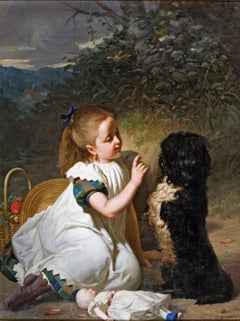
Teaching him a New Trick

Barend WijnveldTeaching him a New Trick

$48,500

H 46.25 in W 35.25 in

Teaching him a New Trick

Located in Mc Lean, VA

19th Century Dutch

Category

1890s Academic Eugene Alexis Girardet Paintings

Materials

Canvas, Oil

Whimsical French Folk Art, Naive, Oil Painting  Madeline Marie Christine Clavier

Whimsical French Folk Art, Naive, Oil Painting Madeline Marie Christine Clavier

By Madeline Christine Clavier

Located in Surfside, FL

MADELINE CHRISTINE CLAVIER (1913-2015) Signature: Signed lower right & titled verso Medium: Oil on canvas Provenance: The collection of the artist's family Marie Christine Clavier was born in Saigon, Vietnam in 1913 to French parents and lived there for her formative years. She returned to France as a teenager and began to study painting. Her work quickly developed into whimsical paintings of poetry and songs – harmonized in a unique and distinct painting technique. Her work has an impasto feel and a folk art, outsider artist sensibility to it. Similar in style to Maik and other fantasy realists who use animals, flowers and foliage in their artworks. Marie Clavier painted ro herself rather than for profit as she was quite independently wealthy. She exhibited extensively in the United States in the 1970s especially across Connecticut and New York, showing at various galleries and cultural centres. She had numerous solo exhibitions in the 1970’s- notably at the Maison Francaise in New York and New York University. She showed at Galerie Bernheim Jeune in Paris. She won many awards for her work including Gold Medals and Palme D’Or medals. In 1988 the prestigious art publisher Leopard D’Or produced catalogue book on her life and work – by this point she had virtually given up painting. She died in 2015 aged 102. Bernheim-Jeune gallery is one of the oldest art galleries in Paris. Opened on Rue Laffitte in 1863 by Alexandre Bernheim (1839-1915), friend of Delacroix, Corot and Courbet, it changed location a few times before settling on Avenue Matignon. The gallery promoted realists, Barbizon school paintings and, in 1874, the first impressionist and later post-impressionist painters. It closed in 2019. In 1901, Alexandre Bernheim, with his sons, Josse (1870-1941), and Gaston (1870-1953), organized the first important exhibition of Vincent van Gogh paintings in Paris with the help of art critic Julien Leclercq. In 1906, Bernheim-Jeune frères started presenting works by Pierre Bonnard, Edouard Vuillard, Paul Cezanne, Henri-Edmond Cross, Kees van Dongen, Henri Matisse, Le Douanier Rousseau, Raoul Dufy, Maurice de Vlaminck, Amedeo Modigliani, Maurice Utrillo and Georges Dufrenoy. From 1906 to 1925, art critic Félix Fénéon was the director of the gallery and was instrumental in bringing in the art of Georges Seurat and Umberto Boccioni. In 1922, an exhibition brought together works by Alice Halicka, Auguste Herbin, Pierre Hodé, Moise Kisling, Marie Laurencin, Henri Lebasque, Fernand Leger and Henri Matisse. The gallery now exhibits painters and sculptors in the tradition of the École de Paris and artists such as Jean Carzou, Shelomo Selinger or Pollès. Her style is a recognizable, cheerful, whimsical and a happy creation. Naïve art is any form of visual art that is created by a person who lacks the formal education and training that a professional artist undergoes (in anatomy, art history, technique, perspective, ways of seeing). Unlike folk art, naïve art does not necessarily evince a distinct cultural context or tradition. Naïve art is recognized, and often imitated, for its childlike simplicity and frankness. Paintings of this kind typically have a flat rendering style with a rudimentary expression of perspective. One particularly influential painter of "naïve art" was Henri Rousseau (1844–1910), a French Post-Impressionist who was discovered by Pablo Picasso. Naïve art is often seen as outsider art that is by someone without formal (or little) training or degree. While this was true before the twentieth century, there are now academies for naïve art. Naïve art is now a fully recognized art genre, represented in art galleries worldwide. Museums devoted to naïve art now exist in Kecskemét, Hungary; Riga, Latvia; Jaen, Spain; Rio de Janeiro, Brasil; Vicq France and Paris. Another term related to (but not completely synonymous with) naïve art is folk art. There also exist the terms "naïvism" and "primitivism" which are usually applied to professional painters working in the style of naïve art (like Paul Gauguin, Mikhail Larionov, Paul Klee). At all events, naive art can be regarded as having occupied an "official" position in the annals of twentieth-century art since - at the very latest - the publication of the Der Blaue Reiter, an almanac in 1912. Wassily Kandinsky and Franz Marc, who brought out the almanac, presented 6 reproductions of paintings by le Douanier' Rousseau (Henri Rousseau), comparing them with other pictorial examples. However, most experts agree that the year that naive art was "discovered" was 1885, when the painter Paul Signac became aware of the talents of Henri Rousseau and set about organizing exhibitions of his work in a number of prestigious galleries. The Earth Group (Grupa Zemlja) were Croatian artists, architects and intellectuals active in Zagreb from 1929 to 1935. The group included the painters Krsto Hegedušić, Edo Kovačević, Omer Mujadžić, Kamilo Ružička, Ivan Tabaković, and Oton Postružnik, the sculptors Antun Augustinčić, Frano Kršinić, and the architect Drago Ibler. A term applied to Yugoslav (Croatian) naive painters working in or around the village of Hlebine, near the Hungarian border, from about 1930. Some of the best known naive artists are Dragan Gaži, Ivan Generalić, Josip Generalić, Krsto Hegedušić, Mijo Kovačić, Ivan Lacković-Croata, Franjo Mraz, Ivan Večenaj and Mirko Virius. Camille Bombois (1883–1970) Ferdinand Cheval, known as 'le facteur Cheval' (1836–1924) Henry Darger (1892–1973) L. S. Lowry (1887–1976) Grandma Moses, Anna Mary Robertson...

Category

20th Century Folk Art Eugene Alexis Girardet Paintings
Materials

Canvas, Oil

Previously Available Items
The Gold Brooch

The Gold Brooch

By Eugene Alexis Girardet

Located in London, GB

Eugene Alexis Girardet French 1853 - 1907 The Gold Brooch Oil on panel, signed, dated and inscribed "Bou Saada, 1894" lower right Image size: 13 x 8 ...

Category

Late 19th Century Eugene Alexis Girardet Paintings
Materials

Oil, Panel

Eugene Alexis Girardet paintings for sale on 1stDibs.

Find a wide variety of authentic Eugene Alexis Girardet paintings available for sale on 1stDibs. You can also browse by medium to find art by Eugene Alexis Girardet in oil paint, paint, canvas and more. Not every interior allows for large Eugene Alexis Girardet paintings, so small editions measuring 6 inches across are available. Customers who are interested in this artist might also find the work of Emile Godchaux, Charles Theodore Frere, and Francis Luis Mora. Eugene Alexis Girardet paintings prices can differ depending upon medium, time period and other attributes. On 1stDibs, the price for these items starts at $35,161 and tops out at $95,000, while the average work can sell for $65,081.