Frank Stella Animal Prints

American, 1936-2024

Frank Stella was one of the central figures in postwar American art. A proponent of minimalism and non-representational abstraction, Stella was a painter, printmaker and sculptor.

A native of Massachusetts, Stella attended Phillips Academy in Andover and earned a BA from Princeton, where he studied art and color theory with Josef Albers and Hans Hofmann. Stella frequented New York galleries as a student and was intrigued by the work of Jackson Pollock and Franz Kline, both of whom were at the height of their creative powers in the late 1950s.

After moving to New York in 1958, Stella gravitated toward the geometric abstraction and restrained painting style of Barnett Newman and Jasper Johns.

Johns’s flat, graphic images of common objects such as targets and flags prompt viewers to question the essential nature of representation and whether these pictures are really paintings or simply new iterations of the items themselves. Stella pushed Johns’s reasoning further, considering paintings on canvas as objects in their own right, like sculptures, rather than representations. This led him to reject certain formal conventions, eschewing sketches and often using nontraditional materials, like house paint.

In 1959, Stella created his “Black Paintings,” series, in which bands of black paint are separated by thin, precise stripes of bare canvas. At a time when contemporary painting was all about wild gestures, thick paint and formal abandon, these pieces created a sensation. That same year, Stella's work was included in the exhibition "Sixteen Americans" at the Museum of Modern Art in New York, and he joined the roster of artists represented by Leo Castelli Gallery. In 1960, he began introducing color into his work and using unconventionally shaped canvases to complement his compositions.

In his “Eccentric Polygon” series, from 1965 and ‘66, Stella embraces asymmetry and bold color, creating forms delineated by painted fields and by the edges of the canvas. This series was followed by the 1967–70 “Protractor” series, characterized by colorful circles and arcs. Named after the ancient cities whose circular plans Stella had noticed while traveling in the Middle East during the 1960s, these works usually comprised several canvases set flush against one another so that the geometric figures in each section came together in a larger, more complex whole.

Also in the mid-1960s, Stella started exploring printmaking, initially working with Kenneth Tyler, of Gemini G.E.L., and later installing printing equipment in his own studio. In 1968, he created the “V” series of lithographs, which included the print Quathlamba I. Following a solo exhibition at the Museum of Modern Art in 1970, Stella began working in three dimensions, adding relief elements to paintings, which could almost be considered wall-mounted sculptures.

Stella’s 1970–73 “Polish Village” series was inspired by documentary photos and architectural drawings of Polish synagogues that had been destroyed by Nazis during World War II. The resulting works — composed primarily of paint and cloth on plywood — are more rugged and less polished than his previous series.

Herman Melville's Moby Dick was Stella's muse for a series of three- dimensional works he created in the 1980s in which waveforms, architectural elements and Platonic solids play a prominent role. During this period, Stella embraced a new, exuberant style that is exemplified in "La Scienza della Fiacca."

In 1997, the artist oversaw the creation of the Stella Project, a 5,000-square-foot work inside the Moores Opera House at the University of Houston. A large free-standing sculpture by Stella stands outside the National Gallery of Art in Washington, D.C.

Stella’s work is in the collections of numerous important museums around the world, including New York’s Museum of Modern Art and Metropolitan Museum of Art; the Menil Collection, in Houston; the Hirshhorn Museum and Sculpture Garden, in Washington, D.C.; and the San Francisco Museum of Modern Art. He was awarded the National Medal of Arts by President Obama in 2009, and was given the Lifetime Achievement Award in Contemporary Sculpture by the International Sculpture Center in 2011.

Find original Frank Stella art for sale on 1stDibs.
to
2
Overall Width
to
Overall Height
to
2
93
152
121
112
109
2
1
1
2
1
2
2
2
2
Artist: Frank Stella
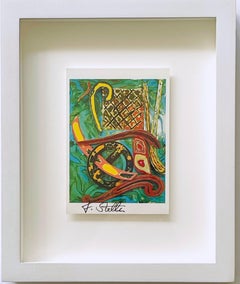
Art Card: Frank Stella The Fossil Whale (Hand Signed by Frank Stella), Framed

Art Card: Frank Stella The Fossil Whale (Hand Signed by Frank Stella), Framed

By Frank Stella

Located in New York, NY

Offset lithograph card Hand signed and dated '93 by Frank Stella on the front Gorgeous card depicting abstract expressionist artist Frank Stella's "The Fossil Whale" on the front cov...

Category

1990s Abstract Expressionist Frank Stella Animal Prints

Materials

Postcard

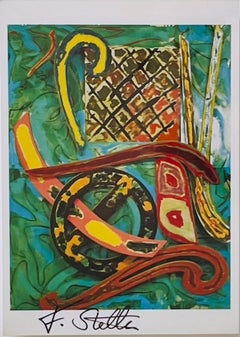
Frank Stella - Exotic bird card, Signed in black marker by Frank Stella, Framed

Frank Stella - Exotic bird card, Signed in black marker by Frank Stella, Framed

By Frank Stella

Located in New York, NY

Offset lithograph postcard Hand signed in black marker by Frank Stella Provenance: Obtained directly from the artist by the present owner This signed card depicts Frank Stella's 1977...

Category

1970s Abstract Frank Stella Animal Prints

Materials

Postcard

Related Items
Lithographier Originale (Les Peintures Sur Carton) (Abstract, Fun, Gestural)

Lithographier Originale (Les Peintures Sur Carton) (Abstract, Fun, Gestural)

By Joan Miró

Located in Kansas City, MO

Joan Miro Lithographier Originale (Les Peintures Sur Carton De Miro) Original Color Lithograph Year: 1965 Size: 14.5x10.5in Edition: 150 Portfolio: DLM 151-152 Publisher: Maeght Ed...

Category

1960s Abstract Expressionist Frank Stella Animal Prints

Materials

Lithograph

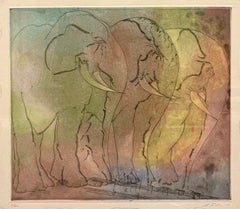
Stanley Boxer Aquatint Intaglio Etching Elephant Herd Abstract Expressionist

Stanley Boxer Aquatint Intaglio Etching Elephant Herd Abstract Expressionist

By Stanley Boxer

Located in Surfside, FL

Elephants. 1979 edition 2/20 Hand signed and dated Framed 24.5 X 28. Sheet 23 X 26 This is from a series of prints Boxer produced at Tyler Graphics between 1975 and 1979. Over thi...

Category

1970s Abstract Expressionist Frank Stella Animal Prints

Materials

Etching, Aquatint, Intaglio

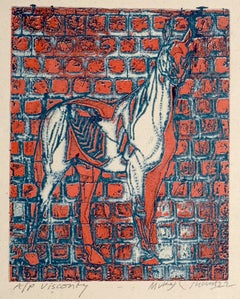
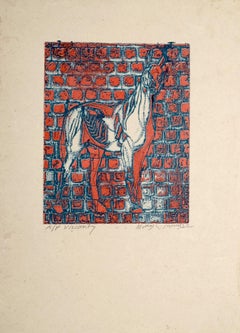
Abstract India Landscape Rajasthan Tarzan Horse Viscosity Print Nature Teracotta

Abstract India Landscape Rajasthan Tarzan Horse Viscosity Print Nature Teracotta

By Mukesh Sharma

Located in Norfolk, GB

There is a natural and raw understanding in Mukesh Sharma’s prints that depict, and are influenced by, the Rajastani communities of his home town in rura...

Category

2010s Abstract Frank Stella Animal Prints

Materials

Archival Ink, Archival Paper, Washi Paper

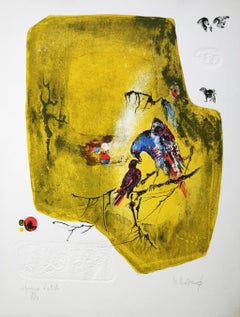
Birds on a Branch original lithograph Dang Lebadang

Birds on a Branch original lithograph Dang Lebadang

By Dang Lebadong

Located in Paonia, CO

Birds on a Branch is a limited edition lithograph ( VI/XXI ) in excellent condition and is signed in pencil by the artist. Three blue and red birds sitting on a branch with a background in yellow and some black. Dang Lebadang...

Category

20th Century Abstract Frank Stella Animal Prints

Materials

Lithograph

"Lithograph V", Abstract Lithograph in Colors, Signed, 1975

"Lithograph V", Abstract Lithograph in Colors, Signed, 1975

By Joan Miró

Located in Astoria, NY

Joan Miro (Spanish, 1893-1983), "Lithograph V", Lithograph in Colors, 1975, from the "Lithographe II" series, published Maeght Editeur, signed in pencil lower right, numbered edition...

Category

1970s Abstract Frank Stella Animal Prints

Materials

Paper, Lithograph

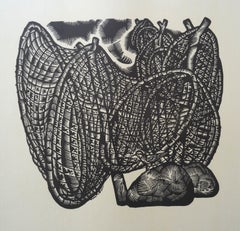
Bird green sandpiper. 1976., Paper, linocut, 80x65 cm

Dainis RozkalnsBird green sandpiper. 1976., Paper, linocut, 80x65 cm, 1976

$576Sale Price|50% Off

H 31.5 in W 25.6 in D 0.04 in

Bird green sandpiper. 1976., Paper, linocut, 80x65 cm

By Dainis Rozkalns

Located in Riga, LV

Bird green sandpiper. 1976., Paper, linocut, print size 46x50 cm; page size 80x65 cm Dainis Rozkalns (1928 - 2018) Artist, graphic artist, illustrator of folklore and fiction publi...

Category

1970s Abstract Geometric Frank Stella Animal Prints

Materials

Paper, Linocut

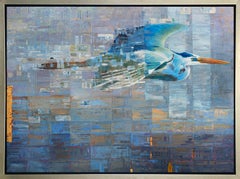
"Blue Heron in Flight, " Limited Edition Giclee Print, 24" x 32"

"Blue Heron in Flight, " Limited Edition Giclee Print, 24" x 32"

By Ned Martin

Located in Westport, CT

This abstract limited edition print features a blue heron bird in flight (facing left). The background is an abstract rectangular pattern with blue and gold rectangles, which blend i...

Category

2010s Abstract Frank Stella Animal Prints

Materials

Digital, Giclée

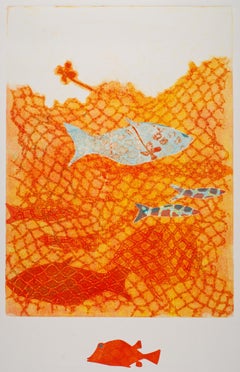
Key West Bound 72

Casey BlanchardKey West Bound 72, 2020

$695

H 14 in W 9 in D 0.1 in

Key West Bound 72

By Casey Blanchard

Located in Boston, MA

Artist Commentary: The Key West Bound Series is about the insistent nature of Key West’s ability to adapt and thrive despite the continual barrage of hurricanes, weather patterns, a...

Category

21st Century and Contemporary Abstract Frank Stella Animal Prints

Materials

Mixed Media, Rag Paper, Monoprint

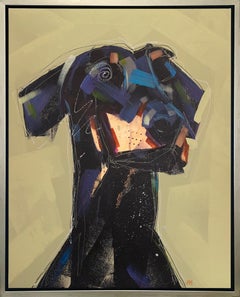
"Doberman" Limited Edition Giclee Print, 50" x 40"

"Doberman" Limited Edition Giclee Print, 50" x 40"

By Russell Miyaki

Located in Westport, CT

This abstracted print of a dog by artist Russell Miyaki features a unique palette and captures a black Doberman dog from the shoulders up, with warm accents in front of a gold backgr...

Category

2010s Abstract Frank Stella Animal Prints

Materials

Digital, Giclée

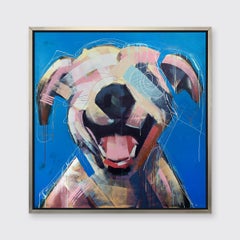
"A Good Day" Limited Edition Giclee Print, 48" x 48"

"A Good Day" Limited Edition Giclee Print, 48" x 48"

By Russell Miyaki

Located in Westport, CT

This abstracted print of a dog by artist Russell Miyaki features a light, colorful palette and loose, expressive, and playful elements to create an energetic composition of a dog wit...

Category

2010s Abstract Frank Stella Animal Prints

Materials

Digital, Giclée

"Lithograph I", Abstract Lithograph in Colors, Signed, 1975

"Lithograph I", Abstract Lithograph in Colors, Signed, 1975

By Joan Miró

Located in Astoria, NY

Joan Miro (Spanish, 1893-1983), "Lithograph I", Lithograph in Colors, 1975, from the "Lithographe II" series, published Maeght Editeur, signed in pencil lower right, numbered edition...

Category

1970s Abstract Frank Stella Animal Prints

Materials

Paper, Lithograph

Key West Bound 55

Casey BlanchardKey West Bound 55, 2020

$595

H 16 in W 9 in D 0.1 in

Key West Bound 55

By Casey Blanchard

Located in Boston, MA

Artist Commentary: The Key West Bound Series is about the insistent nature of Key West’s ability to adapt and thrive despite the continual barrage of hurricanes, weather patterns, a...

Category

21st Century and Contemporary Abstract Frank Stella Animal Prints

Materials

Mixed Media, Rag Paper, Monoprint

Frank Stella animal prints for sale on 1stDibs.

Find a wide variety of authentic Frank Stella animal prints available for sale on 1stDibs. You can also browse by medium to find art by Frank Stella in lithograph and more. Much of the original work by this artist or collective was created during the 1960s and is mostly associated with the Pop Art style. Not every interior allows for large Frank Stella animal prints, so small editions measuring 22 inches across are available. Customers who are interested in this artist might also find the work of Ed Ruscha, George Rodrigue, and Larry Rivers. Frank Stella animal prints prices can differ depending upon medium, time period and other attributes. On 1stDibs, the price for these items starts at $10,500 and tops out at $10,500, while the average work can sell for $10,500.
Questions About Frank Stella Animal Prints
  • 1stDibs ExpertNovember 20, 2024
    Frank Stella is important because he was one of the central figures in postwar American art and influenced later artists as a proponent of minimalism and non-representational abstraction. Stella felt that paintings on canvas were objects in their own right, like sculptures. This led him to reject certain formal conventions, eschewing sketches and often using nontraditional materials, like house paint. His approach to art impacted the work of Clement Greenberg, Carl Andre, Kenneth Noland and many others. Find a collection of Frank Stella art on 1stDibs.
  • 1stDibs ExpertAugust 29, 2024
    Frank Stella was famous for his work as an artist. He was one of the central figures in postwar American art. A proponent of Minimalism and non-representational abstraction, Stella was a painter, printmaker and sculptor. Some of his best-known works include Shoubeegi, Harran II and The Marriage of Reason and Squalor II. Find an assortment of Frank Stella art on 1stDibs.
  • 1stDibs ExpertOctober 24, 2024
    Frank Stella is famous for his work as an artist. He was one of the central figures in postwar American art. A proponent of Minimalism and non-representational abstraction, Stella was a painter, printmaker and sculptor. His work is in the collections of numerous major museums around the world, including New York’s Museum of Modern Art and Metropolitan Museum of Art; the Menil Collection in Houston; the Hirshhorn Museum and Sculpture Garden in Washington, D.C. and the San Francisco Museum of Modern Art. He was awarded the National Medal of Arts by President Obama in 2009 and was given the Lifetime Achievement Award in Contemporary Sculpture by the International Sculpture Center in 2011. He died on May 4, 2024. Some of his best-known works include Harran II, Shoubeegi and “The Marriage of Reason and Squalor” series. On 1stDibs, shop a selection of Frank Stella art.
  • 1stDibs ExpertAugust 29, 2024
    No, Frank Stella was not related to Joseph Stella. While it's possible that in-depth genealogical research may uncover a shared ancestor many generations ago, the two artists are not currently believed to be related. Joseph Stella was born in 1877 in Muro Lucano, Italy, while Frank Stella was born in 1936 in Malden, Massachusetts. On 1stDibs, shop a diverse assortment of Frank Stella and Joseph Stella art.
  • 1stDibs ExpertAugust 29, 2024
    Frank Stella's philosophy, self-described as "what you see is what you see," reflects his belief that art shouldn't be representational and that its merit was in its actual form and not in any meaning that was assigned to it. He considered paintings on canvas to be objects in their own right, like sculptures, rather than representations. This led him to reject certain formal conventions, eschewing sketches and often using nontraditional materials, like house paint. Shop a range of Frank Stella art on 1stDibs.
  • 1stDibs ExpertOctober 24, 2024
    Frank Stella's nationality was American. He was born in Malden, Massachusetts, in 1936. Although his parents were also born in the U.S., all four of his grandparents were natives of Italy who immigrated to the country. Stella attended Phillips Academy in Andover, earned a BA from Princeton University and, in 1958, relocated to New York City. He remained there for much of his life and died there in 2024. On 1stDibs, shop a collection of Frank Stella art.
  • 1stDibs ExpertOctober 24, 2024
    Frank Stella's father was also named Frank. Although he worked as a gynecologist, the elder Frank Stella was an art lover and fostered his son's love of painting. Stella's mother, Constance, attended art school and was a landscape painter. On 1stDibs, explore a variety of Frank Stella art from some of the world's top galleries and dealers.
  • 1stDibs ExpertOctober 15, 2024
    You can see Frank Stella art at a number of museums. Some institutions in the U.S. that have Stella pieces in their permanent collections include the San Francisco Museum of Modern Art in San Francisco, California; the Museum of Modern Art (MoMA) in New York City, New York and the Chrysler Museum of Art in Norfolk, Virginia. In addition, museums may host temporary exhibitions of the artist's work. On 1stDibs, find a selection of Frank Stella art.
  • 1stDibs ExpertOctober 24, 2024
    Frank Stella went to college at Princeton University, earning a bachelor of arts from the institution. While there, he studied art and color theory with Josef Albers and Hans Hofmann. Stella frequented New York galleries as a student and was intrigued by the work of Jackson Pollock and Franz Kline, both of whom were at the height of their creative powers in the late 1950s. After moving to New York in 1958, Stella gravitated toward the geometric abstraction and restrained painting style of Barnett Newman and Jasper Johns. On 1stDibs, shop a collection of Frank Stella art.
  • 1stDibs ExpertOctober 24, 2024
    Frank Stella used a variety of techniques. The American artist eschewed sketches for his paintings and often used nontraditional materials, like house paint. In 1960, he began introducing color into his work and using unconventionally shaped canvases to complement his compositions. Following a solo show at the Museum of Modern Art in New York in 1970, Stella began working in three dimensions, adding relief elements to paintings, which could be considered wall-mounted sculptures. Stella’s 1970–73 “Polish Village” series was inspired by documentary photographs and architectural drawings of Polish synagogues that had been destroyed by the Nazis during World War II. The resulting works — composed primarily of paint and cloth on plywood — are more rugged and less polished than his previous series. Herman Melville's Moby-Dick was Stella's muse for a series of three-dimensional works he created in the 1980s in which waveforms, architectural elements and Platonic solids played a prominent role. During this period, Stella embraced a new, exuberant style exemplified in his piece La Scienza della Fiacca. In addition to paintings and sculptural works, the artist also produced prints using lithography, serigraphy, etching and offset lithography techniques. Explore an assortment of Frank Stella art on 1stDibs.
  • 1stDibs ExpertAugust 29, 2024
    Frank Stella influenced art by encouraging the spread of Minimalism, an extreme form of abstraction that focuses on forms rather than meaning. Through his work, Stella challenged the notion that art must be a representation of something else. He believed that the art itself was the only true meaning of a piece. His philosophy influenced other artists and architects, such as Frank Gehry, Timothy App and Carl Andre. On 1stDibs, shop a range of Frank Stella art.
  • 1stDibs ExpertMay 7, 2024
    Frank Stella (1936–2024) made paintings, prints and sculptures. One of the central figures in postwar American art, Stella was a proponent of minimalism and non-representational abstraction. His famous works include Sinjerli Variation IV, Harran II and his “Eccentric Polygon” series.

    Stella burst onto the scene barely out of college with his “Black Paintings,” sober geometric studies composed of wide black stripes separated by chalky white lines. These won him inclusion in “16 Americans,” the famed 1959–60 group show at New York’s Museum of Modern Art. He stayed at the forefront of art, working with famed gallerist Leo Castelli, relentlessly pursuing geometric form and never repeating himself. 

    Find a collection of Frank Stella art for sale on 1stDibs.
  • 1stDibs ExpertOctober 24, 2024
    Frank Stella actually used more than one element of art. A proponent of Minimalism and non-representational abstraction, Stella was a painter, printmaker and sculptor. Considering paintings on canvas as objects in their own right, like sculptures, rather than representations, he rejected certain formal conventions, eschewing sketches and often using nontraditional materials, like house paint. Over the course of his career, his pieces became more and more three-dimensional, straddling the line between painting and sculpture. In the mid-1960s, Stella started exploring printmaking, initially working with Kenneth Tyler of Gemini G.E.L. and later installing printing equipment in his own studio. On 1stDibs, shop a diverse assortment of Frank Stella art.
  • 1stDibs ExpertNovember 20, 2024
    Here are three interesting facts about Frank Stella. First, Stella considered paintings on canvas as objects in their own right, like sculptures, rather than representations. This led him to reject certain formal conventions, eschewing sketches and often using nontraditional materials, like house paint. Secondly, Stella created a series of works named after the ancient cities whose circular plans Stella had noticed while traveling in the Middle East during the 1960s. Called the “Protractor” series, these works usually involved several canvases set flush against one another so that the geometric figures in each section came together in a larger, more complex whole. In addition, Stella was awarded the National Medal of Arts by President Obama in 2009 and was given the Lifetime Achievement Award in Contemporary Sculpture by the International Sculpture Center in 2011. On 1stDibs, shop a wide variety of Frank Stella art.
  • 1stDibs ExpertAugust 29, 2024
    Frank Stella started making freestanding sculptures in the 1990s. In 1997, the artist oversaw the creation of the Stella Project, a 5,000-square-foot work inside the Moores Opera House at the University of Houston, and a large free-standing sculpture by Stella produced during this period stands outside the National Gallery of Art in Washington, D.C. However, Stella's work began to move toward sculpture much earlier. Following a solo exhibition at the Museum of Modern Art in 1970, Stella began working in three dimensions, adding relief elements to paintings, which could almost be considered wall-mounted sculptures. On 1stDibs, shop a variety of Frank Stella art.
  • 1stDibs ExpertAugust 29, 2024
    The art style Frank Stella is known for is Minimalism, a fully nonrepresentational form of abstraction. Stella considered paintings on canvas as objects in their own right, like sculptures, rather than representations. This led him to reject certain formal conventions, eschewing sketches and often using nontraditional materials, like house paint. Find a variety of Frank Stella art on 1stDibs.
  • 1stDibs ExpertOctober 24, 2024
    Frank Stella made Harran II because of his interest in moving his work away from representation toward minimalist abstractions. He believed paintings on canvas were objects in their own right, like sculptures, rather than symbols for something else. Harran II was a part of Stella's Protractor series, characterized by colorful circles and arcs. Named after the ancient cities whose circular plans Stella had noticed while traveling in the Middle East during the 1960s, these works usually comprise several canvases set flush against one another so that the geometric figures in each section come together in a larger, more complex whole. In the case of Harran II, the name is a nod to a city in Turkey where Stella was inspired by intricate, colorful tile mosaics. Find a variety of Frank Stella art on 1stDibs.
  • 1stDibs ExpertAugust 29, 2024
    To create his lithographs, Frank Stella used a variety of materials. Many of his prints began with collages made of enamel paint, etched magnesium, aluminum and fiberglass. Then, he would transfer the image to a lithograph stone and apply it to paper. For many lithographs, he also employed screen printing techniques to create a layered effect. Shop a collection of Frank Stella art on 1stDibs.