George Elbert Burr Prints and Multiples

American, 1859-1939

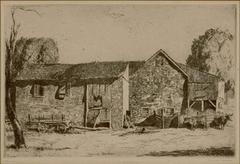
George Elbert Burr was an American printmaker and painter best known for his etchings and drypoints of the desert and mountain regions of the American West. He enjoyed success early, providing illustrations for Harper's, Scribner's Magazine, Frank Leslie's Weekly, and The Cosmopolitan. In 1892, he began a four-year project illustrating a catalog of Heber R. Bishop's collection of jade antiquities for the Metropolitan Museum of Art. This project, producing etchings of over a thousand artifacts, paid well enough for Burr to embark on an extended tour of Europe upon its completion with his wife. Over the next five years, as they traveled in Italy, Germany, and the British Isles, Burr amassed sketches and watercolors that would provide the source material for his copper plate etchings of European scenes. In 1924, the Burrs settled in Phoenix, Arizona, where he would remain for the rest of his life. The change of scenery allowed him to round out his oeuvre of Western landscapes with expansive views of the Sonoran and Mojave deserts. He and his wife, who died in 1941, are buried in Cameron. Today, George Elbert Burr is widely considered to be one of the finest of the early 20th-century American etchers. His prints are in several prominent collections including the Smithsonian American Art Museum, the British Museum, the French National Print Collection, Luxembourg Gallery, Victoria and Albert Museum, the New York Public Library, Brooklyn Museum, Museum of Northern Arizona and the Congressional Library in Washington, D.C.

to
5
Overall Width
to
Overall Height
to
1
1
6
1,319
1,037
943
899
5
3
5
3
3
2
1
1
1
1
1
1
1
1
3
1
1
1
1
3
2
5
Artist: George Elbert Burr
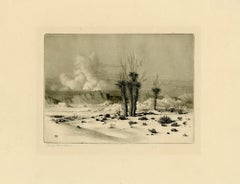
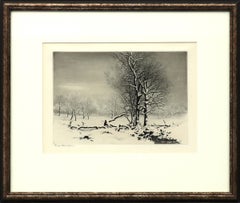
Signed George Elbert Burr Winter Landscape Lithograph, Snow-Covered Trees

Signed George Elbert Burr Winter Landscape Lithograph, Snow-Covered Trees

By George Elbert Burr

Located in Denver, CO

This original signed lithograph by acclaimed American artist George Elbert Burr (1859–1939) beautifully depicts a serene winter landscape with snow-covered trees. Burr’s masterful lithograph technique captures the delicate interplay of light, shadow, and snow, evoking the quiet stillness and crisp beauty of nature in winter. The image measures 7 ¼ by 10 ¼ inches and is presented in a custom archival frame with overall dimensions of 15 x 17 ¾ inches. The artist’s signature authenticates this fine example of early 20th-century American printmaking, making it an ideal addition to collections of Western art, winter landscapes, or vintage lithographs. Born in Ohio, Burr was largely self-taught, gaining recognition for his detailed etchings and lithographs that captured the American West’s rugged beauty. After years of travel across Europe and the U.S. Southwest, he created iconic series like Mountain Moods and the Desert Set...

Category

20th Century American Modern George Elbert Burr Prints and Multiples

Materials

Lithograph

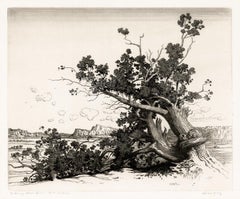
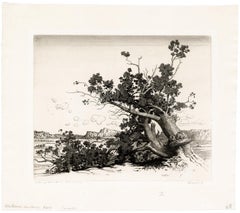
"A Mirage" signed etching / drypoint (trial proof)

"A Mirage" signed etching / drypoint (trial proof)

By George Elbert Burr

Located in Henderson, NV

Medium: original etching and drypoint. Catalogue reference: Seeber 194. This impression on japon paper is annotated "trial proof" and pencil-signed and titled in the margin, with Geo...

Category

1920s George Elbert Burr Prints and Multiples

Materials

Drypoint, Etching

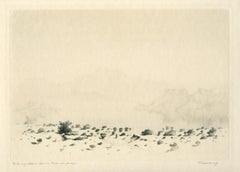
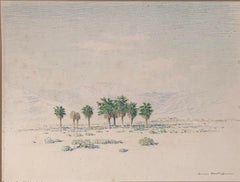
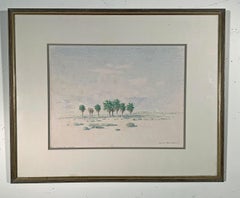
OASIS OF SEVEN PALMS CALIFORNIA

OASIS OF SEVEN PALMS CALIFORNIA

By George Elbert Burr

Located in Portland, ME

Burr, George Elbert. OASIS OF SEVEN PALMS CALIFORNIA. Gouache on paper, not dated, but before 1921. Titled in pencil, lower left, and signed in pencil, lower right, and with the numb...

Category

Early 20th Century George Elbert Burr Prints and Multiples

Materials

Gouache

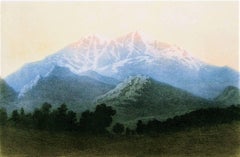
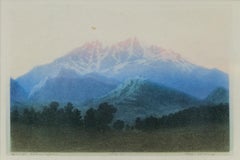
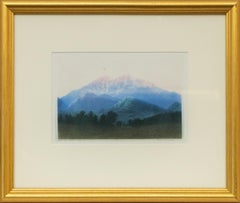
George Elbert Burr Rocky Mountain Color Aquatint Etching, Longs Peak

George Elbert Burr Rocky Mountain Color Aquatint Etching, Longs Peak

By George Elbert Burr

Located in Denver, CO

An exceptional original color aquatint etching by renowned American printmaker George Elbert Burr (1859–1939), depicting the iconic peaks of Longs Peak and Mount Meeker in Colorado's...

Category

1920s American Impressionist George Elbert Burr Prints and Multiples

Materials

Aquatint

Related Items
Arch Beach, California

Arch Beach, California

Located in San Francisco, CA

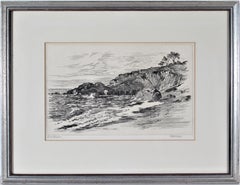
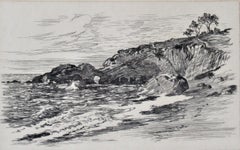
This artwork titled "Arch Beach, California" c.1910 is an original etching on Wove paper by American artist Harley DeWitt Nichols, 1859-1939. It is hand signed and titled in pencil by the artist. The plate mark (image) size is 6.5 x 9.5 inches, framed size is 13 x 17 inches. it is custom framed in a wooden silver frame, with off white matting. It is in excellent condition, especially considering the age. About the artist: Born in the small rural Wisconsin town of Barton, Harley lived a peripatetic life. As a young child, he accompanied his family to Lincoln, Nebraska where he found great excitement in the roaming herds of buffalo and Native Americans. It was in these years that a talent for drawing was discovered. In 1870, after several years of hardship, his father moved the family back to Wisconsin. At the age of 11 he became a water boy...

Category

Early 20th Century American Impressionist George Elbert Burr Prints and Multiples

Materials

Etching

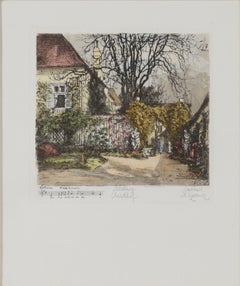
Evening - The depth of the visible -

Evening - The depth of the visible -

Located in Berlin, DE

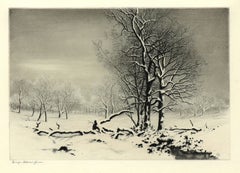
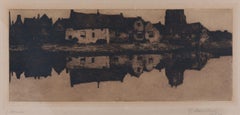
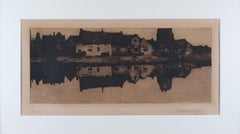
Max Clarenbach (1880 Neuss - Cologne 1952), Evening. Etching, 18 x 41 cm (platemark), 33.5 x 57 cm (frame), inscribed "Abend" in pencil at lower left, signed and dated "M. Clarenbach. 28.III.[19]09". Framed and mounted under glass. - Somewhat browned and slightly foxed. About the artwork The horizontally elongated etching depicts the panoramic view of a small town as seen from the other side of the river. There are gabled houses on the left and a mighty church spire on the right. The bourgeois houses and the large religious building indicate the urban character. These buildings are rendered in dark tones to emphasise the lighter row of houses in the centre of the picture, closer to the water. The chiaroscuro contrast creates two parallel planes that open up a space for the imagination of what the city could be. The imagination is stimulated by the almost entirely dark, barely recognisable buildings, while the arm of the river leading into the city further stimulates the imagination. However, as the silhouette of the city as a whole is reflected in the water, the parallel planes are perceived as a band of houses that stretches across the entire horizontality of the etching and seems to continue beyond the borders of the picture. The reflection has almost the same intensity as the houses themselves, so that the band of buildings merges with their reflection to form the dominant formal unit of the picture. Only the parallel horizontal hatching creates the convincing impression of seeing water, demonstrating Max Clarenbach's mastery of the etching needle. The water is completely motionless, the reflection unclouded by the slightest movement of the waves, creating a symmetry within the formal unity of the cityscape and its reflection that goes beyond the motif of a mere cityscape. A pictorial order is established that integrates everything in the picture and has a metaphysical character as a structure of order that transcends the individual things. This pictorial order is not only relevant in the pictorial world, but the picture itself reveals the order of the reality it depicts. Revealing the metaphysical order of reality in the structures of its visibility is what drives Clarenbach as an artist and motivates him to return to the same circle of motifs. The symmetry described is at the same time inherent an asymmetry that is a reflection on art: While the real cityscape is cut off at the top of the picture, two chimneys and above all the church tower are not visible, the reflection illustrates reality in its entirety. The reflection occupies a much larger space in the picture than reality itself. Since antiquity, art has been understood primarily as a reflection of reality, but here Clarenbach makes it clear that art is not a mere appearance, which can at best be a reflection of reality, but that art has the potential to reveal reality itself. The revealed structure of order is by no means purely formalistic; it appears at the same time as the mood of the landscape. The picture is filled with an almost sacred silence. Nothing in the picture evokes a sound, and there is complete stillness. There are no people in Clarenbach's landscape paintings to bring action into the picture. Not even we ourselves are assigned a viewing position in the picture, so that we do not become thematic subjects of action. Clarenbach also refrains from depicting technical achievements. The absence of man and technology creates an atmosphere of timelessness. Even if the specific date proves that Clarenbach is depicting something that happened before his eyes, without the date we would not be able to say which decade, or even which century, we are in. The motionless stillness, then, does not result in time being frozen in the picture, but rather in a timeless eternity that is nevertheless, as the title "Abend" (evening), added by Clarenbach himself, makes clear, a phenomenon of transition. The landscape of the stalls is about to be completely plunged into darkness, the buildings behind it only faintly discernible. The slightly darkened state of the sheet is in keeping with this transitional quality, which also lends the scene a sepia quality that underlines its timelessness. And yet the depiction is tied to a very specific time. Clarenbach dates the picture to the evening of 28 March 1909, which does not refer to the making of the etching, but to the capture of the landscape's essence in the landscape itself. If the real landscape is thus in a state of transition, and therefore something ephemeral, art reveals its true nature in that reality, subject to the flow of phenomena, is transferred to an eternal moment, subject to a supra-temporal structure of order - revealed by art. Despite this supratemporality, the picture also shows the harbingers of night as the coming darkening of the world, which gives the picture a deeply melancholy quality, enhanced by the browning of the leaf. It is the philosophical content and the lyrical-melancholic effect of the graphic that give it its enchanting power. Once we are immersed in the image, it literally takes a jerk to disengage from it. This etching, so characteristic of Max Clarenbach's art, is - not least because of its dimensions - a major work in his graphic oeuvre. About the artist Born into poverty and orphaned at an early age, the artistically gifted young Max Clarenbach was discovered by Andreas Achenbach and admitted to the Düsseldorf Art Academy at the age of 13. "Completely penniless, I worked for an uncle in a cardboard factory in the evenings to pay for my studies.” - Max Clarenbach At the academy he studied under Arthur Kampf, among others, and in 1897 was accepted into Eugen Dücker...

Category

Early 1900s Realist George Elbert Burr Prints and Multiples
Materials

Etching

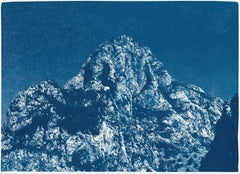
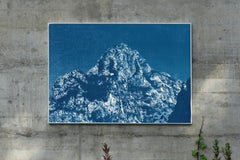
Yosemite Blue Mountain, Cyanotype on Watercolor Paper, Landscape in Indigo

Yosemite Blue Mountain, Cyanotype on Watercolor Paper, Landscape in Indigo

By Kind of Cyan

Located in Barcelona, ES

This is an exclusive handprinted limited edition cyanotype. This cyanotype shows one of the mountains in beautiful Yosemite National park in California. Details: + Title: Yosemite Blue Mountain + Year: 2021 + Edition Size: 100 + Stamped and Certificate of Authenticity provided + Measurements : 70x100 cm (28x 40 in.), a standard frame size + All cyanotype prints are made on high-quality Italian watercolor paper * Frame is for illustrative purposes only. Artwork shipped carefully rolled and packaged in a tube. WHAT IS A CYANOTYPE? The cyanotype (a.k.a. sun-print) process is one of the oldest in the history of photography, dating back to the 1840's. Cyanotypes were then made famous by Anna Atkins, considered the first female photographer. Inspired by nature, we feel the need to look back at a craft that is handmade, analogue, and using an all-natural light source: the sun. Our cyanotypes are made by coating high-quality Italian watercolor paper with a light-sensitive emulsion. We then expose it in direct sunlight for several minutes using a photo negative to get the best image quality. Finally, the print is washed and fixed with water to stop the reaction and prevent fading. What you get is an amazing, royal blue image...

Category

2010s Photorealist George Elbert Burr Prints and Multiples
Materials

Emulsion, Watercolor, Photographic Paper, C Print, Engraving, Etching, M...

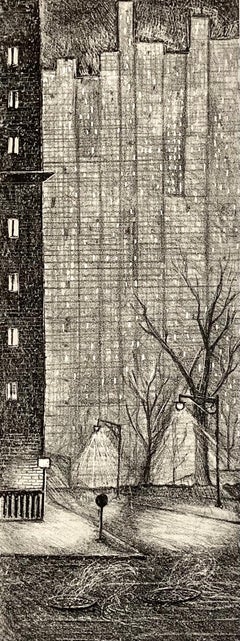
Jack McClain, (Evening in the City) (NYC)

Jack McClain, (Evening in the City) (NYC)

Located in New York, NY

A moody evening in New York City. The buildings capture the quiet that New York sometimes achieves. Signed and dated in pencil.

Category

Mid-20th Century American Modern George Elbert Burr Prints and Multiples
Materials

Lithograph

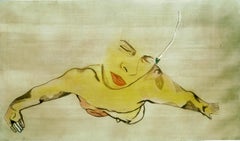
Semen: large scale expressionist nude male figure portrait, floating in pink

Semen: large scale expressionist nude male figure portrait, floating in pink

By Francesco Clemente

Located in New York, NY

This large scale, ethereal portrait depicts a tranquil male nude figure floating in pink and blue. Based on a tempera painting, an expressionist, emotive piece to bring dramatic impa...

Category

1980s Contemporary George Elbert Burr Prints and Multiples
Materials

Drypoint, Etching, Aquatint

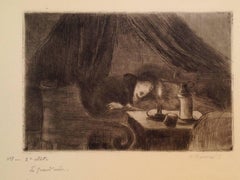
Grand-mere (effet de lumiere)

Grand-mere (effet de lumiere)

By Camille Pissarro

Located in New York, NY

Camille Pissarro (1830-1903), Grand-mere (effet de lumiere), etching and drypoint, 1889, signed in pencil lower right, titled lower left, inscribed “No 3 – ...

Category

1880s Impressionist George Elbert Burr Prints and Multiples
Materials

Drypoint, Etching

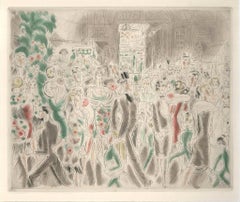
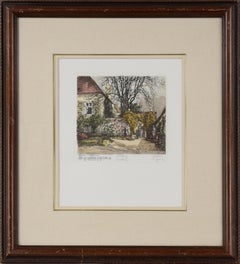
From Rues et Visages de Paris - 1920s - Drypoint/Etching - Modern

From Rues et Visages de Paris - 1920s - Drypoint/Etching - Modern

By Chas Laborde

Located in Roma, IT

Illustrated Plate, from Rues et Visages de Paris is a hand-colored etching and drypoint by Chas Laborde. This original print is hand-colored with tempera and watercolor. In excellent...

Category

1920s Modern George Elbert Burr Prints and Multiples
Materials

Tempera, Watercolor, Drypoint, Etching

"Old Barney"
"Old Barney"

"Old Barney"

By Daniel Garber

Located in Lambertville, NJ

Jim’s of Lambertville Fine Art Gallery is proud to present this piece by Daniel Garber (1880 - 1958). One of the two most important and, so far, the most valuable of the New Hope Sc...

Category

Mid-20th Century American Impressionist George Elbert Burr Prints and Multiples
Materials

Etching

"Improvidence"
"Improvidence"

"Improvidence"

By Daniel Garber

Located in Lambertville, NJ

Jim’s of Lambertville Fine Art Gallery is proud to present this piece by Daniel Garber (1880 - 1958). One of the two most important and, so far, the most valuable of the New Hope Sc...

Category

1920s American Impressionist George Elbert Burr Prints and Multiples
Materials

Etching

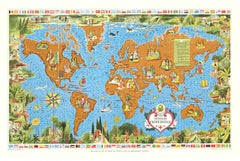
Original 100 Years of the Red Cross World Map vintage planisphere poster

Original 100 Years of the Red Cross World Map vintage planisphere poster

By Lucien Boucher

Located in Spokane, WA

This is a vintage poster titled "Realisation de la Ligue de la Croix-Rouge, Geneva," commemorating one hundred years of the Red Cross from 1863 to 1963. Due to its folds, the poster ...

Category

1960s American Modern George Elbert Burr Prints and Multiples
Materials

Lithograph

Previously Available Items
Palo Verde Trees
Palo Verde Trees

Palo Verde Trees

By George Elbert Burr

Located in Middletown, NY

Etching and engraving on cream wove paper, 5 x 6 3/4 inches (128 x 172 mm), full margins. Signed in pencil in the lower margin. In very good condition with minor age tone. Best know...

Category

Early 20th Century Realist George Elbert Burr Prints and Multiples
Materials

Engraving, Etching

Moonlight Phoenix
Moonlight Phoenix

Moonlight Phoenix

By George Elbert Burr

Located in Santa Monica, CA

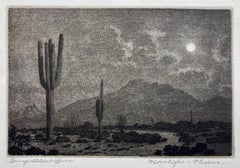
GEORGE ELBERT BURR (1859 – 1939) MOONLIGHT PHOENIX c. 1925 (Seeber 266) Aquatint and etching, Signed and titled in pencil. Image 3 ½ x 5 1/4”, sheet 7 3/8 x 8 ½. Good condition save...

Category

1920s American Realist George Elbert Burr Prints and Multiples
Materials

Aquatint

Desert Twilight, Arizona.

Desert Twilight, Arizona.

By George Elbert Burr

Located in Plano, TX

Desert Twilight, Arizona. Etching and drypoint. c. 1935. Seeber 318. 4 3/4 x 6 3/4 (sheet 8 3/4 x 11 1/8)A glowing impression printed in greenish dark-blue ink on pale cream colored ...

Category

Early 20th Century American Modern George Elbert Burr Prints and Multiples
Materials

Drypoint, Etching

Soapweed, Arizona (no. 2); edition of 40 (original etching from the Desert Set)

Soapweed, Arizona (no. 2); edition of 40 (original etching from the Desert Set)

By George Elbert Burr

Located in Denver, CO

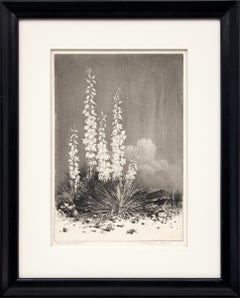
Soapweed, Arizona by George Elbert Burr (1859-1939) original vintage circa 1924 signed etching (drypoint and mezzotint on Arches laid paper), from an edition of 40. This work is part of the artist's renowned series "The Desert Set...

Category

1920s American Realist George Elbert Burr Prints and Multiples
Materials

Etching

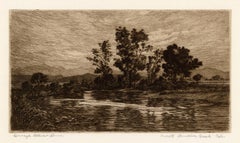
'North Boulder Creek, Colorado' —Southwest American Impressionism

'North Boulder Creek, Colorado' —Southwest American Impressionism

By George Elbert Burr

Located in Myrtle Beach, SC

George Elbert Burr, 'North Boulder Creek, Colorado', etching, c. 1915, Seeber 99. A superb, luminous impression, in dark sepia ink, with skilfully wiped plate tone, on cream laid pap...

Category

1910s American Impressionist George Elbert Burr Prints and Multiples
Materials

Etching

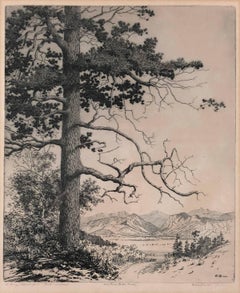
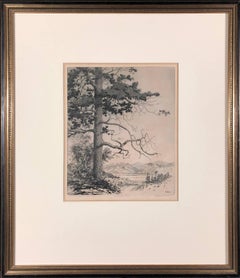
Old Pine Estes Park
Old Pine Estes Park

Old Pine Estes Park

By George Elbert Burr

Located in Missouri, MO

**This is a RARE trial print and a larger size than the normal edition. George Elbert Burr "Lone Oak Estes Park" 1922 Etching Signed, Titled Inscribed Lowe...

Category

1920s American Realist George Elbert Burr Prints and Multiples
Materials

Etching

Longs Peak, Estes Park, Colorado (no. 2).

Longs Peak, Estes Park, Colorado (no. 2).

By George Elbert Burr

Located in Plano, TX

Etching and aquatint printed in colors. Seeber 43. 6 1/8 x 8 3/8 (sheet 9 x 12 1/4). Series: Estes Park. Staining in the margins from a previous mat has been professionally deacidifi...

Category

Early 20th Century American Modern George Elbert Burr Prints and Multiples

Materials

Etching, Aquatint

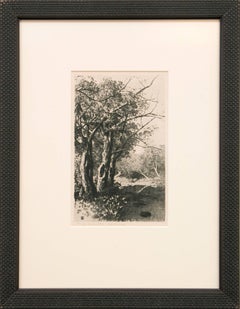
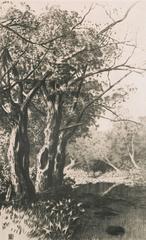
Untitled (Creek and Trees)

Untitled (Creek and Trees)

By George Elbert Burr

Located in Denver, CO

George Elbert Burr, original landscape etching of a Creek and Trees (likely Colorado), signed lower left margin in pencil and dated verso. Presented in a custom frame with all archiv...

Category

1920s Post-Impressionist George Elbert Burr Prints and Multiples
Materials

Etching

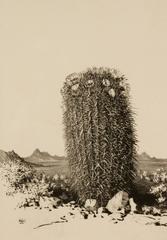
Barrel Cactus, Arizona; edition of 40

Barrel Cactus, Arizona; edition of 40

By George Elbert Burr

Located in Denver, CO

drypoint etching from the famed Desert Set (edition of 40). Seeber Catalogue Raisonne #288. Housed in a custom frame with all archival materials. Outer dimensions measure 16.25 x ...

Category

1920s George Elbert Burr Prints and Multiples
Materials

Drypoint

George Elbert Burr prints and multiples for sale on 1stDibs.
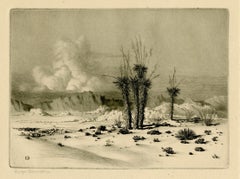
Find a wide variety of authentic George Elbert Burr prints and multiples available for sale on 1stDibs. You can also browse by medium to find art by George Elbert Burr in etching, drypoint, engraving and more. Much of the original work by this artist or collective was created during the 20th century and is mostly associated with the modern style. Not every interior allows for large George Elbert Burr prints and multiples, so small editions measuring 7 inches across are available. Customers who are interested in this artist might also find the work of Louis Oscar Griffith, Walter Tittle, and Daniel Garber. George Elbert Burr prints and multiples prices can differ depending upon medium, time period and other attributes. On 1stDibs, the price for these items starts at $700 and tops out at $1,800, while the average work can sell for $1,320.