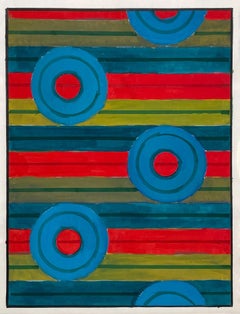
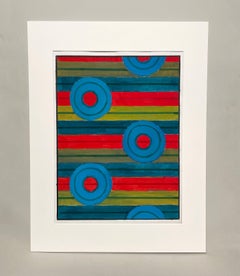
By George L.K. Morris
Located in New York, NY
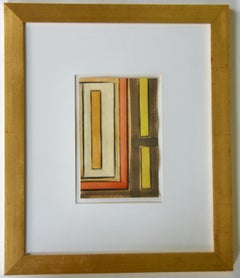
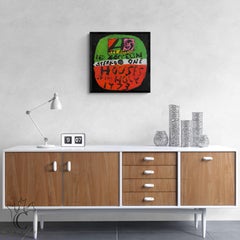
Gouache on paper, 18 7/8 x 14 3/4 in.
Signed (at lower right): Morris; (with monogram, on the back): GLKM [monogram] / 1932 [sic]
Executed circa late 1940s
A passionate advocate of abstract art during the 1930s and 1940s, George L. K. Morris was active as a painter, sculptor, editor, and critic. An erudite man with an internationalist point of view, Morris
eschewed the social, political, and figural concerns that preoccupied so many artists of Depression-era America, believing that painters should focus their attention on the beauty, refinement, and simplicity of pure form instead. His goal, he said, was “to wedge the expression further and further into the confines of the canvas until every shape takes on a spatial meaning” (as quoted in Ward Jackson, “George L. K. Morris: Forty Years of Abstract Art,” Art Journal 32 [Winter 1972–73], p. 150).
Born into an affluent family in New York City, Morris was a descendent of General Lewis Morris, a
signer of the Declaration of Independence. From 1918 until 1924, he attended the Groton School in
Connecticut, studying classics and art. He continued to focus on literature and art while attending
Yale University (1924–28), an experience that prepared him well for his future activity as an artist-critic. After graduating in 1928, Morris studied at the Art Students League of New York, working
under the realist painters John Sloan and Kenneth Hayes Miller, as well as Jan Matulka, the only
modernist on the faculty. In the spring of 1929, Morris traveled to Paris with Albert E. Gallatin, a
family friend and fellow painter who introduced him to leading members of the Parisian avant-garde, including Jean Arp, Pablo Picasso, Georges Braque, Jean Hélion, and Piet Mondrian. Morris also took classes at the Académie Moderne, studying under Fernand Léger and Amédée Ozenfant, important exponents of Synthetic Cubism who influenced his aesthetic development. Indeed, after experimenting with the simplified forms of Modernism for a few years, Morris moved on to abstraction by 1934, adopting a hard-edged, geometric approach inspired by Leger’s cubist style and the biomorphic shapes of Arp and Joan Miró.
Following his return to New York in 1930, Morris built a white-walled, open-spaced studio (inspired
by that of Ozenfant, which had been designed by Le Corbusier) on the grounds of Brockhurst, his
parents’ 46-acre estate in Lenox, Massachusetts. In 1935, he married the painter and collagist Estelle “Suzy...
Category
1940s American Modern George L.K. Morris Art
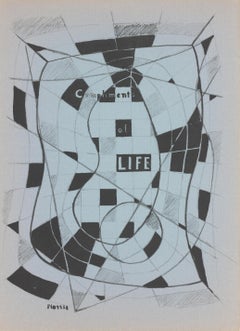
![Untitled [Abstraction]](https://a.1stdibscdn.com/george-lk-morris-1905-1975-american-paintings-untitled-abstraction-for-sale/a_23/1652214284908/APG_8941_unfr_master.jpg?width=240)
![Untitled [Abstraction]](https://a.1stdibscdn.com/george-lk-morris-1905-1975-american-paintings-untitled-abstraction-for-sale-picture-2/a_23/a_101708021652214308831/APG_8941_master.jpg?width=240)