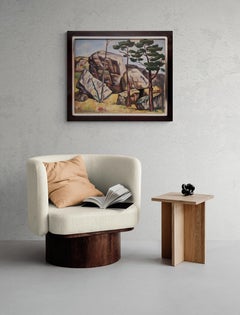
Jan Matulka Art

American, 1890-1972
Matulka studied at the National Academy of Design before traveling to the American Southwest, where he grew inspired by Native-American and Hispanic cultures. Matulka used this inspiration upon returning home to create representational yet distorted artworks. Matulka fluidly oscillates between abstraction and figural painting. He has had many solo exhibitions across NYC and has had his work displayed in notable locations such as The Brooklyn Museum, the Museum of Modern Art, the Whitney Museum of American Art, the Guggenheim Museum, and the Smithsonian American Art Museum.
to
6
2
2
Overall Width
to
Overall Height
to
12
4
5
11
7
3
7
6
4
2
2
2
1
1
1
1
1
7
6
5
3
2
12
11,084
2,853
2,494
1,436
3
11
1
Artist: Jan Matulka
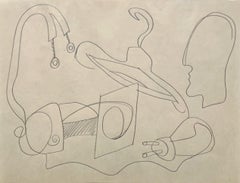
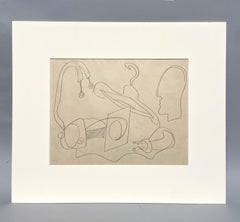
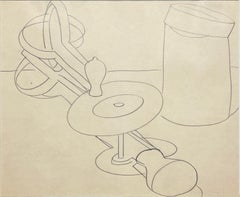
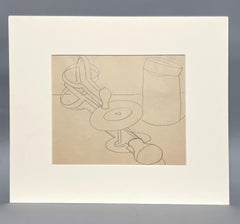
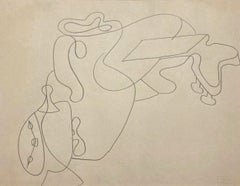
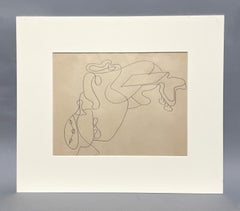
1930s Surrealist Still Life Drawing of Alarm Clock and Mandolin by Jan Matulka

1930s Surrealist Still Life Drawing of Alarm Clock and Mandolin by Jan Matulka

By Jan Matulka

Located in Chicago, IL

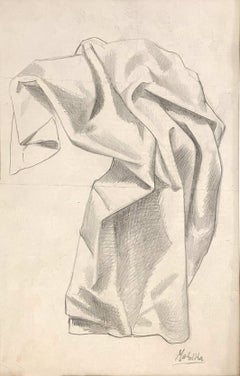
A captivating 1930s Surrealist graphite still life drawing of an alarm clock and mandolin by notable New York Modern artist, Jan Matulka. Artwork size: 8 1/2 x 11 inches. Archivally matted to 14 x 16 1/2 inches. Estate stamped. Provenance: Estate of the artist. An innovative drawing by Matulka reminiscent of the famed series of Modern works by the American painter and contemporary of Matulka, the New York artist Stuart Davis. In 1927, Davis began work on a series of five paintings based on a still life he had created by nailing an eggbeater, an electric fan, and a rubber glove to a table in his studio. Using this group of incongruous and unlikely items, he created his first truly abstract works. An example of these paintings, Egg Beater...

Category

1930s Modern Jan Matulka Art

Materials

Paper, Graphite

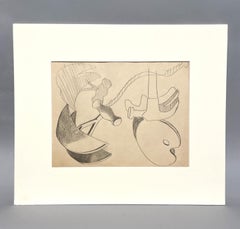
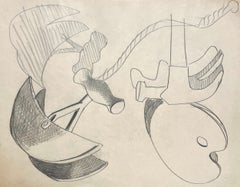
1930s Surrealist Still Life with Hammer, Palette and Chopper by Jan Matulka

1930s Surrealist Still Life with Hammer, Palette and Chopper by Jan Matulka

By Jan Matulka

Located in Chicago, IL

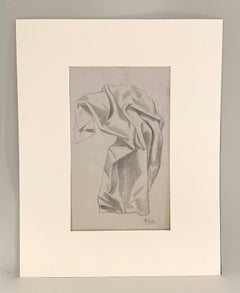
A captivating 1930s Surrealist graphite still life drawing with a hammer, palette and chopper by notable New York Modern artist, Jan Matulka. Artwork size: 8 1/2 x 11 inches. Archivally matted to 14 x 16 1/2 inches. Estate stamped. Provenance: Estate of the artist. An innovative drawing by Matulka reminiscent of the famed series of Modern works by the American painter and contemporary of Matulka, the New York artist Stuart Davis. In 1927, Davis began work on a series of five paintings based on a still life he had created by nailing an eggbeater, an electric fan, and a rubber glove to a table in his studio. Using this group of incongruous and unlikely items, he created his first truly abstract works. An example of these paintings, Egg Beater...

Category

1930s Modern Jan Matulka Art

Materials

Paper, Graphite

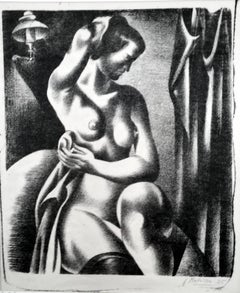
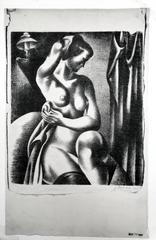
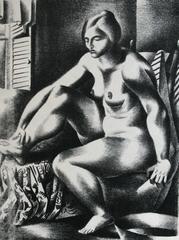
Three-Quarter View of Nude Bathing Seated Near Lamp

Three-Quarter View of Nude Bathing Seated Near Lamp

By Jan Matulka

Located in New York, NY

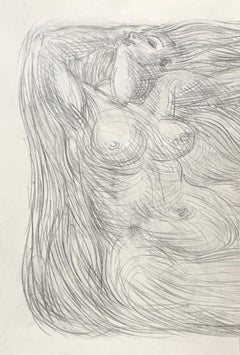
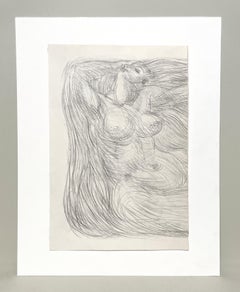
Jan Matulka (1890-1972), Three-Quarter View of Nude Bathing Seated Near Lamp, lithograph, 1925, signed and dated in pencil lower right. Reference: Flint 9...

Category

1920s American Modern Jan Matulka Art

Materials

Lithograph

Still life by Czech / American 20th Century artist Jan Matulka

Still life by Czech / American 20th Century artist Jan Matulka

By Jan Matulka

Located in Petworth, West Sussex

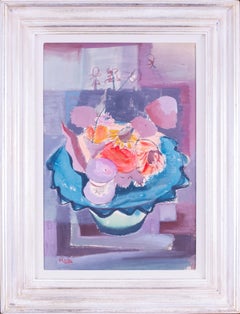
A refined still life by Jan Matulka, executed in gouache on paper, signed lower left. Measuring 21.25 x 14.125 inches (54 x 36 cm), this work exemplifies Matulka’s distinctive approa...

Category

20th Century Modern Jan Matulka Art

Materials

Paper, Gouache

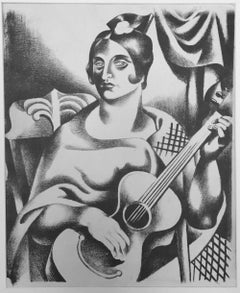
Spanish Woman with Guitar

Spanish Woman with Guitar

By Jan Matulka

Located in New York, NY

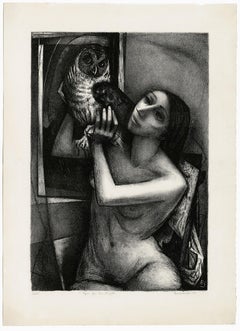
Jan Matulka (1890-1972), Spanish Woman with Guitar, lithograph, 1925, an unsigned proof impression. Reference: Flint 13, only a few impressions known...

Category

1920s American Modern Jan Matulka Art

Materials

Lithograph

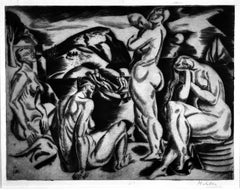
Four Nudes in a Landscape

Four Nudes in a Landscape

By Jan Matulka

Located in New York, NY

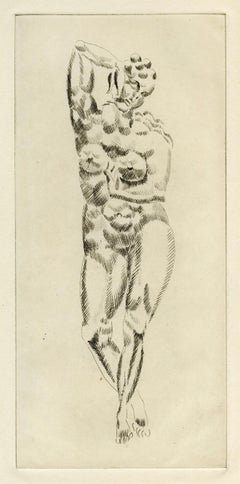
Jan Matulka (1890-1972), Four Nudes in a Landscape, drypoint, c. 1923, signed in pencil lower right margin [also with initials in the plate lower left]. Ref...

Category

1920s American Modern Jan Matulka Art

Materials

Drypoint

Related Items
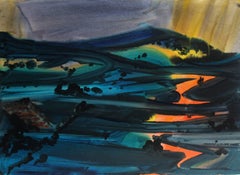
Rainstorm Sunset

Rainstorm Sunset

By Robert Noel Blair

Located in Buffalo, NY

You are viewing a modernist American watercolor painting by Robert Noel Blair. Robert Noel Blair (American, 1912-2003) was an American artist, painter, sculptor, printmaker and te...

Category

American Modern Jan Matulka Art

Materials

Paper, Watercolor

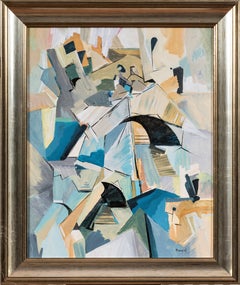
San Marco, Venice — Cubist Italian Cityscape Painting in Blue and Ochre, Acrylic

San Marco, Venice — Cubist Italian Cityscape Painting in Blue and Ochre, Acrylic

By Grégoire Mathias

Located in PÉRIGUEUX, FR

San Marco, Venise Acrylic on Canvas 60 x 49 cm Signed lower right and on the reverse In San Marco, Venise, Grégoire Mathias translates the timeless elegance of Venice’s architecture into his distinctive language of Diachronic Cubism — a style that captures not only multiple spatial perspectives but also the passage of time within a single composition. The familiar arches and reflections of the Venetian lagoon dissolve into an intricate interplay of geometric planes and shifting tones of turquoise, ivory, and sand. The result is a composition that feels both architectural and fluid — an echo of light dancing on water, where memory and presence coexist. Mathias’s mastery lies in how he balances structure and emotion, transforming an iconic cityscape into a meditation on rhythm, space, and movement. Perfect For: Collectors of modern Cubism • Venice and Italy enthusiasts • Contemporary interiors with neutral or coastal tones • Living rooms or entryways seeking architectural depth and movement Collector’s Insight: This painting belongs to Mathias’s Venetian Series, where he explores the interplay between history and modernity through cubist fragmentation. Its soothing palette and elegant balance make it a perfect statement for collectors drawn to contemporary reinterpretations of classic European subjects. Keywords: Venetian painting, Piazza San Marco, cubist architecture, modern cubism, French contemporary art, Greg Mathias, Diachronic Cubism, contemporary Cubism, modern architecture art...

Category

21st Century and Contemporary Cubist Jan Matulka Art

Materials

Canvas, Acrylic

"NY Street Signs" Mid-20th Century WPA 1938 Modernist Abstract Realism Pop Art

"NY Street Signs" Mid-20th Century WPA 1938 Modernist Abstract Realism Pop Art

By Stuart Davis

Located in New York, NY

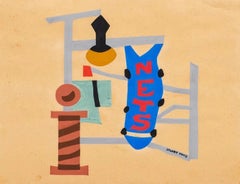
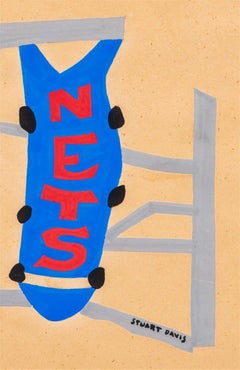
"NY Street Signs" Mid-20th Century WPA 1938 Modernist Abstract Realism Pop Art Stuart Davis (American, 1892-1964) "Street Signs" Modernist gouache and traces of pencil on paper in the proto-pop art style Davis is celebrated for, 1938, signed to lower right, framed. Image: 11 1/4 x 15 1/4 inches. Frame by Bark: 18 1/2 x 22 inches. LITERATURE: A, Boyajian, M. Rutkowski, Stuart Davis, A Catalogue Raisonne, Vol. 2, New Haven, Connecticut, 2007, vol. II, p. 632, no. 1232, illustrated. EXHIBITIONS: ACA Galleries, New York American Artists' Congress: Group Exhibition of Paintings and Sculpture, Dec. 3-16, 1939 (SDAB I, 12/3/39, p. 129). Outlines Gallery, Pittsburgh, Stuart Davis, Mar. 3-16, 1946. Coleman Art Gallery, Philadelphia, 5 Prodigal Sons: Former Philadelphia Artists: Ralston Crawford, Stuart Davis, Charles Demuth, Julian Levi, Charles Sheeler, Oct 4 - 30, 1947 (pamphlet), no. 12. PROVENANCE: The artist; Mr. and Mrs. Frank Bowles, New York, Apr. 3, 1956; thence by descent, Private Collection, New York. NOTES: According to the Catalogue Raissonne, "the title 'Street Signs' is recorded in the artist's account books...

Category

1930s American Modern Jan Matulka Art

Materials

Paper, Gouache, Pencil

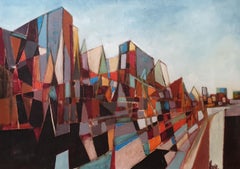
Mid-Century Cubist Cityscape, Oil and Acrylic on Canvas, Signed

Mid-Century Cubist Cityscape, Oil and Acrylic on Canvas, Signed, 1970s

$429Sale Price|69% Off

H 23.63 in W 31.5 in D 0.79 in

Mid-Century Cubist Cityscape, Oil and Acrylic on Canvas, Signed

Located in Cotignac, FR

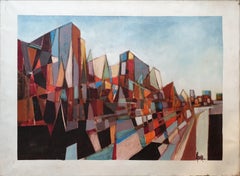
Mid-Century cubist oil and acrylic futuristic cityscape on canvas. Signed bottom right, artist unknown. Highly colourful and well-composed interpretation of a cityscape of the futur...

Category

Mid-20th Century Cubist Jan Matulka Art

Materials

Canvas, Oil, Acrylic

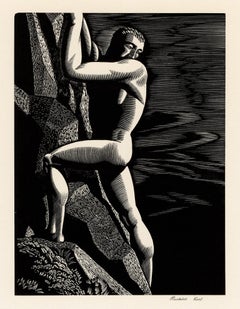
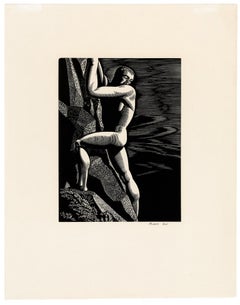
'Mountain Climber' — American Modernism

'Mountain Climber' — American Modernism

By Rockwell Kent

Located in Myrtle Beach, SC

Rockwell Kent, 'Mountain Climber', wood engraving, 1933, edition 250, Burne Jones 93. Signed in pencil. A brilliant, black impression, on cream, wove Japan paper; the full sheet with margins (2 9/16 to 3 5/8 inches); slight skinning at the top sheet edge verso, where previously hinged; otherwise, in excellent condition. Archivally matted to museum standards, unframed. Image size 7 7/8 x 5 7/8 inches (200 x 149 mm); sheet size 14 x 11 1/8 inches (356 x 283 mm). Printed by Pynson Printers, New York. Distributed by The Print Club of Cleveland, Publication No. 11, 1933. Literature: 'Rockwellkentiana,' Harcourt, Brace and Company, New York, 1933. '101 of The World’s Greatest Books', edited by Spencer Armstrong, 1950. Impressions of this work are held in the following museum collections: Akron Art Institute, Burne Jones Collection, IL; Cincinnati Art Museum; Cleveland Museum of Art; Columbus Gallery of Fine Arts; Crystal Bridges Museum of American Art; Davis Museum at Wellesley College; Fine Art Museums of San Francisco; H. M. de Young Museum; Hermitage Museum; Kent Collection, NY; Library of Congress; Memorial Art Gallery, University of Rochester; Metropolitan Museum of Art; New York Public Library; Philadelphia Museum of Art; Princeton University Library; Smithsonian American Art Museum, Spector Collection, NY; SUNY, Plattsburg. ABOUT THE ARTIST Rockwell Kent (1882-1971), though best known as a painter, graphic artist, and illustrator, pursued many careers throughout his life, including architect, carpenter, explorer, writer, dairy farmer, and political activist. Born in Tarrytown, New York, Kent was interested in art from a young age. These ambitions were encouraged by his aunt Jo Holgate, an accomplished ceramicist. Jo came to live with the family after Kent’s father passed away in 1887 and took him to Europe as a teenager, undoubtedly kindling his interest in exploring the world. Kent attended the Horace Mann School in New York City, where he excelled at mechanical drawing. His family’s financial circumstances prevented him from pursuing a career in the fine arts; however, after graduating from Horace Mann in 1900, Kent decided to study architecture at Columbia University. Before matriculating at Columbia, Kent spent the first of three consecutive summers studying painting at William Merritt Chase’s art school in Shinnecock Hills, Long Island. There he found a community of mentors and fellow students who encouraged him to pursue his interest in art. At the end of Kent’s third summer at Shinnecock, Chase offered him a full scholarship to the New York School of Art, where he was a teacher. Kent began taking night classes at the art school in addition to his architecture studies but soon left Columbia to study painting full-time. In addition to Chase, Kent took classes with Robert Henri and Kenneth Hayes Miller, where his classmates included the artists George Bellows and Edward Hopper. Kent spent the summer of 1903 assisting the eccentric painter Abbott Handerson Thayer at his studio in Dublin, New Hampshire—a position he secured through the recommendation of his Aunt Jo. Thayer’s naturalist lifestyle and almost mystical appreciation for natural phenomena greatly influenced Kent; he returned to Dublin for many years to visit Thayer and his family. Thayer gave the young artist time to pursue his work, and that summer Kent painted several views of the New Hampshire landscape, including Mount Monadnock. In 1905 Kent moved from New York to Monhegan Island in Maine, home to a summer art colony, where he continued to find inspiration in nature. Kent soon found success exhibiting and selling his paintings in New York, and in 1907, he was given his first solo show at Claussen Galleries. The following year he married his first wife, Kathleen Whiting (Thayer’s niece), with whom he had five children. The couple divorced in 1924, and Kent married Frances Lee the following year. They divorced after 15 years of marriage, and the artist married Sally Johnstone. For the next several decades, Kent lived a peripatetic lifestyle, settling in several locations in Connecticut, Maine, and New York. During this time he took several extended voyages to remote, often ice-filled, corners of the globe, including Newfoundland, Alaska, Tierra del Fuego, and Greenland, to which he made three separate trips. For Kent, exploration and artistic production were twinned endeavors, and his travels to these rugged, elemental locations inspired his visual art and his writings. He developed a stark, realist landscape style in his paintings and drawings that revealed both nature’s harshness and its sublimity. Kent’s human figures, which appear sparingly in his work, often allude to the mythic themes of isolation, individualism, heroism, and the quest for self-connection. Important exhibitions of works from these travels include the Knoedler Gallery’s shows in 1919 and 1920, featuring Kent’s Alaska drawings...

Category

1930s American Modern Jan Matulka Art
Materials

Woodcut

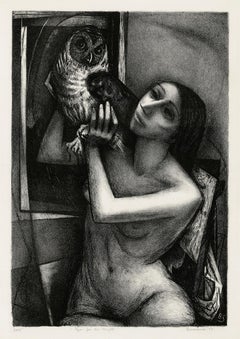
'Eyes for the Night' — Mid-century American Surrealism

'Eyes for the Night' — Mid-century American Surrealism

By Benton Murdoch Spruance

Located in Myrtle Beach, SC

Benton Spruance, 'Eyes for the Night', lithograph, 1947, edition 35, Fine and Looney 260. Signed, dated, titled, and annotated 'Ed 35' in pencil. A fine impression, on heavy, cream ...

Category

1940s American Modern Jan Matulka Art

Materials

Lithograph

An Exquisite 1940s Modern Lithograph of a Female Nude Model, "Flying Figure"

An Exquisite 1940s Modern Lithograph of a Female Nude Model, "Flying Figure"

By Harold Haydon

Located in Chicago, IL

An Exquisite, 1940s Modern Lithograph of a Voluptuous Female Nude Model, "Flying Figure" by Notable Chicago Artist, Harold Haydon (Am. 1909-1994). Completed in 1949, this is a uniqu...

Category

1930s American Modern Jan Matulka Art
Materials

Paper, Lithograph

Tom Wesselmann 1964 American Nude Lithograph, from 1¢ Life

Tom Wesselmann 1964 American Nude Lithograph, from 1¢ Life

By Tom Wesselmann

Located in Washington, DC

Artist: Tom Wesselmann Title: American Nude Portfolio: 1¢ Life Medium: Lithograph in colors Date: 1964 Edition: 2000 Frame Size: 20 3/4" x 28 1/2" Sheet Size: 16 1/4" x 22 3/4" Image...

Category

1960s American Modern Jan Matulka Art

Materials

Lithograph

Female Nude - Standing Female Nude  (Havard)

Female Nude - Standing Female Nude (Havard)

By Elie Nadelman

Located in Fairlawn, OH

Female Nude - Standing Female Nude (Havard) Drypoint, 1920 Unsigned, as issued in the portfolio No signed impression are known to exist From: The Drypoint...

Category

1920s American Modern Jan Matulka Art

Materials

Drypoint

Park XV (Berlin artist, Postwar, Contemporary, Abstract vs Figurative)

Park XV (Berlin artist, Postwar, Contemporary, Abstract vs Figurative)

By Barbara Keidel

Located in Kansas City, MO

Barbara Keidel Park XV (Berlin artist, Postwar, Contemporary, Abstract vs Figurative) Mixed media, pastel on handmade, toned laid paper 1997 Size: 29.5 × 21.25 inches (75 × 54 cm) Si...

Category

1990s Modern Jan Matulka Art

Materials

Pastel, Mixed Media, Laid Paper

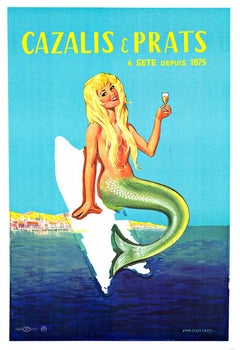
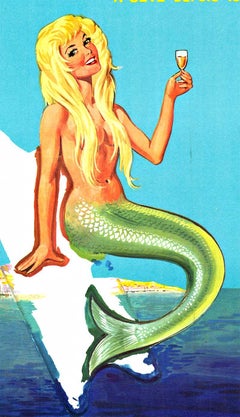
Original CAZALIS & PRATS Grand Cru  Mermaid  vintage French liquor poster

Original CAZALIS & PRATS Grand Cru Mermaid vintage French liquor poster

Located in Spokane, WA

Original CAZALIS & PRATS since 1875. Artist: Emm. Gaillard. Size: 13" x 19.5". Professionally acid-free archival linen backed and ready to frame. Note that a small ink printing line ...

Category

1950s American Modern Jan Matulka Art

Materials

Lithograph

Previously Available Items
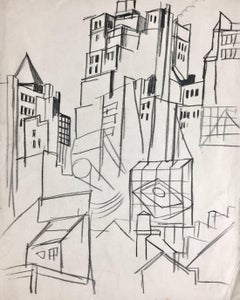
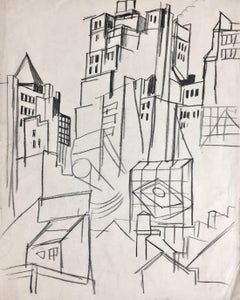
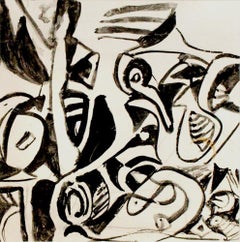
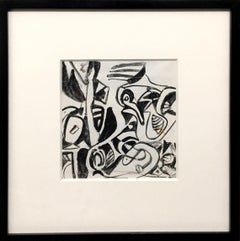
A 1950s Cubist Ink Abstraction by New York Modern Artist, Jan Matulka

A 1950s Cubist Ink Abstraction by New York Modern Artist, Jan Matulka

By Jan Matulka

Located in Chicago, IL

A striking 1950s black & white cubist ink abstraction by New York Modern artist Jan Matulka. Ink and graphite on paper. Image size: 6 x 6 1/2 inches. Archivally matted and fram...

Category

1950s American Modern Jan Matulka Art

Materials

Ink, Graphite, Paper

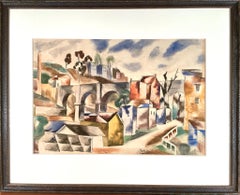
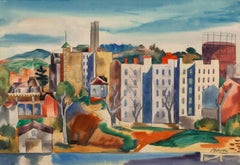
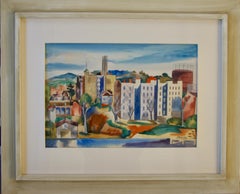
Jan Matulka VIEW OF THE BRONX Watercolor American Modern NYC 20th Century

Jan Matulka VIEW OF THE BRONX Watercolor American Modern NYC 20th Century

By Jan Matulka

Located in New York, NY

VIEW OF THE BRONX Watercolor American Modern Modernism NYC 20th Century Drawing. Jan Matulka (1890 – 1972) "View of the Bronx," 15 x 20 inches. Watercolor on paper, c. 1920s. Signed lower Right. In 1907, he came to the Bronx, New York where he had a poverty-ridden childhood with a mother who tried to raise a family by herself. From 1908 to 1917, he studied at the National Academy of Design, and in 1917, received the first Pulitzer Traveling Scholarship with which he traveled and painted in the Southwest and Florida. His work from this period showed a turning towards a more abstract style, replacing his earlier realism. In 1919, he first went to Paris and then returned in 1927 on a scholarship from the National Academy. In Paris, he was exposed to Cubism, and his painting after that seemed always to carry that influence. He had his first one-man exhibit in New York City in 1925, and by 1930, he and Davis were experimenting with their version of Cubism. Concurrently for New Masses, a communist magazine, he did satiric illustrations expressing his sympathy for the working classes, and from 1929 to 1931, he taught at the Art Students League where he inspired emerging modernists such as David Smith, Dorothy Dehner, and I Rice...

Category

1920s American Modern Jan Matulka Art

Materials

Paper, Watercolor, Graphite

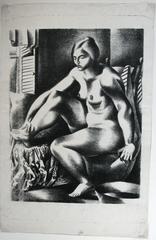
Bather (Nude Bather, Seated, Facing Window).

Bather (Nude Bather, Seated, Facing Window).

By Jan Matulka

Located in Plano, TX

1925. Lithograph. Flint 7. 14 1/8 x 10 3/4 (sheet 18 9/16 x 12 3/8). Very few impressions; no published edition. Fine impression apart from vertical uneven printing line. Printed on ...

Category

1920s American Modern Jan Matulka Art

Materials

Lithograph

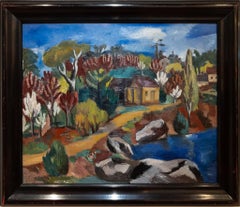
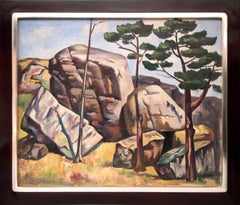
1920s Modernist Mountain Landscape, Framed Colorado Oil Painting, 25 x 30 inches

1920s Modernist Mountain Landscape, Framed Colorado Oil Painting, 25 x 30 inches

By Jan Matulka

Located in Denver, CO

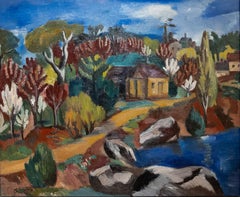
A modernist mountain landscape (likely of Colorado) vintage 1930s oil painting by Jan Matulka (1890-1972). Sogmed nu tje artist in the lower right, estate stamped verso. Custom hand-carved frame measuring 30 x 35 inches, canvas size is 25 x 30 inches. Expedited and International shipping is available - please contact us for a quote. Provenance: Estate of the artist, Jan Matulka About the Artist: By maintaining his Czech birthright and European ties, Jan Matulka played a distinctive role in the development of American modernism. Participating in significant artistic circles in this country and France, he was an enthusiastic emissary of Cubism and Surrealism to both colleagues and students. His independent spirit worked against a successful art career, and personal misfortune and deafness increasingly cut him off from the emerging avant-garde scene. While Matulka experienced a renewed interest in his work before his death, his legacy as an inexhaustible creative force is only now appreciated. Born on a dairy farm in South Bohemia in 1890, Matulka first pursued his artistic ambitions in Prague, an advanced cultural center that quickly embraced Cubist art and architecture. The intellectual vanguard supported a national revival, which included an interest in folk tales and traditions. For the young Czech artist, the simplified yet dynamic forms of Cubism and folk arts would become a liberating vocabulary, one he could apply to the sturdy underpinnings of traditional education. Throughout the many turns of his artwork, Matulka always brought a firm sense of design and command of drawing to his imaginative musings. Arriving in the Bronx with his family in 1907, he began studies the following year at the conservative National Academy of Design, winning the $1500 Joseph Pulitzer Traveling Scholarship upon graduation. Because of the war, his artistic pilgrimage to Picasso’s Spain was stymied. So he traveled to those areas of the US that were settled by the Spanish, such as Florida, Arizona and New Mexico. While in the Southwest, he found a contemporary equivalent of the “primitive” in pueblo, living for a time with the Hopi. Along with naturalistic watercolors, his work stemming from this period is considered among the first modernist interpretations of Southwestern Indian customs. Some of these works were finished from sketches upon his return to New York, where he started to fully express the formalist experimentation of Cubism. In the summer of 1920, Matulka exhibited abstract paintings at Katherine Dreier’s Societe Anonyme along with Patrick Bruce, James Daugherty and Jay Van Everen. Through her largesse, he would have a one-man show in 1926 at the Art Center, 65 East 56th Street, but his thoughtless behavior led to her losing interest in his fortunes. Also upon his return to New York, he married Lida Jirouskova, a librarian whose literary connections led to illustration projects for Matulka. Studying lithography at the Art Students League in the mid-twenties solidified his understanding of graphic principles, and about half of his prints date from between 1925 and 1928. Working in black and white, Matulka developed an understanding of compositions based in shifting relationships of tonality – of contrast of dimension and design. This balance of the linear and the roughhewn characterize even the most colorful of his paintings. Matulka and his wife traveled to Paris in late 1919 or early 1920, and he established a studio in Paris that he kept until 1934. Meeting with the likes of Gertrude Stein, he stayed current with the tastes of the aesthetic elite, such as Diaghilev’s Ballet Russe. Many of his works from this time are reminiscent of Picasso’s mix of neo-classical monumental nudes...

Category

1930s American Modern Jan Matulka Art
Materials

Canvas, Oil

Jan Matulka art for sale on 1stDibs.
Find a wide variety of authentic Jan Matulka art available for sale on 1stDibs. You can also browse by medium to find art by Jan Matulka in pencil, graphite, paper and more. Much of the original work by this artist or collective was created during the 20th century and is mostly associated with the modern style. Not every interior allows for large Jan Matulka art, so small editions measuring 1 inch across are available. Customers who are interested in this artist might also find the work of Winold Reiss, Gordon Grant, and William Zorach. Jan Matulka art prices can differ depending upon medium, time period and other attributes. On 1stDibs, the price for these items starts at $700 and tops out at $65,000, while the average work can sell for $875.
Artists Similar to Jan Matulka