Jean Baptiste Édouard Detaille Landscape Paintings

French, 1848-1912
Jean-Baptiste Édouard Detaille (Paris 5 October 1848 – 23 December 1912 Paris) was a French academic painter and military artist noted for his precision and realistic detail. Detaille grew up in a prosperous military family in Picardy; his grandfather had been an arms supplier for Napoleon. An amateur artist who was friends with a number of collectors and painters, including Horace Vernet, Detaille's father encouraged his son's artistic endeavors. He began his artistic studies at age seventeen under the famous military painter Jean-Louis-Ernest Meissonier; he had originally approached him to ask for an introduction to the renowned Alexandre Cabanel but Meissonier decided to teach Detaille himself. Meissonier became a major influence on his style, and it was he who inculcated an appreciation for accuracy and precision in Detaille. Detaille made his debut as an artist at the Salon—the official art exhibition of the Académie des Beaux-Arts—of 1867 with a painting of Meissonier's studio. At the Salon of 1868, he exhibited his first military painting, The Drummers Halt, which was based solely on his imagination of the French Revolution. With Repose During the Drill, Camp St Maur, which he debuted the following year, Detaille established his reputation as a painter. In the spring of 1870, he went on a "sketching trip" to Algeria with three other young painters, Étienne-Prosper Berne-Bellecour, Alexander Louis Leloir, and Jehan Georges Vibert. Detaille enlisted in the 8th Mobile Bataillon of the French Army when the Franco-Prussian War broke out in 1870; by November he was seeing and experiencing the realities of war. This experience allowed him to produce his famed portraits of soldiers and historically accurate depictions of military manoeuvres, uniforms, and military life in general. He eventually became the official painter of the battles. He published a book called L'Armée Française in 1885, which contains over 300 line drawings and 20 color reproductions of his works. Detaille was one of the first artists to buy photographs from Eugène Atget. In 1912, Detaille created new uniforms for the French army. They were never adopted by the Minister of War, but the blue-gray greatcoats would influence later French World War I uniforms, and the Adrian helmet was heavily influenced by his designs. During his life, he had amassed an impressive collection of military uniforms and artifacts and bequeathed to the Musée de l'Armée in Paris following his death. Detaille appears as a guest at a party at the home of the Princesse de Guermantes in Part Two: Chapter One of Marcel Proust's novel, Cities of the Plain, where Detaille is referred to as "the creator of the Dream", his 1888 painting also known as Le Rêve (The dream) which shows soldiers asleep on a battlefield dreaming of military glory. The painting, which is located at the Musée d'Orsay in Paris.
to
1
1
Overall Width
to
Overall Height
to
2
1
1
2
2
1
1
1
2
1
1
1
1
9
642
633
444
330
2
2
Artist: Jean Baptiste Édouard Detaille
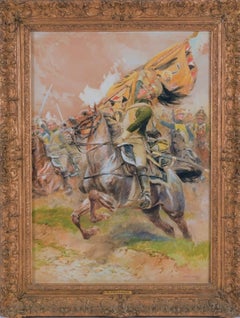
Cavalry Charge 1st Empire - French realism by Edouard Detaille - French art

Cavalry Charge 1st Empire - French realism by Edouard Detaille - French art

By Jean Baptiste Édouard Detaille

Located in PARIS, FR

Conditions : Very good original conditions including a beautiful frame. This Framed under glass with a Length of 90 x 68 cm , this rare composition for sale is an exceptionnel piece...

Category

Late 19th Century Academic Jean Baptiste Édouard Detaille Landscape Paintings

Materials

Tempera

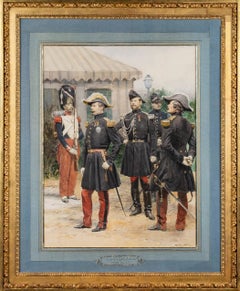
Napoleon III Review Painting, Tempera on carton, Signed, 19th Century

Napoleon III Review Painting, Tempera on carton, Signed, 19th Century

By Jean Baptiste Édouard Detaille

Located in PARIS, FR

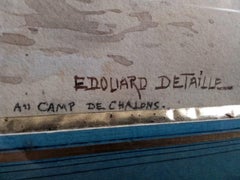
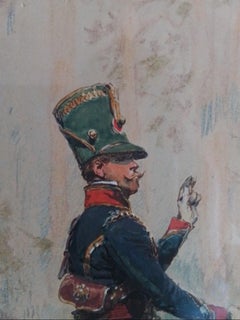
Conditions: Very good condition. In its original frame and glass. A similar composition, but less accomplished, is currently part of the collections of the Musée des Invalides. Signed at the bottom and dated. Complementary shipping worlwide by DHL, FEDEX. Description: This work of art, framed by a majestic golden frame, accurately depicts a group of soldiers in 19th-century uniforms. Every detail, from the golden buttons to the epaulettes, finely illustrates the military equipment of the time. Behind them stands a sober architectural structure, evoking a barracks or a guard post. The color palette, dominated by earthy tones and dark shades of blue, gives a solemn and dignified atmosphere to the scene. The disposition of the soldiers, turned towards the artist, with an attitude both alert and relaxed, captures a moment of daily military life. This painting, with its attention to detail and harmonious composition, transports the viewer into a bygone era, inviting reflection on history and military traditions. EDOUARD DETAILLE The emperor is accompanied by his aide-de-camp, Colonel Castelnau, and Marshal Canrobert. In a gilded wooden frame, under a Marie Louise blue background. Life and time Born in 1848 into a close-knit bourgeois family, Édouard Detaille, the eldest of eight children, displayed early talent in drawing. “He was a prodigy,” notes François Robichon. By the age of thirteen, he exhibited an astonishing surety of hand and a phenomenal sense of composition. His father, connected to Horace Vernet, encouraged him. At seventeen, after passing his baccalaureate, he entered Meissonier’s studio. This relationship, which developed into mutual affection, spared Detaille the academic detour through the École des Beaux-Arts. Rather than dictating an official art style, Meissonier, at the peak of his fame, traveled with his students, introducing them to the nuances of Titian, Rembrandt, and Rubens in Brussels and Lille. In 1867, the Paris of “free trade” dominated the world through the technological revolutions of the Universal Exhibition, and the amiable young man, striking in appearance, discovered the salon of Princess Mathilde and the theater of Dumas fils. He even approached the Empress, noting in his journals, “Not bad, the Empress.” This observation encapsulated Detaille: he had no doubts about his talent, cultivated panache, enjoyed the company of beautiful women, and aimed to conquer the circles of power without sacrificing his freedom. From childhood, he listened to his calling: “Before I could read, I could guess the subjects of battles, the names of famous generals, the weapons of officers and soldiers from the images I admired in the books of Norvins and Laurent de l'Ardèche.” He mingled with collectors and regularly attended military reviews on the Champs-Élysées. His first painting exhibited at the Salon in 1868, “La Halte de tambours,” was praised by critics who immediately recognized “a remarkable truth of observation and simplicity of effect.” The purchase of this work by Princess Mathilde, cousin of Emperor Louis-Napoleon, made Detaille, at twenty, an envied celebrity known to Sainte-Beuve, Théophile Gautier, the Goncourt brothers, and Flaubert. The young artist’s humanistic vision contrasted with the compositions of his predecessors, depicting soldiers in maneuvers, contemplative and resigned as war loomed. **The Combatant’s Vision** The Siege of Paris, where he nearly lost his life in 1870, and the deaths of two brothers in that defeat darkened his outlook. From 1871 onward, Detaille no longer concealed the cruelties of war: German riflemen mowed down by machine gun fire, cavalrymen and panicked horses caught in ambushes, fields plowed by shells strewn with dead animals. The unvarnished tragedy: “It is an absolute fact that no painter has ever rendered a battlefield covered with corpses as it is,” commented Jules Claretie. The fallen bodies still bear the appearance of life in their frozen rigidity. Detaille’s testimony of the devastating defeat and the catastrophic effects of the first total war in history was not a celebration of heroism but a lament, a “lesson in darkness.” “From war, once considered the supreme effort of human genius, we now see only melancholy and horrors,” judged one writer in response to his canvases. “Detaille experienced the reality of combat at a young age during a war that foreshadowed the two world conflicts of the 20th century,” explains François Robichon. With great realism, Detaille painted war from the perspective of the combatant. He introduced a humanity and a critical lucidity regarding the evolution of warfare. His works intensely captured the violence and firepower of new weapons like machine guns. Before he turned thirty, Detaille had become a chronicler of these painful years. He exhibited, as a critic noted, a “striking portrait of modern war” that both French civilians and soldiers had experienced firsthand. He embodied a youth humiliated and eager for revenge. Yet this scrupulous artist also remembered, in his expansive landscapes—from the chalky plateaus of Île-de-France to the Russian plains—the lessons of Corot and Courbet. Manet was not far off. “I wouldn’t want my art to be reduced to mere patriotic art,” he asserted. “A system I often employ and love is to first execute the landscape, very effective, very tight, based on nature…” Echoing Meissonier’s advice: “Always nature, always nature!” Detaille remained close to this father figure, constructing a grand townhouse next to his mentor’s studio at 129 boulevard Malesherbes at the age of 26, having purchased 425 m² of land from the Pereire brothers. He even chose the same architect as Meissonier: Paul Boesvilwald. A bachelor and incorrigible seducer, the painter welcomed his conquests, including Valtesse de la Bigne, amidst his collections, having built his studio in the courtyard. Diplomatic Actor As Detaille’s fame grew, his Malesherbes townhouse quickly became a gathering place for foreign princes, politicians, and heads of state, where Juliette Adam, Léon Gambetta’s muse, offered him valuable advice. The Prince of Wales, the future Edward VII, developed a genuine friendship with the painter. “This fervent patriot, friend of Déroulède, was extraordinarily open to the world,” recounts François Robichon. In just a few years, he gained considerable social, cultural, and international stature. Received at Windsor, at the English court, he was close to Tsar Alexander III and a great friend of Félix Faure. In this capacity, Detaille played a decisive role in the Entente Cordiale, signed in 1904 between England and France, and in the Franco-Russian alliance of 1894, thereby contributing to the Triple Entente among the three powers. An engaged witness of his time—associated with the birth of the “Ligue des Patriotes” alongside Alphonse de Neuville...

Category

Late 19th Century Academic Jean Baptiste Édouard Detaille Landscape Paintings
Materials

Gouache, Oil

Related Items
Sunday on the Wye, Traditional Statement Watercolour Painting, Extra Large Art

Sunday on the Wye, Traditional Statement Watercolour Painting, Extra Large Art

Located in Deddington, GB

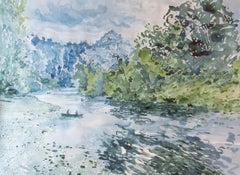
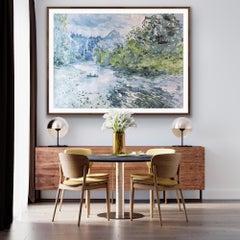
Sunday on the Wye [2021] SOLD UNFRAMED Please note that insitu images are purely an indication of how a piece may look The artist comments "I painted 'Sunday on the Wye' after a day on the river canoeing with the family. It was a wonderful day meandering down stream near Symonds Yat. We turned the bend to see other boats congregated on the pebbles for a Sunday picnic. We beached our boat to take in the surroundings. The day was a great experience with sparkling light on the water and the sounds of the water over rocks. A few quick sketches and many photographs allowed me to then work at a large scale in the studio. It was painted with large brushes with watercolour. The chosen colours are blue and green. The painterly brush marks hold an energy and excitement of the days paddling." This work is sold unframed Artwork by artist Leigh Glover...

Category

21st Century and Contemporary Impressionist Jean Baptiste Édouard Detaille Landscape Paintings

Materials

Paper, Watercolor

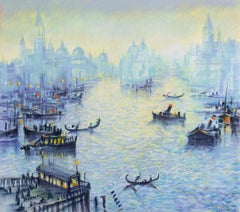
'Venice', French Impressionist, Paris, École des Beaux-Arts, Venetian Vedute

'Venice', French Impressionist, Paris, École des Beaux-Arts, Venetian Vedute

Located in Santa Cruz, CA

Signed lower left, 'Bonnaure' for Alain Bonnaure (French, born 1941) and painted circa 1995. When he was a young artist, Alain Bonnaure's work was purchased by the renowned French p...

Category

1990s Jean Baptiste Édouard Detaille Landscape Paintings

Materials

Pastel, Gouache, Laid Paper

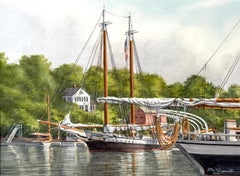
“Classic Sailboats”
“Classic Sailboats”

Ronald Soporito“Classic Sailboats”, Circa 1975

$420Sale Price|20% Off

H 9.5 in W 12.5 in D 1 in

“Classic Sailboats”

Located in Southampton, NY

Beautiful, original watercolor on archival paper of two classic American sailboats by the well known marine artist, Ron Saporito Signed by the artist lower right. Condition is excel...

Category

1970s Academic Jean Baptiste Édouard Detaille Landscape Paintings

Materials

Watercolor, Archival Paper

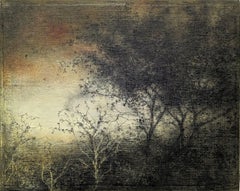
Lull (Tonalist Style Landscape Drawing of Country Forest by Sue Bryan)

Lull (Tonalist Style Landscape Drawing of Country Forest by Sue Bryan)

By Sue Bryan

Located in Hudson, NY

Romantic, tonalist style landscape drawing by Sue Bryan charcoal and acrylic on book pages on wood 8 x 10 inches Hangs flush to the wall, with nail notch on back Signed verso Clean, ...

Category

2010s Contemporary Jean Baptiste Édouard Detaille Landscape Paintings

Materials

Wood, Paper, Charcoal, Acrylic

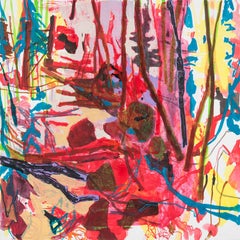
Untitled

Untitled

By Allison Gildersleeve

Located in Dallas, TX

"Behind my canvases, collages, and drawings lies a singular proposition: places are not inert; they are repositories for all that passes through them. My work is an inquiry into the ...

Category

2010s Abstract Jean Baptiste Édouard Detaille Landscape Paintings

Materials

Paper, Ink, Acrylic

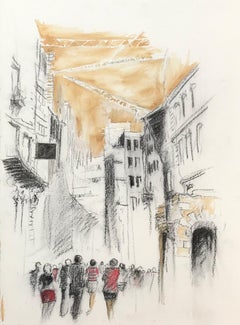
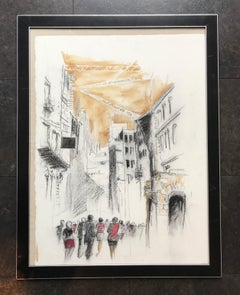
Lively alley by Pierre Duc - Watercolor

Pierre DucLively alley by Pierre Duc - Watercolor

$544Sale Price|61% Off

H 29.93 in W 22.84 in D 0.4 in

Lively alley by Pierre Duc - Watercolor

By Pierre Duc

Located in Geneva, CH

Work on arch paper Black wooden frame with glass pane 87 x 67,5 x 1,5 cm

Category

Late 20th Century Academic Jean Baptiste Édouard Detaille Landscape Paintings

Materials

Watercolor, Pastel

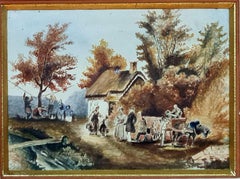
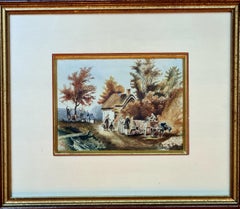
Rural Landscape Watercolour, French School, Mid-19th Century, Framed

Rural Landscape Watercolour, French School, Mid-19th Century, Framed

Located in Cotignac, FR

Mid 19th century watercolour of a rural scene. The painting is not signed but is of very fine quality. Presented in a fine custom gilt frame with a silk and gilt card mount under gla...

Category

Mid-19th Century French School Jean Baptiste Édouard Detaille Landscape Paintings

Materials

Paper, Watercolor, Gouache

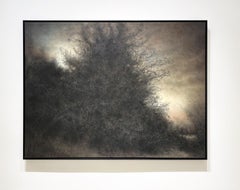
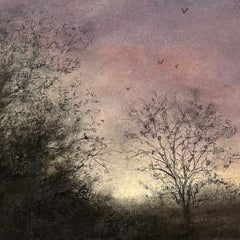
Some Twilight Land (Charcoal Landscape Painting of Country Forest & Sky)

Some Twilight Land (Charcoal Landscape Painting of Country Forest & Sky)

By Sue Bryan

Located in Hudson, NY

Large, highly detailed charcoal and acrylic landscape featuring a lush country forest against a sunlit sky "Some Twilight Land" by Sue Bryan charcoal, acrylic, and pastel on canvas, ...

Category

2010s Contemporary Jean Baptiste Édouard Detaille Landscape Paintings

Materials

Charcoal, Acrylic, Canvas, Oil Pastel

Three Fishermen in a Boat Watercolor, 20th Century American Sporting Art

Three Fishermen in a Boat Watercolor, 20th Century American Sporting Art

By John Whorf

Located in Marco Island, FL

A masterful example of John Whorf at the height of his powers, this large and luminous watercolor depicts three fishermen on a calm, silver-blue lake or bay, their figures rendered w...

Category

20th Century Academic Jean Baptiste Édouard Detaille Landscape Paintings

Materials

Watercolor, Archival Paper

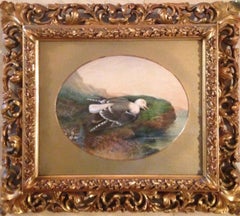
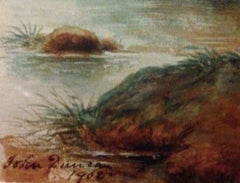
“Dead Gull”
“Dead Gull”

John Duncan“Dead Gull”, 1902

$1,200Sale Price|50% Off

H 15 in W 17 in

“Dead Gull”

By John Duncan

Located in Southampton, NY

In original gold leaf pierced frame Signed and dated lower right 1902 Sight size 7.5 x 9.5 in

Category

Early 1900s Academic Jean Baptiste Édouard Detaille Landscape Paintings

Materials

Paper, Watercolor

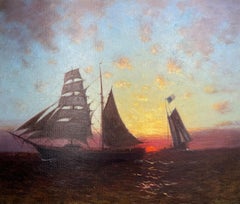
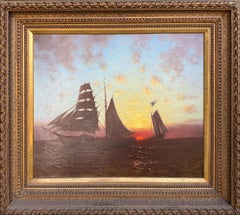
"Ships at Sunset" Hendricks Hallett, Fiery Sunset, Sailing Ships, Marine Scene

"Ships at Sunset" Hendricks Hallett, Fiery Sunset, Sailing Ships, Marine Scene

Located in New York, NY

Hendricks Hallett Ships at Sunset Signed lower left Oil on canvas 22 x 27 inches Hallett, originally from Massachusetts, pursued his studies in Antwerp and Paris. He is primarily r...

Category

1880s Academic Jean Baptiste Édouard Detaille Landscape Paintings

Materials

Canvas, Oil

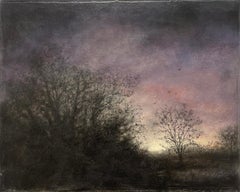
Bring Me the Sunset in a Cup (Tonalist Style Country Landscape at Twilight)

Bring Me the Sunset in a Cup (Tonalist Style Country Landscape at Twilight)

By Sue Bryan

Located in Hudson, NY

Romantic, Tonalist style landscape drawing by Sue Bryan of a lush country forest set against a serene sunset charcoal and acrylic on Arches paper mounted on wood 16 x 20 inches, unf...

Category

2010s Contemporary Jean Baptiste Édouard Detaille Landscape Paintings

Materials

Wood, Paper, Charcoal, Acrylic

Previously Available Items
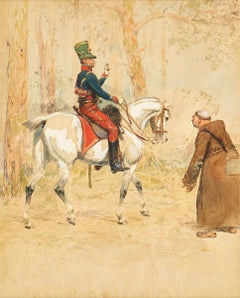
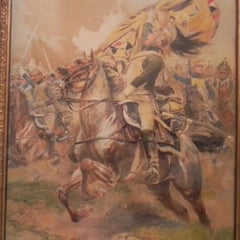
Horse Hunter Of The Imperial Guard Saluting Brother, gouache, signed lower left

Horse Hunter Of The Imperial Guard Saluting Brother, gouache, signed lower left

By Jean Baptiste Édouard Detaille

Located in PARIS, FR

Conditions : Very good overall Conditions, Signature appearance. Frame has a missing gold flake on the upper right. Christie's New York Sale on January 27, 2016. Dimensions with frame 42 x 48 cm. Edouard Detaille: Born in 1848 into a close-knit bourgeois family, Edouard Detaille, the eldest of eight children, showed early talent for drawing. "He was a prodigy," notes François Robichon. At thirteen, he had a stunning surety of hand and a phenomenal sense of composition. His father, connected to Horace Vernet, encouraged him. At seventeen, having passed his baccalaureate, he entered Meissonier's studio. This encounter, which led to mutual affection, spared Detaille the academic detour through the École des Beaux-Arts. Rather than dictating a precisely "official" art, Meissonier, at the height of his fame, traveled with his students, introducing them in Brussels and Lille to the nuances of Titian, Rembrandt, and Rubens. In 1867, the Paris of "free trade" reigned over the world through the technical revolutions of the Exposition Universelle, and the amiable, handsome young man discovered the salon of Princess Mathilde and the theater of Dumas fils. He even approached the empress. "Not bad, the empress," he noted in his journals. This observation encapsulated Detaille: he was confident in his talent, cultivated flair, enjoyed the company of beautiful women, and sought to conquer circles of power without losing his freedom. From childhood, he had listened to his calling: "Before I could read, I imagined the subjects of battles, the names of illustrious generals, the weapons of officers and soldiers, from the images I had admired in the books of Norvins and Laurent de l'Ardèche." He mingled with collectors and would not have missed the military review on the Champs-Élysées for an empire! His first painting exhibited at the Salon in 1868, "The Drummers' Halt," was praised by critics who immediately discerned "remarkable observational truth and simplicity of effect." The purchase of this work by Princess Mathilde, cousin of Emperor Louis-Napoleon, made Detaille, at twenty, an envied celebrity, known to all: Sainte-Beuve, Théophile Gautier, the Goncourt brothers, and Flaubert. The young artist's humanistic vision contrasted with the compositions of his predecessors. His works depicted soldiers in maneuvers, contemplative and resigned in the face of the looming war. The Vision of the Fighter The siege of Paris, where he nearly lost his life in 1870, and the death of two of his brothers in that defeat darkened his outlook. From 1871 onward, Detaille no longer concealed the cruelties of war: German sharpshooters mowed down by machine guns, panicked cuirassiers and horses trapped in an ambush, fields plowed by shells and strewn with dead animals. The unvarnished tragedy: "It is an absolute fact that no painter until now has rendered a battlefield covered in dead as it is," commented Jules Claretie. "The corpses lying there still bear, in their icy rigidity, the appearance of life." Detaille's testimony on the shocking defeat and the devastating effects of the first total war in history was not a celebration of heroism but a lament, a "lesson in darkness." "From war, which used to be considered the supreme effort of human genius, we now see only melancholy and horrors," judged a writer in front of his canvases. "Detaille experienced, at a young age, the reality of battle during this war that bore the seeds of the two world conflicts of the 20th century," explains François Robichon. "With great concern for realism, Detaille paints war from the fighter's perspective. He introduces humanity, a critical lucidity on the evolution of the phenomenon of war. In Detaille's work, with incredible intensity, we find the violence and power of new weapons like machine guns." Detaille became, before he was thirty, the chronicler of these years of pain. He exhibited what a critic described as a "faithful portrait of modern war" that both civilians and soldiers had experienced up close. He embodied a youth humiliated, eager for revenge. Yet this scrupulous artist also remembered, in his vast landscapes, in the chalky plateaus of Île-de-France or in the Russian plain, the lessons of Corot and Courbet. Manet was not far behind. "I wouldn't want my art to be reduced to mere patriotic art," he asserted. "One method I often use and greatly appreciate is to first execute the landscape, very effective, very detailed, closely based on nature..." In him, the advice of Meissonier still resonated: "Do as I do; nature, always nature!" Detaille was so close to this surrogate father that after living on Rue Legendre from 1872 to 1875, he had a mansion built at the age of 26, beginning in 1874, next to his master's studio at 129 Boulevard Malesherbes, on a 425 m² plot purchased from the Pereire family. He had even chosen the same architect as Meissonier: Paul Boesvilwald. A bachelor and incorrigible seducer, the painter entertained his conquests, including Valtesse de la Bigne, amid his collections. He had built his studio in the courtyard. A Diplomatic Actor As Detaille's fame grew, his hotel on Boulevard Malesherbes quickly became a gathering place for foreign princes, politicians, and heads of state, where Juliette Adam, Léon Gambetta's muse, offered him shrewd advice. Thus, the Prince of Wales, the future Edward VII, formed a true friendship with the painter. "This fervent patriot, a friend of Déroulède, was extraordinarily open to the world," recounts François Robichon. "In just a few years, he gained considerable social, cultural, and international standing. Received at Windsor, at the Court of England, he was an intimate of Tsar Alexander III and a close friend of Félix Faure." In this capacity, Detaille was a key player in the Entente Cordiale, signed in 1904, between England and France, the Franco-Russian alliance in 1894, and thus in the Triple Entente among the three powers. An engaged witness of his time—associated with the birth of the "Ligue des Patriotes" with Alphonse de Neuville...

Category

Late 19th Century Academic Jean Baptiste Édouard Detaille Landscape Paintings
Materials

Gouache

Jean Baptiste Édouard Detaille landscape paintings for sale on 1stDibs.

Find a wide variety of authentic Jean Baptiste Édouard Detaille landscape paintings available for sale on 1stDibs. You can also browse by medium to find art by Jean Baptiste Édouard Detaille in gouache, paint, watercolor and more. Much of the original work by this artist or collective was created during the 19th century and is mostly associated with the Impressionist style. Not every interior allows for large Jean Baptiste Édouard Detaille landscape paintings, so small editions measuring 33 inches across are available. Customers who are interested in this artist might also find the work of Francois Gerome, Elie Anatole Pavil, and Victor Gabriel Gilbert. Jean Baptiste Édouard Detaille landscape paintings prices can differ depending upon medium, time period and other attributes. On 1stDibs, the price for these items starts at $2,859 and tops out at $18,196, while the average work can sell for $3,249.

Artists Similar to Jean Baptiste Édouard Detaille