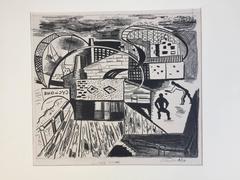
Louis Schanker Prints and Multiples

American, 1903-1981

"Though much of my work is generally classified as abstract, all of my work develops from natural forms. I have great respect for the forms of nature and an inherent need to express myself in relation to those forms. No matter how far my experimental design may take me … there remains always a core of objective reality which I have no desire to destroy or even to impair but only to investigate, analyze, develop." Louis Schanker was one of many members of the American Abstract Artists who chose to base his art in the objects, patterns, and rhythms of nature. Although never a student of Hans Hofmann, Schanker's ideas about art had many parallels with Hofmann's. Concern for the spatial dynamics of a painting's surface, and an insistence on some aspect of nature as a starting point for art, are two areas that mirror a shared philosophy between the two artists. Although much of Schanker's later work is completely abstract, during the 1930s and 1940s he frequently used direct, identifiable themes—motifs drawn from sports, his early years working for a circus, and even socially conscious subjects not normally employed by abstract artists. During the mid 1930s, Schanker began making prints and subsequently became a graphic arts supervisor for the WPA. He also completed murals for radio station WNYC, the Neponsit Beach Hospital in Long Island, and the Science and Health building at the 1939 New York World's Fair. During World War II, Schanker worked as a shipfitter and began teaching the technique of color woodblock printing at the New School for Social Research. In 1949, he became an assistant professor at Bard College, where he remained until his retirement. Throughout the 1930s and 1940s, Schanker exhibited frequently in group shows both in museums and in commercial galleries. He became especially well known for his innovations as a printmaker. Schanker belonged to The Ten, a group that exhibited together in protest against the hegemony of Americanscene painting in Whitney exhibitions and in support of artistic experimentation and an international (rather than nativist) outlook in art.

to
2
3
2
1
Overall Width
to
Overall Height
to
2
13
1,106
999
902
686
8
4
3
1
4
4
5
4
3
2
1
1
1
7
1
5
8
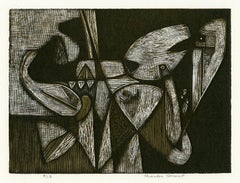
Artist: Louis Schanker
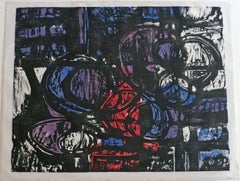
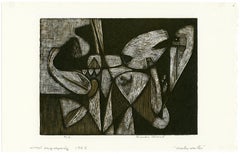
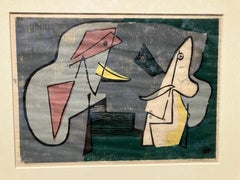
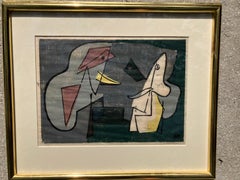
GREEN AND BLACK
GREEN AND BLACK

GREEN AND BLACK

By Louis Schanker

Located in Portland, ME

Schanker, Louis (American, 1903-1981). GREEN & BLACK. Color Woodcut, 1941 Brooklyn Museum Booklet 53. Edition of 55 plus 20 trial Proofs. Signed, titled, and numbered 10/55 and inscr...

Category

1940s Louis Schanker Prints and Multiples

Materials

Woodcut

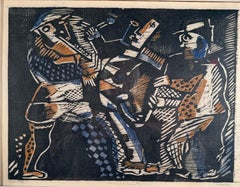
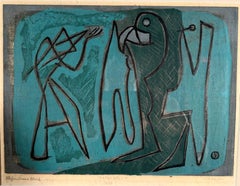
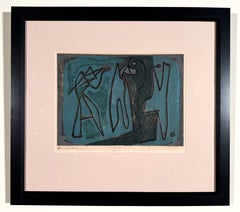
MUSICAL CLOWNS
MUSICAL CLOWNS

MUSICAL CLOWNS

By Louis Schanker

Located in Portland, ME

Schanker, Louis (American, 1903-1981). MUSICAL CLOWNS, Color Woodcut, 1937 Brooklyn Museum Booklet 31. From the Second Edition Edition of 21 (The first edition was 30, plus 12 Trial ...

Category

1930s Louis Schanker Prints and Multiples

Materials

Woodcut

Louis SCHANKER “Jai Alai”

Louis SCHANKER “Jai Alai”

By Louis Schanker

Located in San Francisco, CA

Louis Schanker : 1903-1981. Well, listed American abstract artist. He was well exhibited and is in the permanent collections of many important museums. This fabulous piece is a color...

Category

1930s Abstract Louis Schanker Prints and Multiples

Materials

Woodcut

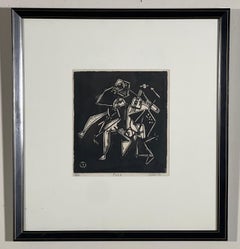
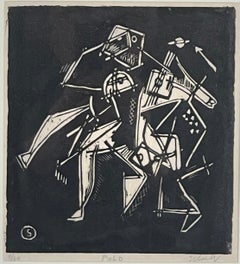
POLO
POLO

POLO

By Louis Schanker

Located in Portland, ME

Schanker, Louis (American, 1903-1981). POLO. Woodcut, 1937. Edition of 30. Signed, titled, and numbered, all in pencil. Printed on Japan paper. 7 7/8 x 7 1/4 inches (image), framed t...

Category

1930s Louis Schanker Prints and Multiples

Materials

Woodcut

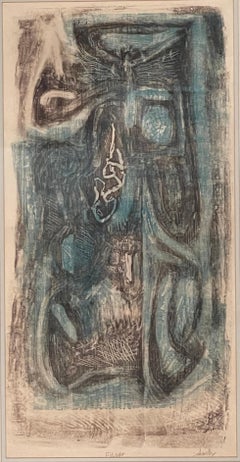
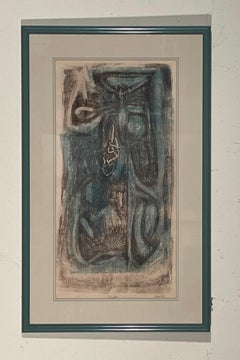
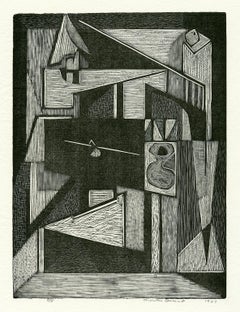
FIGURE NO. 1
FIGURE NO. 1

FIGURE NO. 1

By Louis Schanker

Located in Portland, ME

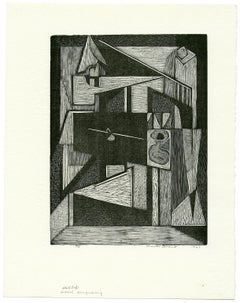
Schanker, Louis (American 1903-1981). FIGURE NO.1. Johnson 99. Wood etching in colors, 1949. Edition of 6. Titled and signed in pencil. 25 1/2 X 13 3/8 inches (image). Framed to 33...

Category

1940s Louis Schanker Prints and Multiples

Materials

Woodcut

CIRCLE IMAGE NO. 25

CIRCLE IMAGE NO. 25

By Louis Schanker

Located in Portland, ME

Schanker, Louis. CIRCLE IMAGE NO. 25. Relief Print in color, 1954-1955. Edition of 210 published by IGAS. Signed and numbered 17/200 (the edition included 10 artist's proofs). 14 x 1...

Category

1950s Abstract Louis Schanker Prints and Multiples

Materials

Woodcut

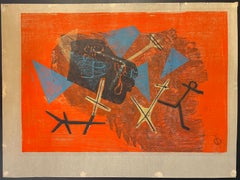
CARNIVAL

CARNIVAL

By Louis Schanker

Located in Portland, ME

Schanker, Louis CARNIVAL. Color woodcut, 1948. Edition of 30. Signed, titled and numbered 24/30 in pencil. 14 1/4 x 21 inches (image), 18 x 24 inches (sheet). Hinging residue, verso,...

Category

1940s Louis Schanker Prints and Multiples

Materials

Woodcut

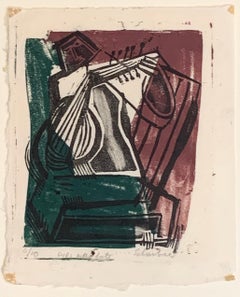
GIRL WITH LUTE

GIRL WITH LUTE

By Louis Schanker

Located in Portland, ME

Schanker, Louis (American 1903-1981). GIRL WITH LUTE. Johnson 18. Linocut in colors, 1938. Edition of 10. Titled, numbered 6/10 and signed in pencil. 5 1/2 x...

Category

1930s Louis Schanker Prints and Multiples

Materials

Linocut

Related Items
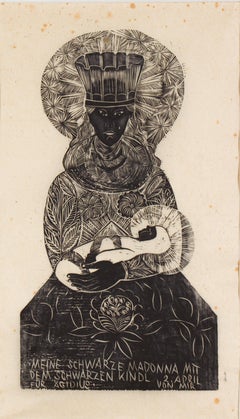
Schwarze Madonna

Auguste KronheimSchwarze Madonna

$1,150

H 21.19 in W 15.75 in

Schwarze Madonna

By Auguste Kronheim

Located in Wien, 9

Auguste Kronheim was born in Amsterdam in 1937. The artist makes woodcuts and drawings. She received her training in drawing from Hanns Kobinger and graduated from the Linz Federal T...

Category

20th Century Modern Louis Schanker Prints and Multiples

Materials

Woodcut

Heron Moon
Heron Moon

Suezan AikinsHeron Moon, c.1990

$750

H 15.75 in W 28.25 in D 0.75 in

Heron Moon

By Suezan Aikins

Located in San Francisco, CA

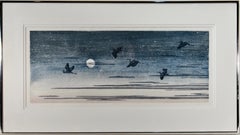
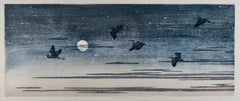
This artwork titled "Heron Moon" c.1990, is a color woodblock print on paper by noted Canadian/Japanese artist Suezan Aikins, b.1952. It is signed, titled and numbered 58/150 in pencil by the artist. The artwork (image) size is 8.5 x 21 inches, framed size is 15.75 x 28.25 inches. Custom framed in a silver metal frame, with double off white matting. It is in excellent condition, the frame have some small minor rubs, barely visible. About the artwork: This artwork required have 5 different carved wood blocks and 9 layers of colors to complete. About the artist: Born in Montreal in 1952, Suezan was influenced early in her life by the works of modern Japanese woodblock printmakers which hung throughout her parents’ home. She attended the Fine Arts programme at Mount Allison University in Sackville, New Brunswick (1969 - 1971), The Ontario College of Art (1971-73), L’ ecole du Musee des Beaux Arts (1974), Nova Scotia College of Art and Design -BFA (1975) as well as a very intensive year of study with Toshi Yoshida in Tokyo (1984-85). She has exhibited extensively in both public and private galleries throughout North America and Japan. Recent exhibitions include solo shows in Tokyo, Osaka, Okinawa, and Boston with group exhibitions at the Wenniger Gallery, Boston, Royal Canadian Academy in Toronto and the Canadian Museum of Nature in Ottawa. Her paintings and woodblock prints are found in many collections such as The Canada Council Art Bank, The Nickle Art Museum, The Art Gallery of Nova Scotia, The Royal Bank of Canada, Prince Takamanonamiya Norihito, the Embassy of Canada in Tokyo, The Thomas Moore Institute as well as private collections. Suezan Aikins was awarded the Elizabeth Greenshields Foundation grant in 1983, Nova Scotia Department of Culture - Development Grants in 1980, 1987 and 1988. She was elected to the Royal Canadian Academy of Art in 1990 and received the Canadian Progress Club- Women of Excellence Award for Culture in 1993. Her work has been featured in a number of television documentaries as well as many Canadian magazines. STUDIES: Yoshida Woodblock Print Studio Tokyo, 84-85 Nova Scotia College of Art & Design, Halifax, 74-75 BFA Ecole du Musee des Beaux Arts, Montreal, 74 Ontario College of Art, Toronto, 71-73 Mt. Allison University, 69-72 SELECTED SOLO SHOWS: 25 Year Retrospective of Woodblock Prints traveled to three Public Galleries in Germany: Dornum Castle; Tollhousverein, Leer; Rastede Palace, Oldenberg 2000-2001 color catalog and reviews. Private Exhibitions, Falmouth, Mass., July 1996; Montreal, November 1996; Gibson Island, Md., April 1999. Gold Paintings and Woodblock Retrospective, travelling: Kabutoya Gallery, Tokyo; Genkan Gallery, Tokyo American Club; Blue Nile Gallery, Osaka; Kanda's Gallery BOQ, Okinawa; May 1994 (color catalogue) Edo Gallery, Boston, November 1992, Private Exhibitions, Chatham, Mass, July 1992, Toronto, Oct. 1991 New Paintings and Woodblocks Kabutoya Gallery, Tokyo, May 1991, and also in 1987. Japanese Garden and Pavilion Foundation, Montreal, September 1990, Ownens Art Gallery, Mount Allison University 1988 Zwickers Gallery, Halifax, NS, 1979; Gallery 78; Fredericton, November, 1983; Robertson Galleries, Ottawa, November, 1982 SELECTED GROUP SHOWS: "A New Leaf" 30 foot instalation of mixed media/ goldleaf reliefs, Artsplace, Annapolis Royal, N.S., 2000 color catalog "Far and Wide" Juried Bienials, Art Gallery of Nova Scotia; 1996 to '99, travelling, catalogs "Moku Hanga Travelling Exhibition: Contemporary Japanese Woodcuts...

Category

Late 20th Century Realist Louis Schanker Prints and Multiples
Materials

Woodcut

Underwater — Mid-century Modern

Underwater — Mid-century Modern

By Charles Quest

Located in Myrtle Beach, SC

Charles Quest, 'Underwater', 1948, chiaroscuro wood engraving, edition 12. Signed, titled, dated and numbered '3/12' in pencil. A fine, richly-inked impression, in dark brown and warm black, on off-white wove paper, with full margins (5/8 to 1 1/2 inch), in excellent condition. Scarce. ABOUT THE ARTIST Charles Quest, painter, printmaker, and fine art instructor, worked in various mediums, including mosaic, stained glass, mural painting, and sculpture. Quest grew up in St. Louis, his talent evident as a teenager when he began copying the works of masters such as Michelangelo on his bedroom walls. He studied at the Washington University School of Fine Arts, where he later taught from 1944 to 1971. He traveled to Europe after his graduation in 1929 and studied at La Grande Chaumière and Academie Colarossi, Paris, continuing to draw inspiration from the works of the Old Masters. After returning to St. Louis, Quest received several commissions to paint murals in public buildings, schools, and churches, including one from Joseph Cardinal Ritter, to paint a replica of Velasquez's Crucifixion over the main altar of the Old Cathedral in St. Louis. Quest soon became interested in the woodcut medium, which he learned through his study of J. J. Lankes' A Woodcut Manual (1932) and Paul Landacre's articles in American Artist magazine ‘since no artists in St. Louis were working in wood’ at that time. Quest also revealed that for him, wood cutting and engraving were ‘more enjoyable than any other means of expression.’ In the late 1940s, his graphic works began attracting critical attention—several of his woodcuts won prizes and were acquired by major American and European museums. His wood engraving entitled ‘Lovers’ was included in the American Federation of Art's traveling print exhibition in 1947. Two years later, Quest's two prize-winning prints, ‘Still Life with Grindstone’ and ‘Break Forth into Singing’, were exhibited in major American museums in a traveling show organized by the Philadelphia Print Club. His work was included in the Chicago Art Institute's exhibition, ‘Woodcut Through Six Centuries’, and the print ‘Still Life with Vise’ was purchased by the Museum of Modern Art in New York. In 1951 he was invited by artist-Curator Jacob Kainen to exhibit thirty wood engravings and color woodcuts in a one-person show at the Smithsonian's National Museum (now known as the American History Museum). Kainen's press release praised the ‘technical refinement’ of Quest's work: ‘He obtains a great variety of textural effects through the use of the graver, and these dense or transparent grays are set off against whites or blacks to achieve sparkling results. His work has the handsome qualities characteristic of the craftsman and designer.’ At the time of the Smithsonian exhibition, Quest's work was represented by three New York galleries in addition to one in his home town. He had won 38 prizes, and his prints were in the collections of the Library of Congress, the Chicago Art Institute, the Metropolitan Museum, and the Philadelphia Museum of Art. In cooperation with the Art in Embassies program, his color woodcuts were displayed at the American Embassy in Paris in 1951. Recognition at home came in 1955 with his first solo exhibition in St. Louis. Press coverage of the show heralded the ‘growth of graphic arts toward rivaling painting and sculpture as a major independent medium’. An exhibition of his prints at the Bethesda Art Gallery in 1983 attracted Curator Emeritus Joseph A. Haller, S.J., who began purchasing his work for Georgetown University's collection. In 1990 Georgetown University Library's Special Collections Division was the recipient of a large body of Quest's work, including prints, drawings, paintings, sculpture, stained glass, and his archive of correspondence and professional memorabilia. These extensive holdings, including some 260 of his fine prints, provide a rich opportunity for further study and appreciation of this versatile and not-to-be-forgotten mid-Western American artist...

Category

1940s American Modern Louis Schanker Prints and Multiples

Materials

Woodcut

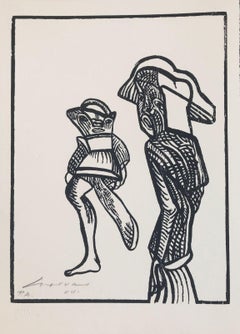
Jose Luis Cuevas original artist proof signed woodcut Ghosts of downtown V paper

Jose Luis Cuevas original artist proof signed woodcut Ghosts of downtown V paper

By José Luis Cuevas

Located in Miami, FL

Jose Luis Cuevas (Mexico, 1934-2017) Artist Proof 'Fantasmas del Centro Histórico V', 2004 woodcut on paper Guarro Biblos 250g. 20.9 x 16 in. (53 x 40.5 cm.) Edition of 60 Unframed I...

Category

Early 2000s Contemporary Louis Schanker Prints and Multiples

Materials

Paper, Woodcut, Ink

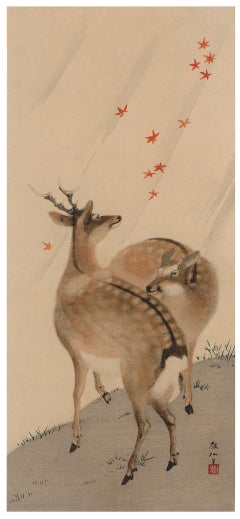
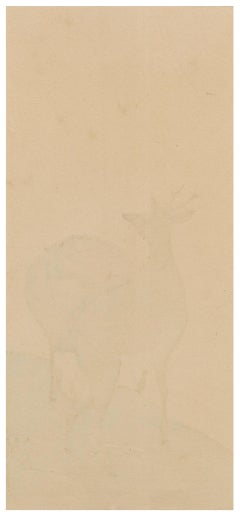
Deer Beneath Falling Maple Leaves — Shijō School Japanese Woodblock Print, Kyoto

Deer Beneath Falling Maple Leaves — Shijō School Japanese Woodblock Print, Kyoto

Located in Myrtle Beach, SC

Mori Sōsen, 'Deer Beneath Falling Maple Leaves', color woodblock print after the artist's watercolor, c. 1895. Signed Sosen in black ink with the artist's seal in red, lower right. A...

Category

1890s Naturalistic Louis Schanker Prints and Multiples

Materials

Woodcut

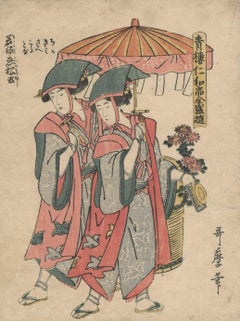
Famous Japanese woodcut artist Kitagawa Utamaro festival in the Yoshiwara

Famous Japanese woodcut artist Kitagawa Utamaro festival in the Yoshiwara

By Kitagawa Utamaro 1

Located in Fairlawn, OH

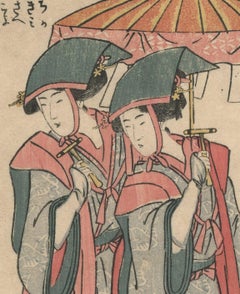
Kitagawa Utamaro (1750-1806) Wakamurasaki, Matsukaze ("Young Murasaki" and "Wind in the Pines.") Color woodcut, c. 1800 Signed in the block, Utamaro fude (see photo) Series: Seirō Niwaka Zensei Asobi ( "Popular Entertainment at the Niwaka Festival, Yoshiwara".) (Green Houses) is a poetic term for the pleasure quarters, specifically the Yoshiwara district."Niwaka" refers to amateur theatrical performances and parades held during the Niwaka festival Format: chuban Fresh colors and condition Housed in an 8 ply rag mat with OP3 Acrylic in a rounded corner Hackman 1" metal leaf frame Image size: 9 x 7 inches Frame size: 14-1/4 x 16-7/8 x 3/4" These are names of chapters from the classic 11th-century novel The Tale of Genji (Genji monogatari). The women in the print are likely performing a parody (mitate) or "modern" version of these classic themes. The print depicts two beauties in elaborate costumes, carrying umbrellas and flowers, typical of the processions held during the Niwaka festival in the Yoshiwara. Kitagawa Utamaro (1750-1806) Kitagawa Utamaro is highly appreciated as the dominating ukiyo-e artist of the late eighteenth century. Yet little is known about his life. Neither the precise date of Utamaro's birth, his birthplace, nor any substantial information about his parents are known. Utamaro’s original name was Ichitaro Kitagawa. It is generally agreed that he started his career as a pupil of the painter Toriyama Sekien. His early known works are actor portraits and theater programs, published under the name of Utagawa Toyoaki. In 1781/82 he changed his name to Kitagawa Utamaro. Around 1783 Utamaro started a successful cooperation with the publisher Tsutaya Juzaburo. Together they published several book illustrations. The early works of Utamaro were influenced by Torii Kiyonaga and Harunobu Suzuki...

Category

Early 1800s Other Art Style Louis Schanker Prints and Multiples

Materials

Woodcut

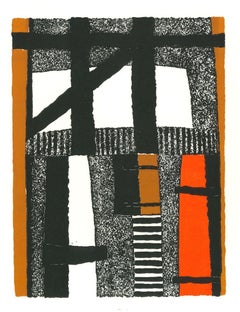
Composition - Woodcut by Luigi Spacal - 1970s

Composition - Woodcut by Luigi Spacal - 1970s

By Luigi Spacal

Located in Roma, IT

Composition is a contemporary artwork realized by Luigi Spacal (Trieste, 1907 - Trieste, 2000) in the 1970s. Original Colored woodcut print on cardboard. Image Dimensions: 18 x 14 cm Good conditions. Lojze Spacal...

Category

1970s Abstract Louis Schanker Prints and Multiples

Materials

Woodcut

'Venus'  — German Expressionism

'Venus' — German Expressionism

By Karl Michel

Located in Myrtle Beach, SC

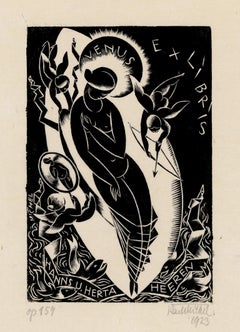
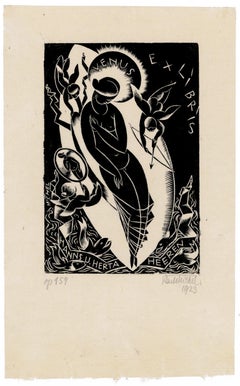
Karl Michel, 'Venus, Ex Libris - Hanns U. Herta Heeren', woodcut, 1923, edition not stated but small. Signed, dated, and numbered 'op.154' in pencil. Signed in the block, lower left. A fine impression, on cream Japan paper, with full margins (15/16 to 2 11/16 inches), in good condition. Printed by the artist. Matted to museum standards (unframed). . Translation: Venus Ex Libris for Hanns and Herta Heeren. Image size 5 15/16 x 4 inches (156 x 102 mm); sheet size 9 5/8 x 6 inches (245 x 152 mm). ABOUT THE ARTIST Karl Michel (1889-1984) was a noted graphic designer and expressionist printmaker during Germany's pre-Nazi Weimar Republic (1919-1933). Michel’s work was the subject of a feature article in the influential German graphic design magazine Das Plakat (The Poster) in 1920. An anti-war advocate, Michel created a suite of 12 wood engravings depicting his impressions of the humanitarian toll of WWII entitled ‘Humanitas’ (Humanity). The German publishing house Greifenverlag published the series in a reduced folio of unsigned prints. Michel’s graphic work is held in the permanent collections of the Auckland War Memorial Museum (New Zealand), Frederikshavn Kunstmuseum & Exlibrissamling (Denmark), Museum of Applied Arts (Budapest), The Robert Gore Rifkind Center for German Expressionist Studies at the Los Angeles County Museum of Art, and the German Expressionism...

Category

1920s Expressionist Louis Schanker Prints and Multiples
Materials

Woodcut

'Chion-in Temple Gate' from 'Eight Scenes of Cherry Blossoms' — Jizuri Seal

'Chion-in Temple Gate' from 'Eight Scenes of Cherry Blossoms' — Jizuri Seal

By Hiroshi Yoshida

Located in Myrtle Beach, SC

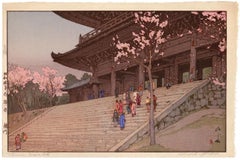
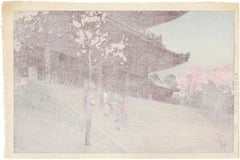
Hiroshi Yoshida, 'Chion-in Temple Gate (Sunset)' from the series 'Eight Scenes of Cherry Blossoms (Sakura hachi dai: Sakura mon)', color woodblock print, 1935. Signed in brush 'Yoshida' and in pencil 'Hiroshi Yoshida'. A superb, early impression, with fresh colors; the full sheet with margins, on cream Japan paper; an area of slight toning in the top right sheet corner, not affecting the image, otherwise in excellent condition. Marked with a jizuri (self-printed) seal, upper left margin. Self-published by the artist. Image size 9 5/8 x 14 3/4 inches (444 x 375 mm); sheet size 10 7/8 x 16 inches (276 x 406 mm). Archivally sleeved, unmatted. Provenance: M. Nakazawa, Tokyo. Literature: Japanese Landscapes of the 20th Century (Hotei Publishing calendar), 2001, May. Collections: Honolulu Museum of Art, Museum of Fine Arts, Boston. ABOUT THE IMAGE Located in Kyoto, Chionin is the main temple of the Jodo sect of Japanese Buddhism, one of the most popular Buddhist sects in Japan, having millions of followers. The Sanmon Gate, Chionin's entrance gate, standing 24 meters tall and 50 meters wide, it is the largest wooden temple gate in Japan and dates back to the early 1600s. Behind the gate, a broad set of stairs leads to the main temple grounds. ABOUT THE ARTIST Painter and printmaker Yoshida Hiroshi (1876-1950) is regarded as one of the greatest artists of the Japanese 'shin hanga' (New Print) movement. Yoshida was born as the second son of Ueda Tsukane in Kurume, Fukuoka Prefecture, a schoolteacher from an old samurai family. In 1891 he was adopted by his art teacher Yoshida Kasaburo in Fukuoka and took his surname. In 1893 he went to Kyoto to study painting, and the following year to Tokyo to join Koyama Shotaro's Fudosha private school; he also became a member of the Meiji Fine Arts Society. These institutions taught and advocated Western-style painting, greatly influencing Yoshida’s artistic development. In 1899 Yoshida had his first American exhibition at Detroit Museum of Art (now Detroit Institute of Art), making the first of many visits to the US and Europe. In 1902 he helped reorganize the Meiji Fine Arts Society, renaming it the Taiheiyo-Gakai (Pacific Painting...

Category

1930s Showa Louis Schanker Prints and Multiples
Materials

Woodcut

Still Life — Mid-century Modern

Still Life — Mid-century Modern

By Charles Quest

Located in Myrtle Beach, SC

Charles Quest, 'Still Life', 1947, wood engraving, edition 8. Signed, dated, and numbered '3/8' in pencil. Titled and annotated 'wood engraving' in the bottom left margin. A fine impression, on off-white wove paper, with full margins (1 to 2 inches), in excellent condition. Scarce. Matted to museum standards, unframed. ABOUT THE ARTIST Charles Quest, painter, printmaker, and fine art instructor, worked in various mediums, including mosaic, stained glass, mural painting, and sculpture. Quest grew up in St. Louis, his talent evident as a teenager when he began copying the works of masters such as Michelangelo on his bedroom walls. He studied at the Washington University School of Fine Arts, where he later taught from 1944 to 1971. He traveled to Europe after his graduation in 1929 and studied at La Grande Chaumière and Academie Colarossi, Paris, continuing to draw inspiration from the works of the Old Masters. After returning to St. Louis, Quest received several commissions to paint murals in public buildings, schools, and churches, including one from Joseph Cardinal Ritter, to paint a replica of Velasquez's Crucifixion over the main altar of the Old Cathedral in St. Louis. Quest soon became interested in the woodcut medium, which he learned through his study of J. J. Lankes' A Woodcut Manual (1932) and Paul Landacre's articles in American Artist magazine ‘since no artists in St. Louis were working in wood’ at that time. Quest also revealed that for him, wood cutting and engraving were ‘more enjoyable than any other means of expression.’ In the late 1940s, his graphic works began attracting critical attention—several of his woodcuts won prizes and were acquired by major American and European museums. His wood engraving entitled ‘Lovers’ was included in the American Federation of Art's traveling print exhibition in 1947. Two years later, Quest's two prize-winning prints, ‘Still Life with Grindstone’ and ‘Break Forth into Singing’, were exhibited in major American museums in a traveling show organized by the Philadelphia Print Club. His work was included in the Chicago Art Institute's exhibition, ‘Woodcut Through Six Centuries’, and the print ‘Still Life with Vise’ was purchased by the Museum of Modern Art in New York. In 1951 he was invited by artist-Curator Jacob Kainen to exhibit thirty wood engravings and color woodcuts in a one-person show at the Smithsonian's National Museum (now known as the American History Museum). Kainen's press release praised the ‘technical refinement’ of Quest's work: ‘He obtains a great variety of textural effects through the use of the graver, and these dense or transparent grays are set off against whites or blacks to achieve sparkling results. His work has the handsome qualities characteristic of the craftsman and designer.’ At the time of the Smithsonian exhibition, Quest's work was represented by three New York galleries in addition to one in his home town. He had won 38 prizes, and his prints were in the collections of the Library of Congress, the Chicago Art Institute, the Metropolitan Museum, and the Philadelphia Museum of Art. In cooperation with the Art in Embassies program, his color woodcuts were displayed at the American Embassy in Paris in 1951. Recognition at home came in 1955 with his first solo exhibition in St. Louis. Press coverage of the show heralded the ‘growth of graphic arts toward rivaling painting and sculpture as a major independent medium’. An exhibition of his prints at the Bethesda Art Gallery in 1983 attracted Curator Emeritus Joseph A. Haller, S.J., who began purchasing his work for Georgetown University's collection. In 1990 Georgetown University Library's Special Collections Division was the recipient of a large body of Quest's work, including prints, drawings, paintings, sculpture, stained glass, and his archive of correspondence and professional memorabilia. These extensive holdings, including some 260 of his fine prints, provide a rich opportunity for further study and appreciation of this versatile and not-to-be-forgotten mid-Western American artist...

Category

1940s American Modern Louis Schanker Prints and Multiples
Materials

Woodcut

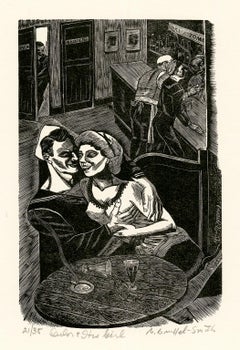
'Sailor and His Girl' —Mid-Century Modernism, WWII

'Sailor and His Girl' —Mid-Century Modernism, WWII

By Bernard Brussel-Smith

Located in Myrtle Beach, SC

Bernard Brussel-Smith, 'Sailor and His Girl', wood engraving, 1941, edition 35. Signed, titled, and numbered '21/35' in pencil. Signed in the block, lower right. A superb, richly-in...

Category

1940s American Modern Louis Schanker Prints and Multiples
Materials

Woodcut

Previously Available Items
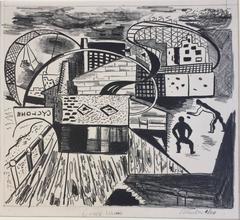
CYCLONE, CONEY ISLAND ca 1933

CYCLONE, CONEY ISLAND ca 1933

By Louis Schanker

Located in Santa Monica, CA

LOUIS SCHANKER (1903 – 1981) CYCLONE, CONEY ISLAND ca 1933 Lithograph 10 7/8 x 12 ½” signed, and with no. 1/10. Rare thus! Annotation: Coney Island. ...

Category

1930s American Modern Louis Schanker Prints and Multiples
Materials

Lithograph

Louis Schanker prints and multiples for sale on 1stDibs.
Find a wide variety of authentic Louis Schanker prints and multiples available for sale on 1stDibs. You can also browse by medium to find art by Louis Schanker in woodcut print, linocut and more. Much of the original work by this artist or collective was created during the 20th century and is mostly associated with the modern style. Not every interior allows for large Louis Schanker prints and multiples, so small editions measuring 12 inches across are available. Customers who are interested in this artist might also find the work of Byron Browne, Caroline Durieux, and Douglas Gorsline. Louis Schanker prints and multiples prices can differ depending upon medium, time period and other attributes. On 1stDibs, the price for these items starts at $750 and tops out at $2,800, while the average work can sell for $1,225.