Otto Henry Bacher Art

to
1
Overall Width
to
Overall Height
to
1
1
1
1
1
11,187
2,855
2,494
1,437
1
Artist: Otto Henry Bacher
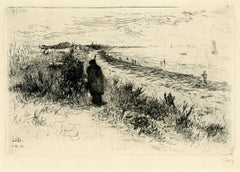
Lido (Venice)
Lido (Venice)

Lido (Venice)

By Otto Henry Bacher

Located in Fairlawn, OH

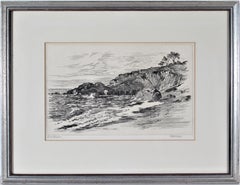
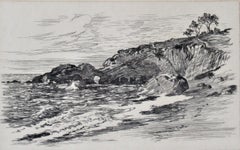
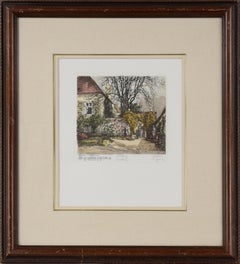
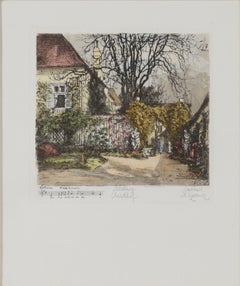
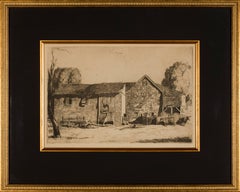
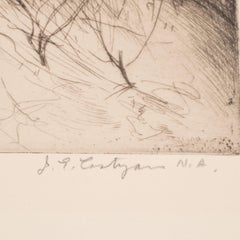
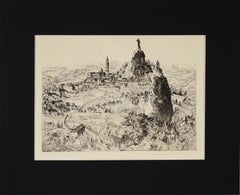
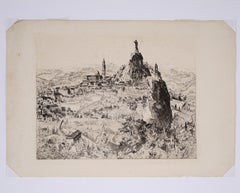
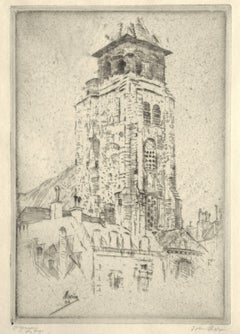
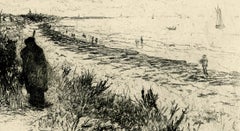
Lido (Venice) Etching on chine collee, 1880 Part of the artist's "Venice Set" Signed upper right in plate :Otto H Bacher" (see photo) Signed with the estate stamp, Lugt 2002 recto lower right beneath image. (see photo) Created October 20, 1880 Reference: Andrew Venice No. 29 Provenance: Estate of the Artist Otto H. Bacher (1856-1909) Otto Henry Bacher was born in Cleveland, Ohio, to a family of German descent. He first studied art at the age of sixteen with local genre trompe l'oeil still-life artist, DeScott Evans. Although he studied with Evans for less than one year, Bacher's early work, comprised mainly of still lifes, betrays Evans's influence. After a short period in Philadelphia, where he studied at the Pennsylvania Academy of the Fine Arts, Bacher returned to Cleveland and met Willis Seaver Adams, an artist from Springfield, Massachusetts, who had just recently arrived upon the Cleveland art scene. Soon the two artists were rooming together. Adams was instrumental in the founding of the Cleveland Art Club, as well as the establishment of the Cleveland Academy of the Fine Arts, to the board of which Adams had Bacher appointed. Also during this time, Bacher began to learn the process of etching from local etcher and landscape painter Sion Longley Wenban. In 1878, Bacher and Adams left for Europe. After stopping briefly in Scotland, Bacher went on to Munich, where he enrolled at the Royal Academy. He quickly tired of the rigors of the academy, and soon he was studying with Cincinnati artist Frank Duveneck, the prime American exponent of the Munich School. In 1879, Bacher made a trip to Florence with Duveneck as one of the celebrated "Duveneck Boys." Early the following year, the group proceeded to Venice, where Bacher and several other artists established studios in the Casa Jankovitz. By this time an avid printmaker, Bacher had his etching press sent from Muni ch, and it was in his Venice studio that he taught Duveneck the rudiments of etching. Soon Bacher, Duveneck, and other members of the Duveneck circle were experimenting in printmaking. Among the group's contributions were some of the first American examples of monotypes, which they called "Bachertypes" because they were printed using Bacher's press. It was also in Venice that Bacher met the venerable American expatriate artist, James McNeill Whistler. On learning of Bacher's press and his collection of etchings by Rembrandt, Whistler made himself a regular visitor to Bacher's studio, and he eventually took his own room in the Casa Jankovitz. Bacher spent much of the rest of 1880 with Whistler, the two artists sharing etching techniques. From Whistler, Bacher learned tone and line graduation; from Bacher, Whistler learned his etching techniques, including better ways of using the acid bath which produced less tedious and more efficient work. Bacher visited Whistler occasionally in the years that followed, and in 1908 he published With Whistler in Venice, his famous recollections of his time with the great artist. Bacher spent the next two years traveling extensively throughout Italy, with Venice as the center of his operations, and he produced a number of important etchings of Italian subjects. Bacher sent several of these works to America in 1881 to be included in the Society of American artists exhibition that year, and had a similar group of works shown at the Royal Society of Painter-Etchers' first exhibition at the Hanover Gallery in London. Following the exhibition, Bacher, along with several other of the American contributors, was elected a Fellow of the Society. Bacher collected twelve of his etchings of Venetian subjects and sold them in bound volumes through his New York dealer, Frederick Keppel. Bacher returned to Cleveland in January 1883 as a fully cosmopolitan artist. He set up a lavish studio furnished with exotic items and objets-d'art he had collected on his travels, and began to hold art classes as a means to supplement his income. He soon joined with Joseph De Camp in forming a summer sketch class in Richfield, Ohio. Bacher and De Camp also planned the Cleveland Room for a major loan exhibition in Detroit that year. During this period, Bacher increasingly painted in oil, and he began to produce sun-dappled canvases in an impressionistic mode. Unable to sell any paintings from this early period, however, Bacher left Cleveland for Paris in 1885, where he planned to undertake further studies. Stopping first in London to visit Whistler, Bacher stayed only briefly in Paris before heading to Venice, where he spent the remainder of the year. In January 1886, Bacher returned to Paris and enrolled at the Académie Julian, and also entered the atelier of Emile-Auguste Carolus-Duran. The life of the student seems never to have suited Bacher, as he stayed in Paris only through June, before departing again for Venice. For the next six months he, Robert Blum, and Charles Ulrich...

Category

1880s American Impressionist Otto Henry Bacher Art

Materials

Etching

Related Items
Arch Beach, California

Arch Beach, California

Located in San Francisco, CA

This artwork titled "Arch Beach, California" c.1910 is an original etching on Wove paper by American artist Harley DeWitt Nichols, 1859-1939. It is hand signed and titled in pencil by the artist. The plate mark (image) size is 6.5 x 9.5 inches, framed size is 13 x 17 inches. it is custom framed in a wooden silver frame, with off white matting. It is in excellent condition, especially considering the age. About the artist: Born in the small rural Wisconsin town of Barton, Harley lived a peripatetic life. As a young child, he accompanied his family to Lincoln, Nebraska where he found great excitement in the roaming herds of buffalo and Native Americans. It was in these years that a talent for drawing was discovered. In 1870, after several years of hardship, his father moved the family back to Wisconsin. At the age of 11 he became a water boy...

Category

Early 20th Century American Impressionist Otto Henry Bacher Art

Materials

Etching

George Elbert Burr Rocky Mountain Color Aquatint Etching, Longs Peak

George Elbert Burr Rocky Mountain Color Aquatint Etching, Longs Peak

By George Elbert Burr

Located in Denver, CO

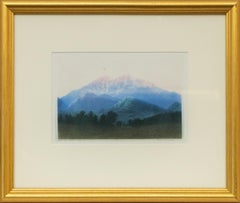
An exceptional original color aquatint etching by renowned American printmaker George Elbert Burr (1859–1939), depicting the iconic peaks of Longs Peak and Mount Meeker in Colorado's...

Category

1920s American Impressionist Otto Henry Bacher Art

Materials

Aquatint

"Old Barney"
"Old Barney"

"Old Barney"

By Daniel Garber

Located in Lambertville, NJ

Jim’s of Lambertville Fine Art Gallery is proud to present this piece by Daniel Garber (1880 - 1958). One of the two most important and, so far, the most valuable of the New Hope Sc...

Category

Mid-20th Century American Impressionist Otto Henry Bacher Art

Materials

Etching

"Improvidence"
"Improvidence"

"Improvidence"

By Daniel Garber

Located in Lambertville, NJ

Jim’s of Lambertville Fine Art Gallery is proud to present this piece by Daniel Garber (1880 - 1958). One of the two most important and, so far, the most valuable of the New Hope Sc...

Category

1920s American Impressionist Otto Henry Bacher Art

Materials

Etching

Broad Street (Wall Street)

Broad Street (Wall Street)

By Bror Julius Olsson Nordfeldt

Located in Myrtle Beach, SC

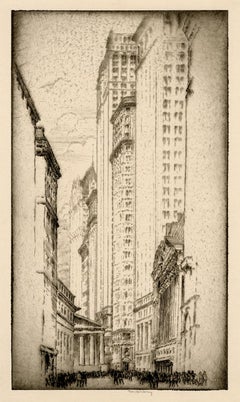
B.J.O. Nordfeldt, 'Broad Street (Wall Street)', etching, edition not stated, c. 1915. Signed in pencil. A superb impression, with rich burr, selectively wiped plate tone, and inky plate edges, on cream wove paper; the full sheet with margins (3/4 to 1 1/4 inches), in excellent condition. Printed by the artist. Matted to museum standards, unframed. Impressions of this work are in the permanent collections of the Fine Arts Museums of San Francisco, Princeton University, Smithsonian American Art Museum. A view looking down Broad Street past the New York Stock Exchange Building on the right with the columned Federal Hall...

Category

1910s American Impressionist Otto Henry Bacher Art

Materials

Etching

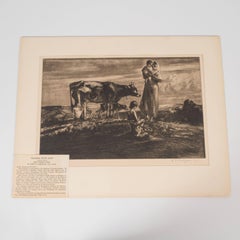
"Woman, Boy and Goats", Original Signed Etching by John E. Costigan

"Woman, Boy and Goats", Original Signed Etching by John E. Costigan

By John Costigan

Located in New York, NY

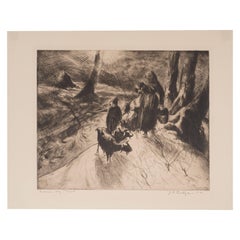
This original, limited edition etching, was realized by the esteemed American artist John E. Costigan, who is represented in the collections of the Metropolitan Museum, the Philips Memorial Gallery in Washington and the Brooklyn Museum, to name only a few of the many institutions that feature his work. This print, with its highly considered composition and its loose style of figuration- deftly balances realism and abstraction- helps to explain his acclaim. This etching features a mother walking with her child and two goats in a forested glen. It is a Classic pastoral scene rendered in Costigan's inimitable style- somewhere between Theodore Rousseau and Thomas Hart Benton. These offer a beautiful glimpse of a bygone American pastoral...

Category

1930s American Impressionist Otto Henry Bacher Art

Materials

Etching

Vintage Etching - Cathedral of Notre Dame and the Chapel of St. Michel, 1928

Vintage Etching - Cathedral of Notre Dame and the Chapel of St. Michel, 1928

By John Taylor Arms

Located in Soquel, CA

Vintage Etching - Cathedral of Notre Dame and the Chapel of St. Michel, 1928 Vintage black and white etching of the Cathedral of Notre Dame and the Chapel of St. Michel, 1928 by Joh...

Category

1920s American Impressionist Otto Henry Bacher Art

Materials

Etching, Laid Paper

Signed Original Pastoral Etching by John E. Costigan

Signed Original Pastoral Etching by John E. Costigan

By John Costigan

Located in New York, NY

This original, limited edition etching, was realized by the esteemed American artist John E. Costigan, who is represented in the collections of the Metropolitan Museum, the Philips M...

Category

1930s American Impressionist Otto Henry Bacher Art

Materials

Etching

"Spring Valley Willows"

"Spring Valley Willows"

By Daniel Garber

Located in Lambertville, NJ

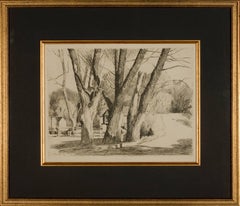
Jim’s of Lambertville Fine Art Gallery is proud to present this piece by Daniel Garber (1880 - 1958). One of the two most important and, so far, the most valuable of the New Hope School Painters, Daniel Garber was born on April 11, 1880, in North Manchester, Indiana. At the age of seventeen, he studied at the Art Academy of Cincinnati with Vincent Nowottny. Moving to Philadelphia in 1899, he first attended classes at the "Darby School," near Fort Washington; a summer school run by Academy instructors Anshutz and Breckenridge. Later that year, he enrolled at the Pennsylvania Academy of the Fine Arts. His instructors at the Academy included Thomas Anshutz, William Merritt Chase and Cecilia Beaux. There Garber met fellow artist Mary Franklin while she was posing as a model for the portrait class of Hugh Breckenridge. After a two year courtship, Garber married Mary Franklin on June 21, 1901. In May 1905, Garber was awarded the William Emlen Cresson Scholarship from the Pennsylvania Academy, which enabled him to spend two years for independent studies in England, Italy and France. He painted frequently while in Europe, creating a powerful body of colorful impressionist landscapes depicting various rural villages and farms scenes; exhibiting several of these works in the Paris Salon. Upon his return, Garber began to teach Life and Antique Drawing classes at the Philadelphia School of Design for Women in 1907. In the summer of that same year, Garber and family settled in Lumbertville, Pennsylvania, a small town just north of New Hope. Their new home would come to be known as the "Cuttalossa," named after the creek which occupied part of the land. The family would divide the year, living six months in Philadelphia at the Green Street townhouse while he taught, and the rest of the time in Lambertville. Soon Garber’s career would take off as he began to receive a multitude of prestigious awards for his masterful Pennsylvania landscapes. During the fall of 1909, he was offered a position to teach at the Pennsylvania Academy as an assistant to Thomas Anshutz. Garber became an important instructor at the Academy, where he taught for forty-one years. Daniel Garber painted masterful landscapes depicting the Pennsylvania and New Jersey countryside surrounding New Hope. Unlike his contemporary, Edward Redfield, Garber painted with a delicate technique using a thin application of paint. His paintings are filled with color and light projecting a feeling of endless depth. Although Like Redfield, Garber painted large exhibition size canvases with the intent of winning medals, and was extremely successful doing so, he was also very adept at painting small gem like paintings. He was also a fine draftsman creating a relatively large body of works on paper, mostly in charcoal, and a rare few works in pastel. Another of Garber’s many talents was etching. He created a series of approximately fifty different scenes, most of which are run in editions of fifty or less etchings per plate. Throughout his distinguished career, Daniel Garber was awarded some of the highest honors bestowed upon an American artist. Some of his accolades include the First Hallgarten Prize from the National Academy in 1909, the Bronze Medal at the International Exposition in Buenos Aires in 1910, the Walter Lippincott Prize from the Pennsylvania Academy and the Potter Gold Medal at the Art Institute of Chicago in 1911, the Second Clark Prize and the Silver Medal from the Corcoran Gallery of Art for “Wilderness” in 1912, the Gold Medal from the Panama-Pacific Exposition in San Francisco of 1915, the Second Altman Prize in1915, the Shaw prize in 1916, the First Altman Prize in 1917, the Edward Stotesbury Prize in1918, the Temple Gold Medal, in 1919, the First William A...

Category

1940s American Impressionist Otto Henry Bacher Art

Materials

Etching

St. Germain-Des-Pres, Paris

St. Germain-Des-Pres, Paris

By John Marin

Located in New York, NY

John Marin (1870-1953), St. Germain-Des-Pres, Paris, etching, 1906. Signed in pencil lower right and titled lower left [also signed and dated in the plate]. Zigrosser 47, only state,...

Category

Early 1900s American Impressionist Otto Henry Bacher Art

Materials

Etching

"Birmingham Meeting House"

"Birmingham Meeting House"

By Daniel Garber

Located in Lambertville, NJ

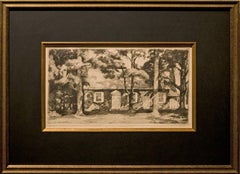
Jim’s of Lambertville Fine Art Gallery is proud to present this piece by Daniel Garber (1880 - 1958). One of the two most important and, so far, the most valuable of the New Hope Sc...

Category

1930s American Impressionist Otto Henry Bacher Art

Materials

Etching

Otto Henry Bacher art for sale on 1stDibs.

Find a wide variety of authentic Otto Henry Bacher art available for sale on 1stDibs. You can also browse by medium to find art by Otto Henry Bacher in etching and more. Much of the original work by this artist or collective was created during the 19th century and is mostly associated with the Impressionist style. Not every interior allows for large Otto Henry Bacher art, so small editions measuring 17 inches across are available. Customers who are interested in this artist might also find the work of Levon West, George Elbert Burr, and David Rosenthal. Otto Henry Bacher art prices can differ depending upon medium, time period and other attributes. On 1stDibs, the price for these items starts at $800 and tops out at $2,000, while the average work can sell for $1,400.

Artists Similar to Otto Henry Bacher