Sadao Watanabe. Art

Japanese, 1913-1998
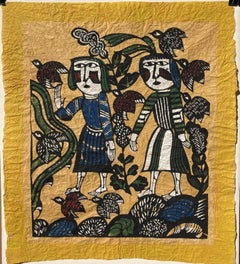
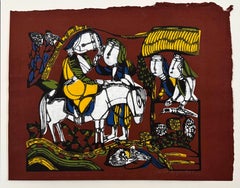
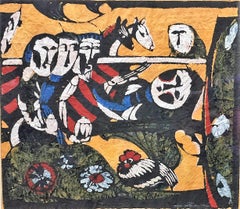
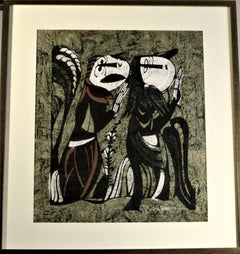
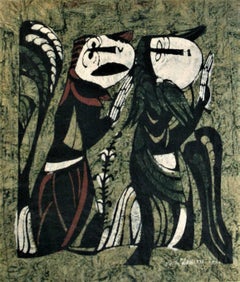
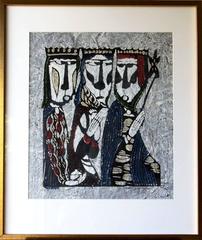
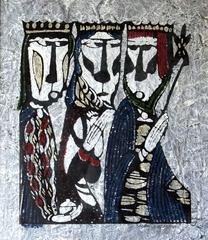
Sadao Watanabe, born in Tokyo in 1913, used the medium called kappazuri ("stencil printing"), a technique related to 'katazome' ("stencil dyeing"). 'Katazome' is said to have originated in Okinawa (the method there was called 'bingata'). The paper most widely used in Japan for stencil printing is called 'shibugami', made from several layers of 'kozo' paper laminated with persimmon tannin. The sheets are dried and smoke-cured to strengthen them and make them flexible and waterproof. Once the artist makes a drawing, it is fixed to the 'shibugami' with a thin adhesive. The basic pattern is then carved into a "key impression" stencil (the equivalent to the keyblock in woodblock printing) called the 'omogata'. If colors will also be used for the final design, separate stencils are sometimes cut for each color. If the stencil pattern has thin lines they can be reinforced with silk gauze, which still allow for uniform printing of colors. The first stage of the printing process involves the application and drying of a dye-resist paste to cover all the portions of the design to be left unprinted by the design. The patterns and colors can then be brushed over the stencil while affecting only those areas without resist paste. Typically the first colors printed are the lighter areas so that darker colors can be overprinted. After all the colors are printed and dried, the key impression stencil is finally used to print the key design over all the previous colors. The dye resist paste is then washed off (called 'mizumoto', "to wash by water") and the paper is dried on a wood board. Watanabe typically printed on a colored ground, so he would first apply a color to the paper. Watanabe, who was baptized a Christian in 1930, based his designs exclusively on Biblical subjects, though his Christian stories and figures are interpreted through a filter of traditional Japanese techniques and even some older Buddhist figure prints. The folk-art movement in Japan began in the 1930s as an attempt to keep alive various traditional arts, among them stencil printing. Watanabe was an early member of a small but important group of artists who dedicated themselves to learning and preserving these arts. Watanabe's emotioonally moving Biblical prints are have been popular throughout the world, and have been hung in the Vatican, the White House, in museums and in private collections.
to
2
5
1
1
3
Overall Width
to
Overall Height
to
10
1
1
1
5
1
8
2
3
2
2
2
2
1
1
1
1
5
3
3
2
10
11,047
2,850
2,494
1,431
8
2
Artist: Sadao Watanabe.
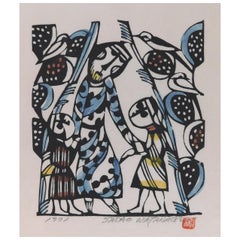
GIRLS WITH LOTS OF QUAILS

GIRLS WITH LOTS OF QUAILS

By Sadao Watanabe

Located in Santa Monica, CA

SADAO WATANABE (Japanese 1913-1996) GIRLS WITH LOTS OF QUAILS, 1965 鶉と少女 Hand colored stencil print on momigami textured paper. Signed and numbered in white. Edition 50, Image 17 x 2...

Category

1960s Modern Sadao Watanabe. Art

Materials

Stencil

Moses Smiting the Rock of Meribah, Exodus

Moses Smiting the Rock of Meribah, Exodus

By Sadao Watanabe

Located in San Francisco, CA

This artwork, "Moses Smiting the Rock of Meribah, Exodus" 1972 is an original color stencil on hand crumpled momigami paper. It is hand signed, dated and numbered 47/70 in White ink by the artist. The artwork size is 27.5 x 24.75 inches, framed size is 39 x 36 inches. It is custom framed in a wooden gold frame, with matting and black color spacer. It is in excellent condition, Please NOTE, the dark area at the lower left corner of the frame is only the shadow, the frame is in perfect condition. About the artist: Sadao Watanabe born and raised in Tokyo, was a Japanese printmaker in the 20th Century. He was famous for his Biblical prints rendered in the mingei (folk art) tradition of Japan. As a student of the master textile dye artist Serizawa Keisuke...

Category

Late 20th Century Modern Sadao Watanabe. Art

Materials

Stencil

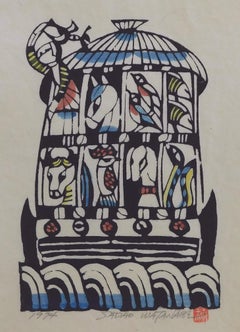
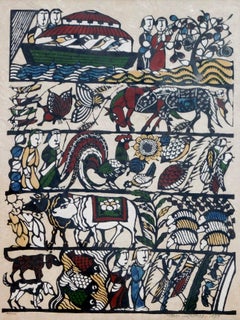
Original Pencil Signed Stencil Print - Noah's Art

Original Pencil Signed Stencil Print - Noah's Art

By Sadao Watanabe

Located in Phoenix, AZ

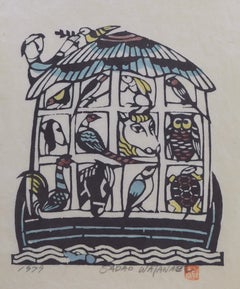
Original Stencil Print by Sadao Watanabe (1913-1996) on hand-made washi paper. The image is from the Old Testament - Noah’s Ark. Artist’s chop mark and pencil signature are seen lowe...

Category

Late 20th Century Sadao Watanabe. Art

Materials

Paper, Ink

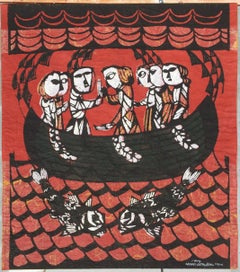
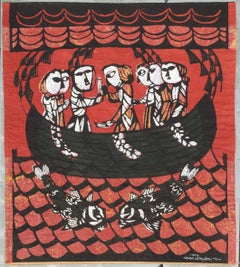
Jonah
Jonah

Sadao WatanabeJonah, 1959

$1,200Sale Price|20% Off

Jonah

By Sadao Watanabe

Located in Santa Monica, CA

SADAO WATANABE (Japanese 1913-1996) JONAH, 1959 Color stencil, signed, numbered and dated in white ink. Sheet, 25 5/8 x 22 5/8 inches. Edition: 44/50. Good color and generally good ...

Category

1950s Modern Sadao Watanabe. Art

Materials

Woodcut, Stencil

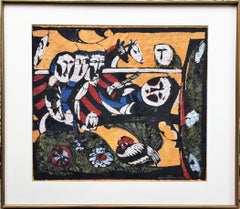
Surreal Composit - Woodcut by Sadao Watanabe - 20th Century

Surreal Composit - Woodcut by Sadao Watanabe - 20th Century

By Sadao Watanabe

Located in Roma, IT

Surreal Composit is an original woodcut, hand colored, on paper realized by Sadao Watanabe for College Women's Association of Japan Student Travel grant fund. Specially woodcut wit...

Category

20th Century Modern Sadao Watanabe. Art

Materials

Woodcut

Original Pencil Signed Stencil Print, 1974 - Noah's Ark

Original Pencil Signed Stencil Print, 1974 - Noah's Ark

By Sadao Watanabe

Located in Phoenix, AZ

Original Stencil Print by Sadao Watanabe (1913-1996) on hand-made washi paper. The image is from the Old Testament - Noah’s Ark. Artist’s chop mark and pencil signature are seen lowe...

Category

Mid-20th Century Sadao Watanabe. Art

Materials

Paper, Ink

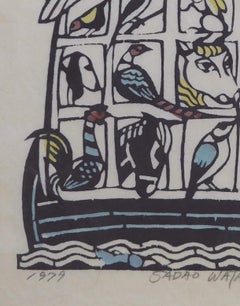
Sadao Watanabe Stencil Print, 1979 - Noah's Ark

Sadao Watanabe Stencil Print, 1979 - Noah's Ark

By Sadao Watanabe

Located in Phoenix, AZ

Sadao Watanabe (1913-1996) Limited Edition Stencil Print on Hand Made Paper. Title: Noah's Ark. Created 1979. No. 45 of the edition of 100. Image size: 29 1/2"h x 21 1/2"w. Unframed....

Category

1970s Sadao Watanabe. Art

Materials

Stencil

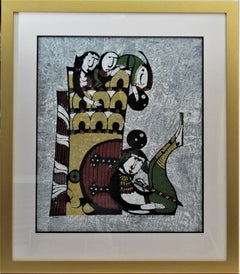
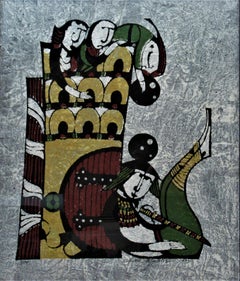
Three Men Defending a Fort

Three Men Defending a Fort

By Sadao Watanabe

Located in San Francisco, CA

This artwork, "Three Men Defending a Fort" 1972 is an original color stencil on hand crumpled momigami paper. It is hand signed, dated and numbered 5/20 in black ink by the artist. The artwork size is 26.5 x 22.5 inches, framed size is 36 x 31.75 inches. It is custom framed in a wooden gold frame, with fabric matting and black color spacer. It is in excellent condition. About the artist: Sadao Watanabe born and raised in Tokyo, was a Japanese printmaker in the 20th Century. He was famous for his Biblical prints rendered in the mingei (folk art) tradition of Japan. As a student of the master textile dye artist Serizawa Keisuke...

Category

Late 20th Century Modern Sadao Watanabe. Art

Materials

Stencil

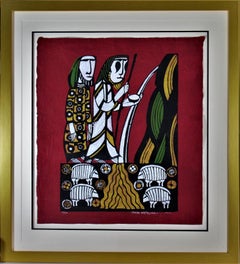
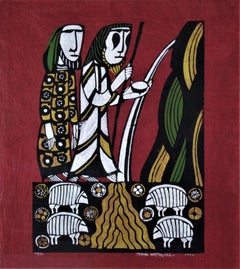
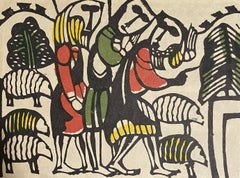
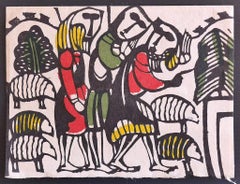
Shepherds -  Woodcut by Sadao Watanabe - Late 20th Century

Shepherds - Woodcut by Sadao Watanabe - Late 20th Century

By Sadao Watanabe

Located in Roma, IT

Shepherds is an original woodcut artwork realized by Sadao Watanabe. The state of preservation is very good. The artwork is specially designed for the college women' association of...

Category

Late 20th Century Contemporary Sadao Watanabe. Art

Materials

Woodcut

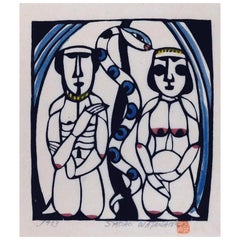
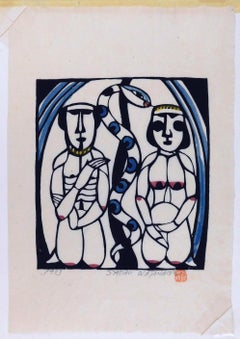
Sadao Watanabe Original Stencil Print, 1973 - Adam and Eve

Sadao Watanabe Original Stencil Print, 1973 - Adam and Eve

By Sadao Watanabe

Located in Phoenix, AZ

Stencil Print by Sadao Watanabe, hand colored on hand-made washi paper. This image depicts Adam & Eve with the snake in the garden of Eden from Genesis. Artist’s chop mark and penci...

Category

Late 20th Century Sadao Watanabe. Art

Materials

Paper

Related Items
Large French Judaica Lithograph Colorful Jewish Wedding Hebrew Calligraphy

Large French Judaica Lithograph Colorful Jewish Wedding Hebrew Calligraphy

By Théo Tobiasse

Located in Surfside, FL

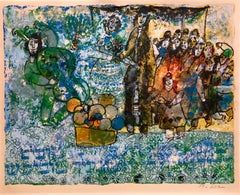
Theo Tobiasse Title "On the Shores of the Circus" Suite: Song of Songs of King Solomon Year: 1975 Medium: Original lithograph in colors on paper (deckle edged paper) Publisher: Leon Amiel, Paris & New York Signature: Hand signed by the artist Theo Tobiasse, born Tobias Eidesas, 1927 in Jaffa then in British Mandate Palestine, died 2012 in Cagnes-sur-Mer in France. Well known painter, engraver, draftsman and sculptor. French Jewish artist. The youngest son of Chaim (Charles) Eidesas and Brocha (Berthe) Slonimsky from Kaunas, Lithuania, Théo Tobiasse was born in Mandatory Palestine in 1927, where his Jewish parents lived since 1925, far from the threat of pogroms and upheavals of East European policies. The family encountered material difficulties and decided to return to Lithuania, ultimately leaving for Paris in 1931 where his father typographer finds work in a Russian printing press. Theo Tobiasse shows very early talent for drawing and painting, and during a visit to the Special Exhibition of 1937 held in Paris, he is enchanted by Raoul Dufy. The death of his mother (in June 1939) followed by the outbreak of the Second World War, Paris under the German Nazi occupation, the wearing of the yellow star and his registration at the National School of Decorative Arts denied for racist reasons upsets his life. He enrolled in a private advertising design course on the boulevard Saint-Michel, which he abandoned nine months later because his family, narrowly escaping the Winter Vélodrome roundup in July 1942 was forced to hide in an apartment in Paris for two years. At the Liberation of Paris, he quickly began a career as an advertising graphic designer with the Draeger art printer and also produced tapestry cartoons, stage sets and Hermes showcases at the Hermès boutique on rue du Faubourg Saint-Honoré. In 1950, he obtained French nationality and moved to Nice in the Alpes-Maritimes, where he continued his advertising graphic design career. His first paintings were exhibited at the Salon des peintres du Sud-Est in 1960. He was laureate in 1961 the "prize of the young Mediterranean painting" and Armand Drouant offers him a first contract and exhibited at the Faubourg Saint-Honoré Gallery in Paris in 1962. Théo Tobiasse also won the Dorothy Gould Prize in 1961. He decided to devote himself solely to the visual arts. Numerous exhibitions are dedicated to him all over the world, in Paris at the Drouant Gallery, in Geneva, Montreal or Tokyo, then London, Zurich, Lausanne, Los Angeles, Kiev, and then a first personal exhibition in New York (1968). Self-taught, he studied the technique of grand masters in museums during his travels. The reliefs, glazes and colors of Rembrandt's Jewish Fiancee at the Rijksmuseum in Amsterdam, in particular, open up new technical possibilities that he explores in his canvases back to his studio. The figurative subjects without narrative or symbolism (cat, bird, kite, velocipede, etc.) of his first paintings, allow him to focus on the techniques, the color and the texture of oil painting and gouache. From 1964, Theo Tobiasse develops a more personal iconography drawn from his own memories of his childhood in Lithuania, the wanderings of a family seeking a land of asylum and the Holocaust. The train, the one which drove his family from Kaunas to Paris, or the Jews to the camps, becomes a recurring motif and memory a major theme in his work. A visit to Jerusalem, Israel in 1970 brings him closer to his Israeli Jewish origins. He created his first Judaic stained-glass windows on the theme of "Jewish Feasts" for the Jewish Community Center in Nice and a monumental oil painting titled " Que tentes sont beau", O Jacob (1982). He continues to travel and immerse himself in the cultures he meets, New Orleans jazz, Mexican archaeological sites and Native American totems . In New York, he meets Elie Wiesel (1982). While Josy Eisenberg makes a film about Théo Tobiasse, entitled Tell me who you are painting, for French television in 1977, many personal exhibitions are devoted to him in France and abroad, notably at the Passali gallery in Paris, France. Atheneum Museum in Geneva and the Nahan Gallery in New Orleans. In 1983, a retrospective exhibition of his work was organized in Nice , at the Museum of Contemporary Art in Ponchettes. Carborundum engraving, lithography, stained glass, mosaic, pottery, bronze and ceramic sculpture are all tools of expression he first explored in the studio he had built at his home on the heights of Nice (1954 -1972), then to the Rauba Capeu wharf in Nice (1971-1976). He leaves Nice to install his main workshop on his property in Saint-Paul-de-Vence in 1976. In collaboration with Pierre Chave, lithographer in Saint-Paul-de-Vence, Théo Tobiasse is developing a technique for making lithographs of eighteen to twenty colors that he produces for many original portfolio editions published in France, Sweden and the United States. In addition to the theme of memory of the wanderings and exodus of his family and the Jewish people, the personal iconography of Tobiasse comprises three other major themes that recur in his work: The cities that are dear to him (Paris and Jerusalem, first, then New York and Venice from the 1980s); twenty-eight monochrome gouaches, From Notre-Dame to Saint-Germain-des-Près (1969). The Hebrew Bible, an endless source of human dramas, which he re-imagines in contemporary times. Rachel (1978), Sarah and the three messengers (1981),Bathsheba in the Garden of Pomegranates (1982). The woman, lover, erotic and shameless, Daphnis and Chloé (1978), Portrait of a woman immobile in ecstasy , (1978), a creature-sex apple whose skin burns and arms twist (1980). To explore the theme of the erotic woman, Tobiasse adopts nude drawing in graphite, ink and pastel on paper, as well as the writing of poetic texts he inscribed in his drawings and notebooks. The American merchant, Kenneth Nahan Sr., met in 1978, encourages Théo Tobiasse to join in the United States other French painters he represents, including Max Papart and James Coignard. Tobiasse moved to New York in 1984. He first worked at the Chelsea Hotel and then set up his studio in Manhattan. He decides to split his time and his work between Saint-Paul-de-Vence and New York. The first paintings painted in America are distinguished from their European production by their scale and their bright themes. Oil-painted canvases are filled with family portraits, children, and biblical characters. My family came from Lithuania, Little Girl Sitting , Saul and David (1984). In these paintings, families no longer flee the pogroms in the trains, but land in New York, new host country according to his imagination, as in America (1984). He also created the Myriam sculpture in New York, which became the model for the Venus, a monumental bronze sculpture to be installed at the entrance of Saint-Paul-de-Vence in 2007 15. New York joins the inspiring cities of Theo Tobiasse and the woman now personifies freedom. Along with Marc Chagall, Raya Sorkine, Zamy Steynovitz and Yoel Benharrouche, Tobiasse becomes one of the pillars of modern French Judaica...

Category

1970s Modern Sadao Watanabe. Art
Materials

Lithograph

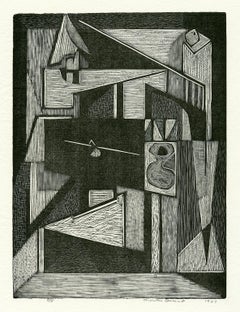
Untitled
Untitled

Untitled

By Charles William Smith

Located in Fairlawn, OH

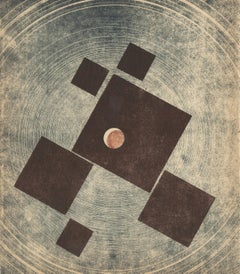
Untitled Color woodcut, 1939 Unsigned as issued Signed and dedicated by the artist on the justification page (see photo) From: Abstractions By Charles Smith Forward by Carl O. Schnie...

Category

1930s American Modern Sadao Watanabe. Art

Materials

Woodcut

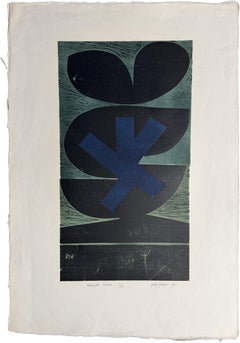
Midnight Flower 1969 Signed Limited Edition Large Woodcut

Midnight Flower 1969 Signed Limited Edition Large Woodcut

Located in Rochester Hills, MI

Peter Green Midnight Flower Paper Size = 26½" x 38½" inches Signed in pencil, titled, dated and marked 1/30 Born in 1933, Peter Green studied at Brighton College of Art and the In...

Category

1960s Modern Sadao Watanabe. Art
Materials

Woodcut

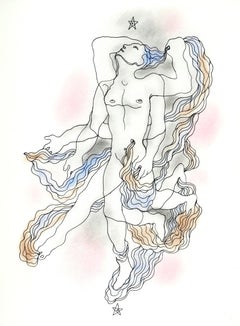
Jean Cocteau, Untitled, from The White Book, 1930

Jean Cocteau, Untitled, from The White Book, 1930

By Jean Cocteau

Located in Southampton, NY

This exquisite lithograph and pochoir with hand coloring by Jean Cocteau (1889–1963), titled Sans titre (Untitled), from the album Le Livre blanc (The White Book), precede dun fronti...

Category

1930s Modern Sadao Watanabe. Art
Materials

Lithograph, Stencil

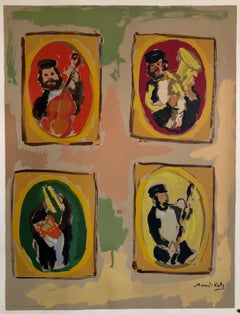
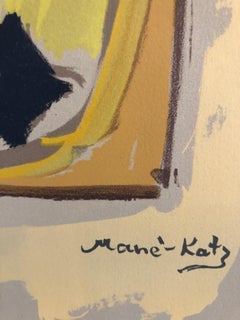
Colorful Russian French Judaica Jewish Shtetl Wedding Lithograph Mourlot Paris

Colorful Russian French Judaica Jewish Shtetl Wedding Lithograph Mourlot Paris

By Mane Katz

Located in Surfside, FL

Mane-Katz (1894-1962) Original Lithograph published by Andre Sauret, Monte Carlo, 1966, printed in France, by Mourlot. The ouvrage sheet is not included. this is from a limited editi...

Category

1960s Modern Sadao Watanabe. Art
Materials

Lithograph

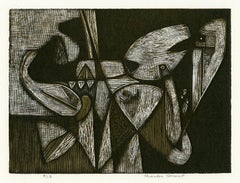
Underwater — Mid-century Modern

Underwater — Mid-century Modern

By Charles Quest

Located in Myrtle Beach, SC

Charles Quest, 'Underwater', 1948, chiaroscuro wood engraving, edition 12. Signed, titled, dated and numbered '3/12' in pencil. A fine, richly-inked impression, in dark brown and warm black, on off-white wove paper, with full margins (5/8 to 1 1/2 inch), in excellent condition. Scarce. ABOUT THE ARTIST Charles Quest, painter, printmaker, and fine art instructor, worked in various mediums, including mosaic, stained glass, mural painting, and sculpture. Quest grew up in St. Louis, his talent evident as a teenager when he began copying the works of masters such as Michelangelo on his bedroom walls. He studied at the Washington University School of Fine Arts, where he later taught from 1944 to 1971. He traveled to Europe after his graduation in 1929 and studied at La Grande Chaumière and Academie Colarossi, Paris, continuing to draw inspiration from the works of the Old Masters. After returning to St. Louis, Quest received several commissions to paint murals in public buildings, schools, and churches, including one from Joseph Cardinal Ritter, to paint a replica of Velasquez's Crucifixion over the main altar of the Old Cathedral in St. Louis. Quest soon became interested in the woodcut medium, which he learned through his study of J. J. Lankes' A Woodcut Manual (1932) and Paul Landacre's articles in American Artist magazine ‘since no artists in St. Louis were working in wood’ at that time. Quest also revealed that for him, wood cutting and engraving were ‘more enjoyable than any other means of expression.’ In the late 1940s, his graphic works began attracting critical attention—several of his woodcuts won prizes and were acquired by major American and European museums. His wood engraving entitled ‘Lovers’ was included in the American Federation of Art's traveling print exhibition in 1947. Two years later, Quest's two prize-winning prints, ‘Still Life with Grindstone’ and ‘Break Forth into Singing’, were exhibited in major American museums in a traveling show organized by the Philadelphia Print Club. His work was included in the Chicago Art Institute's exhibition, ‘Woodcut Through Six Centuries’, and the print ‘Still Life with Vise’ was purchased by the Museum of Modern Art in New York. In 1951 he was invited by artist-Curator Jacob Kainen to exhibit thirty wood engravings and color woodcuts in a one-person show at the Smithsonian's National Museum (now known as the American History Museum). Kainen's press release praised the ‘technical refinement’ of Quest's work: ‘He obtains a great variety of textural effects through the use of the graver, and these dense or transparent grays are set off against whites or blacks to achieve sparkling results. His work has the handsome qualities characteristic of the craftsman and designer.’ At the time of the Smithsonian exhibition, Quest's work was represented by three New York galleries in addition to one in his home town. He had won 38 prizes, and his prints were in the collections of the Library of Congress, the Chicago Art Institute, the Metropolitan Museum, and the Philadelphia Museum of Art. In cooperation with the Art in Embassies program, his color woodcuts were displayed at the American Embassy in Paris in 1951. Recognition at home came in 1955 with his first solo exhibition in St. Louis. Press coverage of the show heralded the ‘growth of graphic arts toward rivaling painting and sculpture as a major independent medium’. An exhibition of his prints at the Bethesda Art Gallery in 1983 attracted Curator Emeritus Joseph A. Haller, S.J., who began purchasing his work for Georgetown University's collection. In 1990 Georgetown University Library's Special Collections Division was the recipient of a large body of Quest's work, including prints, drawings, paintings, sculpture, stained glass, and his archive of correspondence and professional memorabilia. These extensive holdings, including some 260 of his fine prints, provide a rich opportunity for further study and appreciation of this versatile and not-to-be-forgotten mid-Western American artist...

Category

1940s American Modern Sadao Watanabe. Art
Materials

Woodcut

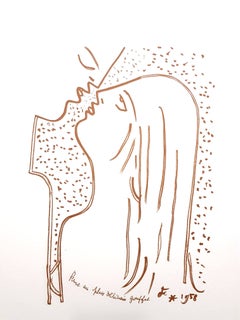
Jean Cocteau - The Kiss - Original Lithograph

Jean Cocteau - The Kiss - Original Lithograph

By Jean Cocteau

Located in Collonge Bellerive, Geneve, CH

Original Lithograph by Jean Cocteau Title: The Kiss Signed in the plate Dimensions: 32 x 25.5 cm Edition: 200 1959 Publisher: Bibliophiles Du Palais Unnumbered as issued

Category

1950s Modern Sadao Watanabe. Art
Materials

Lithograph

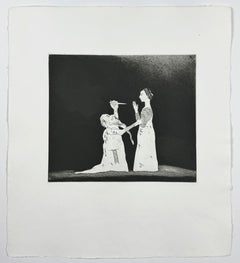
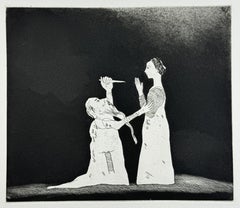
Old Rinkrank threatens the Princess by David Hockney Brothers Grimm Fairy Tales

Old Rinkrank threatens the Princess by David Hockney Brothers Grimm Fairy Tales

By David Hockney

Located in New York, NY

This etching from David Hockney’s celebrated Six Fairy Tales from the Brothers Grimm portfolio depicts the somewhat obscure story Old Rinkrank, which Hockney chose to illustrate beca...

Category

1960s Modern Sadao Watanabe. Art
Materials

Etching, Aquatint

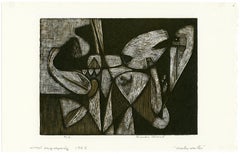
Still Life — Mid-century Modern

Still Life — Mid-century Modern

By Charles Quest

Located in Myrtle Beach, SC

Charles Quest, 'Still Life', 1947, wood engraving, edition 8. Signed, dated, and numbered '3/8' in pencil. Titled and annotated 'wood engraving' in the bottom left margin. A fine impression, on off-white wove paper, with full margins (1 to 2 inches), in excellent condition. Scarce. Matted to museum standards, unframed. ABOUT THE ARTIST Charles Quest, painter, printmaker, and fine art instructor, worked in various mediums, including mosaic, stained glass, mural painting, and sculpture. Quest grew up in St. Louis, his talent evident as a teenager when he began copying the works of masters such as Michelangelo on his bedroom walls. He studied at the Washington University School of Fine Arts, where he later taught from 1944 to 1971. He traveled to Europe after his graduation in 1929 and studied at La Grande Chaumière and Academie Colarossi, Paris, continuing to draw inspiration from the works of the Old Masters. After returning to St. Louis, Quest received several commissions to paint murals in public buildings, schools, and churches, including one from Joseph Cardinal Ritter, to paint a replica of Velasquez's Crucifixion over the main altar of the Old Cathedral in St. Louis. Quest soon became interested in the woodcut medium, which he learned through his study of J. J. Lankes' A Woodcut Manual (1932) and Paul Landacre's articles in American Artist magazine ‘since no artists in St. Louis were working in wood’ at that time. Quest also revealed that for him, wood cutting and engraving were ‘more enjoyable than any other means of expression.’ In the late 1940s, his graphic works began attracting critical attention—several of his woodcuts won prizes and were acquired by major American and European museums. His wood engraving entitled ‘Lovers’ was included in the American Federation of Art's traveling print exhibition in 1947. Two years later, Quest's two prize-winning prints, ‘Still Life with Grindstone’ and ‘Break Forth into Singing’, were exhibited in major American museums in a traveling show organized by the Philadelphia Print Club. His work was included in the Chicago Art Institute's exhibition, ‘Woodcut Through Six Centuries’, and the print ‘Still Life with Vise’ was purchased by the Museum of Modern Art in New York. In 1951 he was invited by artist-Curator Jacob Kainen to exhibit thirty wood engravings and color woodcuts in a one-person show at the Smithsonian's National Museum (now known as the American History Museum). Kainen's press release praised the ‘technical refinement’ of Quest's work: ‘He obtains a great variety of textural effects through the use of the graver, and these dense or transparent grays are set off against whites or blacks to achieve sparkling results. His work has the handsome qualities characteristic of the craftsman and designer.’ At the time of the Smithsonian exhibition, Quest's work was represented by three New York galleries in addition to one in his home town. He had won 38 prizes, and his prints were in the collections of the Library of Congress, the Chicago Art Institute, the Metropolitan Museum, and the Philadelphia Museum of Art. In cooperation with the Art in Embassies program, his color woodcuts were displayed at the American Embassy in Paris in 1951. Recognition at home came in 1955 with his first solo exhibition in St. Louis. Press coverage of the show heralded the ‘growth of graphic arts toward rivaling painting and sculpture as a major independent medium’. An exhibition of his prints at the Bethesda Art Gallery in 1983 attracted Curator Emeritus Joseph A. Haller, S.J., who began purchasing his work for Georgetown University's collection. In 1990 Georgetown University Library's Special Collections Division was the recipient of a large body of Quest's work, including prints, drawings, paintings, sculpture, stained glass, and his archive of correspondence and professional memorabilia. These extensive holdings, including some 260 of his fine prints, provide a rich opportunity for further study and appreciation of this versatile and not-to-be-forgotten mid-Western American artist...

Category

1940s American Modern Sadao Watanabe. Art
Materials

Woodcut

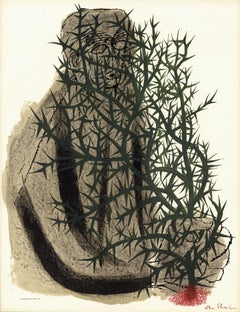
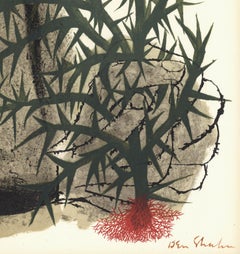
Blind Botanist
Blind Botanist

Ben ShahnBlind Botanist, 1963

$2,100

H 26.75 in W 20.5 in

Blind Botanist

By Ben Shahn

Located in New York, NY

This 1963 lithograph, printed in color, is a fine example of Ben Shahn’s long preoccupation with the theme of the blind botanist and illustrates his con...

Category

Late 20th Century Modern Sadao Watanabe. Art
Materials

Lithograph

Jean Cocteau - Olé - Original Lithograph

Jean Cocteau - Olé - Original Lithograph

By Jean Cocteau

Located in Collonge Bellerive, Geneve, CH

Jean Cocteau - Olé - Original Lithograph 1934 Signed and dated in the plate Numbered in pencil Edition : /200 Dimensions: 50 x 33 cm Provenance : Succession Dermit, Cocteau's heir

Category

1930s Modern Sadao Watanabe. Art
Materials

Lithograph

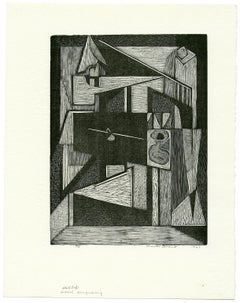
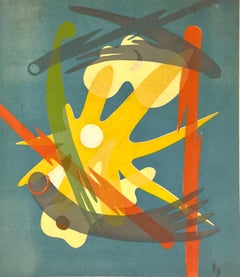
(Abstraction) by DD
(Abstraction) by DD

(Abstraction) by DD, 1940

$750

H 15.25 in W 13.25 in

(Abstraction) by DD

Located in New York, NY

This image is an extravaganza of modernist motifs. The monogram 'D.D.' is at the lower right.

Category

Mid-20th Century American Modern Sadao Watanabe. Art
Materials

Woodcut

Previously Available Items
The Good Samaritan, by Sadao Watanabe

The Good Samaritan, by Sadao Watanabe

By Sadao Watanabe

Located in Palm Springs, CA

By: Watanabe Sadao Medium: Stencil Painting Title: The Good Samaritan Date: 1976 Stencil woodblock print of the parable of the Good Samaritan. Fresh c...

Category

1970s Contemporary Sadao Watanabe. Art
Materials

Woodcut, Stencil

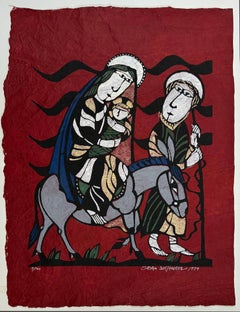
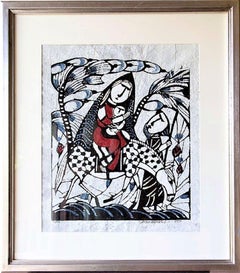
Biblical Scene - Flight to Egypt

Biblical Scene - Flight to Egypt

By Sadao Watanabe

Located in Palm Springs, CA

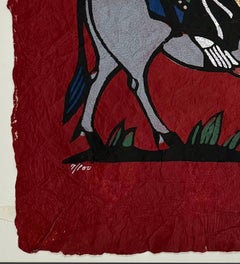
By: Watanabe Sadao Medium: Stencil Painting Title: Flight to Egypt Date: 1979 Edition: 7/100 Stencil woodblock print of the Biblical Scene - Flight to ...

Category

1970s Contemporary Sadao Watanabe. Art
Materials

Woodcut, Stencil

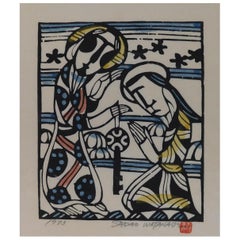
Sadao Watanabe Stencil Print, 1973 - St. Peter and the Key of the Kingdom

Sadao Watanabe Stencil Print, 1973 - St. Peter and the Key of the Kingdom

By Sadao Watanabe

Located in Phoenix, AZ

Stencil Print by Sadao Watanabe, hand colored on hand-made washi paper. This image depicts the words in Mathew 16:19 when Christ gives great authority to Peter saying: I will give yo...

Category

Late 20th Century Sadao Watanabe. Art
Materials

Paper

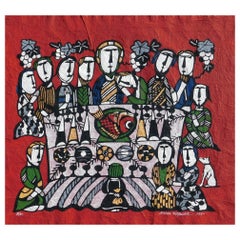
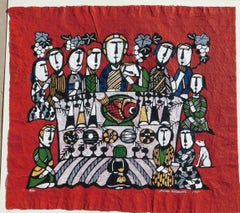
Sadao Watanabe Original Stencil Print, 1980 - The Last Supper

Sadao Watanabe Original Stencil Print, 1980 - The Last Supper

By Sadao Watanabe

Located in Phoenix, AZ

Sadao Watanabe (1913-1996) Limited Edition Stencil Print on Hand Made Paper Title: The Last Supper. Created 1980. No. 35 of the edition of 80. Image size: 18"h x 21 1/2"w. Sheet si...

Category

1980s Sadao Watanabe. Art
Materials

Paper

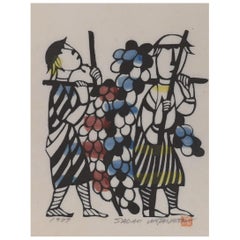
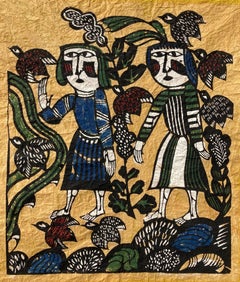
Sadao Watanabe Original Stencil Print, 1979 - Harvesting the Grape in Canaan

Sadao Watanabe Original Stencil Print, 1979 - Harvesting the Grape in Canaan

By Sadao Watanabe

Located in Phoenix, AZ

Stencil Print by Sadao Watanabe, hand colored on hand-made washi paper. The image is from the story of Moses: Numbers 13:23, 'and they came to the valley of Eshcol, and cut down from...

Category

Late 20th Century Sadao Watanabe. Art
Materials

Paper

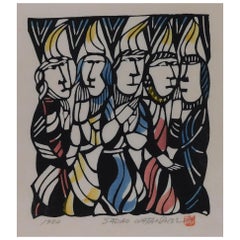
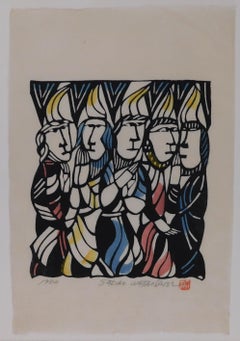
Sadao Watanabe Original Stencil Print, 1982 - Pentecost

Sadao Watanabe Original Stencil Print, 1982 - Pentecost

By Sadao Watanabe

Located in Phoenix, AZ

Stencil Print by Sadao Watanabe, hand colored on hand-made washi paper. This image depicts the flames of fire seen on the day of Pentecost from the book of Acts. Artist’s chop mark a...

Category

1980s Sadao Watanabe. Art
Materials

Paper

Sadao Watanabe Original Stencil Print, 1971 - Jesus and the Children

Sadao Watanabe Original Stencil Print, 1971 - Jesus and the Children

By Sadao Watanabe

Located in Phoenix, AZ

Stencil Print by Sadao Watanabe (1913-1996) on hand-made washi paper. The image is of Jesus welcoming the children from Luke 18:15-17: “Suffer the little children and forbid them not...

Category

Late 20th Century Sadao Watanabe. Art
Materials

Paper

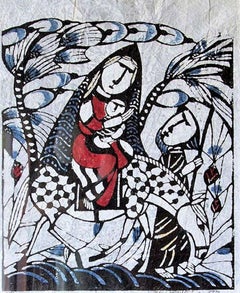
The Flight Into Egypt.

Sadao WatanabeThe Flight Into Egypt., 1969

Sold

H 35.5 in W 30.75 in D 2 in

The Flight Into Egypt.

By Sadao Watanabe

Located in Plano, TX

The Flight Into Egypt. 1969. Color dye stencil (Kappazuri). 20 5/8 x 17 5/8 (sheet 27 x 24). Edition 50, #35. Printed on crumpled, hand-made paper on...

Category

1960s Modern Sadao Watanabe. Art
Materials

Watercolor, Color, Stencil

The Nativity- "Housed in a 28 x 32-inch brown wood and gold metal frame."

The Nativity- "Housed in a 28 x 32-inch brown wood and gold metal frame."

By Sadao Watanabe

Located in Plano, TX

(A similar image with color variant from 1960 in an edition of 50 is entitled The Three Wise Men Visit Mary.) 1961. Hand-colored dye stencil (Kappazuri). 21 1/2 x 24 1/8 (sheet 23 1/...

Category

1960s Showa Sadao Watanabe. Art
Materials

Handmade Paper, Stencil

Hope
Hope

Sadao WatanabeHope, 1961

Sold

H 32 in W 30 in D 1 in

Hope

By Sadao Watanabe

Located in Plano, TX

1961. Color dye stencil (kappizuri). 20 1/2 x 17 5/7 (sheet 25 x 23). Edition 50, #16. . Printed on (momogami) crumpled, hand-made paper on the full sheet with deckle edges. Signed, ...

Category

1960s Showa Sadao Watanabe. Art
Materials

Color, Stencil

The Three Wise Men
The Three Wise Men

Sadao WatanabeThe Three Wise Men, 1969

Sold

H 40 in W 34 in D 3 in

The Three Wise Men

By Sadao Watanabe

Located in Plano, TX

The Three Wise Men. 1969. Color dye stencil (Kappazuri). 27 x 24. Edition 50, #35. Printed on crumpled, hand-made paper on the full sheet with deckle ed...

Category

1960s Modern Sadao Watanabe. Art
Materials

Stencil

Sadao Watanabe. art for sale on 1stDibs.
Find a wide variety of authentic Sadao Watanabe. art available for sale on 1stDibs. If you’re browsing the collection of art to introduce a pop of color in a neutral corner of your living room or bedroom, you can find work that includes elements of blue and other colors. You can also browse by medium to find art by Sadao Watanabe. in stencil, woodcut print, paper and more. Much of the original work by this artist or collective was created during the 20th century and is mostly associated with the modern style. Not every interior allows for large Sadao Watanabe. art, so small editions measuring 8 inches across are available. Customers who are interested in this artist might also find the work of Kiyoshi Saitō, Mikio Watanabe, and Utagawa Kunisada III. Sadao Watanabe. art prices can differ depending upon medium, time period and other attributes. On 1stDibs, the price for these items starts at $501 and tops out at $2,550, while the average work can sell for $2,000.
Artists Similar to Sadao Watanabe.