Svenskt Tenn Furniture

Today, the name Svenskt Tenn is associated around the world with the vibrant, modernist textiles and furniture of Josef Frank, who was the Swedish company’s chief designer in the mid-20th century. But the term “svenskt tenn” actually means “Swedish pewter,” and the very first goods the company sold were stylish pewter objects, such as an elegant 1927 candelabra found in the collection of the Saint Louis Art Museum, or a sleek, understated mirror in the collection of the National Museum of Fine Arts. These pieces were designed to appeal to discerning but price-conscious shoppers in 1920s-era Stockholm.

Art teacher and interior designer Estrid Ericson (1894–1981) partnered with pewter artisan Nils Fougstedt (1881–1954) to establish Svenskt Tenn in 1924, and their creations quickly gained a reputation for high quality and affordability, winning a gold medal at the International Exhibition of Modern Decorative and Industrial Arts in Paris in 1925 — the design fair that brought global attention to the Art Deco style.

The experience of renovating her own apartment in the 1920s exposed Ericson to Swedish functionalism — or funkis, as it was known in Sweden — a branch of modernism that advocated uncomplicated forms, subdued colors and utility. She was inspired to open an interior design department at Svenskt Tenn, and in 1930 the firm introduced its first line of furniture.

Selections included items produced by the companies Gemla and Bodafors, as well as original designs by Ericson and the architects Uno Åhrén and Björn Trägårdh, who had worked together on the redesign and expansion of the showroom. The trio’s furniture was displayed at Stockholm’s Galleri Modern in 1931, where it was met with praise from critic Gotthard Johansson, a leading proponent of Swedish functionalism. Johansson admired the “pure lines” and “modern austerity” of the furniture, establishing Svenskt Tenn as an important voice in Swedish design.

But the signature partnership that would come to define the look of Svenskt Tenn was in part the result of political turmoil and the emergence of Nazism in Europe. When Josef Frank fled Vienna for Stockholm in 1933, he was already an accomplished architect who questioned modernist orthodoxy in design. He disliked tubular steel furniture and believed that monochromatic surfaces were distressing to viewers, while pattern and ornament gave interiors a sense of warmth and calm. Ericson was an admirer of Frank’s work, and offered him the chance to design products for Svenskt Tenn. Their professional partnership, particularly in textile design, would eventually become one of the hallmarks of Swedish modernism.

Frank and Ericson collaborated from 1934 until Frank’s death in 1967, with Frank creating unmistakable, bold designs and Ericson employing her flair for interiors, merchandising and display. The pair called their shared approach “Accidentism” or “The Happy Chances Philosophy,” mixing and matching the new and antique, the serious with the playful and pattern with solid colors to find eclectic new combinations in their showroom.

Frank’s textiles are like a visual catalogue of exotic plants and flowers, geological formations and maps, inspired in part by Ericson’s world travels and by Frank’s love of folk art. Svenskt Tenn continues to sell fabric, wallpaper and household goods, many of which sport variations of Frank's signature botanical motifs. Antique and vintage Svenskt Tenn pewter, lighting, furniture, textiles and decorative objects are generally priced anywhere from $2,500 to $25,000 depending on scale and condition.

The tenets of Scandinavian modernism are as fresh and relevant now as they were in the 1950s — light-filled and airy rooms with white walls are perfect settings for comfortable furniture upholstered in one of Josef Frank’s indelible patterns, and nearly a century since its founding, the signature aesthetic of Svenskt Tenn remains as distinctive and timeless as ever.

Find antique and vintage Svenskt Tenn mirrors, seating, tables and other furniture on 1stDibs.
to
4
188
57
245
139
54
34
1
1
1
2
243
23
214
6
18
63
21
74
17
3
2
198
134
79
63
44
242
240
238
2
1
245
245
245
83
12,650
3,579
2,587
2,351
Creator: Svenskt Tenn
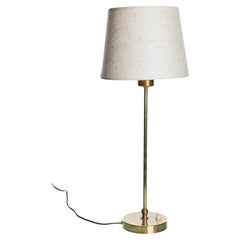
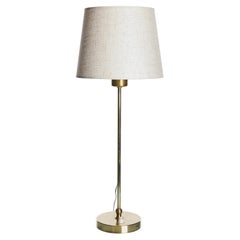
Brass Table lamp by Josef Frank for Firma Svensk Tenn, model 2332, 1960s

Brass Table lamp by Josef Frank for Firma Svensk Tenn, model 2332, 1960s

By Svenskt Tenn, Josef Frank

Located in Göteborg, SE

Ideal for a range of settings, from a stately living room to an elegant office, this table lamp not only serves as a functional lighting solution but also as a testament to exquisite...

Category

1960s Swedish Mid-Century Modern Vintage Svenskt Tenn Furniture

Materials

Brass

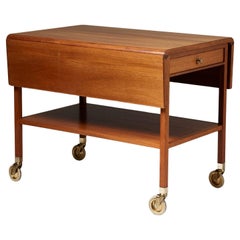
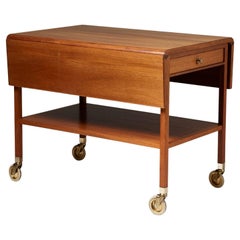
Walnut and Brass Serving Trolley Model 756 by Josef Frank for Svenskt Tenn 1940s

Walnut and Brass Serving Trolley Model 756 by Josef Frank for Svenskt Tenn 1940s

By Svenskt Tenn, Josef Frank

Located in Stockholm, SE

Serving trolley model 756 designed by Josef Frank for Svenskt Tenn, Sweden, 1940s. Veneered walnut and brass. H: 65 cm W: 53 cm Width when fully extended: 89 cm D: 80 cm Josef Fr...

Category

1940s Swedish Mid-Century Modern Vintage Svenskt Tenn Furniture

Materials

Brass

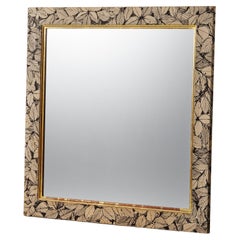
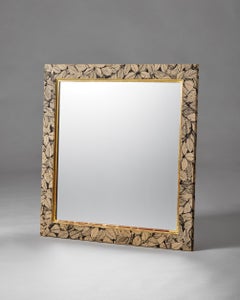
Mirror designed by Svenskt Tenn with fabric designed by Viola Gråsten for NK

Mirror designed by Svenskt Tenn with fabric designed by Viola Gråsten for NK

By Viola Grasten, NK (Nordiska Kompaniet), Svenskt Tenn

Located in Stockholm, SE

Mirror designed by Svenskt Tenn with fabric designed by Viola Gråsten for Nordiska Kompaniet, Sweden, 1960s. Signed. Mirrored glass, brass and textile. Provenance: Bought in the S...

Category

1960s Swedish Mid-Century Modern Vintage Svenskt Tenn Furniture

Materials

Brass

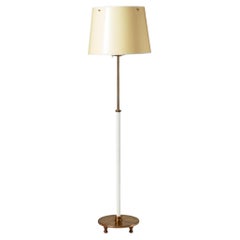
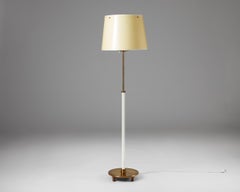
Floor Lamp Model 2564 Designed by Josef Frank for Svenskt Tenn, Sweden, 1950s

Floor Lamp Model 2564 Designed by Josef Frank for Svenskt Tenn, Sweden, 1950s

By Josef Frank, Svenskt Tenn

Located in Stockholm, SE

Floor lamp model 2564 designed by Josef Frank for Svenskt Tenn, Sweden, 1950s. White lacquered brass and Lacquered Paper. Stamped. This elegant brass floor lamp is adjustable in h...

Category

Mid-20th Century Swedish Mid-Century Modern Svenskt Tenn Furniture

Materials

Brass

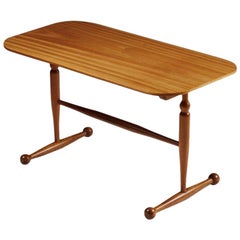
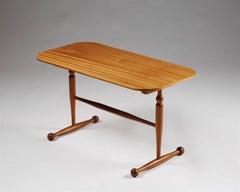
Josef Frank Occasional Table, Mahogany, Svenskt Tenn, Sweden, 1950s

Josef Frank Occasional Table, Mahogany, Svenskt Tenn, Sweden, 1950s

By Josef Frank, Svenskt Tenn

Located in Stockholm, SE

Occasional table designed by Josef Frank for Svenskt Tenn, Sweden. 1950s. Mahogany. H: 45 cm L: 80 cm D: 40 cm Josef Frank was a true European, he was also a pioneer of what would become classic 20th century Swedish design and the “Scandinavian Design Style”. Austrian- born Frank started his design career as an architect after having trained at the Technische Hochschule in Vienna between 1903 and 1910. After his training he went on to teach at Kunstgewerbeschule (The Viennese School of Arts and crafts) where he developed and espoused the new school of modernist thinking towards Architecture and Design that was coming to fruition in Vienna at the time. He also went on to lead the Vienna Werkbund throughout the 1920s. This was a truly progressive group of Architects and Designers who set about improving the daily lives of Austrian people through modernist design and architecture in partnership with Arts and Crafts ideals and construction. Frank’s leadership of the Werkbund had already cemented his place at the forefront of European design. Frank’s time in Vienna was typified by his design for the “Die Wohnung” exhibition of the Deutscher Werkbund in Stuttgart, 1927 where he exhibited along side his contemporaries at the forefront of design, such as the likes of Le Corbusier and Walter Gropius. Here he showed a specially designed pair of flat-roofed reinforced concrete houses in what is now seen as a typical modernist style. What separated Frank’s house from the other 32 houses of the exhibition was the interior and furniture inside the building. It was described as “Neo-Classical” and filled with an eclectic mix of period pieces, modern design and pieces designed by Frank himself that seemed to cross the two worlds. This was a complete opposite direction to that which his fellow Architects were travelling in with their pared back and angular aesthetics. Frank said of his own work: “The house is not a work of art, simply a place where one lives,” and by this reasoning Frank rejected the regimental mechanisation of the living space that his contemporaries believed in, instead he set about creating congenial and spontaneous interiors. Frank’s practice saw him placing the bright colours and the soft forms of nature back into the furnishings and interiors that he thought modernism sorely mist. Frank, along with Oskar Walch set up Haus und Garten in Vienna in 1925. This was Frank’s first commercial foray into furniture and home furnishings and the company went on to become the most influential furnishing house in Vienna with a riotous depth of colour and interesting shapes becoming the trademark of their design. However this success was to come to an end with rise of Nazism in Vienna in the early 1930’s. Frank was Jewish, and he and his wife Anna decided they would leave Vienna for her motherland: Sweden, in 1933. Frank continued to design for Haus and Garten, visiting Vienna occasionally and designing the pieces that would continue to be the company’s best...

Category

1950s Swedish Scandinavian Modern Vintage Svenskt Tenn Furniture

Materials

Mahogany

Svenskt Tenn furniture for sale on 1stDibs.

Svenskt Tenn furniture are available for sale on 1stDibs. These distinctive items are frequently made of metal and are designed with extraordinary care. There are many options to choose from in our collection of Svenskt Tenn furniture, although brown editions of this piece are particularly popular. Many of the original furniture by Svenskt Tenn were created in the Scandinavian Modern style in europe during the 20th century. If you’re looking for additional options, many customers also consider furniture by Hans Bergström, ASEA, and AB Markaryd. Prices for Svenskt Tenn furniture can differ depending upon size, time period and other attributes — on 1stDibs, these items begin at $510 and can go as high as $164,000, while a piece like these, on average, fetch $3,943.