Want more images or videos?
Request additional images or videos from the seller
1 of 12

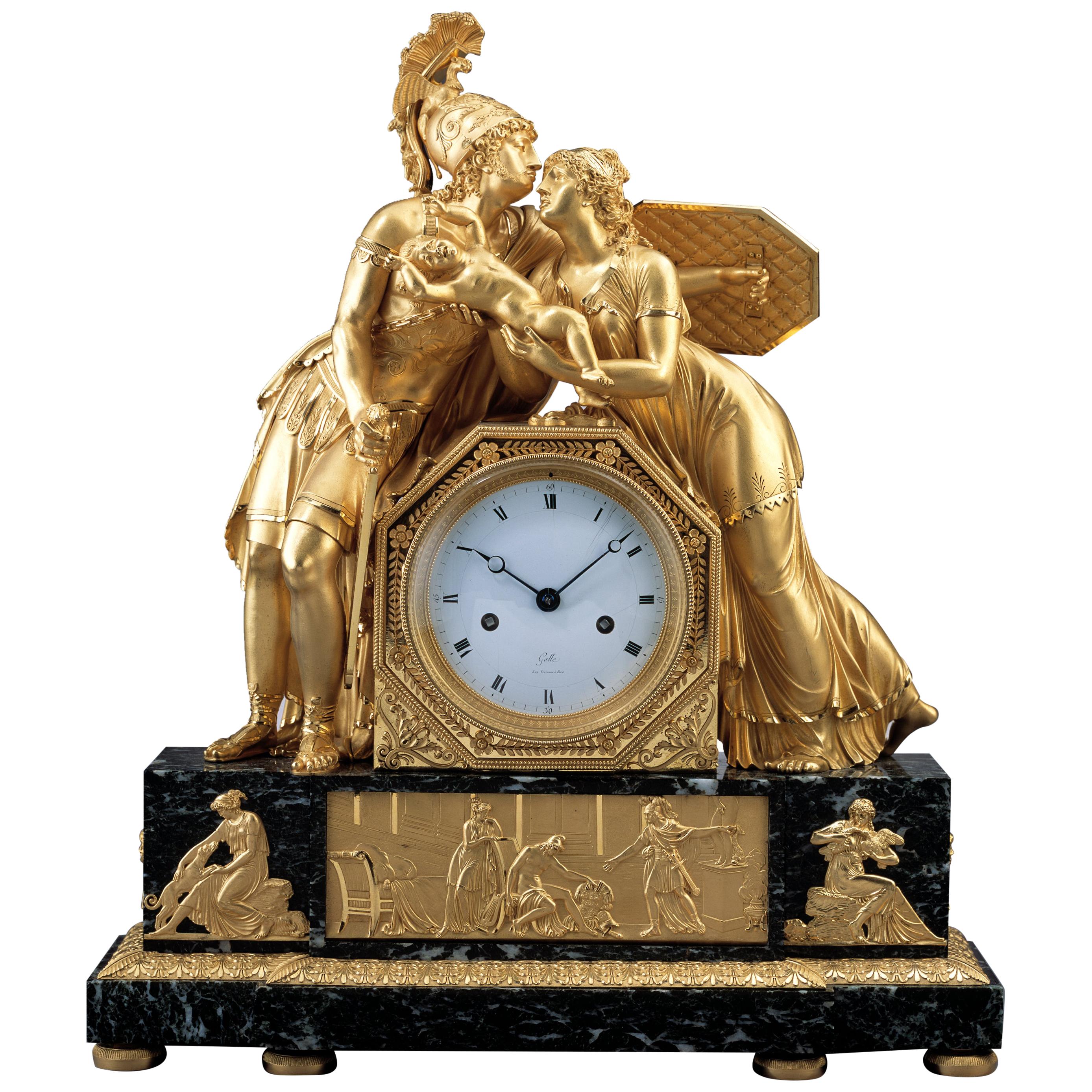
Allegorical French Empire clock Titled " Le Sacrifice d’Iphigénie "

$12,800
$16,00020% Off
£9,634.05
£12,062.9820% Off
€11,271.24
€14,106.6720% Off
CA$18,102.77
CA$22,646.4520% Off
A$18,386.88
A$23,054.1120% Off
CHF 10,595.83
CHF 13,276.5220% Off
MX$221,994.39
MX$277,823.5220% Off
NOK 123,080.62
NOK 154,103.2320% Off
SEK 124,107.54
SEK 155,480.6420% Off
DKK 84,256.24
DKK 105,436.9920% Off

About the Item

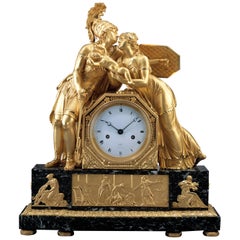
A fine example of a period French Empire mantle clock which depicts the argument between Achilles and Agamemnon in Homer’s Iliad. The case is of matte and burnished gilded bronze, the stepped rectangular base has a large frieze across the front depicting soldiers at war. The clock is adorned with decorative armorial mounts on each side of the frieze. The central rectangular plinth is richly decorated and houses the original dial and silk-string suspension movement, a gilt helmet and sword decorate the top. The white enamel dial with Breguet hands also has a hand indicating the days of the month, the dial is signed ‘Ridel a Paris’. On each side of the plinth are the two standing patinated bronze figures. The Iliad starts off with a dispute between Agamemnon son of Atreus, and Achilles son of Peleus. Agamemnon is the King of Mycenae and brother to the King of Sparta, Menelaus. Menelaus lost his wife, Helen, to Paris, the son of Priam, and has called upon his brother to go to war with the Trojans to get back Helen. Agamemnon being the hubris person he is, agreed and gathered thousands upon thousands of Greeks to attack Troy. Before the Greeks attacked Troy they overtook another city where Agamemnon took a priest’s daughter, Chryseis, as his prize. Her father, Chryses, tried to ransom his daughter, but Agamemnon laughed at him and sent him away. The priest then prayed to the sun god Apollo. Apollo heard his prayer and he rained arrows upon the Greeks. Achilles recognized that the reason the men were getting ill was because of Agamemnon’s refusal of the ransom. Achilles called a gathering of the men to explain this phenomenon and Agamemnon was forced to return the priest’s daughter. After Agamemnon lost his prize he decided to take Briseis, Achilles’ woman. Achilles response to this was pure outrage and he then decides to take himself out of the war with the Trojans. This decision determines the rest of the events that occur in the Iliad.
  • Creator:
    Claude Galle (Clockmaker),Ridel a Paris (Clockmaker)
  • Attributed to:
    Claude Galle (Manufacturer)
  • Dimensions:
    Height: 24 in (60.96 cm)Width: 21 in (53.34 cm)Depth: 8 in (20.32 cm)
  • Style:
    Empire (Of the Period)
  • Materials and Techniques:
    Bronze,Gilt,Patinated
  • Place of Origin:
  • Period:
  • Date of Manufacture:
    circa 1810
  • Condition:
    Wear consistent with age and use. The gilding which is original, was professionally cleaned.
  • Seller Location:
    Vancouver, CA
  • Reference Number:
    1stDibs: LU4631214743951

More From This Seller

View All
Rare French Empire Clock in Gilt and Patinated Bronze Signed Lepaute

Rare French Empire Clock in Gilt and Patinated Bronze Signed Lepaute

By Jean-André Lepaute 1

Located in Vancouver, British Columbia

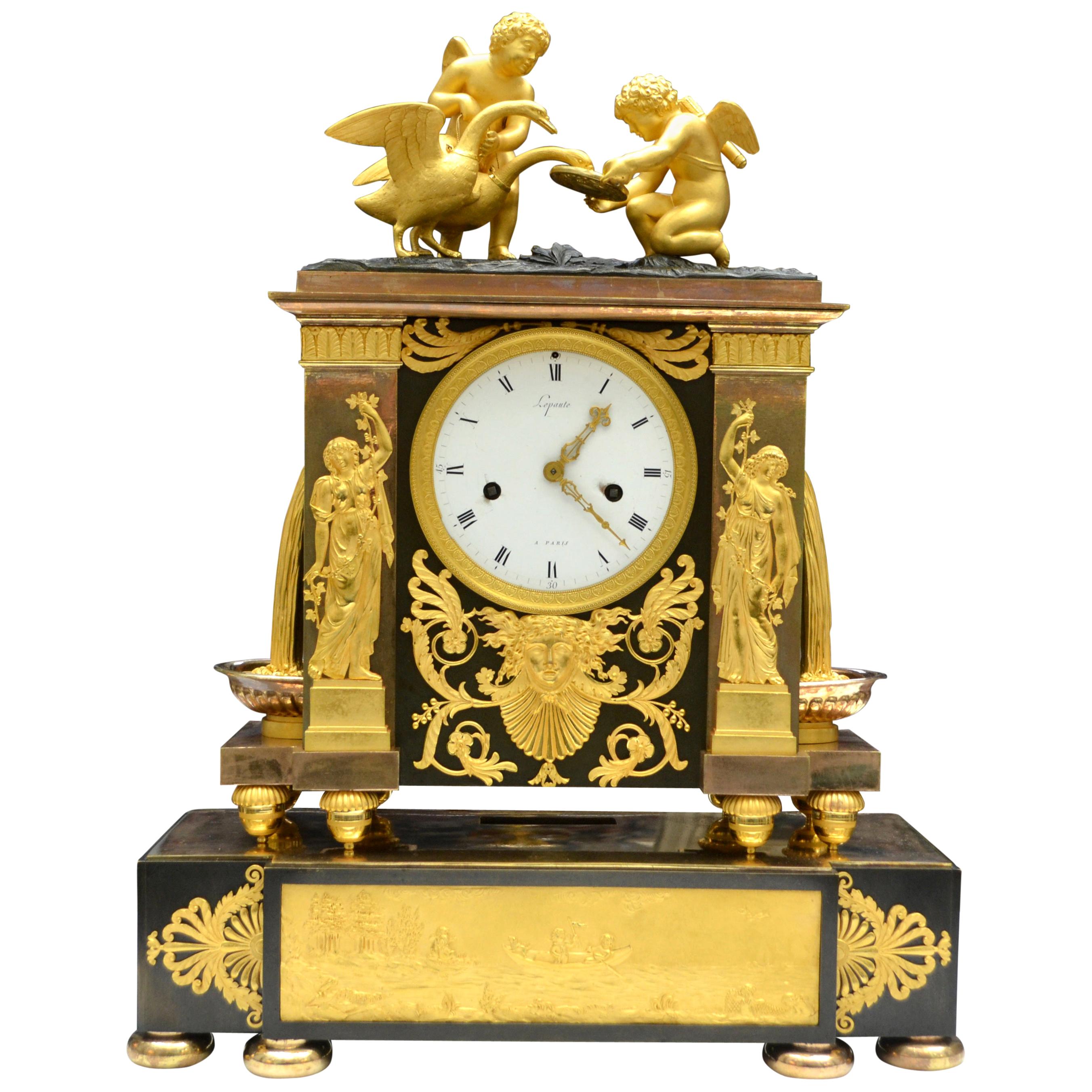
An extremely rare and important French Empire mantle clock signed by the master clock making dynasty of Jean-Andre Lepaute and his brother Jean-Baptiste Lepaute. The case, in the form of an antique portal...

Category

Antique Early 19th Century French Empire Mantel Clocks

Materials

Bronze
French Empire Allegorical Clock Depicting Roman Triumph and Power

French Empire Allegorical Clock Depicting Roman Triumph and Power

Located in Vancouver, British Columbia

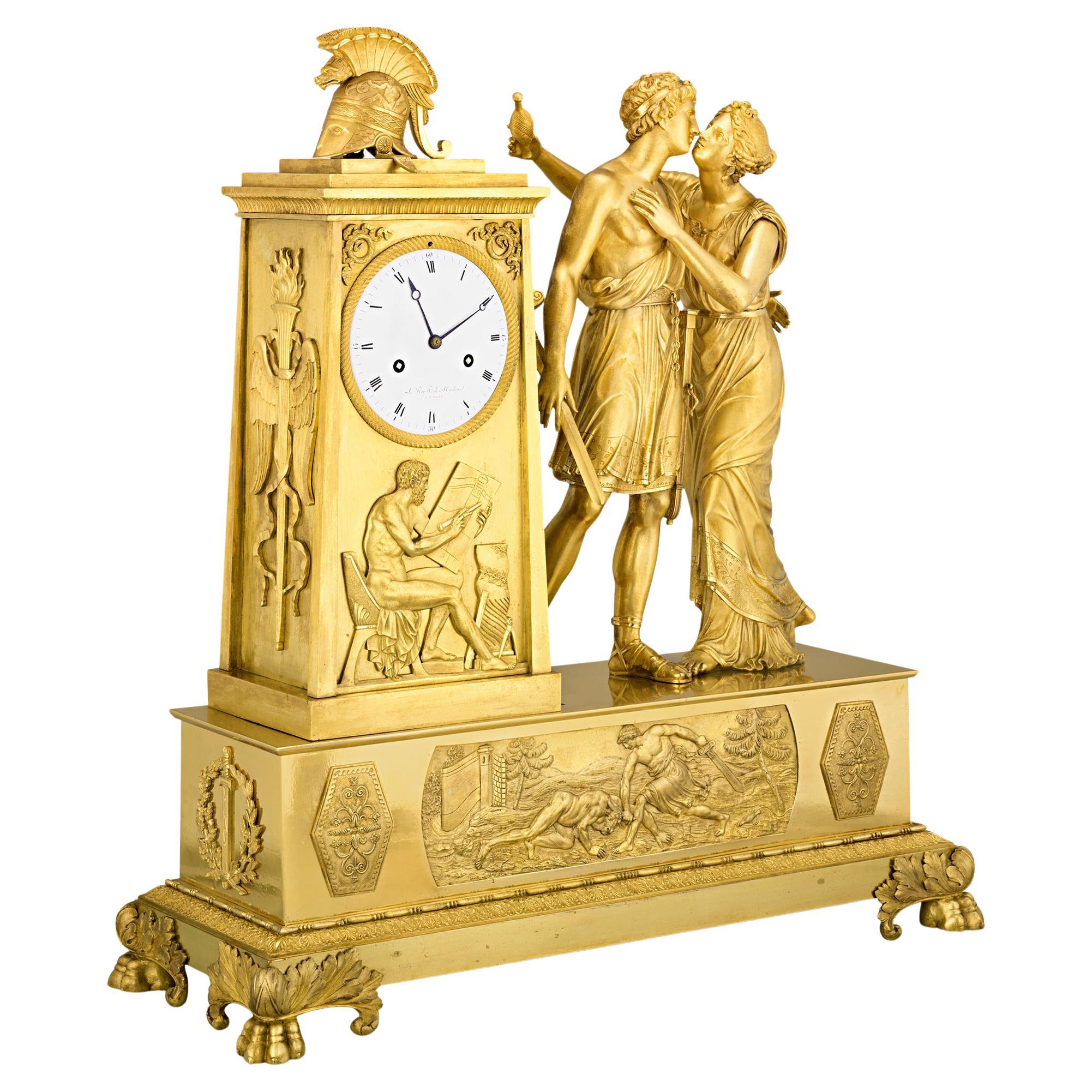
A figural gilt bronze French Empire clock, ‘Allegory to Triumph and Power’. A Roman emperor stands to the right of the central rectangular plinth housing the movement; atop the plint...

Category

Antique Early 19th Century French Empire Mantel Clocks

Materials

Bronze
French Empire Allegorical Clock of Love Nourishing Life

French Empire Allegorical Clock of Love Nourishing Life

Located in Vancouver, British Columbia

A figural French Empire clock in gilded bronze representing an allegory on how love nourishes life or “L’Amour alimentant la vie” in French. The clock shows a seated winged Amor refi...

Category

Antique Early 19th Century French Empire Mantel Clocks

Materials

Bronze

French Empire Mantle Clock in Bronze and Marble, Circa 1820

French Empire Mantle Clock in Bronze and Marble, Circa 1820

By Claude Galle

Located in Vancouver, British Columbia

The clock features a winged cupid standing on his chariot drawn by two doves and supported on clouds; cupid holds the reins to two doves which appear to be guiding the chariot. The open 'wheel' of the chariot contains the outer enamel clock dial...

Category

Antique Early 19th Century French Empire Mantel Clocks

Materials

Marble, Bronze

Allegorical French Louis Philippe Clock of Clio the Greek Muse of History

Allegorical French Louis Philippe Clock of Clio the Greek Muse of History

Located in Vancouver, British Columbia

A French Louis Philippe allegorical gilt bronze and marble mantle clock depicting Clio, The Greek Muse of History. The standing figure of a gilded Clio is ...

Category

Antique Mid-19th Century French Louis Philippe Mantel Clocks

Materials

Bronze

French Empire Gilt Bronze Allegorical Clock of the Astronomical Sciences

French Empire Gilt Bronze Allegorical Clock of the Astronomical Sciences

Located in Vancouver, British Columbia

A fine example of a period French Empire mantle clock in finely chased and gilded bronze made in France in the first quarter of the 19thC. One of the Greek muses with a star atop h...

Category

Antique Early 19th Century French Empire Mantel Clocks

Materials

Bronze
You May Also Like

Odysseus and Theseus French Empire Mantle Clock by André Antoine Ravrio

Odysseus and Theseus French Empire Mantle Clock by André Antoine Ravrio

Located in New Orleans, LA

Odysseus and Theseus French Empire Mantel Clock André Antoine Ravrio Circa 1800 This monumental Empire mantel clock by André Antoine Ravrio, whose case is crafted entirely of gilded...

Category

Antique Early 19th Century French Empire Mantel Clocks

Materials

Bronze
French Early 19th Century Empire Gilt Bronze Mantel Clock by Claude Galle

French Early 19th Century Empire Gilt Bronze Mantel Clock by Claude Galle

By Claude Galle

Located in Worpswede / Bremen, DE

Claude Galle, (1759–1815, master in 1786) is one of the most renowned bronziers active during the Napoleonic period, such as Pierre-Philippe Thomire, André-Antoine Ravrio and Louis-S...

Category

Antique Early 1800s French Empire Mantel Clocks

Materials

Marble, Bronze

Meditation French Empire Mantel Clock by Claude Galle

Meditation French Empire Mantel Clock by Claude Galle

By Claude Galle

Located in New Orleans, LA

Empire Mantel Clock Claude Galle Circa 1810 This Empire period mantel clock by Galle exemplifies the sophisticated allegorical artistry of early 19th-century French horology. Repres...

Category

Antique 19th Century French Empire Table Clocks and Desk Clocks

Materials

Marble, Bronze, Enamel

Claude Galle French Empire Gilt Bronze Mantel Clock, circa 1805

Claude Galle French Empire Gilt Bronze Mantel Clock, circa 1805

By Claude Galle

Located in Lisbon, PT

An exceptional and highly collectible French Empire mantel clock attributed to the celebrated Parisian bronzier Claude Galle, dating to circa 1805. Executed in richly gilded and dark...

Category

Antique 19th Century French Empire Mantel Clocks

Materials

Marble, Metal, Bronze, Enamel, Ormolu

Early 19th Century Empire Mantel Clock by Ledure with Apollo or Eros

Early 19th Century Empire Mantel Clock by Ledure with Apollo or Eros

By Pierre-Victor Ledure, Claude Hemon

Located in Worpswede / Bremen, DE

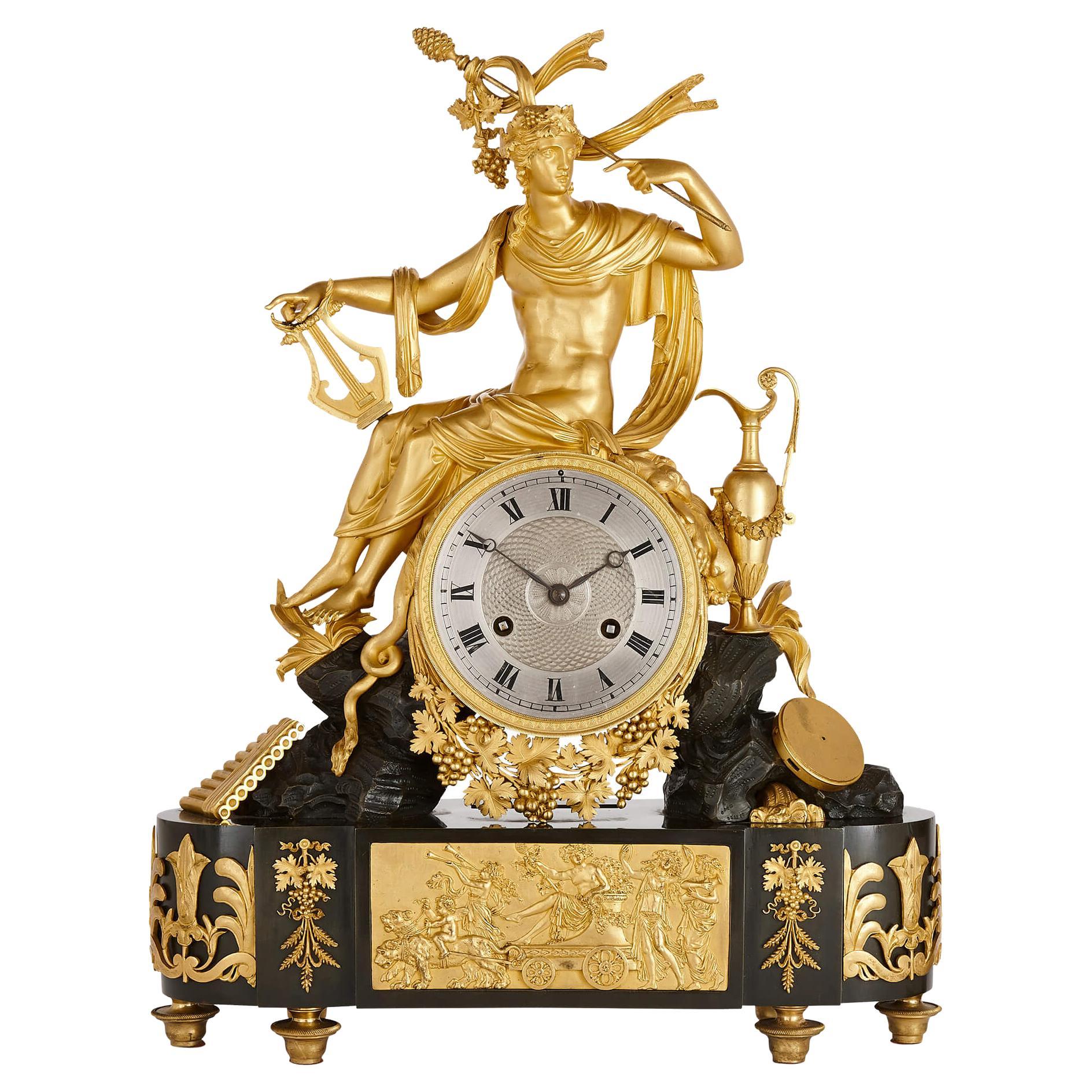
The clock is signed on the enamel dial by the famous Parisian bronzier ”Ledure Bronzier à Paris” and the clockmaker ”Hedon Hr" (horloger). Patinated and fully sculpted bronze figure ...

Category

Antique Early 19th Century French Empire Mantel Clocks

Materials

Bronze

19th Century French Empire Clock, Japy Frères et Cie Movement

19th Century French Empire Clock, Japy Frères et Cie Movement

By Japy Frères

Located in North Palm Beach, FL

This magnificent mantel clock exemplifies the height of French Empire Revival design in the 19th century—where classical grandeur, refined materials, and superb craftsmanship converg...

Category

Antique Late 19th Century French Empire Mantel Clocks

Materials

Belgian Black Marble, Bronze, Copper