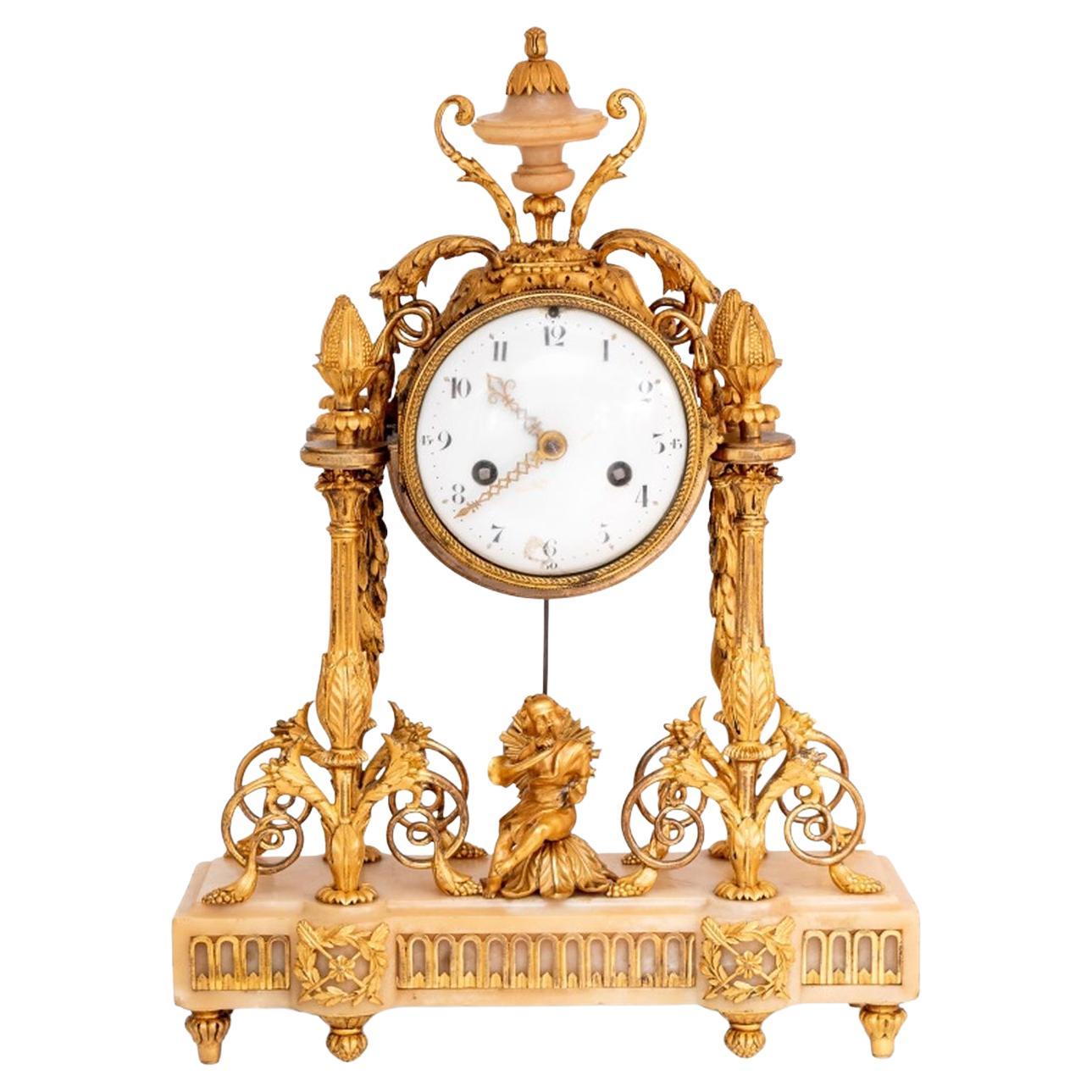
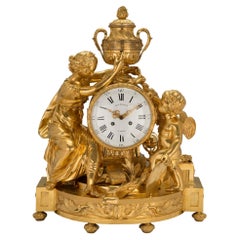
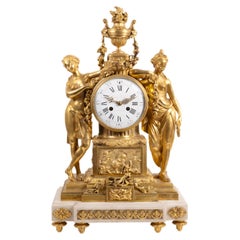
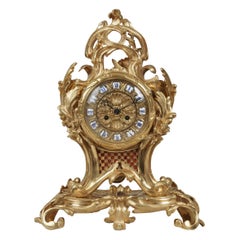
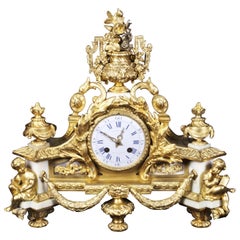
Excellent fire-gilded Empire bronze mantel clock: structure in the form of a rectangular, stepped pedestal that tapers at the front corners, on four spindle feet, with relief ornaments appliquéd on the front of the pedestal, featuring a volute-shaped leaf and flower garland with a butterfly in the centre, flaming torches entwined with snakes in the fluting, probably alluding to the pangs of love felt by the young lady sitting on the sofa in a loose-fitting, lightly falling house dress with a cloche hat, taken by the hand and consoled by a winged cupid standing next to her with a
shouldered quiver.
The chaise longue, which is equipped with two lateral backrests and cushions, is covered by a greenish patinated bronze cloth canopy, covering the clockwork above, with a fringed festoon hanging down in front, crowned with a high curved bow with a love arrow and bow.
Guilloche metal dial with Roman hours painted in black enamel and a minute circle around the outside, black Breguet hands, silk-suspended solar pendulum, fourteen-day movement, count wheel striking mechanism with half-hour and hour strike on bell.
Movement with engraved numbers 13789V - 20040V.
Movement checked by master clockmaker, completely cleaned and fully functional, key present.
The Empire style clock case was probably made in France around 1790. At the time, such clocks were an important export article, particularly in Paris.
As early as the second half of the 18th century, the fireplace had become established as a place to set up clocks – initially in the castles of France. Special clocks with a monumental character were developed for this location, which was very important in terms of the room's effect. The visualisation of the technical construction of the clockwork took a back seat. The clock had become an occasion for a small sculpture at eye level. The themes changed. Before the French Revolution, the theme was time itself: dawn, evening, youth, mortality. The Napoleonic era needed heroes, gods, brave and loyal citizens. In the second decade of the 19th century, the themes became less controversial – depictions of festivities, lovers and goddesses of fertility increased.
Made around 1790/1800
Dimensions:
Height: 53,0 cm / 20.86 in
Width: 37,0 cm / 14.56 in
Depth: 14,5 cm / 5.70 in
Weight: 13.560 Grams / 477.31 oz / 436.01 troy oz
Condition:
Very well maintained overall condition, movement checked by master clockmaker, completely cleaned and fully functional, key present.