Neoclassical Busts

NEOCLASSICAL STYLE

Neoclassical design emerged in Europe in the 1750s, as the Age of Enlightenment reached full flower. Neoclassical furniture took its cues from the styles of ancient Rome and Athens: symmetrical, ordered, dignified forms with such details as tapered and fluted chair and table legs, backrest finials and scrolled arms.

Over a period of some 20 years, first in France and later in Britain, neoclassical design — also known as Louis XVI, or Louis Seize — would supersede the lithe and curvaceous Rococo or Louis XV style.

The first half of the 18th century had seen a rebirth of interest in classical antiquity. The "Grand Tour" of Europe, codified as a part of the proper education of a patrician gentleman, included an extended visit to Rome. Some ventured further, to sketch the ruins of ancient Greece. These drawings and others — particularly those derived from the surprising and rich archaeological discoveries in the 1730s and ’40s at the sites of the Roman cities of Pompeii and Herculaneum — caused great excitement among intellectuals and aesthetes alike.

Neoclassical furniture is meant to reflect both grace and power. The overall appearance of neoclassical chairs, tables and cabinetry is strong and rectilinear. These pieces are, in effect, classical architecture in miniature: chair and table legs are shaped like columns; cabinets are constructed with elements that mirror friezes and pediments.

Yet neoclassicism is enlivened by gilt and silver leaf, marquetry, and carved and applied ornamental motifs based on Greek and Roman sculpture: acanthus leaves, garlands, laurel wreaths, sheaves of arrow, medallions and chair splats are carved in the shapes of lyres and urns. Ormolu — or elaborate bronze gilding — was essential to French design in the 18th and 19th centuries as a cornerstone of the neoclassical and Empire styles.

As you can see from the furniture on these pages, there is a bit of whimsy in such stately pieces — a touch of lightness that will always keep neoclassicism fresh.

Find antique neoclassical furniture today on 1stDibs.

to
18
181
5
15
96
70
5
20
18
17
1
1
1
1
1
1
3
2
1
279
220
177
127
61
56
51
21
14
14
13
10
10
10
7
5
1
94
81
65
56
26
108
62
144
62
55
19
19
Height
to
Width
to
186
186
186
2
2
2
1
1
Style: Neoclassical
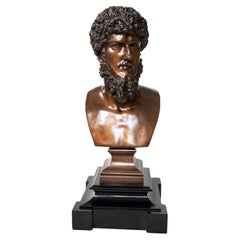
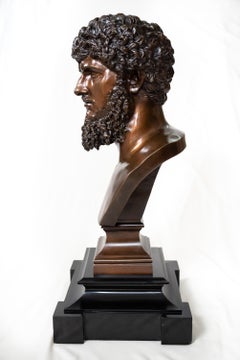
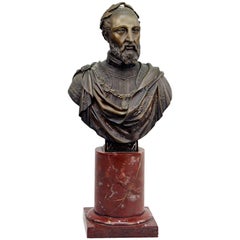
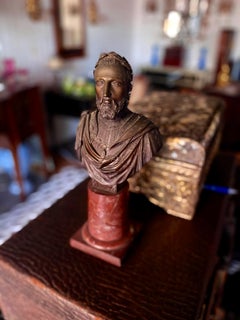
A Patinated Bronze Bust of Lucius Verus

A Patinated Bronze Bust of Lucius Verus

Located in 263-0031, JP

Lucius Verus was Co-Emperor with Marcus Aurelius during the first nine years of Marcus’ reign. A handsome guy, his image became popular during and after his imperial days. This bust ...

Category

Late 19th Century French Antique Neoclassical Busts

Materials

Marble, Bronze

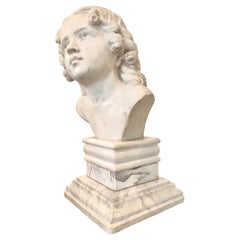
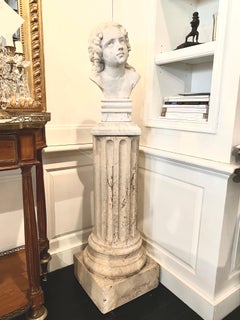
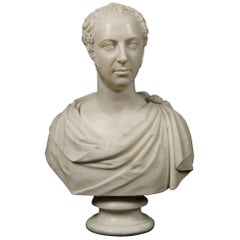
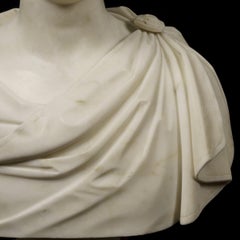
Antique Carved Marble Bust in the Neoclassical Taste

Antique Carved Marble Bust in the Neoclassical Taste

Located in London, GB

A male portrait bust in the Roman manner by Lawrence MacDonald (1799-1878) Carved in Carrara marble, rising from a round socle supporting a waisted column, the bust having resemblances to Arthur Wellesley, the Duke of Wellington as a young man. Signed by the artist, 'L. MacDonald, Romae, 1847'. Dated 1847 Dimensions: H: 26 in / 65 cm W: 19.5 in / 49 cm D: 10 in / 26 cm Lawrence MacDonald (1799-1878) Macdonald worked as an ornamental sculptor for the architect James Gillespie Graham before entering the Trustees' Academy, Edinburgh, in 1822. In Rome, in 1823 he was one of the founders of the British Academy of Art. He returned to Edinburgh in 1826 and became a member of the Royal Scottish Academy in 1829. Four years later he settled in Rome, and from 1844 he worked in Bertel Thorvaldsen's former studio. He became the city's most fashionable portrait sculptor and, according to the Art Journal, his studio was filled with 'the peerage done into marble, a plaster galaxy of rank and fashion'. His sitters included the essayist Henry Taylor...

Category

1840s British Antique Neoclassical Busts

Materials

Marble

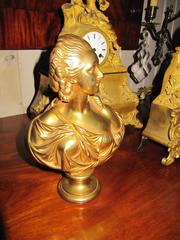
Charming Gilt Bronze Bust of a Woman

Charming Gilt Bronze Bust of a Woman

Located in Buchanan, MI

Charming gilt bronze bust of a woman, spectacular gilt finish. Would look lovely in an office or library

Category

19th Century French Antique Neoclassical Busts

Materials

Gold Leaf

Neoclassical busts for sale on 1stDibs.

Find a broad range of unique Neoclassical busts for sale on 1stDibs. Many of these items were first offered in the 21st Century and Contemporary, but contemporary artisans have continued to produce works inspired by this style. If you’re looking to add vintage busts created in this style to your space, the works available on 1stDibs include decorative objects, building and garden elements, serveware, ceramics, silver and glass and other home furnishings, frequently crafted with stone, marble and other materials. If you’re shopping for used Neoclassical busts made in a specific country, there are Europe, Italy, and France pieces for sale on 1stDibs. While there are many designers and brands associated with original busts, popular names associated with this style include Affortunato Gory, Antonio Frilli, Camille Tharaud, and Copeland. It’s true that these talented designers have at times inspired knockoffs, but our experienced specialists have partnered with only top vetted sellers to offer authentic pieces that come with a buyer protection guarantee. Prices for busts differ depending upon multiple factors, including designer, materials, construction methods, condition and provenance. On 1stDibs, the price for these items starts at $400 and tops out at $75,000 while the average work can sell for $4,450.