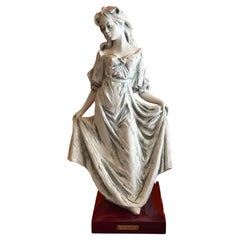
Large Staffordshire Pearlware Figure of Venus, Over Two Feet High, Circa 1810
This large Staffordshire pearlware figure represents Venus, standing barefoot on a swirling mound of blue-gray waves that stands for the sea from which she rose, the whole raised on a canted rectangular plinth marbled in green, ochre and iron-red. She wears a high-waisted gown in mottled manganese purple with short puffed sleeves and a green band at the bodice and hem, edged in blue and set with ochre buttons, the skirt slit at the front to show her legs and her sandals with black lacing; she gathers a fall of the same purple drapery in her left hand and raises her right to her breast. Her hair is parted at the center, drawn back over a fillet and coiled behind, and her face is painted with the pink cheeks and dark red mouth of the Staffordshire enamelers.
The figure is press-molded and hollow, with a circular vent hole in the underside of the base, and is unmarked, as Staffordshire figures of this date generally are. The bluish glaze gathering in the folds of the drapery is characteristic of pearlware.
Figures of this scale are uncommon. Myrna Schkolne records the model from a single example, in the collection of Arnold and Barbara Berlin, which is painted only with scattered flowers on a white ground; the present figure, enameled throughout in purple, green and blue, is a markedly richer version of the same model.
Venus rising from the sea was among the classical subjects the Staffordshire potters took up in the Regency, when a taste for antiquity ran through everything from architecture to dress. The potters worked from prints rather than from marbles, and thought nothing of putting a goddess into the high-waisted gown and sandals of the day, so that the figure reads at once as a classical subject and as a fashionable young woman of about 1810.
Figures of this height were difficult to make and more difficult to fire, and few were attempted: the larger the model, the greater the risk of warping or collapse in the kiln, and the greater the chance of loss in two centuries of handling. Where Faith, Hope and Charity survive in numbers at a foot or so high, mythological subjects at over two feet are rare.
At over two feet, a figure with the presence of a piece of sculpture: for a hall table, a mantel, a library shelf, or a cabinet of early English pottery where it will dominate everything around it.
Dimensions
Height: 24¼ inches (61.6 cm)
Width: 8½ inches (21.6 cm)
Depth: 8 inches (20.3 cm)
Provenance
Earle D. Vandekar of Knightsbridge
References
Myrna Schkolne, Staffordshire Figures 1780 to 1840, Volume 4: Family, Friendship, Play, & Classical Subjects (Atglen, PA: Schiffer Publishing, 2014), p. 186, fig. 194.37, the Berlin collection example of this model.